Lend-Lease Act of 1941: How America Supplied the Allies Before Entering WWII
Why FDR signed Lend-Lease on March 11, 1941, what countries received equipment and how the program affected Allied victory and postwar diplomacy.
Quick answer
The Lend-Lease Act became law on March 11, 1941, allowing President Franklin D. Roosevelt to supply military equipment and other defense goods to governments whose defense he considered vital to U.S. security. The United States began by helping Britain and expanded aid to other Allies, including China and the Soviet Union after Germany attacked it in June 1941. The program ultimately provided roughly $50 billion in wartime assistance, valued in contemporary dollars. It began before the United States formally entered World War II and was not simply a cash loan that every country repaid in full.
Key facts
On this page
- Britain’s position after France fell in 1940
- The destroyers-for-bases agreement came first
- Roosevelt’s ‘garden hose’ explanation
- Congress debates the Lend-Lease bill
- What the act authorized on March 11, 1941
- What was supplied: aircraft, tanks, trucks and more
- Britain and the Commonwealth as major recipients
- Aid to the Soviet Union after June 1941
- Lend-Lease and China
- Was Lend-Lease compatible with neutrality?
- How much aid was sent, and was it all repaid?
- Lend-Lease’s long-term significance
- Timeline
- FAQs
- Sources
Britain’s position after France fell in 1940
Germany’s victory over France in June 1940 left Britain facing the possibility of invasion and a long campaign against German forces. British aircraft, naval vessels and industrial production depended on overseas supplies, while the Royal Navy had to protect shipping across the Atlantic. The United States could manufacture important materials but was not yet a formal belligerent in Europe. President Roosevelt sought ways to help Britain survive without immediately committing American combat forces.
British purchases of American weapons and equipment strained financial resources, particularly as dollar and gold reserves declined. Earlier neutrality legislation, including ‘cash-and-carry’ arrangements, allowed some purchases but generally required payment and transport by the buying nation. Those terms became increasingly difficult to sustain. The United States needed a different legal framework if it intended to keep supplying large quantities of goods without insisting on ordinary immediate payment.
The destroyers-for-bases agreement came first
In September 1940 Roosevelt arranged to transfer fifty older American destroyers to Britain in exchange for long-term rights to use British base sites in the Atlantic and Caribbean region. That agreement preceded the Lend-Lease Act and was a separate executive arrangement. It demonstrated both the urgency of Britain’s naval needs and the administration’s willingness to depart from strict commercial neutrality for reasons it considered essential to American security.
The transaction was controversial because opponents worried about presidential power and movement toward war. Supporters considered it a practical way to strengthen Atlantic defense while assisting Britain. Its legal basis and exchange of bases differed from the later Lend-Lease program, which supplied a much broader mechanism for transferring defense articles. Keeping these events separate makes the evolution of American aid policy clearer.
Roosevelt’s ‘garden hose’ explanation
Roosevelt sought a simple public analogy to explain why Britain should receive supplies even if it could not pay cash immediately. He compared helping a neighbor whose house was on fire to lending a garden hose: the urgent priority was to stop the fire, not negotiate the hose’s full commercial price while the danger spread. The analogy helped make an unfamiliar legal and financial arrangement understandable to voters worried about becoming involved in European warfare.
The speech did not mean the United States had abandoned all consideration of its own interests. The administration argued that helping Britain resist Germany was essential to American defense and might prevent direct involvement in a much larger conflict. Critics doubted that supplying weapons could coexist indefinitely with neutrality. The garden-hose comparison became memorable because it exposed the central argument: providing aid could be presented as self-protection rather than simple charity.
Congress debates the Lend-Lease bill
Roosevelt proposed legislation in early 1941, and Congress considered H.R. 1776 through heated debate. Supporters argued that Britain needed immediate access to weapons and that American security was linked to preventing German domination of Europe. Opponents feared the president would receive sweeping authority to transfer matériel without sufficient congressional control. The debate involved the constitutional balance between foreign policy, military preparedness and legislative oversight.
Public opinion was not divided neatly into people who wanted to help Britain and those who wanted Germany to prevail. Many Americans sympathized with Britain yet opposed entering war; others feared that even indirect military aid would bring naval conflict. Congress ultimately approved Lend-Lease, with the bill reaching the president for signature on March 11. The House History office and National Archives preserve accounts of those debates and the statute.
What the act authorized on March 11, 1941
The law permitted the president, within statutory and appropriations limits, to manufacture, procure, transfer, lend or lease qualifying defense articles to a government whose defense he deemed vital to U.S. security. The term ‘defense articles’ included weapons, vehicles, ships and equipment, while related information and services also formed part of authorized assistance. It was not a general legal power for the president to distribute all federal property without conditions.
The act required accounting and reporting to Congress, and appropriations were needed to fund production and procurement. The structure was flexible because recipients might receive goods to use during wartime rather than purchase them through an ordinary civilian contract. A transferred vehicle or aircraft could be destroyed before the war ended, so the program was never realistically designed as a simple rental arrangement in which every item would return intact.
What was supplied: aircraft, tanks, trucks and more
Lend-Lease aid included aircraft, tanks, military vehicles, ships, industrial machinery, raw materials, fuel-related products and other goods necessary to sustain wartime operations. Trucks and locomotives could be as important as weapons because armies required transport and supplies to move. Food and other essential materials also supported Allied forces and civilian capacity. The exact assortment differed between recipients and changed as wartime needs evolved.
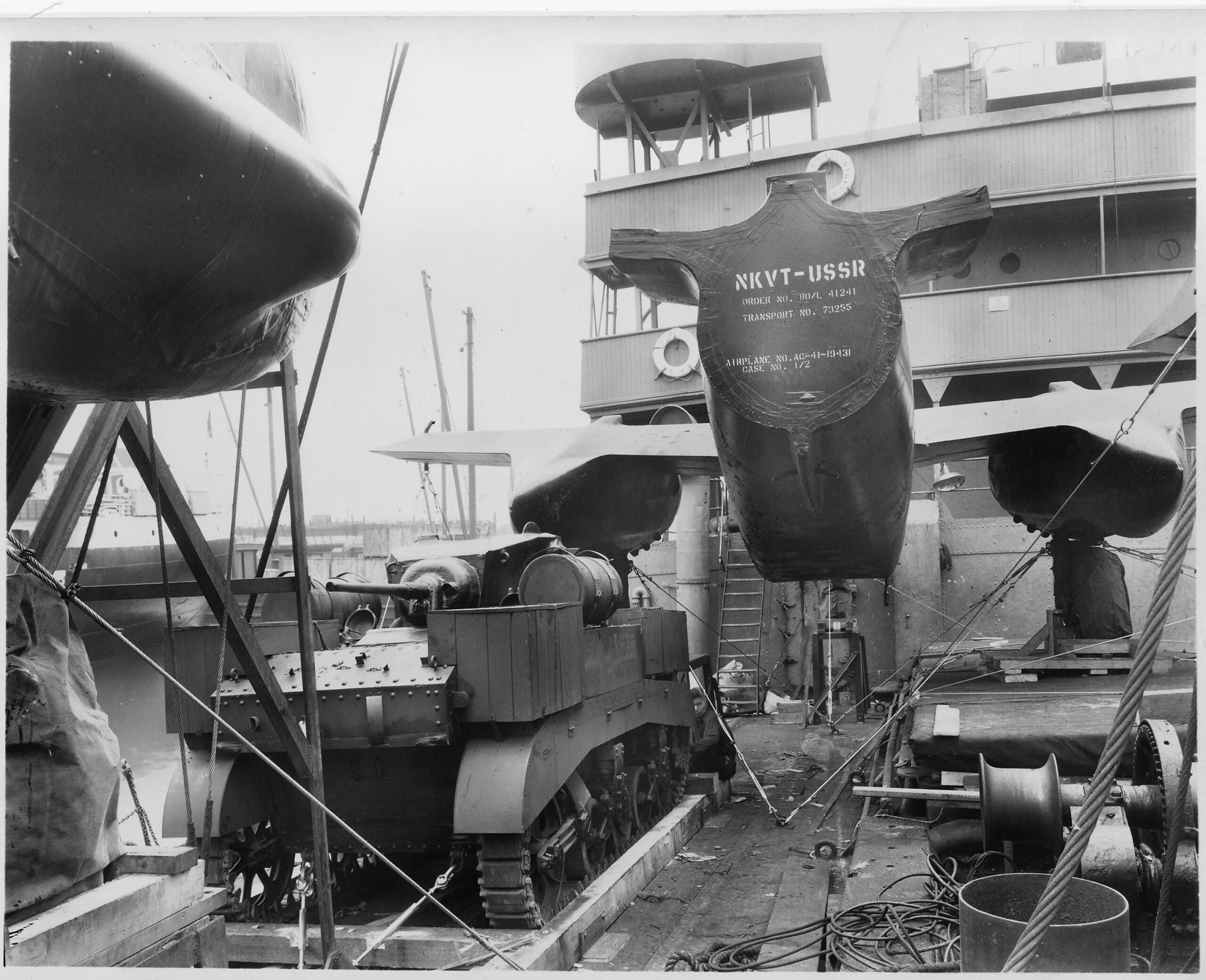
The featured photograph shows vehicles and aircraft-related cargo being transported for the Soviet Union during the war. Its historical value lies in documenting the logistics of physical aid rather than depicting Roosevelt signing the legislation. The image underscores that the program was implemented through manufacturing, ports, shipping and large international supply networks. A statutory authorization alone could not move a single tank without people and infrastructure to build and deliver it.
Britain and the Commonwealth as major recipients
The United Kingdom was the central early beneficiary because of its confrontation with Germany and urgent need for matériel. Lend-Lease helped Britain continue fighting while its financial resources were under immense strain. Supplies also supported Commonwealth war efforts and other theaters in which Britain was engaged. The precise value and categories of assistance varied across annual reports, and official accounting distinguished transfers made before and after U.S. entry into the war.
Allied cooperation also involved exchange of facilities, technology, information and services. British and other governments provided forms of ‘reverse Lend-Lease,’ supplying support to American forces in their territories and during joint operations. That relationship is why saying the entire program was an outright one-way gift with no reciprocal arrangements would be inaccurate. It operated as a system of wartime cooperation under negotiated terms.
Aid to the Soviet Union after June 1941
Germany invaded the Soviet Union in June 1941, dramatically changing the strategic situation. The United States extended assistance to Soviet forces under the Lend-Lease framework as the eastern front became central to the war against Nazi Germany. Deliveries moved through dangerous routes, including Arctic convoys, the Persian Corridor and the Pacific. Ships, trucks and railway equipment had to survive enemy threats and difficult transport conditions.
Soviet factories produced most Soviet military equipment, but imported American trucks, food, industrial supplies and other goods contributed significantly to mobility and logistics. The scale of that contribution remains a subject of detailed historical study, and it would be misleading either to claim the program single-handedly won the Eastern Front or that it was irrelevant. The National WWII Museum and contemporary government reports provide evidence about specific categories of supplies delivered.
Lend-Lease and China
China had fought against Japanese invasion since 1937, before the United States entered the Pacific War. American policymakers viewed continued Chinese resistance as strategically important and included China among major recipients of assistance. Supplying Chinese forces and infrastructure presented formidable challenges because access routes were threatened or controlled by Japan. Aircraft, vehicles, communications equipment and other materials moved through changing transport networks.
China’s experience differed from Britain’s and the Soviet Union’s, and therefore figures from one recipient should not be presented as though they describe all Allied deliveries. The need to overcome difficult geography and contested sea and land routes illustrates the limits of industrial output alone. Successful Lend-Lease required supply chains, diplomacy and decisions about military priorities as well as legislative authority.
Was Lend-Lease compatible with neutrality?
When the program began in March 1941, the United States was not yet formally at war. Yet substantial military support to powers fighting Germany and Japan made American neutrality increasingly limited in practical terms. Some critics argued that the policy favored one side so strongly that it amounted to intervention without a declaration of war. Roosevelt insisted that keeping hostile powers from dominating vital regions was a defense interest.
The historical chronology is clear: the statute was passed in March, the Atlantic Charter followed in August, and the United States entered war after Pearl Harbor in December. Neither the statute nor the charter itself declared war. The distinction helps explain how the United States moved through successive steps from neutrality legislation to assistance and then full combat participation.
How much aid was sent, and was it all repaid?
Contemporary U.S. government reporting puts total Lend-Lease aid at roughly $49 billion through December 31, 1945, with many general histories rounding the amount to $50 billion. These are 1940s nominal-dollar values, not modern inflation-adjusted sums. The program’s accounting combined multiple forms of assistance, and figures may differ according to closing date and whether some goods or services are counted in a particular report.
Postwar financial arrangements addressed remaining inventories, settlements and outstanding goods, but the program did not require every wartime recipient to repay the full original book value of everything delivered. Items consumed or destroyed in battle could not simply be returned. Reciprocal aid and negotiated settlements were important features of the system. The word ‘lease’ in the law’s name therefore should not be interpreted as an ordinary peacetime equipment rental contract.
Lend-Lease’s long-term significance
The program made American manufacturing an essential part of Allied military capacity before and during U.S. combat involvement. It helped sustain Britain’s resistance, supported other Allied fronts and strengthened cooperation among governments whose military efforts were often far apart. U.S. factories built enormous quantities of equipment, while the War Production Board later coordinated competing domestic production demands after America entered the war.
Lend-Lease also helped shape postwar diplomatic and economic relationships. Agreements with recipients included principles affecting international trade and economic cooperation, while wartime alliances influenced the design of later global institutions. The central historical point is not simply that money was transferred. The United States developed a legal and industrial system for supplying nations it viewed as essential to its own defense, changing its role in the war months before Pearl Harbor.
Timeline
- September 1940: Destroyers-for-bases agreement aids Britain
- December 1940: Roosevelt publicly presents garden-hose rationale
- March 11, 1941: Lend-Lease Act signed
- June 1941: Germany invades Soviet Union; Allied needs expand
- August 1941: Atlantic Charter announced
- December 1941: United States enters World War II
- 1942–1945: Aid and reverse assistance expand
- 1945 onward: Program winds down and postwar settlements negotiated
Frequently asked questions
When was Lend-Lease signed?
March 11, 1941.
Did it start before Pearl Harbor?
Yes. It was enacted nearly nine months before the United States entered the war.
Which countries received aid?
Britain, the Soviet Union, China and more than 30 other countries or governments received assistance during the war.
How much did it cost?
Roughly $50 billion in wartime nominal dollars, according to official histories.
What was transferred?
Aircraft, tanks, trucks, ships, food, machinery, raw materials and other defense goods and services.
Was everything paid back?
No. Wartime supplies were subject to various return, reciprocal-assistance and settlement arrangements rather than full conventional repayment.
Did Lend-Lease declare war?
No. U.S. entry followed the December 1941 attacks and declarations of war.
What was reverse Lend-Lease?
Aid and services supplied by Allied governments to support American operations.
Sources and further reading
- National Archives — Lend-Lease Act (original text and history)
- Office of the Historian — Lend-Lease and Military Aid
- FDR Presidential Library — Lend-Lease Program
- U.S. House History — Lend-Lease Act
- U.S. Navy History — Lend-Lease Statute, March 11, 1941
- National WWII Museum — Lend-Lease to the Eastern Front