Election of 1876: Hayes vs. Tilden, Disputed Votes and Final Results
Why Tilden won the popular vote but Hayes won the presidency—and how Congress resolved twenty disputed electoral votes.
In 1876 Samuel J. Tilden won more popular votes than Rutherford B. Hayes. Twenty electoral votes were disputed. An Electoral Commission awarded the contested votes to Hayes, giving him 185 votes against Tilden’s 184. The disputed outcome became closely associated with the end of Reconstruction in 1877.
This guide explains who the candidates were, why four states’ returns were contested, and what the final official count meant.
On this page — 20 topics
What happened in the presidential election of 1876?
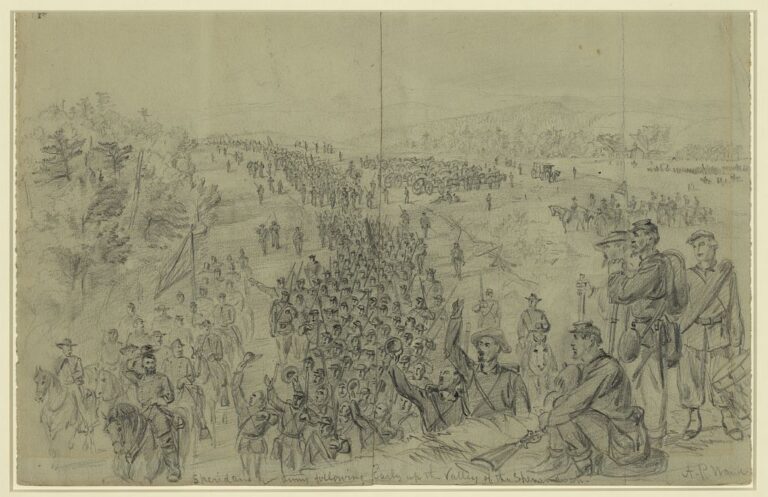
The presidential election of 1876 became one of the most disputed in United States history. Democratic candidate Samuel J. Tilden won more popular votes than Republican Rutherford B. Hayes, but results from several states were contested. After a specially created Electoral Commission and congressional proceedings, Hayes received 185 electoral votes to Tilden’s 184. The decision came only days before the inauguration in March 1877. The controversy unfolded during the final stage of Reconstruction, when Black political participation and federal support for Southern Republican governments were under intense pressure. The election was not merely a counting problem: claims of intimidation, fraud and competing state officials reflected a larger struggle over political authority after the Civil War.
Who was Rutherford B. Hayes?
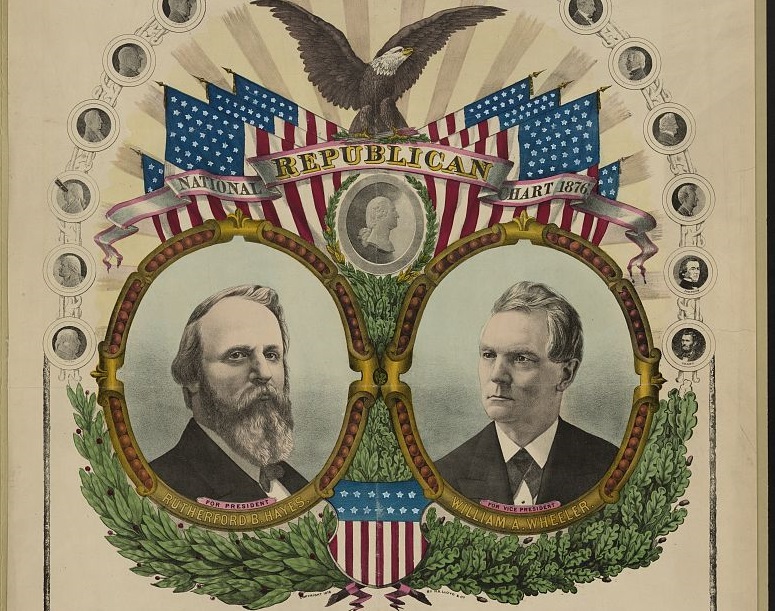
Rutherford B. Hayes was the Republican candidate and governor of Ohio, with a record as a Union officer during the Civil War. Republicans hoped his reputation for personal integrity could appeal to voters concerned about corruption and the economic consequences of the Panic of 1873. His running mate was William A. Wheeler of New York. Hayes supported civil-service reform and spoke of national reconciliation, but the Republican Party also carried the legacy of Reconstruction and federal protection of freedpeople’s rights. As the dispute developed, Hayes’s path to the presidency depended on contested returns from the South and Oregon. His subsequent Southern policy would be closely associated with the political transition of 1877.
Who was Samuel J. Tilden?
Samuel J. Tilden was a Democrat and the governor of New York. He had established a reputation for challenging political corruption, including the influence of the Tweed Ring, and argued for honest government and reform. His running mate was Thomas A. Hendricks of Indiana. Democrats campaigned against the record of the Republican administration and called for a change after years of federal intervention in Southern politics. Tilden ultimately received more votes nationally than Hayes and appeared close to winning the Electoral College. Yet his campaign also operated in a political climate where white supremacist intimidation and violence affected the ability of Black Republicans to participate safely in several Southern states.
What were the major campaign issues?
The long depression that followed the Panic of 1873 made employment, currency and economic policy important to voters. Charges of corruption in federal government and civil-service reform also shaped both parties’ appeals. Another central issue was Reconstruction: Republicans associated their party with Union victory and constitutional protections, while many Democrats demanded reduced federal involvement in Southern state governments. Political violence and contested election administration were not side issues. In some regions, elections took place amid threats directed at Black voters and Republican organizers. The campaign’s themes therefore mixed national financial problems with profoundly unequal local conditions. Understanding both is necessary to explain why the final election returns became so bitterly disputed.
Why did the popular vote and electoral vote differ?
The president is chosen through the Electoral College rather than through a direct national popular-vote majority. Each state receives electoral votes under constitutional rules, and state outcomes determine how those votes are allocated. In 1876 Tilden led Hayes in the national popular vote, but he did not secure an uncontested electoral majority. Election disputes in Florida, Louisiana and South Carolina, along with a separate issue involving an Oregon elector, created uncertainty about who would receive the necessary electoral votes. The distinction between the popular-vote lead and the Electoral College outcome is fundamental. It is incorrect to say that the national popular vote was recounted and directly awarded to Hayes.
How many electoral votes were required?
There were 369 electoral votes in the 1876 election, so a majority required 185. Initial undisputed returns left Tilden with 184 electoral votes, one short of that threshold, while Hayes had 165. Twenty electoral votes were contested: four from Florida, eight from Louisiana, seven from South Carolina and one from Oregon. This arithmetic explains why the dispute was decisive. Hayes had to win all twenty disputed votes to reach 185; Tilden needed only one to attain an electoral majority. The National Archives’ official Electoral College record ultimately lists Hayes with 185 and Tilden with 184. These numbers should not be confused with vote totals from state-level popular elections.
Why were returns disputed in Florida?
Florida had four electoral votes at stake, and both parties disputed the state results. Election officials and political organizers traded accusations of fraud, intimidation and improper counting. The state’s returning board faced pressure over which ballots and precinct results should be accepted. Rival interpretations produced competing claims about the lawful electoral slate. This was not a routine numerical recount governed by the modern procedures familiar from later elections. Officials operated under nineteenth-century state rules amid intense partisan conflict. The Florida dispute became one part of the twenty-vote problem Congress ultimately had to resolve. A historical account should distinguish disputed evidence and allegations from findings that every complaint was necessarily valid.
What happened in Louisiana?
Louisiana held eight disputed electoral votes and had experienced sustained political conflict during Reconstruction. Republican and Democratic forces challenged election results while allegations of voter intimidation, ballot manipulation and unequal enforcement circulated. White supremacist violence had threatened Black political participation, making the question of what constituted a fair vote particularly serious. The state returning board reported results favorable to Hayes, but Democrats disputed the process and claimed their own victory. Louisiana’s electoral dispute overlapped with competing claims to state government authority. The episode illustrates how a presidential election could become inseparable from efforts to control state offices and the future of federal protection in the South.
Why was South Carolina contested?
South Carolina accounted for seven disputed electoral votes. The state had a substantial Black electorate and a Republican government that faced organized white Democratic opposition and violence. Republican and Democratic leaders disputed results and the legitimacy of the state’s political institutions. Competing claims to the governorship added to uncertainty surrounding presidential electors. The electoral controversy cannot be described responsibly without acknowledging that the exercise of voting rights was affected by racial intimidation. At the same time, partisan allegations and legal disagreements required examination of actual returns and procedures. South Carolina demonstrates why the presidential settlement carried consequences beyond the identity of the national officeholder.
What was the Oregon elector dispute?
Oregon’s controversy differed from the three Southern disputes. Hayes won Oregon’s popular presidential vote, but questions arose over the eligibility of one Republican elector, John W. Watts, because he had served as a federal postmaster. The Constitution prohibits certain federal officeholders from serving as presidential electors. The Democratic governor certified an alternative arrangement, while Republicans challenged that decision and the elector resigned his federal position. The competing papers reached Washington alongside Southern returns. This dispute accounted for one of the twenty electoral votes and provides a reminder that the crisis was not solely about Southern ballot counts. It also involved constitutional qualifications and disagreements over who could certify an elector.
Why were there competing electoral returns?
Electoral votes were recorded and transmitted by officials operating within contested state political systems. In 1876 some states submitted rival certificates or competing claims as to which electors had been lawfully appointed. The Constitution prescribed important steps for counting electoral votes but left disagreements about how Congress should resolve competing returns. House Democrats and Senate Republicans had opposing incentives and interpretations. The absence of an accepted process raised the possibility that Congress would not agree on a president before the inauguration date. The crisis therefore involved both disputes about what happened within states and a procedural dispute at the national level. Both problems had to be addressed to produce a recognized result.
What was the Electoral Commission?
Congress created a fifteen-member Electoral Commission in January 1877 to consider the disputed electoral votes. It consisted of five senators, five representatives and five Supreme Court justices. The arrangement was intended to provide a mechanism acceptable to both houses, which were controlled by different parties. The commission initially seemed capable of including an independent member, but the final composition produced an eight-to-seven Republican majority. Decisions on the contested votes generally followed that division. The commission was not a permanent court created by the Constitution, nor did it investigate every allegation of intimidation in every county. It was a specific political-legal solution to the immediate electoral impasse.
How did the commission reach its decisions?
The commission considered competing certificates and legal arguments concerning the disputed states. Its key decisions favored Hayes by votes of eight to seven, with Republican members forming the majority. In the end all twenty disputed electoral votes were awarded to Hayes. Congress then counted the result through proceedings that involved objections and attempts to delay. Critics charged that the process followed partisan loyalties rather than an impartial examination of the election’s fairness. Supporters argued that a recognized institutional procedure was necessary to prevent a dangerous constitutional breakdown. Historians continue examining the evidence, but the official outcome is unambiguous: the completed count gave Hayes 185 electoral votes.
When was Hayes declared the winner?
The controversy continued into early March 1877, shortly before the scheduled presidential transition. Congress finally completed the electoral count on March 2, declaring Hayes the winner. Hayes took the oath privately on March 3 and participated in a public inauguration on March 5 because March 4 fell on a Sunday. These dates are easy to confuse when simplified accounts speak of one inauguration day. The late resolution illustrates the severity of the crisis: competing claims persisted until the final hours before a new administration had to take office. The outcome established which candidate would serve but did not settle broader questions about the fairness of Southern elections or protection of voters.
What was the Compromise of 1877?
The term Compromise of 1877 describes political understandings and negotiations associated with acceptance of Hayes’s presidency and the withdrawal of the remaining federal military support from contested Republican governments in the South. Historians disagree about how formal or binding individual promises were; there was no single signed national treaty bearing that name. The election settlement and the transition in Southern policy were closely linked, but they should not be collapsed into a simple legal contract that every participant signed. The broader outcome was the weakening of the last Reconstruction-era Republican governments in South Carolina and Louisiana as national political priorities shifted.
Did the election end Reconstruction?
Many histories use 1877 as the conventional endpoint of Reconstruction because the contested election’s aftermath coincided with federal withdrawal of support for remaining Republican state governments in the South. However, Reconstruction was a process, not an institution terminated by a single presidential order. Some state governments had changed hands earlier, while constitutional amendments and federal statutes remained in force after 1877. Black communities continued political organizing even as violence and discriminatory practices eroded participation. The election accelerated an important political transition, but later disfranchisement developed over years and varied by state. Explaining the distinction makes both the election and Reconstruction more historically accurate.
Why does the election still matter?
The contest illustrates the tension between electoral rules, public legitimacy and unequal political participation. Tilden’s popular-vote lead did not determine the presidency because the Electoral College count was decisive, and Congress needed an extraordinary commission to resolve disputed returns. The aftermath also changed the federal government’s approach to Southern political conflict. These two elements should remain connected but analytically distinct. Electoral history concerns state certificates, constitutional procedures and congressional counting; Reconstruction history concerns who could vote safely and whether federal institutions would protect constitutional rights. Their intersection makes 1876 unusually consequential in American political history and explains why the dispute continues to attract attention from historians of both elections and civil rights.
Disputed electoral votes and final count
| State | Contested votes |
|---|---|
| Florida | 4 |
| Louisiana | 8 |
| South Carolina | 7 |
| Oregon | 1 |
| Total | 20 |
All twenty were awarded to Hayes, producing the final 185–184 Electoral College result.
1876–1877 election timeline
| Date | Development |
|---|---|
| November 7, 1876 | Presidential election; rival returns emerge from several states. |
| January 1877 | Congress establishes the Electoral Commission. |
| February 1877 | Commission votes 8–7 in favor of Hayes on disputed returns. |
| March 2, 1877 | Congress completes the count: Hayes 185, Tilden 184. |
| March 3–5, 1877 | Hayes takes the oath and is publicly inaugurated. |
| Spring 1877 | Federal support is withdrawn from remaining contested Republican Southern governments. |