Federal Income Tax Begins (1913–1914): First Form 1040 and How It Worked
From a new constitutional power to the first tax forms, collections and filing procedures.
Quick answer
The federal income tax was put into operation by the Revenue Act of October 3, 1913, after ratification of the Sixteenth Amendment. The Bureau of Internal Revenue introduced Form 1040 in January 1914 to report income earned in 1913. Initially the tax applied chiefly to higher-income Americans, with a 1% normal rate above exemptions and graduated additional taxes on high incomes.
The 1913 income tax was not simply a constitutional amendment or a signature on a law. It became a working system when federal officials created forms, instructed filers and assessed returns. Understanding this first filing cycle explains why the beginning of modern federal taxation belongs to both 1913 and 1914.
Key facts
On this page
- The difference between permission to tax and collecting the tax
- The Revenue Act of October 3, 1913
- Who actually had to pay?
- What the first Form 1040 looked like
- How the first return and payment process worked
- The Bureau of Internal Revenue before the IRS name
- Deductions, exemptions and withholding in 1913
- What taxpayers and critics argued about
- World War I transformed the scale
- Why the first 1040 matters in American history
- Timeline
- Frequently asked questions
- Sources
The difference between permission to tax and collecting the tax
The story of federal income taxation has two separate parts. The Sixteenth Amendment settled a constitutional problem: Congress could lay taxes on incomes without apportioning those taxes among the states according to population. That change did not itself hand people a form, define a taxable salary, or build a collection system. Congress still needed a statute, the Treasury needed procedures, and taxpayers needed instructions. The Revenue Act of 1913 supplied the statutory framework, while the Bureau of Internal Revenue carried out the administrative work. Confusing the amendment with the machinery of taxation overlooks much of what made 1913 and 1914 historically important.
The distinction matters because Americans had encountered federal income taxes before. Congress imposed temporary taxes during the Civil War, and Congress tried another peacetime tax in 1894, but the Supreme Court’s 1895 decision in Pollock complicated that effort. The Sixteenth Amendment removed the apportionment obstacle for taxes on income; the subsequent legislation defined the new tax. Our separate guide to the Sixteenth Amendment explains the legal debate in depth. This article focuses instead on the operational questions that an accountant, employer, or taxpayer would have encountered in the first years.
The Revenue Act of October 3, 1913
President Woodrow Wilson signed the Revenue Act of 1913 on October 3. The measure was often called the Underwood-Simmons Tariff Act because it substantially revised import duties as well as establishing the modern income tax. Fiscal policy and trade policy were therefore joined in one act. Tariff reductions were politically significant, but supporters did not assume the tax could immediately replace all customs revenue. The initial income-tax base was limited, collection practice remained experimental, and the Treasury continued to depend on several established revenue streams.
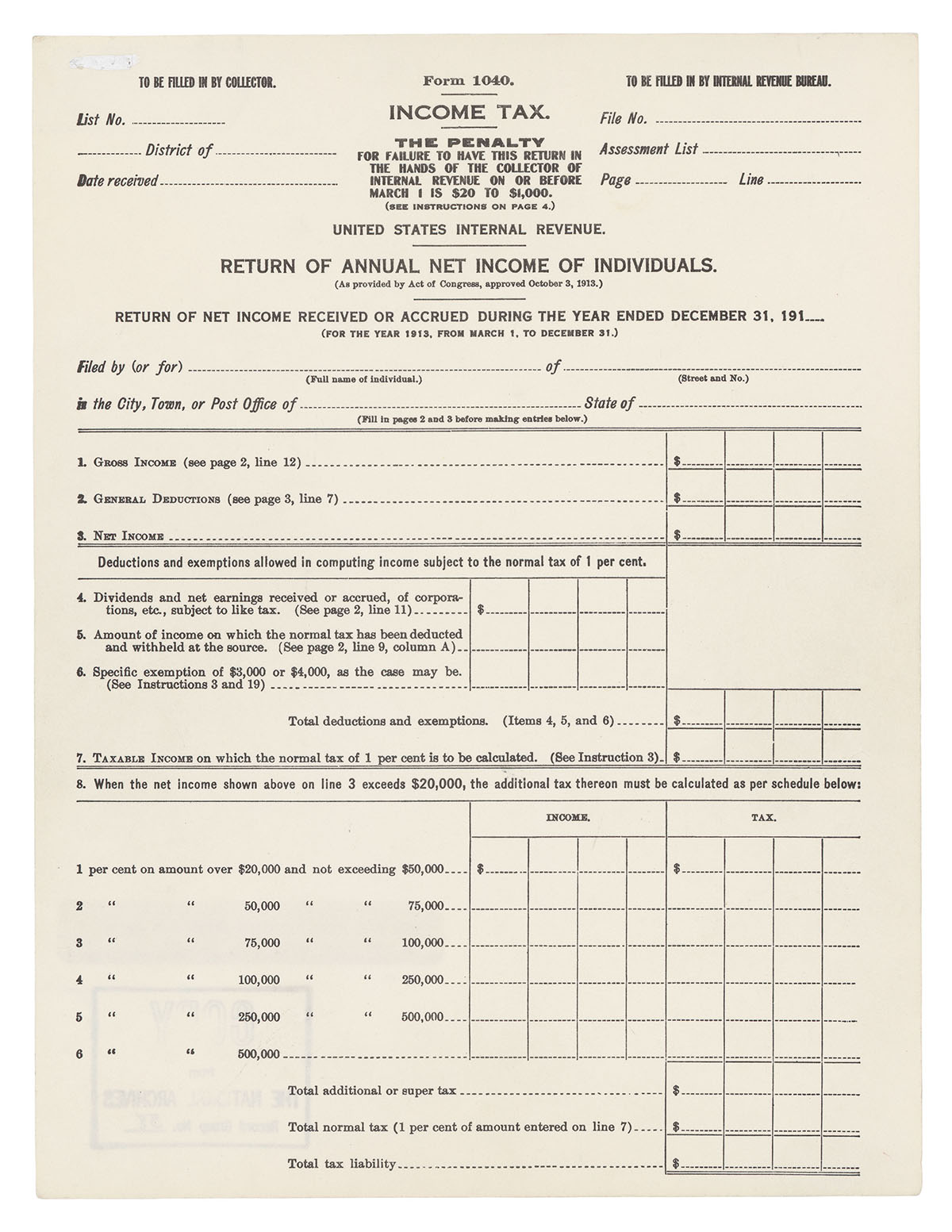
The law introduced a normal tax of 1% on taxable net individual income above the relevant exemption and additional graduated surtaxes on much higher incomes. It also addressed corporate income and specific administrative questions. The starting point for an ordinary person’s liability was not simply a headline salary: gross income, permitted deductions, exemptions, and income already taxed or withheld had to be considered. The original form was designed to bring that information together, although interpreting what counted as income and what could be deducted posed questions that the Bureau would continue to answer.
Who actually had to pay?
The new levy was deliberately narrower than the federal individual income tax familiar today. The basic exemption was $3,000 for an unmarried individual and $4,000 for a married couple under the statute’s rules, amounts substantially above the earnings of many working Americans of the period. Those thresholds should not be converted casually into a percentage of the entire population: the number of return filers, number of taxpayers, and share of workers were different statistics. National Archives explanations emphasize that less than one percent of the population paid individual income tax in the initial years, illustrating its limited early reach.
Nor did passing an income threshold mean that the entire income was taxed at the highest rate. After allowable deductions and the statutory exemption were considered, the normal tax generally applied at 1% to the remaining amount. Additional surtaxes began at higher levels and increased across income bands; the highest combined marginal rate under the 1913 schedule reached 7%. Because exemptions, income types, and deductions mattered, exact historic liabilities require reconstructing a particular person’s facts under the statute rather than applying a modern tax calculator retroactively.
What the first Form 1040 looked like
The first Form 1040 was a four-page document including instructions, unveiled by the Treasury on January 5, 1914. Its number was not an encoded tax rate or a constitutional reference: it came from the ordinary sequence of numbered Bureau forms. On the front page, taxpayers could see spaces for gross income, deductions, net income, exemptions, and the calculation of normal and additional taxes. The document also warned of penalties for failing to comply. Its physical simplicity can be misleading; categories such as business receipts, investments, and deductions still required judgment.
The original form covered 1913 income, with a special opening period beginning March 1 rather than January 1. That is why historical images of the first return may show the period ending December 31, 1913, yet references to the form’s public release date point to 1914. A form headed 1913 is not evidence that citizens were filing that document throughout 1913. The distinction between tax year and filing year is essential when comparing the first return to the filing cycles used in later decades. The National Archives preserves an image of the original, while the Library of Congress has reproduced its pages and explained their context.
How the first return and payment process worked
In the opening filing cycle, a taxpayer did not use the modern practice of attaching a payment to an electronically processed return. The Bureau relied on district collectors and field agents, who reviewed what had been submitted and calculated or verified the amount due. An IRS historical account notes that the first year’s taxpayers did not send payment with the form: officials checked the calculations and sent bills. This makes the implementation story one about government capacity as well as tax rates. Establishing an enforceable routine required staff, printed forms, instructions, correspondence, record keeping, and a way to answer disputed questions.
Filing a return also demanded new habits from those whose earnings came from several sources. A wage earner, a landlord, and a small-business proprietor might need to organize very different evidence of income and expenses. The Bureau had to communicate rules that were unfamiliar to many of the people affected, and it created specialized arrangements for answering questions about the law. Administrative uncertainty was unsurprising: the country had enacted a lasting peacetime income tax, but neither the detailed practice nor a modern mass-filing culture already existed.
The Bureau of Internal Revenue before the IRS name
The agency responsible was the Bureau of Internal Revenue, part of the Treasury Department. The institution traced its roots to Civil War revenue legislation and already handled various internal taxes. Adding a permanent individual income-tax system broadened its work rather than bringing an entirely new government agency into existence. Historical writing that says the Internal Revenue Service started collecting taxes in 1913 uses the agency’s current name retrospectively; the official name IRS was adopted much later, in 1953.
Personnel and procedures mattered because a legal entitlement to levy a tax could not collect itself. Returns had to be distributed and received across a geographically large country. Agents had to apply consistent rules to occupations and businesses with different sources of income. The Bureau also faced the problem of explaining deductions and deadlines without the instant communications available to modern tax administrators. Those practical requirements created a lasting framework: filing instructions, standardized forms, local enforcement, and further interpretations of ambiguous provisions.
Deductions, exemptions and withholding in 1913
The exemption was only one adjustment in the calculation. A return also asked about permitted deductions and specific forms of income, and the statute included collection rules affecting payments made by other parties. It is easy to assume that because the tax was new there was no withholding of any sort; it is equally misleading to equate 1913 practice with the later system of routine wage withholding. Withholding at the source existed in limited and complicated forms under the early law, while the broad wage-withholding arrangements familiar from the mid-twentieth century developed later.
An effective historical explanation therefore separates the legal rate, the amount of income subject to tax, the process of filing, and the process of collecting payment. Those are four different questions. A modest statutory rate does not tell us how quickly the Bureau could process returns. The existence of Form 1040 does not show that all adults filed it. And a high-income surtax does not mean every dollar a person earned faced the same percentage. Thinking in these categories also clarifies later debates about fairness, administration and the ability of government to finance expensive national programs.
What taxpayers and critics argued about
Supporters of the income tax generally associated it with a more progressive distribution of federal revenue burdens, especially after decades in which customs duties and excise taxes supplied much of the government’s income. High tariffs could raise consumer prices and place different burdens on households depending on what they purchased. A graduated income tax offered a different approach: higher earnings could face additional marginal rates. Yet support was not uniform, and arguments about constitutional authority, federal power, privacy, administrative burdens and the effects on investment had deep roots before the amendment was ratified.
The early tax did not immediately settle these disputes. Court challenges and statutory amendments followed, while changing economic conditions produced demands for different exemptions and rates. As with other Progressive Era reforms, claims about ‘fairness’ were often contested political judgments rather than measurements historians can simply assume. The historical record is most illuminating when it shows the actual choices Congress made and the outcomes it could observe. The tax was modest in its first year, but it created a mechanism capable of substantial expansion.
World War I transformed the scale
The original law is sometimes mistaken for the birth of today’s fully developed mass income-tax system. In reality, the subsequent expansion is a separate story. The fiscal demands of World War I led Congress to change rates and broaden the reach of the tax, producing much larger federal revenue needs than the architects of 1913 had faced. The administrative infrastructure built in the opening years became more important as growing numbers of individuals and firms had to comply. A limited tax on comparatively high incomes became a major instrument of national finance.
War-time change also shows why a single historic income-tax figure cannot stand for the entire early twentieth century. Rates, exemptions, and rules changed repeatedly. The 1913 top marginal rate was not the same as a World War I rate, and neither can be treated as a description of today’s law. For researchers, the lesson is to pair every figure with the precise tax year and statutory setting. In the case of the first Form 1040, the relevant starting points are the 1913 act and the 1914 administrative cycle.
Why the first 1040 matters in American history
The first federal income-tax return is significant because it makes a large constitutional and legislative shift visible at the scale of an ordinary administrative document. It shows exactly what the government wanted to know, how it organized income categories, and which exemptions and calculations it considered important. A citizen reading the form could see that Congress’s new power was no longer abstract. There were actual fields to complete, a place to submit the return, penalties for noncompliance, and people tasked with enforcing the rules.
It also links several distinct Progressive Era reforms. The Seventeenth Amendment changed how senators were chosen; the Federal Reserve Act revised banking institutions; and the new income tax changed federal revenue collection. These developments were connected by their setting, but they did not do the same thing. Readers who distinguish constitutional authorization, tax legislation, and actual filing procedure gain a clearer account of how the modern federal government developed.
Timeline
- 1895: Supreme Court Pollock decision complicates a peacetime federal income tax
- February 1913: Sixteenth Amendment ratified and formally proclaimed
- October 3, 1913: Revenue Act signed by President Wilson
- January 5, 1914: Treasury unveils first Form 1040
- 1914: Bureau begins handling the first returns for 1913 income
- 1953: Bureau formally takes the IRS name
Frequently asked questions
Did the Sixteenth Amendment itself start income-tax collection?
No. It gave Congress constitutional authority to tax income without apportionment among the states. The Revenue Act of October 3, 1913 created the tax rules, and the Bureau of Internal Revenue administered them.
Was the first Form 1040 used in 1913 or 1914?
It reported income for the 1913 tax period but was unveiled in January 1914, so the tax year and the filing year are different.
What were the original exemptions?
The basic individual exemption was $3,000, with a $4,000 married-couple provision under the law. The precise amount due also depended on deductions and income categories.
Did most Americans pay the 1913 federal income tax?
No. The initial thresholds were high compared with ordinary wages and the tax applied to a comparatively small share of the population.
Was the IRS founded in 1913?
The institution already existed as the Bureau of Internal Revenue. It was formally renamed the Internal Revenue Service in 1953.
What was the first tax rate?
The 1913 law imposed a 1% normal tax on taxable net income above exemptions, with additional graduated surtaxes for higher incomes; the top combined marginal rate reached 7%.
Sources and further reading
These archival and government sources provide the principal dates, original documents and administrative background. Interpretive comparisons are identified in the article.
Related history
Explore the legal foundations and neighboring Progressive Era reforms: