Seventeenth Amendment (1913): Direct Election of Senators Explained
Why Americans changed how the Senate was chosen and what the amendment says about vacancies.
The Seventeenth Amendment established direct popular election of U.S. senators in each state, replacing the original constitutional system in which state legislatures chose senators. Congress proposed it on May 13, 1912, and the necessary states ratified it on April 8, 1913. It also specifies how Senate vacancies are filled and permits temporary gubernatorial appointments when state law allows. Each state still elects two senators for six-year terms.
This guide traces state legislative elections, the Oregon system, ratification and voting-rights limits after 1913.
On this page — 25 topics
What is the Seventeenth Amendment?
The Seventeenth Amendment to the United States Constitution provides that senators are elected directly by the people of each state rather than chosen by state legislatures. Congress proposed the amendment on May 13, 1912, and it received the required number of state ratifications on April 8, 1913. The amendment addressed corruption, legislative deadlock and public demands for greater democratic control over the upper house of Congress. It retained the Senate’s basic structure of two senators per state serving six-year terms. Its text also addresses vacancies, allowing states to authorize temporary appointments in specified circumstances. The amendment changed an important part of the Constitution’s original design without making the Senate equivalent to the House of Representatives.
How were senators originally selected?
Article I of the original Constitution directed state legislatures to choose the United States senators representing their states. Delegates at the Constitutional Convention believed that this could protect a role for state governments within the federal system and encourage a degree of distance from day-to-day popular politics. Citizens directly elected members of the House of Representatives, but most did not cast a direct ballot for individual U.S. Senate seats. That system lasted for approximately 125 years before the Seventeenth Amendment became part of the Constitution. Its historical significance was not that senators previously held office for life or were appointed by the president. They served fixed six-year terms, with legislatures selecting replacements under applicable rules.
Why did reformers demand direct elections?
By the late nineteenth century critics argued that legislative selection gave too much influence to political machines, railroad corporations and wealthy interests. Disputes over candidates could occupy state legislatures for extended periods, sometimes preventing them from filling a Senate seat at all. Reformers believed that direct voting would reduce backroom bargaining and make senators answerable to the voters they represented. The proposal also fit a broader Progressive Era movement supporting political primaries, initiative and referendum systems, and changes to election administration. Supporters did not all agree on every issue, but they shared concern that legislative selection could weaken public trust. The amendment emerged after decades of campaigning rather than from one scandal alone.
What caused Senate vacancies under the original system?
When the houses of a state legislature or competing political factions could not agree on a candidate, the state might fail to elect a senator promptly. Some deadlocks lasted months and left a seat vacant. The National Archives cites such difficulties as an important reason reform gained momentum around 1900. A vacancy could reduce a state’s influence in federal decisions, including legislation and national appointments. Critics argued that state lawmakers spent too much time on Senate selection rather than their other duties. The situation varied by state, and the old system did not produce deadlock at every election. Nevertheless, prominent cases helped persuade the public and federal lawmakers that the constitutional process needed revision.
Was corruption part of the movement?
Accusations of bribery and influence-buying damaged confidence in legislative Senate elections. The political career and investigation of Illinois Senator William Lorimer became one of the best-known examples of this concern during the final push for reform. State legislatures could be vulnerable to concentrated interests seeking to influence a smaller group of lawmakers instead of a much larger electorate. However, direct elections did not end political money, lobbying or every opportunity for corruption. Supporters viewed the amendment as a structural improvement that would place the final decision in voters’ hands. The historical record supports serious concerns about particular selection practices, but not an assumption that every senator elected before 1913 obtained office through bribery.
Who was William Lorimer?
William Lorimer was an Illinois politician whose Senate election became the subject of investigations and controversy over alleged bribery and improper influence. The U.S. Senate ultimately declared his election invalid in 1912. The case strengthened public arguments that direct election might reduce opportunities for corruption in legislative selection. It took place near the same time Congress was debating the constitutional amendment, making it especially influential in political discussion. A factual account must distinguish Lorimer’s particular contested election from all Senate selections made under the earlier system. The National Archives identifies the investigation as an important factor in growing support for reform and a useful primary-source episode in the history of the amendment.
What was the Oregon system?
Before national ratification, some states developed arrangements under which voters expressed preferences for U.S. Senate candidates and candidates for the state legislature pledged to follow the popular result. The Oregon system became a widely discussed example of this approach. It allowed states to move toward direct popular choice without immediately changing the constitutional rule that legislatures formally selected senators. Variants spread to other states, though their procedures were not identical. The system demonstrated that voters and state politicians increasingly preferred public participation in Senate selection. It also highlighted the limits of partial reform: final legal selection still depended on legislators until the federal Constitution was amended.
When did Congress first consider direct election?
Proposals for direct Senate elections appeared long before the Seventeenth Amendment was ratified. The National Archives notes an early House proposal in 1826 and describes repeated campaigns during the nineteenth century. Reform gathered strength later as nationwide newspapers reported allegations of corruption and state deadlocks. The House of Representatives supported versions of the proposal at different times, but the Senate resisted because the reform directly affected how its members gained office. This long chronology contradicts the idea that the amendment was unexpectedly drafted after the 1912 presidential election. Its passage followed many unsuccessful efforts, state experiments and a change in political conditions that eventually made ratification possible.
What happened in Congress in May 1912?
Congress approved the proposed Seventeenth Amendment on May 13, 1912, sending it to the states for ratification. This approval followed debates over federal control of elections and the scope of the proposed change. Some lawmakers supported direct election but disagreed about whether the federal government should retain authority to address discriminatory state election practices. The amendment ultimately preserved important features of the constitutional election framework while changing who selected senators. Congressional approval was not the same as ratification; it initiated the state approval process required by Article V. The measure became part of the Constitution the next year, after sufficient state legislatures voted to approve it.
When was the Seventeenth Amendment ratified?
The required three quarters of the states had ratified the proposed amendment by April 8, 1913. The National Archives preserves the original document and records an official notification dated May 31, 1913. These dates should be distinguished from the congressional proposal of May 13, 1912. The ratification was completed after the presidential election of 1912 but was the product of a much longer campaign. The amendment was not signed into law by Woodrow Wilson in the ordinary presidential bill-signing process. Constitutional amendments require congressional proposal and state ratification, with federal officials recording the outcome. This makes the chronology different from the 1913 Federal Reserve Act or 1914 antitrust legislation.
What does the amendment’s first paragraph mean?
The first paragraph states that the Senate is composed of two senators from each state, elected by the people, for six years, with each senator having one vote. It also specifies that voters in each state must have the qualifications required for electors of the most numerous branch of the state legislature. In other words, the amendment ties Senate voter qualifications to existing qualifications for relevant state legislative elections rather than establishing one universal national list of voter requirements. This provision matters for the history of discrimination and voting rights. The amendment gave eligible citizens a direct role in Senate selection but did not immediately remove all state barriers affecting who could vote.
Did the amendment change the number of senators?
No. Every state continued to have two U.S. senators, each normally elected for a six-year term. The amendment did not change the distribution of Senate seats according to state population or make its representation proportional like that of the House of Representatives. Wyoming and New York, for example, would each still have two senators despite their very different populations. The central change was the method of choosing senators. The Senate retained staggered terms so that only part of its membership ordinarily came before voters in a given election cycle. These features were important to the Constitution’s broader design and survived the campaign for direct election.
How are senators elected after 1913?
Voters in each state now select senators through statewide elections conducted under federal constitutional and applicable election law. Regular Senate elections take place at intervals corresponding to six-year terms, with seats divided into classes so that not all are contested at once. The exact voting procedures and ballot rules depend on the governing laws, subject to constitutional requirements. The Seventeenth Amendment itself does not prescribe modern campaign-finance rules or every detail of state election administration. It establishes direct election and related constitutional principles. The modern electorate has changed substantially since 1913 because later amendments and civil rights legislation expanded and protected voting access for groups previously excluded.
What does the amendment say about vacancies?
The amendment provides that when a Senate vacancy occurs, the executive authority of the state shall issue a writ of election to fill it. It also permits the legislature of a state to empower the executive to make temporary appointments until an election fills the vacancy, in the manner the legislature directs. This means a governor’s power to appoint a temporary senator depends on applicable state law rather than an unconditional federal authorization in every case. Procedures vary by state and have been the subject of later statutes and disputes. The constitutional framework distinguishes temporary appointments from ordinary direct elections and provides continuity while preserving a role for voters in selecting a permanent replacement.
Can a governor always appoint a senator?
No. The Seventeenth Amendment allows state legislatures to authorize temporary appointments, but it does not require every state to give its governor identical appointment powers. Some state laws require special elections quickly or place conditions on temporary selections. The details can also change through later legislation. Historically, the vacancy clause was a compromise intended to prevent lengthy absence of representation while maintaining the principle of popular choice. Readers should not treat an appointment made under one state’s law as evidence that all governors have the same authority. The primary constitutional distinction is between the mandatory issuance of a writ for election and the optional temporary appointment power when the legislature grants it.
Did women vote for senators in 1913?
The amendment did not itself establish equal voting rights for women throughout the United States. Some western states had already enacted women’s suffrage laws, so eligible women in those jurisdictions could vote in Senate elections. Many other states still denied women the franchise on the basis of sex until the Nineteenth Amendment was ratified in 1920. Racial discrimination also continued to exclude many eligible citizens in practice, particularly Black Americans in the South. These barriers show that direct election by the people did not mean universal adult suffrage in 1913. The electorate was shaped by the voting qualifications and restrictions in effect at the time.
How did racial discrimination limit direct election?
Southern states maintained poll taxes, literacy tests, intimidation and discriminatory administration that prevented many Black citizens from voting despite the Fifteenth Amendment. Because the Seventeenth Amendment tied elector qualifications to those used in state legislative elections, these barriers affected participation in the direct election of senators. The amendment altered the selection method but did not create a complete national civil rights enforcement system. Later voter-registration campaigns, litigation and the Voting Rights Act of 1965 addressed discriminatory restrictions through different legal mechanisms. A history that portrays the 1913 amendment as immediately allowing every adult citizen to choose senators overlooks the unequal political realities of the Progressive Era and the long struggle for enforceable voting rights.
How was the Seventeenth Amendment different from the Sixteenth?
Both amendments were ratified in 1913 but addressed distinct constitutional questions. The Sixteenth Amendment, ratified in February, authorized Congress to tax incomes without a state-by-state population apportionment. The Seventeenth, ratified in April, changed Senate elections from legislative selection to direct popular voting. Neither amendment created the Federal Reserve or established a new regulatory commission. Their close timing reflects the intensity of Progressive Era reform, but the proposals had separate political histories and purposes. Recognizing the distinction avoids common confusion in summaries of Wilson’s presidency and prevents the mistaken conclusion that presidents directly sign constitutional amendments in the same way as ordinary legislation.
Did every state support the change?
The amendment required approval from three quarters of the states, not unanimity. Some political leaders opposed direct election because they considered legislative selection an important protection of state authority within the federal system. Others feared that national electoral campaigns would increase demagoguery or political spending. Supporters countered that voters needed a direct way to hold senators accountable and reduce the influence of machine politics. These arguments continued after ratification. Some modern critics advocate repealing the amendment, while defenders regard popular election as a fundamental democratic achievement. Historical analysis should explain the opposing constitutional arguments without assuming either that all states welcomed the change or that the amendment resolved every problem in politics.
Did direct elections eliminate Senate corruption?
No electoral structure can guarantee honest candidates or eliminate the influence of organized interests. The Seventeenth Amendment removed a method of selecting senators that critics associated with legislative bargaining, occasional deadlock and bribery allegations. But candidates continued to seek campaign funds, build party alliances and appeal to powerful groups. National elections created different forms of political competition, some of which generated new concerns about spending and publicity. The amendment’s significance is best understood as changing where political accountability was placed, not as a permanent cure for corruption. It made voters the formal selectors of senators while leaving questions about campaign regulation and equal access to elections for later generations.
Why does the Seventeenth Amendment matter today?
The amendment is one of the most important changes to the original structure of Congress. It shifted Senate selection toward direct popular accountability while preserving equal state representation and six-year terms. It also established a constitutional framework for filling vacancies that continues to influence state law. The change emerged from a long history of public pressure, experiments such as the Oregon system, and controversies over legislative deadlocks and corruption. Its limitations reveal why suffrage and equal voter access remained separate struggles. Studying the Seventeenth Amendment alongside the Fifteenth and Nineteenth Amendments helps explain that who selects representatives and who is permitted to vote are related but different constitutional questions.
Where can the original amendment be read?
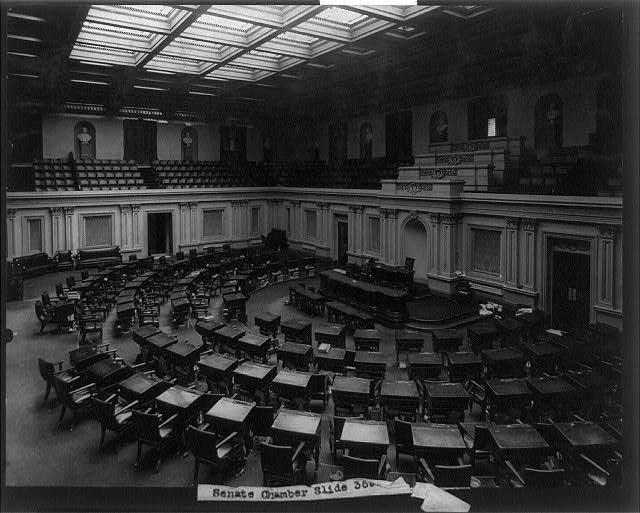
The National Archives Milestone Documents collection preserves the amendment and confirms its proposal in May 1912 and ratification in April 1913. The Archives’ legislative-history feature discusses deadlocks, corruption and the Oregon system. The Library of Congress provides contemporary newspaper sources through its Seventeenth Amendment research guide, while the U.S. Senate publishes historical material about the evolution of its elections. The photograph accompanying this guide shows the Senate chamber after the amendment, not the moment legislators approved it. Reading the constitutional text and original debates offers a more reliable account than confusing the reform with the creation of entirely new Senate seats.
Seventeenth Amendment timeline
| Date | Event |
|---|---|
| 1787 | Constitution establishes legislative selection of senators. |
| 1826 | Early congressional proposals for direct election appear. |
| Late 1800s | Deadlocks and corruption allegations strengthen reform movements. |
| Early 1900s | Oregon system and similar voter-preference mechanisms expand. |
| 1912 | Lorimer election controversy heightens concern. |
| May 13, 1912 | Congress proposes Seventeenth Amendment. |
| April 8, 1913 | Required number of states ratify amendment. |
| May 31, 1913 | Official notification of ratification recorded. |
| 1914 onward | Regular federal Senate elections operate under direct-vote framework. |
| 1920 | Nineteenth Amendment prohibits sex-based voting restrictions. |
Historical sources
- National Archives — Seventeenth Amendment
- National Archives — Legislative History and Notification
- Library of Congress — Newspaper Guide
- U.S. Senate — Direct Election of Senators
- Constitution Annotated — Seventeenth Amendment
- National Archives — Amendments 11–27 Text
- Library of Congress — Senate Chamber Historical Photograph