Fair Labor Standards Act of 1938: Minimum Wage, Overtime and Child Labor
How Roosevelt’s 1938 labor law introduced a federal 25-cent minimum wage, overtime after 44 hours and rules against oppressive child labor.
Quick answer
President Franklin D. Roosevelt signed the Fair Labor Standards Act (FLSA) on June 25, 1938, and its main provisions began taking effect October 24 that year. For covered employees, the original law set a minimum wage of 25 cents per hour and a standard workweek of 44 hours, with overtime pay at one and one-half times the regular rate for additional hours. It also restricted oppressive child labor in covered occupations. The wage minimum and overtime thresholds increased or changed under the original schedule and later amendments; many workers were initially excluded.
Key facts
On this page
- Why Congress debated national labor standards
- Earlier labor reform and constitutional disputes
- The legislative campaign of 1937–1938
- What the first 25-cent minimum wage covered
- Why the first standard workweek was 44 hours
- How the law restricted oppressive child labor
- Who was outside the original protections?
- How the Labor Department enforced the statute
- United States v. Darby and the 1941 Supreme Court ruling
- The difference between the FLSA and the Wagner Act
- Why the 1938 law became a lasting reform
- What later amendments changed
- Timeline
- FAQs
- Sources
Why Congress debated national labor standards
The economic crisis of the 1930s exposed large differences in pay and working conditions across American industries. Some workers labored long hours for very low wages, while children continued to work in settings that reformers considered dangerous or detrimental to schooling. State laws addressed some abuses, but standards varied geographically and by industry. Businesses also worried that competitors could gain an advantage by paying less or employing children. Those circumstances helped create demand for a federal baseline.
Supporters of nationwide rules argued that low wages and long hours could undermine purchasing power and fair competition. Critics feared that federal requirements would raise costs or eliminate jobs in regions with lower average incomes. A federal minimum was also legally controversial because the Supreme Court had restricted certain wage and labor laws in earlier decisions. The challenge was to create rules connected to Congress’s constitutional authority over interstate commerce.
Earlier labor reform and constitutional disputes
Efforts to limit child labor and excessive hours predated Roosevelt’s presidency. The Keating–Owen Child Labor Act of 1916 sought to keep products made by certain child workers out of interstate commerce, but the Supreme Court struck it down in 1918. Progressive-era reformers also supported shorter workdays, workplace inspection and state wage boards. These efforts shaped the ideas that federal policymakers carried into the New Deal.
The judicial context shifted during the 1930s. In 1937 the Supreme Court upheld a state minimum-wage law in West Coast Hotel v. Parrish, opening a stronger legal path for wage regulation. Congress still had to determine the specific scope of federal jurisdiction and navigate resistance among lawmakers. The 1938 statute was not a sudden invention of the idea that work should have basic standards; it was the result of a long reform struggle.
The legislative campaign of 1937–1938
Roosevelt asked Congress to establish minimum standards for wages and hours as part of his broader effort to improve living conditions and stabilize economic competition. Secretary of Labor Frances Perkins and other officials helped develop the proposals and build support. The legislative process was difficult, with objections over regional wages, small businesses and the relationship between federal regulation and state labor laws. Proposals were revised as supporters sought enough votes in both chambers.
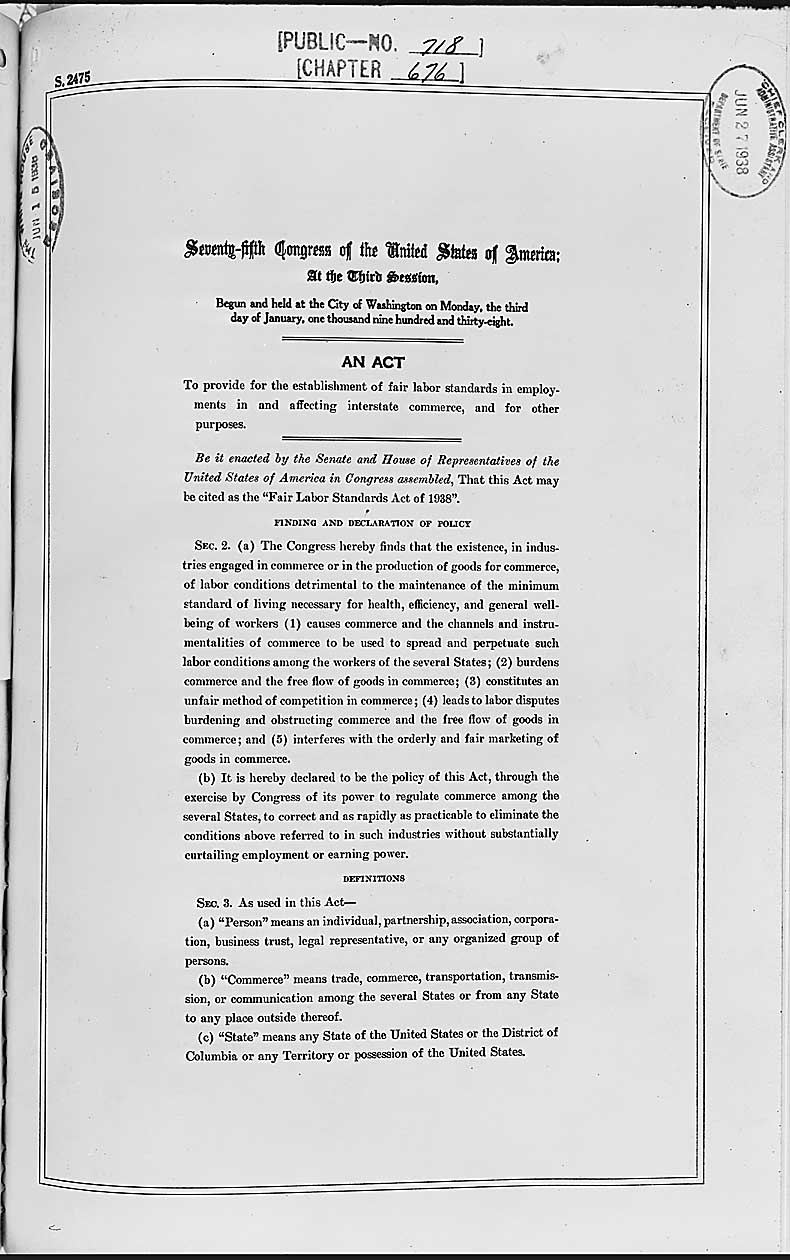
The final bill emerged after prolonged debates and congressional maneuvering. Roosevelt signed it on June 25, 1938, calling it an important advance for workers. The original statute, reproduced in this article’s featured image, is a primary source for its provisions and timing. Its language is more precise than modern slogans about an eight-hour day or a universal forty-hour workweek, because the original schedule used different thresholds and excluded some employment.
What the first 25-cent minimum wage covered
The FLSA initially required covered employees to be paid at least 25 cents per hour. This applied within the statute’s coverage rules, principally involving employees engaged in interstate commerce or the production of goods for such commerce. The law did not immediately require every employer in every occupation to pay the federal minimum, and categories of workers were exempted under its original terms. State laws sometimes applied separate or stronger protections.
The 25-cent figure is a historical nominal wage, not an amount that should be compared directly with present-day purchasing power without adjusting for inflation and living costs. Workers in different communities faced different expenses. The rate also changed under the statutory schedule: 30 cents followed in 1939, with 40 cents established on the schedule for later years. A historically accurate article must state that the rate did not remain fixed at 25 cents for the entire New Deal.
Why the first standard workweek was 44 hours
The original act required overtime compensation for covered hours beyond 44 per week during its initial phase. The threshold decreased to 42 hours in 1939 and 40 hours in 1940 under the scheduled transition. Workers covered by the overtime provisions were generally entitled to at least one-and-one-half times their regular rate for hours over the applicable threshold. This arrangement made additional hours more expensive without directly banning every longer workweek.
Many summaries say the FLSA created an immediate nationwide forty-hour maximum in June 1938. That is misleading on two counts: the original effective threshold was 44 hours, and the statute’s overtime system usually permitted additional hours if the appropriate premium was paid. The law established a standard for compensation, not a universal prohibition on employing an adult for more than forty hours under all circumstances.
How the law restricted oppressive child labor
The FLSA prohibited certain forms of oppressive child labor connected to interstate commerce and the production of goods for it. The rules generally restricted nonagricultural employment of children under sixteen and hazardous work for those under eighteen, with statutory exceptions and details. This built on earlier labor-reform efforts that had been limited by judicial decisions. The Department of Labor’s history traces the difficult path from nineteenth-century campaigns to the 1938 legislation.
These protections were not identical in every industry. Agriculture and particular types of family or permitted work followed different rules, and many exceptions developed through legislation and regulation. Nor did the law instantly eliminate illegal child labor. Enforcement depended on investigations, employer compliance and the government’s resources. It nevertheless created a more durable federal framework than earlier statutes invalidated by the courts.
Who was outside the original protections?
The statute’s scope and exemptions were major limitations. Agricultural workers, domestic employees and some other groups were not given the same coverage as workers in the industrial and commercial activities addressed by the original law. These exclusions mattered especially because Black workers, women and low-income families were concentrated in occupations with limited legal protection. A federal rule described as a national labor standard could therefore benefit people very unevenly.
Coverage expanded through later statutory amendments, judicial interpretations and administrative rules, but it remained complex. The existence of a federal minimum did not automatically end discriminatory wage systems or unequal bargaining power. A careful history needs to describe both the new protections and the practical boundaries that determined who could claim them. These exclusions should not be hidden behind a simplified claim that all workers received the same rights in 1938.
How the Labor Department enforced the statute
The law created a federal system to investigate compliance and administer wage, hour and child-labor requirements. Employers covered by the provisions could be required to keep employment records and make pay adjustments. Officials had to interpret coverage, exemptions and what counted as compensable working time. Investigations and litigation helped develop the meaning of the statute as workplaces and business practices changed.
Legal duties do not enforce themselves. Workers could fear losing employment if they complained, and inspectors faced limited resources. The government therefore needed clear rules, investigations and judicial remedies. Subsequent decisions shaped the act’s application, including how work and overtime were measured. The FLSA became a continuing institution of labor law rather than a single announcement that settled every dispute at the moment Roosevelt signed it.
United States v. Darby and the 1941 Supreme Court ruling
In United States v. Darby in 1941, the Supreme Court upheld the FLSA’s core wage-and-hour provisions as within Congress’s power over interstate commerce. The ruling rejected the earlier narrow approach associated with the 1918 child-labor decision and affirmed substantial federal authority over labor conditions affecting commerce. That constitutional result strengthened the statute’s long-term foundation.
The decision came three years after enactment. It would be inaccurate to claim that the Supreme Court had approved the final FLSA text before the president signed it in 1938. Legislative passage, implementation and subsequent constitutional review were distinct stages. The changing Supreme Court jurisprudence also connects this law to the 1937 court-packing controversy, although the expansion proposal itself failed.
The difference between the FLSA and the Wagner Act
The Wagner Act of 1935 protected the right of certain employees to organize and bargain collectively and established the National Labor Relations Board. The Fair Labor Standards Act of 1938 addressed minimum wages, overtime and child labor through a different statutory framework. A worker’s right to organize a union and a worker’s entitlement to a specified minimum wage are related issues but not the same legal entitlement.
The distinction matters in historical discussion and in interpreting old labor records. A workplace could be covered by one statute’s provisions but subject to different exclusions or enforcement procedures under the other. The FLSA did not require every employee to join a union, and the NLRA did not itself impose the original 25-cent minimum wage. Together they demonstrate the New Deal’s multi-part approach to labor relations and standards.
Why the 1938 law became a lasting reform
The FLSA created a durable basis for federal wage, hour and child-labor rules. Although Congress repeatedly amended it and raised the minimum wage, the original framework remains an important part of how the United States regulates covered employment. Its provisions shaped compensation practices, encouraged recordkeeping and made exploitative working conditions a subject of federal enforcement. State laws sometimes supplied additional protections.
Its historical limitations should remain visible. The statute did not guarantee universal coverage or eliminate all poverty, and its effects differed by sector. The best account recognizes both the accomplishment of a minimum legal standard and the exclusions that influenced who benefited. The long struggle from earlier child-labor reform to 1938 and the Supreme Court ruling of 1941 makes the act an important milestone in American labor history.
What later amendments changed
Congress expanded coverage and changed minimum-wage levels in later decades, often reflecting debates over inflation, employer costs and the standard of living. Modern FLSA regulations and exemptions should not simply be projected backward into the 1938 law. The initial wage, the 44-hour threshold and early child-labor rules are facts of their own time, while the present-day statute contains many subsequent revisions.
Historical research is more precise when it identifies which version of the law applied to a worker at a given date. For the original New Deal legislation, the key milestones are June 25, 1938 for signing, October 24 for the initial effective provisions, and the scheduled changes during 1939 and 1940. The New Deal overview shows how this workplace reform fit into the administration’s wider program.
Timeline
- 1916: Keating–Owen federal child labor law enacted
- 1918: Supreme Court strikes down Keating–Owen
- 1937: West Coast Hotel v. Parrish upholds state minimum-wage law
- June 25, 1938: Roosevelt signs Fair Labor Standards Act
- October 24, 1938: Initial provisions take effect; 25 cents and 44 hours
- 1939: Scheduled changes to wage and hour provisions
- 1940: Forty-hour standard workweek takes effect
- 1941: Supreme Court upholds FLSA in United States v. Darby
Frequently asked questions
When was the Fair Labor Standards Act passed?
June 25, 1938.
When did it take effect?
The principal initial provisions took effect October 24, 1938.
What was the original federal minimum wage?
25 cents per hour for covered employees.
Was the original workweek forty hours?
No. The overtime threshold began at 44 hours, then dropped to 42 and to 40 by 1940.
What did the FLSA do about child labor?
It restricted oppressive child labor in covered activities, with rules concerning age, hazardous work and exemptions.
Did it protect every employee?
No. Coverage and exemptions left major groups outside the original protections.
Is it the same as the Wagner Act?
No. The 1935 Wagner Act addresses collective bargaining; the 1938 FLSA addresses pay standards, hours and child labor.