Keating–Owen Child Labor Act (1916): Rules, Hammer v. Dagenhart and Repeal
The first major federal child-labor restrictions, the rules they attempted to enforce and why the Supreme Court invalidated them.
Quick answer
The Keating–Owen Child Labor Act was signed by President Woodrow Wilson on September 1, 1916. It prohibited interstate shipment of goods made under specified child-labor conditions, including factory work by children under 14 and mine work by those under 16. It took effect in September 1917 but the Supreme Court struck it down in Hammer v. Dagenhart on June 3, 1918. Broader durable federal rules came with the Fair Labor Standards Act of 1938.
Key facts
On this page
- The conditions that pushed child labor into national politics
- Why Congress approached the problem through interstate commerce
- The act signed on September 1, 1916
- The age limits and the types of workplace covered
- The rules governing older children and hours
- The role of the Children’s Bureau in enforcement
- The legal challenge in Hammer v. Dagenhart
- Why the ruling did not end the reform movement
- The Fair Labor Standards Act of 1938
- The human stories behind the legal language
- What the Keating–Owen Act ultimately represents
- Timeline
- FAQ
- Sources
The conditions that pushed child labor into national politics
At the beginning of the twentieth century many American children worked in textile mills, mines, factories, fields and family businesses. Their circumstances varied considerably: some had limited family duties while others worked long days around dangerous machinery or in environments that interrupted education. Reformers highlighted particularly hazardous industrial work because injury, fatigue and lost schooling could carry consequences well beyond childhood. A national solution was difficult, however, because states enacted different restrictions and employers selling across state lines did not all operate under the same rules.,Organizations such as the National Child Labor Committee investigated workplaces and campaigned for stronger protections. Photographer Lewis Hine recorded children working in mills and mines, producing images that became important evidence in reform publicity. These photographs are historical sources, not proof that every child experienced identical conditions. They helped show what particular young workers faced, while reports and testimony gave the campaign broader factual context. Congress eventually considered whether federal authority over interstate commerce could be used to address the problem.
Why Congress approached the problem through interstate commerce
The federal Constitution distributes authority between the national government and the states. In 1916 Congress did not assume that it could simply legislate every aspect of working conditions anywhere in the country. Its commerce power offered one possible route: prohibit goods produced under specified child-labor conditions from being shipped between states or into foreign commerce. The distinction mattered legally because the act did not purport to make every instance of child employment a federal crime at the moment it occurred.,This approach linked working conditions to the movement of products in trade. A factory might operate locally, but if it shipped its goods across state boundaries the law could affect those shipments. Supporters argued that the national market should not circulate goods made under defined harmful conditions. Critics questioned whether Congress was regulating commerce or indirectly controlling manufacturing and labor arrangements reserved for states. That argument eventually became central to the Supreme Court case that invalidated the law.
The act signed on September 1, 1916
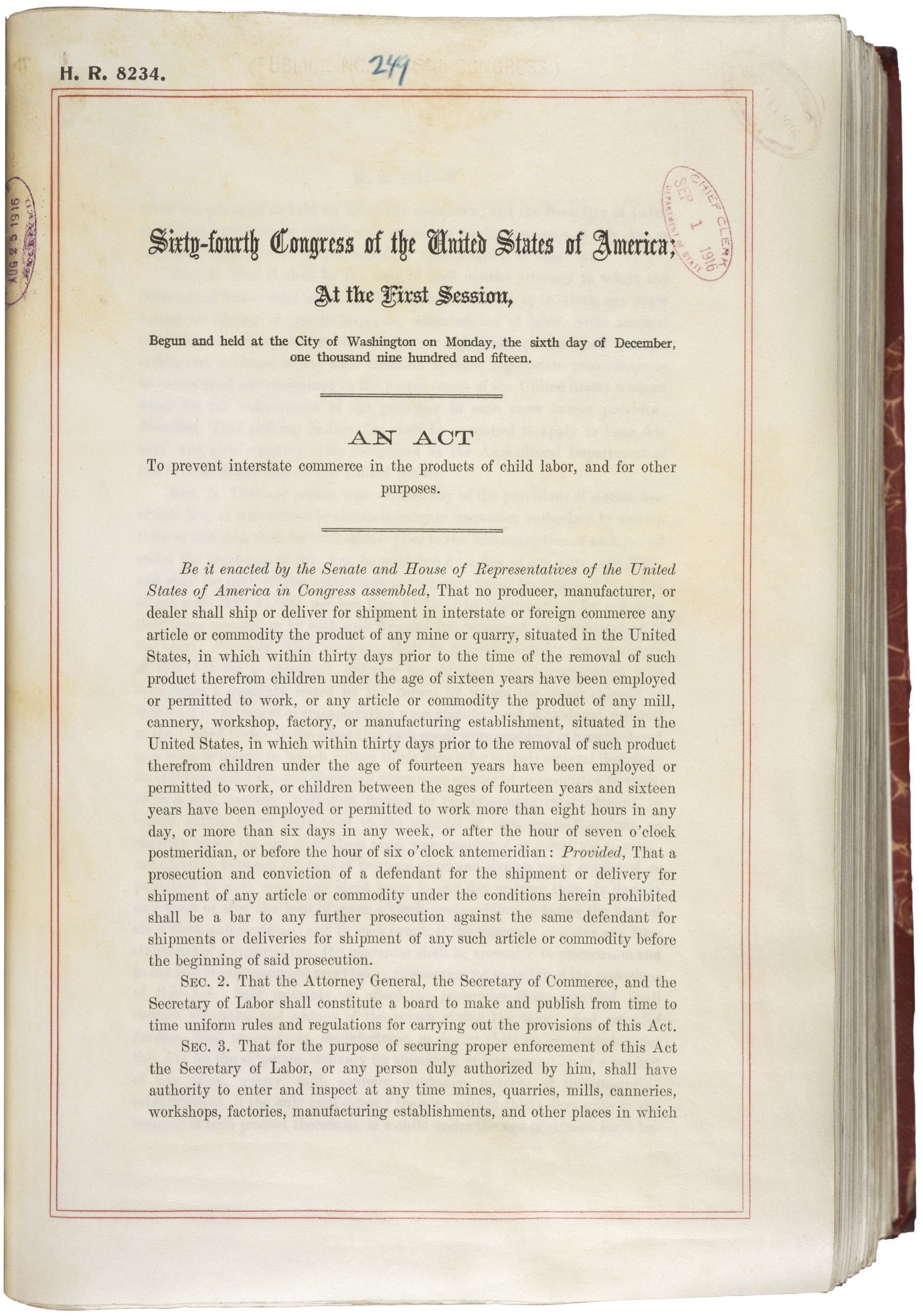
The measure is usually called the Keating–Owen Act after Representative Edward Keating of Colorado and Senator Robert L. Owen of Oklahoma. President Woodrow Wilson signed it on September 1, 1916. Its original legal text appears at 39 Stat. 675 and is preserved by the National Archives. Reading that document is useful because broad descriptions such as ‘Congress banned child labor’ can obscure what the statute actually prohibited. It specified ages, hours and classes of workplaces in connection with interstate shipment.,The law also established enforcement procedures involving federal investigation and administrative rules. It allowed an interval before taking effect, giving employers and officials time to prepare. The effective date was September 1, 1917, a year after signature. Consequently, a historical timeline should not describe the rules as fully operational from the signing day in 1916. The one-year difference is particularly important when assessing how long the measure actually operated before its invalidation in 1918.
The age limits and the types of workplace covered
The act targeted goods produced in mines and quarries where children under 16 had been employed during the relevant period. For mills, canneries, workshops, factories and manufacturing establishments it addressed the work of children younger than 14. It also covered work by children aged 14 to 16 that exceeded the stated limits on hours or occurred during prohibited nighttime hours. The statutory provisions were specific, and readers should not substitute a single minimum employment age for every kind of workplace.,The prohibition concerned shipment of goods associated with these conditions, using a look-back period of 30 days before removal of the products. It was therefore a trade restriction with employment rules embedded in its criteria. It did not abolish all agricultural work, household tasks, street trades or every possible kind of youthful employment throughout the United States. Recognizing the legal boundaries of the act avoids the false conclusion that, because it passed, no child could lawfully work anywhere in the country.
The rules governing older children and hours
For children aged 14 to 16 in covered manufacturing settings, the law set limits of no more than eight hours in a day, no more than six days in a week and no employment during the period from 7 p.m. to 6 a.m. under the relevant prohibition. Younger children in specified covered establishments and children under 16 in mines and quarries were subject to different age restrictions. These details mattered because the law sought to address both very young workers and excessive schedules.,Such rules should be read in the social context of the time. Factories might need workers for particular shifts, while families sometimes depended on children’s earnings. Reformers emphasized health and schooling; opponents and some employers argued about family income, business practices and constitutional authority. A careful historical account does not assume that passing one federal law immediately resolved the poverty and educational barriers that contributed to child labor. Effective protection required enforcement and wider social changes.
The role of the Children’s Bureau in enforcement
The U.S. Children’s Bureau, founded in 1912, became closely associated with the administration of the first federal child-labor law. Its officials could draw on research about working children and were tasked with implementing aspects of enforcement after the act took effect. Inspection, record collection and the interpretation of legal definitions were essential because a prohibition on shipping certain goods could not function merely through public announcements.,Federal officials had to identify employers, determine ages and hours of work, investigate compliance and deal with resistance. In some cases birth records were incomplete, complicating proof of age. These practical questions help explain why law reform involved administrative capacity as well as constitutional debate. The Bureau’s own later reports described the limited period during which it administered the act. Researchers can consult those records rather than assuming that the statute was uniformly enforced in every workplace.
The legal challenge in Hammer v. Dagenhart
The 1918 Supreme Court case arose from a North Carolina cotton-mill dispute involving a father who challenged the federal measure in relation to his sons’ work. The central issue was whether Congress’s power to regulate interstate commerce extended to prohibiting the transportation of ordinary goods because of the child-labor conditions under which they had been produced. The government defended the statute as a valid regulation of goods moving between states. Opponents argued that it reached too far into manufacturing and employment within individual states.,On June 3, 1918, the Supreme Court ruled against the law by a five-to-four vote. The majority drew a constitutional distinction between regulating interstate trade and regulating local production conditions. The dissent took a broader view of Congress’s ability to restrict commerce in products linked to labor practices that lawmakers sought to discourage. The dispute was about the scope of federal authority under the Constitution, not a judicial finding that the working conditions described by reformers did not exist.
Why the ruling did not end the reform movement
The invalidation of the Keating–Owen Act was a major setback for advocates of national child-labor restrictions, but it did not eliminate state laws, local organizing or the public discussion of children’s work. Reformers looked for alternative legislative and constitutional approaches. Congress also explored a tax-based method, which encountered its own Supreme Court challenge. Calls for a constitutional amendment specifically addressing child labor became part of the continuing campaign during the 1920s.,The complexity of that history matters because it resists a misleading success-or-failure narrative. The 1916 act did not remain a lasting legal protection, but its enactment showed that a national political coalition had developed around the issue. Its defeat illustrated how interpretations of federalism could shape reforms even when supporters had assembled persuasive social evidence. Later lawmakers and judges faced the same underlying questions about working conditions, interstate markets and the responsibilities of government.
The Fair Labor Standards Act of 1938
Permanent federal regulation of many forms of child labor developed under the Fair Labor Standards Act of 1938. That legislation also addressed minimum wages and overtime, building a broader federal labor framework during the New Deal. The legal circumstances and Supreme Court interpretations differed from those of the 1916 law. It would therefore be inaccurate to suggest that Keating–Owen remained in force until 1938 or that its provisions simply continued under a different name.,The 1938 statute had its own definitions, exemptions and later amendments. It did not create identical rules for every form of work. The history of 1916 and 1938 is best understood as a progression through different legislative approaches, legal disputes and administrative developments. The earlier law provided a prominent attempt and a constitutional turning point; the later framework gave federal regulation greater durability. The U.S. Bureau of Labor Statistics reviews these changes in its history of labor-law reform.
The human stories behind the legal language
The most important evidence about child labor is not limited to bills and court opinions. Factory investigations, family accounts, photographs and local reports reveal the daily experiences behind debates over interstate commerce. Working children could face repetitive duties, exposure to machinery, long schedules and reduced opportunities for schooling. Their family’s reliance on income could make the issue morally and economically complicated. Describing those circumstances accurately calls for attention to place, occupation, household resources and the child’s own experience.,Photographs used by reform groups were powerful but were selected to draw public attention to dangerous or troubling conditions. They should be credited correctly and not described as showing a scene that was never photographed. Legal sources answer a different set of questions: what Congress authorized, what officials attempted to enforce and how judges interpreted those powers. Using both types of evidence produces a fuller history than a purely emotional or purely legal account.
What the Keating–Owen Act ultimately represents
The act stands at the intersection of child welfare, industrial change and the division of authority in the federal system. The legislative goal was to restrict trade in goods associated with clearly specified forms of child labor, but the constitutional strategy did not survive Supreme Court review. Its relatively short effective life is central to the story. Histories that mention the act’s passage without the 1918 decision wrongly suggest that its protections continued uninterrupted.,The period also links several distinct reform efforts. The Children’s Bureau gathered information, child-labor advocates built public pressure, Congress enacted the 1916 measure and the Supreme Court set limits that reformers later sought to overcome. The Triangle Shirtwaist Factory Fire illustrates parallel pressures for safer workplaces, though it was not the same event or legislation. Studying these cases together makes the varied methods and limits of Progressive Era labor reform easier to understand.
Timeline
- 1912: Children’s Bureau established
- September 1, 1916: Wilson signs Keating–Owen Act
- September 1, 1917: The law takes effect
- June 3, 1918: Supreme Court strikes down the act
- 1924: Congress proposes a child-labor constitutional amendment
- 1938: Fair Labor Standards Act enacted
Frequently asked questions
When was the Keating–Owen Act signed?
President Woodrow Wilson signed it on September 1, 1916.
When did the law take effect?
September 1, 1917, one year after passage.
Did it prohibit all child labor?
No. It restricted interstate shipments of goods produced under specified conditions in covered workplaces.
What were the factory age rules?
They targeted work by children younger than 14 and excessive or nighttime work by children aged 14 to 16.
Why was the act overturned?
In Hammer v. Dagenhart (1918), the Supreme Court majority held that Congress had exceeded its commerce power by regulating local production conditions through a shipment ban.
When were durable national protections adopted?
The Fair Labor Standards Act of 1938 provided a later, more durable federal framework for many kinds of child labor.
Sources and further reading
Primary documents and specialist historical sources support the dates and legal distinctions in this article.