1939 New York World’s Fair: World of Tomorrow, Trylon and Perisphere
How the 1939–40 exposition turned a former Queens ash dump into a vision of tomorrow through Futurama, television and modern architecture.
Quick answer
The New York World’s Fair opened April 30, 1939, at Flushing Meadows in Queens, on the 150th anniversary of George Washington’s first presidential inauguration. Organized around ‘Building the World of Tomorrow,’ the exposition featured the Trylon and Perisphere, General Motors’ Futurama, new consumer technology and international pavilions. It operated for two seasons, in 1939 and 1940, drawing approximately 44.9 million visits altogether. The fair celebrated technological optimism even as World War II began in Europe during its first season.
Key facts
On this page
- Why New York planned a fair during the Great Depression
- From Flushing Meadows ash dump to exhibition ground
- Opening day: April 30, 1939
- The Trylon and Perisphere
- Democracity and the city of tomorrow
- General Motors’ Futurama
- Television and the RCA demonstrations
- Consumer technologies, design and household life
- International pavilions and world politics
- Visitors, crowds and the economics of the fair
- The second season in 1940
- What survives and why the fair remains influential
- Timeline
- FAQs
- Sources
Why New York planned a fair during the Great Depression
In the 1930s New York City faced economic hardship even while planners and business leaders envisioned a modern urban future. A world’s fair could generate construction jobs, attract visitors and promote industrial innovation. Its organizers believed an exposition focused on tomorrow would give people reasons for confidence after years of unemployment and financial instability. They also hoped to strengthen New York’s international reputation as a center of trade, culture and modern design.
The project was not simply a government welfare program. A corporation organized the exposition, and manufacturers, foreign participants and public authorities took part for different reasons. Some expected commercial publicity; others wanted to present scientific or national achievements. The fair’s ambitions therefore mixed public spectacle, business promotion and urban redevelopment. Its success cannot be evaluated solely by whether every invention on display became common within a few years.
From Flushing Meadows ash dump to exhibition ground
The fair occupied a large area of Flushing Meadows in Queens, previously known in part for ash dumps and degraded land. Redevelopment required extensive grading, drainage, road construction, landscape work and new buildings. The location was connected to the larger planning ambitions of Robert Moses, who saw a future public park as one possible legacy of the project. The enormous effort changed the physical geography of the neighborhood.
Construction itself revealed contrasts between the idealized future and the difficult conditions of the present. Workers built spectacular pavilions while many Americans were still struggling to recover from the Depression. The enormous facilities also required water, electricity, transport services and planning for millions of visitors. Later historians study the fair as an episode in New York City infrastructure and land-use history, not merely a collection of temporary exhibits.
Opening day: April 30, 1939
The fair opened on April 30, 1939, exactly 150 years after George Washington’s first inauguration in New York City. President Franklin D. Roosevelt delivered an opening address, and the event attracted national attention. The anniversary linked a celebration of future technology to the history of the United States’ constitutional government. Visitors encountered architecture, art, transportation exhibits, model homes and entertainment across the vast grounds.
The opening did not make every exhibition complete or guarantee that the fair would meet its financial goals. Organizers continued managing attendance, publicity and costs throughout the season. Yet the date became an important cultural milestone because of the scale of the spectacle and the international participation. The contrast between a historic presidential anniversary and the futuristic theme was deliberate: organizers used the past to frame the country’s imagined future.
The Trylon and Perisphere
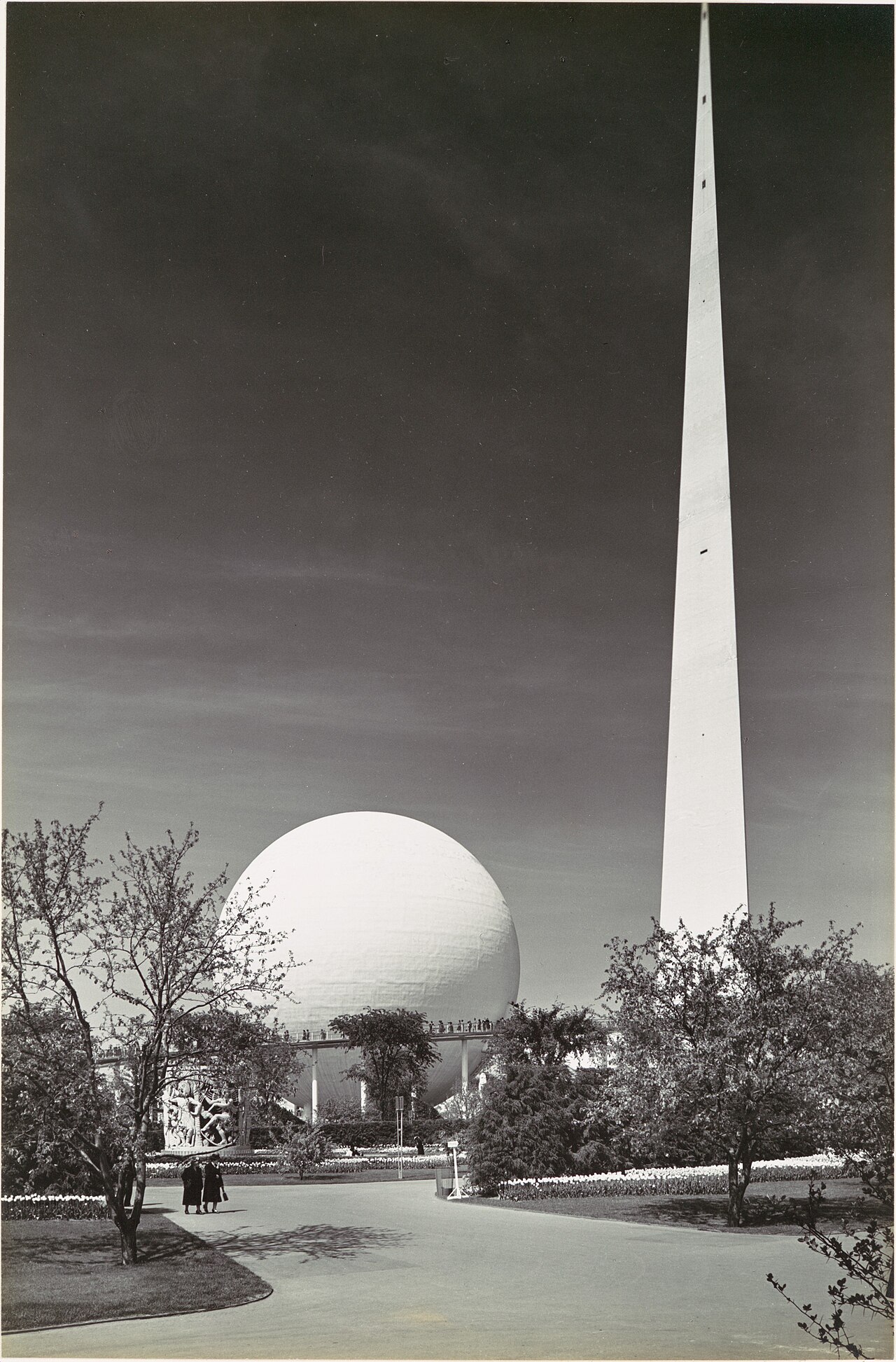
The exposition’s most recognizable structures were the slender triangular Trylon and the enormous spherical Perisphere. They formed the Theme Center and were intended to symbolize progress through clean, modern geometry. The Trylon reached about 700 feet, and the Perisphere was about 200 feet across. Their extraordinary size and form made them central to posters, photographs and visitors’ memories. The architectural ensemble became synonymous with the 1939 fair.
The photograph accompanying this article shows the two structures, taken by Samuel H. Gottscho and preserved by the Metropolitan Museum of Art. It is licensed CC0 and specifically identified with the World’s Fair. The photograph documents architectural design rather than claiming that the globe contained a genuine future city outside an exhibition. The fair used symbols and models to communicate hope, and those images remain among its most lasting historical records.
Democracity and the city of tomorrow
Inside the Perisphere, visitors encountered the Democracity model, a vision of future urban development. Designers imagined communities organized around planned transportation, green spaces and defined patterns of residence and work. The presentation offered a carefully composed ideal rather than a prediction guaranteed to occur. It reflected contemporary debates about urban planning, congestion and the relationship between modern industry and everyday life.
The model’s appeal rested partly on its contrast with crowded streets and aging urban infrastructure. Yet idealized planning concepts raise questions about who controls development and which communities fit the design. Not every visitor would share the same idea of a desirable future. Historians therefore treat Democracity as evidence of 1930s ambitions and assumptions rather than a literal blueprint implemented after the fair closed.
General Motors’ Futurama
One of the fair’s best-known attractions was General Motors’ Futurama, designed by Norman Bel Geddes. It presented a large-scale model of the United States imagined decades ahead, with a network of high-speed roads and carefully planned urban and rural landscapes. Visitors moved through a staged viewing experience designed to make the miniature future appear vivid and convincing. Futurama demonstrated how industrial companies used entertainment and spectacle to sell ideas about transportation.
Some later highways resembled aspects of the exhibit’s ideas, but the fair did not invent automobiles or directly authorize the Interstate Highway System. Future national road policy was shaped by many engineers, legislators and planners over decades. The attraction is significant because it reveals the strong association between mobility and progress in American consumer culture. It also leaves open the environmental and community costs of car-centered development, which were not central to the sales pitch.
Television and the RCA demonstrations
Television was a major subject of public curiosity at the fair. RCA demonstrated broadcasting technology, and Roosevelt’s opening address became associated with a prominent televised public appearance. Visitors could see the promise of moving images transmitted electronically, a novelty for many Americans. The demonstrations helped manufacturers present television as a future household product and reinforced the exposition’s focus on scientific innovation.
It would be incorrect to say that the fair brought nationwide household television service to America overnight. Equipment remained expensive, broadcasting infrastructure limited and ownership uncommon. World War II subsequently interrupted much civilian consumer manufacturing. Television became widespread mainly in the postwar period. Its presence in 1939 is best understood as a persuasive demonstration of a technology on the path to broader adoption, not the completion of that process.
Consumer technologies, design and household life
Manufacturers filled exhibition spaces with visions of modern homes, appliances, materials and efficient workplaces. Visitors encountered demonstrations of refrigeration, household electrical devices, industrial production and new materials. Companies used architectural design and theatrical presentations to make products appear essential to an improved future. The fair thus revealed how consumer advertising and education could merge in an environment that encouraged wonder.
The emphasis on homes and labor-saving technology connected with the broader electrification of the countryside during the 1930s. The Rural Electrification Administration had begun financing systems for farm communities only a few years before the fair opened. For many families the future showcased in Queens remained financially or geographically distant. The contrast illustrates the gap between a public demonstration and access to technology in ordinary homes.
International pavilions and world politics
The exposition included displays from foreign countries, giving visitors opportunities to encounter national cultures, products and government messages. International participation formed a central part of the fair’s ambition to present cooperation and technological progress. Yet 1939 was a period of worsening international tension. Germany invaded Poland in September, and Britain and France declared war, beginning World War II in Europe while the fair was still operating.
The war changed the meaning of optimism at the exposition. National pavilions could become symbols of countries already under attack or occupation, and international participation became more difficult in the second season. The fair’s promise of a peaceful technological future existed alongside a radically different political reality. This contradiction became one of the most poignant aspects of its historical legacy.
Visitors, crowds and the economics of the fair
The exposition attracted approximately 44.9 million visits across its two seasons, according to New York City’s archival history. That is an attendance total, not a count of unique individuals; some visitors attended more than once. The event was hugely popular as a cultural spectacle, but the enormous cost of constructing and operating the site created financial problems. Large crowds alone did not ensure the fair’s organizers achieved their expected economic results.
Ticket prices, transportation and travel expenses also shaped who could attend. A New York resident might visit more easily than a family living far away during the Depression. Contemporary photographs and promotional materials show enthusiastic crowds, but the experience was not equally accessible to everyone. The fair’s economic story is a reminder that public attention and profitability are different measures of success.
The second season in 1940
The fair reopened in 1940 with changes to attractions and presentation. The worsening war in Europe affected public expectations and foreign displays, while organizers sought new visitors and improved finances. Its second season ended in late October 1940, bringing the vast temporary exposition to a close. Many buildings were dismantled or repurposed, and the site continued its transformation into a public landscape.
The fair should not be confused with the separate New York World’s Fair held at Flushing Meadows in 1964–65. Although the later exposition reused the location, it had different organizers, structures, technology and political context. The Trylon and Perisphere were symbols of 1939–40, whereas the later fair is more closely associated with the Unisphere. Distinguishing those events helps visitors interpret archival photographs and memorabilia correctly.
What survives and why the fair remains influential
The Trylon and Perisphere themselves did not remain standing, but photographs, architectural drawings, promotional films and artifacts preserve their designs. The fair’s site became part of Flushing Meadows–Corona Park, which continued evolving in the following decades. New York’s public archives and the New York Public Library hold extensive collections documenting exhibitors, contractors, exhibits and the city’s transformation.
The fair’s enduring importance is cultural as well as architectural. It captured a particular moment when Americans sought confidence in technology, planned cities and consumer invention while the world approached war. The exhibits were not forecasts that all came true, yet they reveal how people in the late 1930s imagined progress. Comparing it with the 1893 Chicago World’s Fair shows how two generations expressed their expectations through international expositions.
Timeline
- 1935–1938: Planning and construction at Flushing Meadows
- April 30, 1939: Fair opens on Washington inauguration anniversary
- 1939: Trylon, Perisphere, Futurama and television demonstrations attract crowds
- September 1939: War begins in Europe during fair season
- 1940: Second season operates amid wartime change
- Late October 1940: Fair closes after approximately 44.9 million visits
- Post-1940: Grounds repurposed and later become park and site of another fair
Frequently asked questions
When did the 1939 New York World’s Fair open?
April 30, 1939.
Where was it?
Flushing Meadows in Queens, New York City.
What was its theme?
Building the World of Tomorrow.
What were the Trylon and Perisphere?
The signature triangular tower and giant sphere at the fair’s Theme Center.
What was Futurama?
A General Motors exhibit envisioning future roads and American communities.
Did the fair introduce widespread household television?
No. RCA demonstrated television, but widespread domestic adoption came later.
How many people attended?
Approximately 44.9 million visits across 1939 and 1940, not necessarily unique people.
Was it the same as the 1964 New York fair?
No. A later fair used the same general site with different structures and exhibits.