Battle of Tarawa (November 1943): Betio, Coral Reef and Marine Casualties
Why the November 20–23, 1943 assault on Betio became so deadly, how low tides stopped landing boats, and what U.S. forces learned about amphibious warfare.
Quick answer
The Battle of Tarawa took place November 20–23, 1943, during Operation Galvanic in the Gilbert Islands. U.S. Marines attacked Betio, a small island within Tarawa Atoll defended by a heavily fortified Japanese garrison. A shallow reef and unexpectedly low water prevented many landing craft from reaching the beach, forcing Marines to wade under intense fire. Approximately 1,000 Marines were killed, with additional Navy casualties, and most Japanese defenders died. The U.S. victory helped secure the central Pacific advance but revealed serious problems in amphibious planning and casualty recovery.
Key facts
On this page
- Why Tarawa mattered to the central Pacific campaign
- Japanese preparations on Betio
- The American invasion force and planning
- November 20: bombardment and the first landing waves
- The coral reef and unusually low water
- Establishing the beachhead
- The struggle on November 21 and 22
- The final Japanese counterattack and November 23
- American casualties and the shock of the public response
- Japanese losses and questions of surrender
- How Tarawa changed amphibious doctrine
- Missing Marines and continued recovery efforts
- Why Tarawa remains an important military history case
- Timeline
- FAQs
- Sources
Why Tarawa mattered to the central Pacific campaign
After holding Guadalcanal and winning naval victories in 1942 and early 1943, the United States planned a series of operations across islands controlled by Japan. The Gilbert Islands lay along approaches to the Marshall Islands, and their airfields could support reconnaissance and further Allied advances. American commanders sought to capture Tarawa and nearby objectives as part of Operation Galvanic, gradually extending air and naval power westward.
Betio Island was especially important because Japanese forces had developed an airfield and extensive defenses there. The island was small, but its position within a shallow lagoon created difficult terrain for an amphibious assault. Capturing the airstrip could support future operations; failing to seize it might delay the larger offensive. The battle is therefore best understood as one stage in a methodical advance rather than an isolated attempt to occupy a remote beach.
Japanese preparations on Betio
The Japanese garrison fortified Betio with coastal guns, machine-gun positions, trenches, bunkers and obstacles. Defenders expected an amphibious assault and designed many positions to survive preliminary bombardment. Rear Admiral Keiji Shibasaki commanded the defense during the early battle and had confidence that the island would be costly to capture. His force included Japanese naval troops and labor units with different assignments.
The compact island provided little room for a landing force to escape enemy observation or move around strongpoints. Defensive positions were reinforced with logs, concrete and earth, requiring more than occasional shellfire to neutralize. Japanese preparations did not make the island impregnable, but they greatly increased the danger facing landing craft and troops concentrated near the shoreline.
The American invasion force and planning
The U.S. 2nd Marine Division was assigned the central assault on Betio, supported by Navy warships, aircraft and amphibious vessels. Marine commanders developed landing plans involving designated beaches on the lagoon side of the island. Naval gunfire and aerial bombardment were expected to weaken Japanese defenses before the infantry came ashore. Amphibious tractors, commonly called amtracs or LVTs, were vital because they could cross obstacles that ordinary boats could not.
Planning depended on assumptions about the tide, the depth of water over the reef and the capacity of landing craft. Some warnings suggested the reef could prove difficult or impossible for boats to cross at low water, but predictions and expectations remained contested. The assault would expose how dangerous a small error in assessing local geography could become when thousands of men had to reach narrow beaches under enemy fire.
November 20: bombardment and the first landing waves
American ships bombarded Betio early on November 20, followed by the first waves of Marines. From a distance the bombardment appeared intense, leading some participants to expect that defenses had been destroyed. In reality, many Japanese emplacements remained capable of firing. As landing craft approached, defenders opened heavy fire with machine guns, artillery and other weapons.
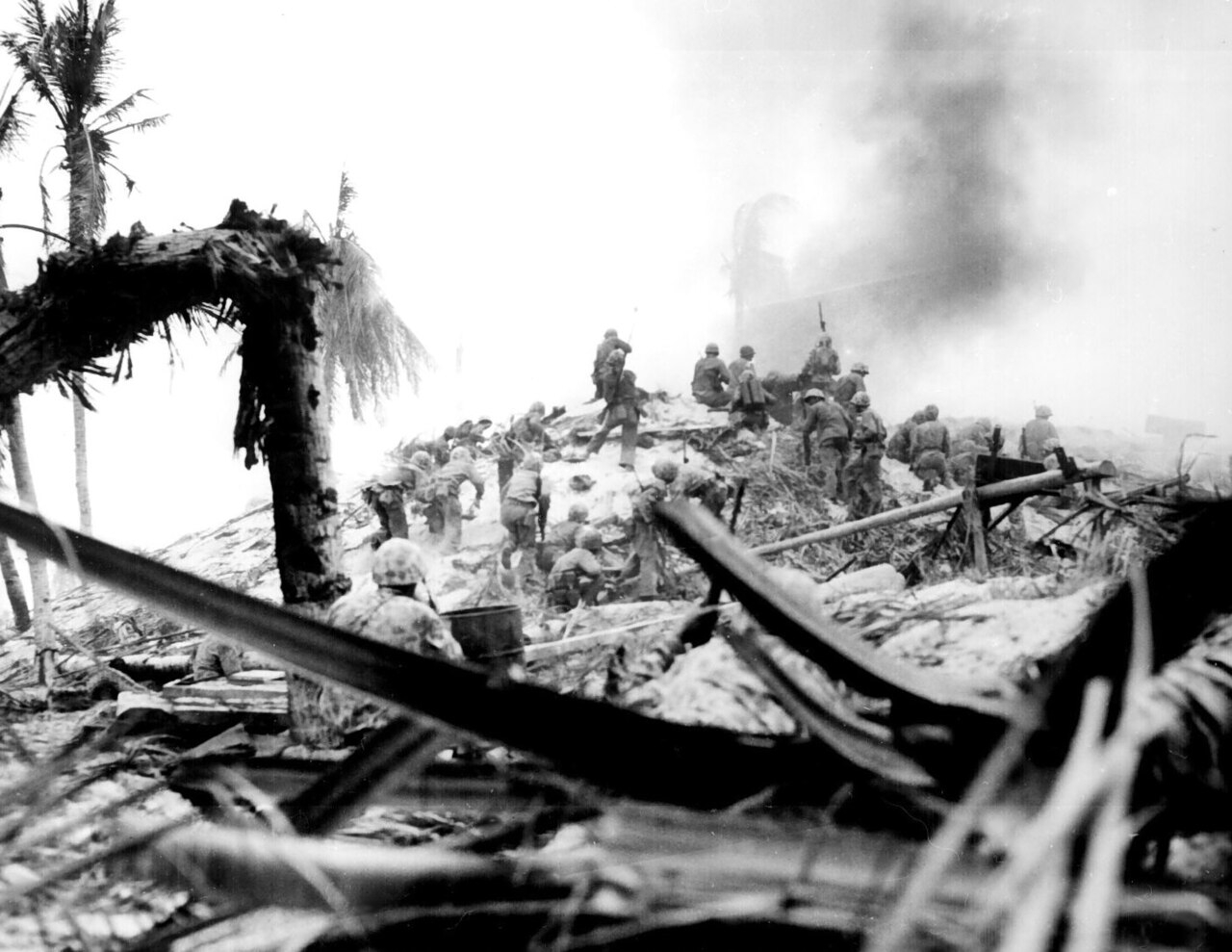
The first waves faced severe losses, particularly where men had to leave their vehicles far from shore. The featured historical photograph records Marines under the conditions of the Tarawa operation. Its value is documentary, but one image cannot show every beach or wave. The assault developed differently by sector, and the actions of individual Marines and Navy crews determined whether small footholds could survive.
The coral reef and unusually low water
A coral reef surrounded much of the island and created the battle’s most famous obstacle. Many ordinary landing boats could not clear the reef during low water, leaving them stranded offshore. Marines were forced to disembark and wade hundreds of yards through water that sometimes reached their chests, carrying equipment while exposed to Japanese defensive fire. Some amphibious tractors managed to cross the reef but suffered heavy damage.
Descriptions of the tide vary because local conditions and timing differed, yet official accounts agree that water depth caused a major crisis. The reef problem was not a minor inconvenience; it disrupted planned waves, separated troops from their support and increased casualties before men reached the beach. The experience prompted serious reassessment of landing-craft requirements and tidal reconnaissance in future amphibious operations.
Establishing the beachhead
Marines who reached Betio struggled to organize under intense fire. Men found cover behind seawalls, damaged vehicles and improvised positions while officers attempted to regroup scattered units. Communications failed in some areas and units became intermingled, complicating the coordination of artillery and reinforcements. Small groups advanced inland while others remained pinned down near the shoreline.
The defenders resisted fiercely, and Japanese positions could continue firing after nearby structures appeared destroyed. Marines used infantry weapons, explosives and close assault to clear bunkers and trenches. These actions were costly and exhausting, often conducted at very short range. Although American forces gained ground during the first day, victory was by no means assured from the initial beachhead.
The struggle on November 21 and 22
American troops gradually expanded their positions and established firmer control of key parts of Betio over the next two days. Additional reinforcements, naval support and close infantry attacks helped isolate Japanese strongpoints. The island’s restricted geography meant that even modest advances could threaten defensive lines, but resistance remained intense at multiple locations.
Japanese leadership and communications were disrupted during the battle, including the death of Rear Admiral Shibasaki. Defenders continued fighting in smaller groups, and some launched counterattacks during the night. American forces faced fatigue and repeated casualties. The cost of these days demonstrated why a small island could demand more sustained infantry combat than many planners had anticipated.
The final Japanese counterattack and November 23
On the night of November 22–23, Japanese defenders launched a final major counterattack that American Marines repulsed. By the morning of November 23 the organized resistance on Betio was collapsing, and U.S. forces secured the main objective. Some isolated Japanese personnel remained hidden or continued resisting after the principal battle ended, but the four-day engagement had effectively been decided.
The date range November 20–23 describes the main battle on Betio rather than every later military activity in Tarawa Atoll. American personnel subsequently cleared positions, prepared the airfield and dealt with casualties and surviving prisoners. The atoll remained a military base throughout the war. Distinguishing the combat victory from subsequent occupation helps give the correct meaning to the battle’s end.
American casualties and the shock of the public response
The U.S. Navy’s official history records 1,009 Marines killed and 2,101 wounded during combat operations, with additional Navy losses. Other commonly quoted totals combine Marine and Navy deaths and may differ according to whether missing personnel or later deaths are included. These differences should be labeled rather than blended into a single apparently exact figure. The scale of loss in four days shocked American observers.
Photographs and newsreel coverage revealed bodies on the beaches and devastated positions. The public increasingly recognized that the Pacific advance would involve costly assaults against fortified islands. Veterans and families experienced the losses directly, while commanders examined how landing craft, artillery and naval coordination might be improved. Tarawa’s brutality was not merely a statistic about the size of the Japanese garrison.
Japanese losses and questions of surrender
Most of the Japanese defenders died during the battle, while relatively few were taken prisoner. Japanese military doctrine and fear of captivity contributed to resistance in situations where surrender might have saved lives. Some Korean laborers who had been brought to the island under Japanese control also died or were captured, underscoring that the garrison and workforce did not consist of one homogeneous group.
The high death toll did not mean every Japanese defender made an identical individual decision. Some were wounded, isolated or unable to surrender safely. Historians must avoid treating the tragedy as proof of a universal national character rather than a product of military policy, coercion and the specific conditions of the battle. Later Pacific campaigns would bring further questions about surrender, civilian safety and the cost of fortified defenses.
How Tarawa changed amphibious doctrine
The battle produced lessons for planning later landings. Commanders examined the need for better understanding of tides, more amphibious tractors, more effective preliminary fire and improved coordination between shore troops and ships. Stronger communication systems and methods for delivering reinforcements under fire also became priorities. Some of these improvements would be applied during subsequent operations in the Marshall and Mariana Islands.
Learning from Tarawa did not eliminate casualties in later landings. Japanese defenses and geography differed from island to island, and Allied planning could still fail. But the experience made the hazards of a reef-protected fortress unmistakable. The Battle of Saipan shows how later operations confronted a different combination of beaches, terrain and civilian populations.
Missing Marines and continued recovery efforts
Not all American dead were recovered or identified during or immediately after the battle. Temporary graves, wartime construction and changes to the island made later accounting difficult. Decades afterward, the Defense POW/MIA Accounting Agency and partners continued investigating burial sites and identifying remains. Such work involves historical maps, excavation, forensic methods and family records.
The ongoing search demonstrates that the battle’s consequences did not end in November 1943. Families and communities continued living with uncertainty about missing servicemen. Recovery projects also require respect for the people living on Tarawa today. The battle is part of the history of Kiribati as well as of American military institutions, and the physical landscape remains connected to that shared past.
Why Tarawa remains an important military history case
Tarawa combined determined Japanese defenses, difficult geography and Allied planning assumptions that proved inadequate under fire. The result was a costly American victory followed by changes in amphibious doctrine. The operation showed that naval superiority did not automatically make a defended beach safe and that logistics and local environmental conditions could shape an invasion as strongly as troop numbers.
Studying Tarawa alongside Guadalcanal and later battles reveals the evolution of the Pacific campaign from long island struggles to a series of heavily contested amphibious assaults. The enduring record includes tactical lessons, the experiences of Marines and Navy crews, Japanese defenders and the continuing work of accounting for the missing.
Timeline
- 1943: Allied central Pacific offensive planned
- November 20, 1943: 2nd Marine Division lands on Betio
- November 20: Reef and low tide strand many landing craft
- November 21–22: Marines expand beachhead and clear strongpoints
- Night of November 22–23: Final major Japanese counterattack repulsed
- November 23: Main battle on Betio ends
- After 1943: Airfield used for Allied operations
- Recent decades: Recovery and identification work continues
Frequently asked questions
When was the Battle of Tarawa?
November 20–23, 1943.
Where was the main fighting?
Betio Island, within Tarawa Atoll in the Gilbert Islands.
Why did landing craft get stuck?
The shallow coral reef and low water prevented many boats from reaching the beach.
How many Marines were killed?
The Navy records 1,009 Marines killed in combat, plus additional Navy losses.
Who defended Betio?
A fortified Japanese garrison commanded early in the battle by Rear Admiral Keiji Shibasaki.
Did the United States win?
Yes, but only after four days of extremely costly fighting.
Are servicemen still missing?
Yes. Defense POW/MIA researchers continue investigating and identifying remains.
Sources and further reading
Related history
- Guadalcanal
- Battle of Saipan
- Battle of Midway