Presidential Election of 1944: Roosevelt vs. Dewey, Truman and the Wartime Vote
How Franklin Roosevelt won a fourth presidential term against Thomas Dewey by 432–99 electoral votes and why Harry Truman joined the ticket.
Quick answer
The U.S. presidential election took place on November 7, 1944, during World War II. Democratic incumbent Franklin D. Roosevelt defeated Republican New York governor Thomas E. Dewey by 432 electoral votes to 99, winning about 53.4% of the popular vote against Dewey’s 45.9%. Roosevelt became the first and only president elected to a fourth term. Harry S. Truman replaced Henry Wallace as the Democratic vice-presidential nominee, while John W. Bricker ran with Dewey. Roosevelt died on April 12, 1945, making Truman president only 82 days after the inauguration.
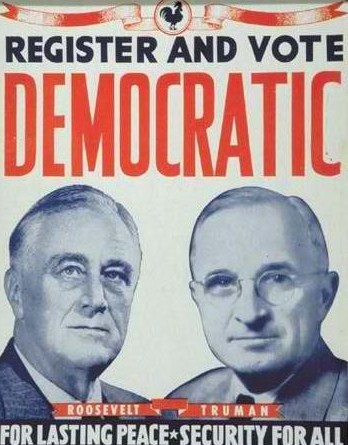
Key facts
On this page
- Why the 1944 election happened during war
- Roosevelt’s record after three presidential terms
- How Thomas Dewey became the Republican nominee
- John W. Bricker and the Republican ticket
- Why Henry Wallace was removed from the Democratic ticket
- How Harry Truman became the vice-presidential candidate
- The debate over Roosevelt’s health
- What the campaigns said about postwar America
- How service members cast wartime ballots
- The result: Roosevelt 432, Dewey 99
- The January 1945 inauguration
- Roosevelt’s death and Truman’s succession
- The legacy of Roosevelt’s final election
- Timeline
- FAQs
- Sources
Why the 1944 election happened during war
Americans went to the polls in November 1944 while U.S. forces were fighting Germany and Japan. The Normandy invasion had opened a major western front in Europe, Allied armies were pushing across France, and the Pacific campaign continued at enormous cost. Wartime production had transformed factories, employment and daily consumption, while millions of service members were overseas. The election therefore involved questions of military leadership, diplomatic planning and the transition to a future peace.
Roosevelt had already won in 1932, 1936 and 1940. Seeking a fourth term was unprecedented, and his health and age drew private and public attention. Supporters emphasized experienced leadership, continuity with Allied commanders and confidence in victory. Critics argued that government needed fresh leadership and that extended presidential service risked concentrating power. The contest was a genuine election with competing campaigns, even though war dominated national priorities.
Roosevelt’s record after three presidential terms
Roosevelt’s presidency included the emergency banking measures of 1933, the wider New Deal and the shift from neutrality to support for the Allied war effort. Under his administration the United States helped Britain through Lend-Lease, mobilized industry after Pearl Harbor and participated in the liberation of occupied territory. These achievements shaped the Democratic campaign’s message that changing leadership midwar could create risks.
His record also included controversies over government power, domestic civil liberties and the unequal effects of wartime policies. The incarceration of Japanese Americans under Executive Order 9066 was a major violation of rights, and racial discrimination remained widespread. An honest election history considers both policy accomplishments and failures rather than presenting the wartime administration as above criticism.
How Thomas Dewey became the Republican nominee
Thomas E. Dewey was governor of New York and had attracted national recognition as a prosecutor and politician. Republicans selected him as their candidate during the 1944 convention, hoping his relative youth and record of administration would challenge Roosevelt’s long tenure. Dewey offered himself as a capable executive who could manage wartime obligations while improving domestic government.
Dewey did not campaign as an opponent of defeating Nazi Germany or Japan. His platform and speeches criticized aspects of administration, bureaucracy and presidential leadership while supporting the country’s war effort. He also accepted important elements of the social safety net that had developed during the New Deal. The result was a contest less polarized around participation in the war than around confidence, competence and the future shape of government.
John W. Bricker and the Republican ticket
Ohio governor John W. Bricker became Dewey’s running mate. He brought experience in Republican politics and connections to voters who were concerned about federal expansion and conservative principles. The nomination reflected party efforts to balance geography and ideology. Dewey and Bricker did not campaign on precisely identical personal platforms, but they presented a shared alternative to a fourth Roosevelt administration.
The vice-presidential choice mattered because the war made succession and leadership continuity unusually important. Although the electorate focused primarily on the presidential candidates, the Constitution placed the vice president first in line to succeed a president who died or left office. That principle became unexpectedly central after Roosevelt’s death in April 1945. Comparing the tickets therefore requires more than listing familiar names.
Why Henry Wallace was removed from the Democratic ticket
Henry A. Wallace had served as vice president during Roosevelt’s third term, after a previous career in agricultural administration. By 1944 he had strong support among progressive Democrats and some labor groups, but many party officials considered his positions and political style controversial. They feared that his nomination could weaken the party or create difficulties in governing during the transition from war to peace.
Roosevelt did not simply name a successor by decree. Convention delegates and party leaders had to select the vice-presidential nominee, and intensive negotiations occurred among competing candidates and factions. Wallace retained supporters, but the final vote favored Harry Truman. The change reflected political considerations, internal party relationships and concern about who might assume the presidency in the event of Roosevelt’s death.
How Harry Truman became the vice-presidential candidate
Harry S. Truman, a senator from Missouri, had become known for leading a Senate committee investigating wartime government contracts and military spending. His reputation for examining waste and administrative problems appealed to party leaders seeking a capable and relatively uncontroversial nominee. Truman’s background in the Senate differed substantially from Wallace’s, and he had not been Roosevelt’s most visible national political partner.
The Democratic convention nominated Truman after a contested selection process. The featured Roosevelt–Truman campaign poster reflects the newly assembled ticket and should not be mistaken for a poster from the earlier Roosevelt–Wallace election in 1940. Truman’s selection became historically consequential not because contemporaries knew the president would die soon, but because he was in fact elevated to the presidency within a few months.
The debate over Roosevelt’s health
Roosevelt’s physical condition attracted attention during the 1944 campaign. He had long lived with the consequences of paralysis, and by the final war years he suffered serious cardiovascular illness that was not fully understood by the public. Some observers noted fatigue or physical deterioration, while his campaign aimed to demonstrate that he remained capable of leading the country.
On October 21 Roosevelt appeared in New York amid rain during a major campaign appearance, reinforcing the image of an active candidate. Yet an energetic public event could not settle medical questions that remained private. The difference between public perceptions and later medical evidence is important. Historians should avoid claiming that every voter knew the full state of his health or that his death in April 1945 was certain at the time of the election.
What the campaigns said about postwar America
Both major parties expected the war to end eventually and debated how the nation should return from military mobilization to civilian economic life. Questions included employment for returning veterans, the operation of New Deal institutions, taxation and future American involvement in international organizations. The GI Bill had been enacted in June 1944, giving servicemen and women access to important postwar benefits subject to eligibility and unequal administration.
The campaign also considered whether the United States should join a new international security institution to avoid a return to isolation. The precise details of the United Nations were still being negotiated, and neither party could promise that diplomacy would eliminate future conflicts. Voters were choosing leaders for an uncertain transition as well as a continuing war. Those overlapping concerns gave the election significance beyond the immediate battlefield.
How service members cast wartime ballots
Millions of Americans serving in the armed forces were far from their normal polling places. Military absentee voting became a significant practical and political issue. Federal and state governments debated how to provide ballots, verify eligibility and deliver materials across oceans under wartime conditions. The 1944 Soldier Voting Act provided a federal framework, but arrangements and participation also depended on state systems.
Voter access was unequal. Many Black Americans still faced poll taxes, intimidation and other barriers, especially in the South, and service members’ logistical difficulties could prevent voting. The existence of an election during wartime did not mean every eligible voter had an easy or equal opportunity to participate. Historical accounts of participation should therefore distinguish the right to vote from the ability to cast and count a ballot.
The result: Roosevelt 432, Dewey 99
Roosevelt won 432 electoral votes and Dewey won 99, according to the National Archives. The American Presidency Project records approximately 25.6 million popular votes for Roosevelt, or 53.4%, compared with about 22.0 million for Dewey, or 45.9%. The remaining popular vote went to minor candidates. Although the Electoral College victory was decisive, the national popular margin was considerably narrower than the overwhelming result of the 1936 election.
Roosevelt carried thirty-six states and Dewey carried twelve. The result reflected continued confidence in the incumbent during war, but millions of Americans voted for political change. Electoral votes are allocated state by state rather than directly in proportion to national ballots, so the 432–99 tally does not imply four voters supported Roosevelt for every Dewey voter. Distinguishing the two measures makes the scope of the victory clear.
The January 1945 inauguration
Roosevelt began his fourth presidential term on January 20, 1945, with Harry Truman as vice president. Wartime circumstances produced an unusually restrained inauguration compared with large peacetime celebrations. Fighting continued in Europe and the Pacific, and the administration focused on Allied cooperation and planning for victory.
The new term began under the Twentieth Amendment’s January schedule, which had been in effect since 1937. Roosevelt was the first president elected to a fourth term, but the Constitution at that time still did not impose a formal two-term limit. The Twenty-Second Amendment would be ratified in 1951. This distinction prevents applying current presidential eligibility rules retroactively to 1944.
Roosevelt’s death and Truman’s succession
On April 12, 1945, Roosevelt died at Warm Springs, Georgia. Harry Truman immediately became president under the constitutional succession process. Roosevelt had served only 82 days of his fourth term, and major wartime decisions—including the conclusion of the war in Europe and the final stages of the Pacific War—passed to Truman. The shift was extraordinarily consequential because the new president had not been fully involved in every secret military and diplomatic undertaking.
Truman’s succession does not change the electoral result: Americans elected Roosevelt and Truman in November 1944. It does show why the vice-presidential nomination became so significant in retrospect. The transition also illustrates the constitutional importance of peaceful succession during national emergency. Military commitments and government administration continued despite the unexpected loss of a long-serving leader.
The legacy of Roosevelt’s final election
The election of 1944 was the last presidential contest held during Roosevelt’s lifetime. It confirmed public willingness to retain an experienced wartime president even after three terms, while revealing substantial Republican opposition. It brought Harry Truman into the vice presidency and thereby shaped the leadership that would oversee the war’s end and the beginning of postwar confrontation.
The result also influenced later debates over presidential tenure and institutional stability. Roosevelt’s unprecedented electoral record helped generate support for the Twenty-Second Amendment, though its adoption came years afterward. The campaign is best understood at the intersection of war, domestic policy, party politics and succession, rather than reduced to a simple referendum on Roosevelt’s personal popularity.
Timeline
- 1940: Roosevelt wins third presidential term
- June 1944: GI Bill enacted and D-Day invasion begins
- July 1944: Democrats nominate Roosevelt and Truman
- November 7, 1944: Roosevelt wins 432–99 electoral votes
- January 20, 1945: Fourth inauguration
- February 1945: Roosevelt attends Yalta Conference
- April 12, 1945: Roosevelt dies; Truman succeeds
- 1951: Twenty-Second Amendment ratified
Frequently asked questions
When was the 1944 presidential election?
November 7, 1944.
Who won?
Franklin D. Roosevelt defeated Republican Thomas E. Dewey.
What was the electoral vote?
Roosevelt 432, Dewey 99.
What was the popular vote split?
About 53.4% Roosevelt and 45.9% Dewey.
Who ran for vice president?
Harry S. Truman with Roosevelt and John W. Bricker with Dewey.
Why was Henry Wallace replaced?
Many Democratic leaders opposed his renomination, and the party convention ultimately selected Truman.
Was a fourth term illegal?
No. The constitutional two-term limit was ratified in 1951.
When did Truman become president?
April 12, 1945, following Roosevelt’s death.