Yalta Conference of 1945: Roosevelt, Churchill, Stalin and Poland’s Future
What the Big Three agreed at Yalta in February 1945 about Poland, Germany, the United Nations and Soviet entry into the Pacific War.
Quick answer
The Yalta Conference took place in Crimea from February 4 to 11, 1945, when Franklin D. Roosevelt, Winston Churchill and Joseph Stalin met as Germany neared defeat. The leaders discussed the occupation and disarmament of Germany, Poland’s borders and future government, the establishment of the United Nations and Soviet participation in the war against Japan. They issued a Declaration on Liberated Europe, which promised democratic processes but was not consistently implemented. Yalta shaped the final wartime settlement and remains controversial because Soviet domination of Eastern Europe followed despite diplomatic language about free elections.
Key facts
On this page
- Why the Big Three met again in 1945
- Why Yalta in Crimea was chosen
- Roosevelt’s concerns about Germany and the Pacific
- Churchill’s interest in Poland and European balance
- Stalin’s security demands
- Poland’s eastern border and the Curzon Line
- The dispute over a Polish government
- The Declaration on Liberated Europe
- How Germany would be occupied after defeat
- The United Nations and Security Council voting
- Soviet entry into the war against Japan
- What Yalta did not decide
- Roosevelt’s death and the changing diplomacy of 1945
- Why Yalta remains controversial
- Timeline
- FAQs
- Sources
Why the Big Three met again in 1945
By February 1945 Nazi Germany was under severe military pressure from both east and west. Soviet troops had advanced far across Eastern Europe, while American, British and other Allied armies were approaching Germany from the west. The war was not over, but victory in Europe appeared increasingly likely. Allied governments needed to coordinate the final military campaign and make decisions about occupation, borders and reconstruction.
Roosevelt, Churchill and Stalin had last met together at Tehran in late 1943. Their military cooperation had helped sustain the offensive against Germany, but disputes about Poland and the postwar balance of power were growing. Yalta required political compromise at a moment when Soviet armies controlled much of the territory being discussed. The actual position of those armies limited the leverage available to western leaders.
Why Yalta in Crimea was chosen
Stalin preferred a meeting relatively close to the Soviet Union, and the leaders agreed to convene at Yalta on the Crimean Peninsula. The talks were held primarily at the Livadia Palace and other nearby locations. Roosevelt traveled despite poor health, and Churchill also faced demanding wartime responsibilities. Security, transport and accommodation presented logistical challenges in a region badly affected by the war.
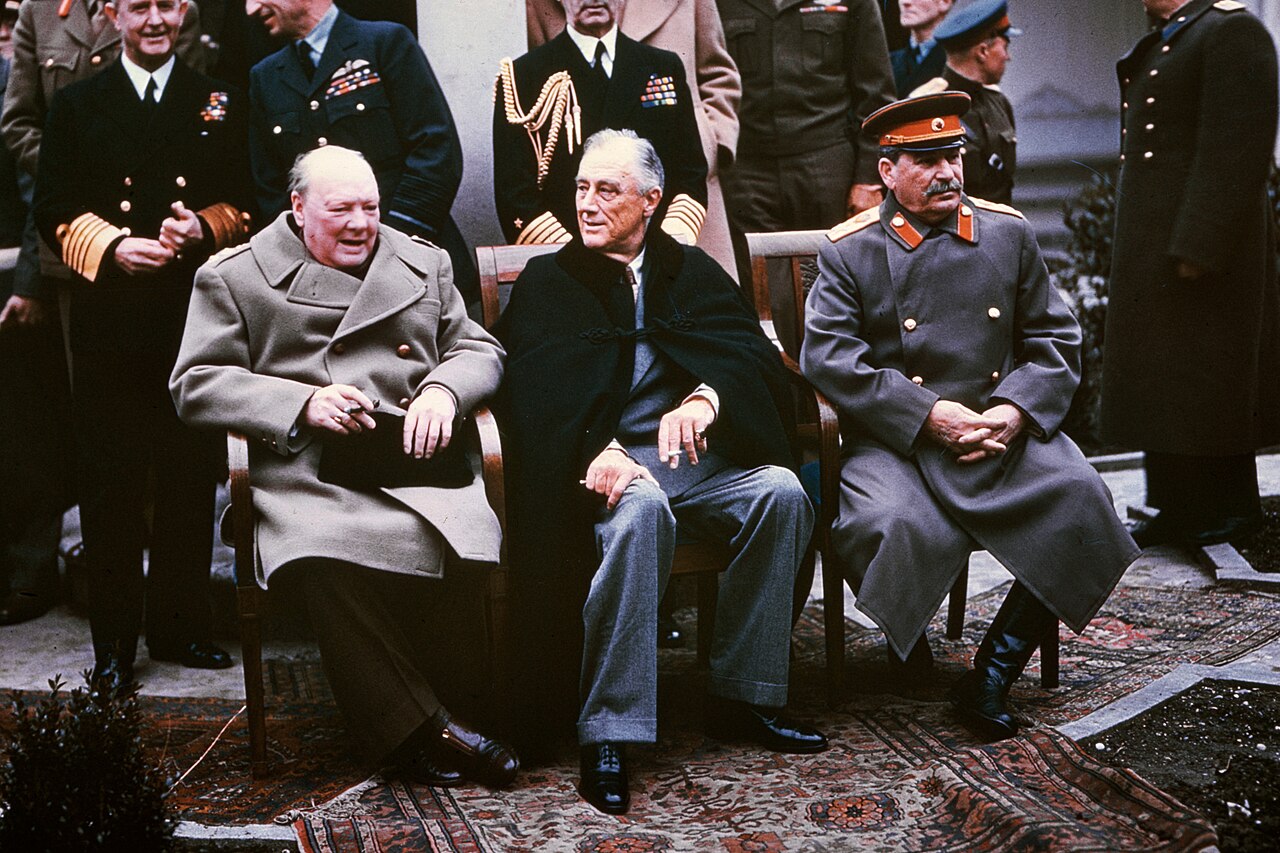
The setting mattered because it placed the Western Allied leaders on Soviet-controlled territory. Photographs show the Big Three seated together, with military officers and advisers nearby. The featured image is a contemporary record of the summit, but its appearance of unity cannot be interpreted as proof that all policy disagreements were resolved. Negotiations involved lengthy sessions, informal discussions and teams of foreign ministers and specialists.
Roosevelt’s concerns about Germany and the Pacific
Roosevelt wanted Allied agreement on arrangements that would prevent a revived aggressive Germany and permit effective international cooperation after the war. He also hoped Stalin would join the United Nations and enter the war against Japan, reducing the expected cost of further Pacific operations. U.S. forces were still fighting across the Pacific, and planners anticipated difficult campaigns ahead.
Roosevelt therefore approached negotiations with multiple objectives that could not always be traded independently. Reaching agreement on United Nations voting rules or Soviet participation in the Pacific War involved discussion of concessions and assurances elsewhere. Historians debate how much different priorities affected his bargaining over Eastern Europe. It is inaccurate to assume either complete naivety or perfect foresight; contemporary officials faced incomplete information about future military and diplomatic developments.
Churchill’s interest in Poland and European balance
Churchill regarded Poland’s future as a particularly important test of Allied promises. Britain had entered the European war in 1939 following Germany’s invasion of Poland. The Polish government-in-exile in London and Soviet-backed authorities had competing claims to represent the country. British leaders feared that a settlement imposed by Moscow could undermine the sovereignty of the state for which Britain had originally gone to war.
Churchill also considered the broader balance of influence in Europe and the role of France after liberation. He wanted arrangements that would avoid any one major power dominating the continent. His concerns did not produce a complete solution at Yalta. With Soviet troops already across Eastern Europe, diplomatic language could not by itself determine what governments would later emerge under occupation.
Stalin’s security demands
Stalin argued that the Soviet Union needed secure western borders after suffering devastating German invasions and casualties. Soviet leaders viewed friendly or compliant governments in neighboring countries as essential safeguards against another attack. Their demand for influence in Poland conflicted with the Western Allies’ public commitment to national self-determination and democratic government.
The security argument helps explain Soviet policy without excusing coercion or the suppression of political opposition. Stalin’s government controlled the Red Army and possessed significant leverage on the ground. The Yalta negotiations exposed a clash between security claims and the right of populations to choose their governments. That contradiction would become central to postwar tensions.
Poland’s eastern border and the Curzon Line
Poland’s proposed eastern frontier was discussed in relation to the Curzon Line, with adjustments considered. The Soviet Union sought to retain much of the territory it had occupied after its 1939 invasion of eastern Poland. This meant Poland would shift westward, with compensation expected through former German territory. Such changes would affect millions of people and create conditions for later forced migrations.
Yalta did not settle every final boundary detail. Decisions developed through later negotiations, wartime occupation and postwar treaties. It is therefore misleading to treat a map discussed at Yalta as the complete legal resolution of every Polish territorial dispute. The conference established a political direction that had profound consequences for eastern and central Europe.
The dispute over a Polish government
The Western Allies supported a broadly representative Polish government and sought free elections, while Soviet officials recognized and supported authorities aligned with Moscow. The Yalta arrangements called for reorganizing the existing provisional government on a broader democratic basis and holding elections. The wording attempted to reconcile incompatible views about which Polish groups would actually possess authority.
Implementation proved deeply contentious. Soviet power, intimidation and restrictions on opposition prevented the kind of genuinely open competition that the Western Allies expected from the public declarations. By 1947 Polish elections were held in circumstances widely criticized for coercion and fraud. The gap between Yalta’s promise and the realities of Soviet-backed rule became a major source of criticism of the wartime settlement.
The Declaration on Liberated Europe
The leaders issued a Declaration on Liberated Europe, which expressed commitments to help liberated peoples form democratic institutions of their own choosing. It referred to broadly representative governments and free elections where necessary. The statement reflected Allied efforts to frame their military victory as liberation rather than replacement of German domination by another form of external control.
The declaration had political significance but lacked a straightforward mechanism capable of compelling Stalin to permit opposition parties to operate freely in areas controlled by Soviet forces. Different interpretations emerged soon after the conference. The resulting conflicts demonstrate why an international declaration can express ideals that governments do not consistently uphold. Yalta’s legacy cannot be understood without examining implementation after the leaders departed.
How Germany would be occupied after defeat
The Big Three discussed dividing Germany into occupation zones and creating machinery for coordinated Allied administration. The United States, Britain and Soviet Union had already considered division, and France was to receive an occupation zone carved from the Western Allies’ allocations. Berlin also became subject to occupation arrangements despite its location within the Soviet zone.
The objective was to disarm Germany, remove Nazi institutions and prevent renewed aggression. The conference did not create the later Federal Republic of Germany and German Democratic Republic on the spot. Those states emerged in 1949 after years of worsening conflict between Western powers and the Soviet Union. Postwar division was shaped by occupation policy, economic choices and the broader political confrontation that developed after Germany’s surrender.
The United Nations and Security Council voting
Roosevelt regarded a durable international organization as a major postwar goal. At Yalta the leaders resolved important issues concerning the planned United Nations, including arrangements for great-power voting in the Security Council. The organization was intended to provide a forum and security mechanism that the League of Nations had failed to supply effectively between the world wars.
The San Francisco Conference later drafted and adopted the United Nations Charter in 1945. Yalta was a crucial preparatory step but not itself the signing or formal creation of the UN. The continuing influence of permanent Security Council members reflects choices made amid wartime negotiations. Those arrangements promoted major-power involvement while also limiting the organization’s ability to act when permanent members disagreed.
Soviet entry into the war against Japan
Stalin agreed that the Soviet Union would enter the war against Japan within two or three months after Germany’s surrender. A separate agreement addressed Soviet interests in the Far East, including arrangements involving Sakhalin and the Kuril Islands and privileges associated with China and Mongolia. These discussions had significant implications for regional sovereignty and postwar relations.
The Soviet Union entered the war against Japan in August 1945 after Germany had surrendered in May. American military leaders had sought Soviet assistance partly because projections for continued war in Asia involved serious risks. The Soviet offensive in Manchuria, American atomic bombings and Japan’s internal decisions all contributed to the war’s final stage. Yalta’s agreement was one part of that complex sequence, not a complete prediction of the circumstances of surrender.
What Yalta did not decide
The conference did not conclude World War II, create the later NATO or Warsaw Pact, or finalize every boundary in postwar Europe. Many institutions and conflicts associated with the Cold War developed over subsequent years. Historians sometimes describe Yalta as the moment Europe was divided into spheres of influence, but Soviet military control over much of Eastern Europe was already an established fact by February 1945.
The conference gave diplomatic form to some realities while leaving crucial questions unresolved. Its significance lies in how those agreements interacted with occupation, political coercion and later Western responses. The United States and Britain protested Soviet conduct as hopes for genuine cooperation diminished. Judging Yalta fairly requires attention to the options leaders actually possessed at the time and to the actions taken afterward.
Roosevelt’s death and the changing diplomacy of 1945
Roosevelt died on April 12, 1945, only two months after Yalta. Harry S. Truman became president and faced the continuing war, the imminent defeat of Germany and growing tensions over Soviet conduct. Churchill also left office after Britain’s July 1945 election, bringing new leaders into negotiations at Potsdam. These changes complicated the continuity of wartime diplomacy.
Yalta consequently became a reference point for disputes among leaders who had not all participated in the original talks. Different interpretations of promises about Poland, liberated Europe and occupation fueled political argument. Later critics sometimes judged the agreement mainly by the Cold War outcome, while defenders emphasized the limited alternatives available with the Red Army already occupying much of Eastern Europe.
Why Yalta remains controversial
The Yalta Conference combined genuine Allied cooperation against Nazi Germany with arrangements that did not secure full self-determination in Eastern Europe. Its decisions helped prepare Germany’s occupation, the United Nations and Soviet participation in the Pacific War. At the same time, the Polish settlement and declaration on liberated nations became examples of diplomatic promises undermined by the reality of military control.
The historical issue is not simply whether Roosevelt, Churchill or Stalin ‘won’ a meeting. Their decisions were shaped by war, geography and unequal leverage. A careful account distinguishes what the leaders publicly agreed from what happened later, acknowledging both the necessity of wartime coordination and the serious limitations of the settlement as a foundation for postwar freedom.
Timeline
- November–December 1943: Big Three meet at Tehran
- February 4, 1945: Yalta Conference opens
- February 11, 1945: Conference ends
- April 12, 1945: Roosevelt dies
- May 1945: Germany surrenders
- July–August 1945: Potsdam Conference
- August 1945: Soviet Union enters war against Japan
- 1947: Polish elections under Soviet-backed political control
Frequently asked questions
When was the Yalta Conference?
February 4–11, 1945.
Who attended?
Franklin D. Roosevelt, Winston Churchill and Joseph Stalin.
Where was Yalta?
On the Crimean Peninsula, then in the Soviet Union.
What did they decide about Germany?
They discussed Allied occupation zones, disarmament and postwar control.
What did Yalta say about Poland?
It addressed borders, an expanded provisional government and promised free elections, but subsequent Soviet-backed practices undermined those promises.
Was the UN founded at Yalta?
No. Voting arrangements were negotiated; the UN Charter followed at San Francisco in 1945.
Did Stalin agree to fight Japan?
Yes. Soviet entry was promised within two to three months after Germany’s defeat.
Did Yalta create the Cold War?
It was an important precursor to postwar disputes, but Cold War tensions developed through many later actions and events.