G.I. Bill of 1944: Education, Home Loans and Unequal Benefits for Veterans
What the Servicemen’s Readjustment Act provided in 1944, why colleges and homeownership changed after WWII and how discrimination limited Black veterans’ access.
Quick answer
President Franklin D. Roosevelt signed the Servicemen’s Readjustment Act, commonly known as the G.I. Bill, on June 22, 1944. The law offered eligible World War II veterans federal assistance for education and job training, temporary unemployment allowances and government guarantees on certain private loans for homes, farms and businesses. Benefits helped millions rebuild civilian lives, but access was unequal: Black veterans often faced segregated colleges, discriminatory mortgage lending and local barriers. The legislation did not give every veteran a free house or guarantee college admission.
Key facts
On this page
- Why wartime leaders planned for peace before victory
- The American Legion and the push for legislation
- The June 22, 1944 signing
- Education and college tuition assistance
- Vocational education and apprenticeship opportunities
- Temporary unemployment allowances
- How the home-loan guarantee worked
- The relationship with suburban expansion
- Why Black veterans often received unequal benefits
- Women veterans and different postwar expectations
- What the law cost and what the economy gained
- Later veterans’ education legislation
- Why the 1944 G.I. Bill remains significant
- Timeline
- FAQs
- Sources
Why wartime leaders planned for peace before victory
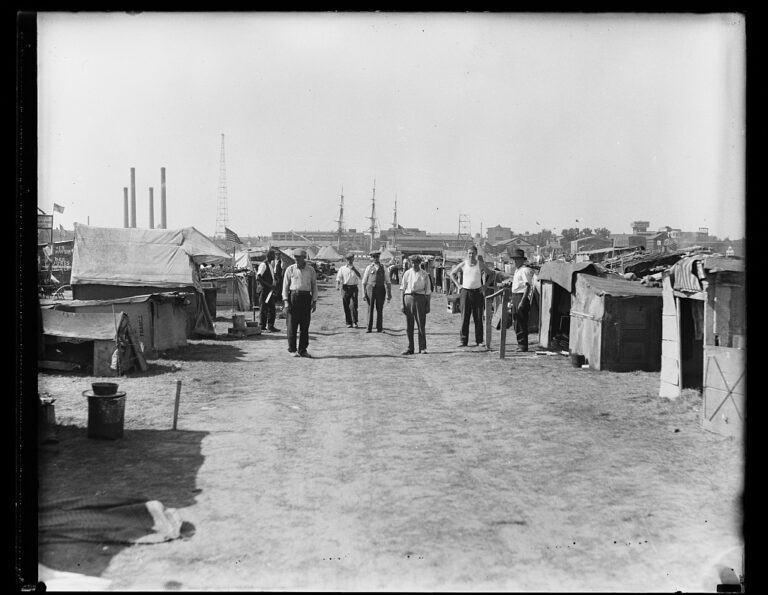
American leaders remembered the difficult experience of veterans returning after World War I and the struggles that later contributed to the Bonus Army protest. By 1944 millions of men and women were serving in uniform, and officials feared that sudden demobilization would flood labor markets before industry could adjust from wartime production. Unemployment, interrupted education and the expense of finding housing threatened to undermine the transition to civilian life.
Congress therefore considered ways to help veterans resume education, train for work and establish homes or businesses. Planning took place while the war was still ongoing, demonstrating an awareness that military victory would not automatically resolve economic uncertainty. Supporters viewed public assistance as recognition of service and a means of preventing another severe postwar slump. Opponents debated cost, eligibility and how much responsibility federal agencies should assume.
The American Legion and the push for legislation
The American Legion helped advocate a comprehensive veterans’ benefits bill, working with legislators who sought broader support for returning servicemembers. The phrase ‘GI Bill of Rights’ became associated with the proposal, emphasizing that veterans needed opportunities rather than only one-time payments. Political supporters from different parties argued that an orderly adjustment from military service would benefit the wider American economy.
The legislation was not created by one organization alone. Members of Congress, veterans’ groups and federal officials debated its design and administration. The resulting compromise passed both houses and reached Roosevelt in June 1944. Its provisions reflected a mix of assistance to individual veterans and an attempt to strengthen the nation’s postwar economy through education, employment and private borrowing.
The June 22, 1944 signing
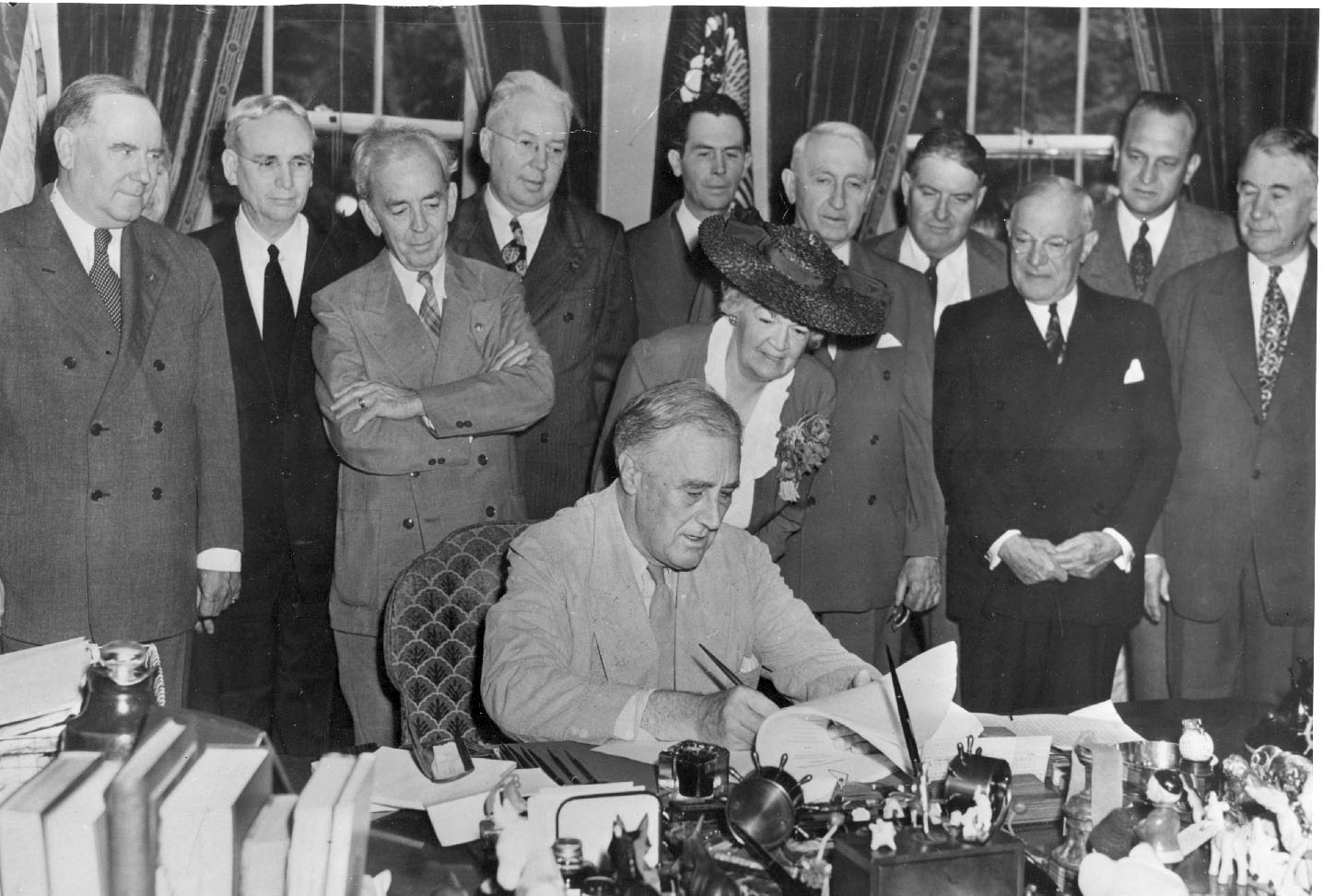
Roosevelt signed the Servicemen’s Readjustment Act on June 22, 1944. The National Archives preserves the original law and explains its central purpose: helping returning veterans adjust to civilian life after World War II. The featured historical photograph records Roosevelt at the signing, making it especially relevant to the founding of the program. It should not be confused with later amendments or programs for veterans of subsequent conflicts.
The act did not begin a separate national system in which all veterans automatically received identical benefits. Eligibility depended on military service and other statutory criteria, and different types of assistance operated through separate administrative procedures. Education benefits, unemployment allowances and loan guarantees each had rules that mattered to individual applicants. Those details help explain why veterans’ experiences diverged even under the same federal law.
Education and college tuition assistance
One of the act’s best-known provisions supported tuition and related expenses for eligible veterans attending approved educational institutions. Monthly subsistence allowances could help cover living costs while studying. The assistance expanded access to college for veterans who might otherwise have lacked the money or time to pursue degrees. Many universities increased capacity, and education became an important path into professional and technical employment.
The law did not guarantee admission to a particular college or remove every academic entrance requirement. Institutions still decided whom to accept, and some states maintained legally segregated higher education. Veterans also followed different routes, including university degrees, vocational courses and other forms of approved training. The significance of the education program was not merely the number of people entering prestigious universities; it broadened the possibility of learning across many occupations.
Vocational education and apprenticeship opportunities
Many veterans wanted skilled employment rather than a conventional four-year degree. The G.I. Bill supported approved vocational education and training that could prepare people for trades, technical occupations and business work. Wartime experience had already given some servicemembers practical skills, while others needed new qualifications for industries shifting to peacetime production. Education assistance could help bridge the gap between those two environments.
Programs varied by region and provider. A veteran might enroll in a technical school, complete an apprenticeship or pursue agricultural training, subject to the rules of the benefit. The value of these pathways depended on local employment conditions and the quality of instruction. A history focused only on university students would miss how the legislation supported a wider restructuring of the labor force after the war.
Temporary unemployment allowances
The act also provided readjustment allowances for eligible veterans unable to find suitable work. This assistance reflected fears that wartime industry would shrink before civilian businesses could create enough jobs. Payments could provide a limited bridge during job searches, while vocational training and education offered longer-term routes to employment. The allowances were conditional and time-limited rather than permanent lifetime income for every veteran.
Unemployment benefits should not be treated as the sole reason the postwar labor market avoided Depression-level unemployment. Wartime savings, consumer demand, production changes and broader economic policies also mattered. But federal assistance reduced hardship for some veterans during the transition. The program demonstrates that the law addressed immediate income problems as well as future educational or housing opportunities.
How the home-loan guarantee worked
The G.I. Bill authorized federal guarantees for eligible private loans connected to homes, farms and businesses. This reduced risk for participating lenders and could make borrowing more accessible or affordable for qualified veterans. The government did not simply build a house for every veteran and give away the title. Borrowers still needed a lender, an acceptable property or business plan, and the ability to meet loan obligations.
Federal guarantees became closely associated with postwar homeownership. Veterans could finance purchases without having to save as large a down payment as earlier arrangements often demanded. However, mortgage access also depended on local banks, real estate agents and neighborhoods. The National Housing Act of 1934 had established a separate federal mortgage-insurance program that shaped the housing market in parallel.
The relationship with suburban expansion
After 1945 demand for housing increased as veterans returned, families formed and construction revived. Government-backed mortgage finance supported the purchase of new single-family homes, including housing in expanding suburbs. Roads, utilities and builders contributed to the development of communities outside older city centers. The G.I. Bill was one important part of this transformation, alongside FHA insurance, private investment and local development policies.
It would be inaccurate to credit the entire postwar suburban boom to the G.I. Bill alone. Population shifts, wages, automobile ownership and land-use decisions also shaped growth. Equally, not every veteran moved to a suburb or bought a house. Some remained renters, purchased farms or settled in urban neighborhoods. A careful history describes how loan guarantees expanded opportunities while acknowledging the larger social and economic forces operating at the same time.
Why Black veterans often received unequal benefits
The law’s text did not formally exclude Black veterans from all benefits on the basis of race, but local educational and housing systems frequently restricted their actual access. Segregated colleges had limited places and resources, and some white institutions refused admission. Veterans who wanted to use tuition support could therefore confront barriers the federal benefit did not remove. The National Archives explicitly documents these inequalities in its explanation of the original law.
Mortgage finance presented additional obstacles. Banks often refused loans in Black neighborhoods, while racial covenants and discriminatory real estate practices blocked purchases in many white suburban developments. A veteran could qualify for a federal guarantee yet fail to obtain a willing lender or acceptable housing. The distinction between a benefit formally available by statute and a benefit practically accessible in a segregated society is essential to evaluating the program’s legacy.
Women veterans and different postwar expectations
Women served during World War II through organizations including the Women’s Army Corps and Navy women’s programs, as well as other military branches. Their eligibility for particular veteran benefits depended on service status and applicable law. Many women faced social expectations that encouraged them to leave wartime jobs or return to domestic roles, even if they hoped to continue professional education or employment.
The Women Airforce Service Pilots illustrate a particularly important distinction: WASP members were classified as civilian employees during the war and gained later recognition for veterans’ benefits in 1977. It would be inaccurate to say every woman who flew military aircraft during the war received all original GI Bill privileges automatically. Military status and the legal recognition of service mattered.
What the law cost and what the economy gained
The government spent substantial funds on education and other assistance during the postwar decades. Historians and economists have studied whether the benefits increased lifetime earnings, tax revenue and homeownership. Many analyses find important positive effects, but precise estimates differ by eligibility, region, study period and outcome. Higher education could raise skills and earnings, while homeownership allowed some families to build wealth as property values increased.
These benefits were not distributed equally, so national averages can conceal disparities between racial groups and communities. Government spending also interacted with a rapidly expanding postwar economy and with the institutions administering the programs. The responsible conclusion is that the G.I. Bill was a major contributor to economic opportunity for many veterans, not that every beneficiary became prosperous or that a single law explains the entire postwar boom.
Later veterans’ education legislation
The original G.I. Bill addressed World War II service, but Congress later created or revised programs for veterans of other wars and periods. The Veterans’ Readjustment Assistance Act of 1952, often called the Korean War G.I. Bill, established a different benefit structure for eligible Korean War-era veterans. Later programs changed administration, funding and eligibility as military and educational systems evolved.
These later statutes should not be projected backward into 1944. Modern benefit levels and transfer rules differ from what Congress enacted during the final years of World War II. When interpreting a veteran’s historic documents, the relevant law is the one in force for that service period and benefit claim. The original 1944 act remains the defining milestone even though the phrase G.I. Bill later acquired a broader meaning.
Why the 1944 G.I. Bill remains significant
The G.I. Bill linked recognition of military service with education, employment and housing opportunities in civilian society. It helped millions of Americans seek qualifications, buy homes or survive the early transition from wartime work. The legislation was unusually broad in its attempt to address different needs rather than simply providing one payment when a person left the armed forces.
Its legacy is also a lesson in the limits of formally neutral public benefits when discriminatory institutions determine access. Black veterans and others faced barriers that weakened the law’s promise of equal opportunity. Reading the 1944 statute alongside housing history and veterans’ testimony reveals both its extraordinary influence and the inequalities that shaped the postwar United States.
Timeline
- 1919–1930s: Earlier veterans’ benefits and Bonus Army controversies
- 1943–1944: Congress debates postwar readjustment benefits
- June 22, 1944: Roosevelt signs Servicemen’s Readjustment Act
- 1945 onward: Veterans return to civilian education and housing markets
- Late 1940s: College enrollment and home-loan use expand
- 1952: Separate Korean War veterans’ benefits law
- Later decades: GI Bill programs amended and expanded
Frequently asked questions
When was the original GI Bill passed?
June 22, 1944.
What was its formal name?
The Servicemen’s Readjustment Act of 1944.
What benefits did it offer?
Education and training assistance, unemployment readjustment allowances and guarantees on eligible private loans.
Did it give every veteran a free house?
No. It could help eligible borrowers obtain private loans but did not automatically award property.
Did Black veterans benefit equally?
No. Segregated schools, discriminatory lending and housing restrictions prevented many from accessing benefits on equal terms.
Did it guarantee college admission?
No. Education benefits did not remove admission requirements or institutional segregation.
Was the 1944 GI Bill the same as modern programs?
No. Eligibility and benefits changed under later statutes.