Tuskegee Airmen (1941–1945): Red Tails, WWII Missions and Segregation
How Black American aviators trained in Alabama, flew with the 99th Squadron and 332nd Fighter Group, and challenged segregation during World War II.
Quick answer
The Tuskegee Airmen were Black American military aviators and supporting personnel trained through a segregated Army Air Forces program in Alabama during World War II. The 99th Pursuit Squadron began training in 1941 and deployed to combat in 1943; the 332nd Fighter Group subsequently escorted bombers over Europe with aircraft that became known as the Red Tails. Their service helped challenge racist assumptions about military aviation, although segregation and unequal treatment persisted. The popular claim that they never lost a bomber they escorted is historically inaccurate: records document losses, although their escort record was distinguished.
Key facts
On this page
- Why Black Americans were excluded from military aviation
- The Civilian Pilot Training Program and Tuskegee
- The formation of the 99th Pursuit Squadron in 1941
- Benjamin O. Davis Jr. and leadership
- The 99th Squadron enters combat in 1943
- The formation of the 332nd Fighter Group
- Why the Red Tails became famous
- Did the Tuskegee Airmen never lose an escorted bomber?
- Discrimination at home and abroad
- Women and civilian supporters in the Tuskegee story
- The path toward armed-forces desegregation
- The Tuskegee Airmen’s historical legacy
- Timeline
- FAQs
- Sources
Why Black Americans were excluded from military aviation
Before World War II, the U.S. military imposed racial segregation in many branches, and Black Americans faced barriers to becoming pilots in the Army Air Corps. Racist beliefs about intelligence, technical skill and leadership were used to justify exclusion, despite the accomplishments of Black civilian aviators. Civil-rights organizations and community leaders pressed federal officials to offer aviation opportunities that matched Black citizens’ rights and service obligations.
The debate intensified as the country expanded its air forces before entering the war. African American men were subject to national defense responsibilities yet were denied access to prestigious flying roles. The Tuskegee training program was therefore both a military initiative and a product of sustained political pressure. It did not begin as evidence that Black men needed a fundamentally different kind of aviation education; it was organized within a segregated institution.
The Civilian Pilot Training Program and Tuskegee
Tuskegee Institute in Alabama participated in federally supported civilian pilot training before the military flight school began. The institution had educators and facilities capable of preparing students for aviation careers. Civilian training helped demonstrate that Black pilots could acquire the same navigation, mechanical and flying skills required of other aviators. A network of advocates pushed for full participation in military aviation rather than being limited to private flying.
The Army developed training near Tuskegee, including Moton Field for primary instruction and Tuskegee Army Air Field for advanced military training. The sites served different stages of the program and should not be treated as a single building. The National Park Service preserves Moton Field as part of Tuskegee Airmen National Historic Site, providing evidence about instructors, airfields and the wider community involved in the effort.
The formation of the 99th Pursuit Squadron in 1941
The War Department established the 99th Pursuit Squadron in 1941 as a segregated unit for Black military aviators. The squadron’s training demanded the same fundamental skills needed for combat pilots, including navigation, formation flying and operating increasingly powerful aircraft. Candidates faced strict academic, physical and flight requirements. Their progress occurred under intense scrutiny because opponents of racial integration used every difficulty to question the program’s viability.
The first class of military pilots completed its training in 1942, including Benjamin O. Davis Jr., who became a central leader of the Tuskegee Airmen. The squadron’s existence did not end discrimination. Black officers and enlisted personnel still faced separate facilities, biased assumptions and limits on advancement. The training program succeeded because its members persevered within conditions that imposed burdens not equally applied to white aviators.
Benjamin O. Davis Jr. and leadership
Benjamin O. Davis Jr. served as an important commander of the 99th and later the 332nd Fighter Group. His career required overcoming institutional barriers that had limited Black opportunities in the officer corps. He defended the competence of his pilots when questions arose about their combat performance and led formations that became famous for disciplined fighter operations.
Davis was part of a larger network of instructors, maintenance workers, administrators and squadron leaders whose contributions made air operations possible. Military aviation depends on ground crews to repair engines, load ammunition and keep aircraft serviceable. A narrative centered only on a handful of famous pilots omits the men and women involved in the broader Tuskegee training effort and the families and organizations that supported them.
The 99th Squadron enters combat in 1943
The 99th Fighter Squadron deployed to North Africa and entered combat in 1943. Its pilots initially flew Curtiss P-40 Warhawk fighters in operations connected with Allied campaigns in the Mediterranean. They gained experience supporting ground forces and attacking military targets. Reviews of performance were influenced by both military considerations and the racial prejudice of some officers who doubted the unit’s effectiveness.
Investigations and reassessments challenged sweeping claims that Black fighter pilots were incapable of combat. The squadron’s experience also demonstrated how difficult it was to judge performance without considering assignment types, aircraft, weather and tactical conditions. Comparing isolated mission statistics across units can be misleading when they fought in different circumstances. The combat record should be evaluated through official reports rather than either hostile stereotypes or celebratory legends.
The formation of the 332nd Fighter Group
The 332nd Fighter Group brought together several Black fighter squadrons, including the 100th, 301st and 302nd, later joined by the 99th. Operating in the Mediterranean and European theaters, the group flew fighter missions and eventually escorted American heavy bombers toward targets in Axis-controlled territory. The responsibilities required long-range navigation, combat discipline and cooperation with other air units.
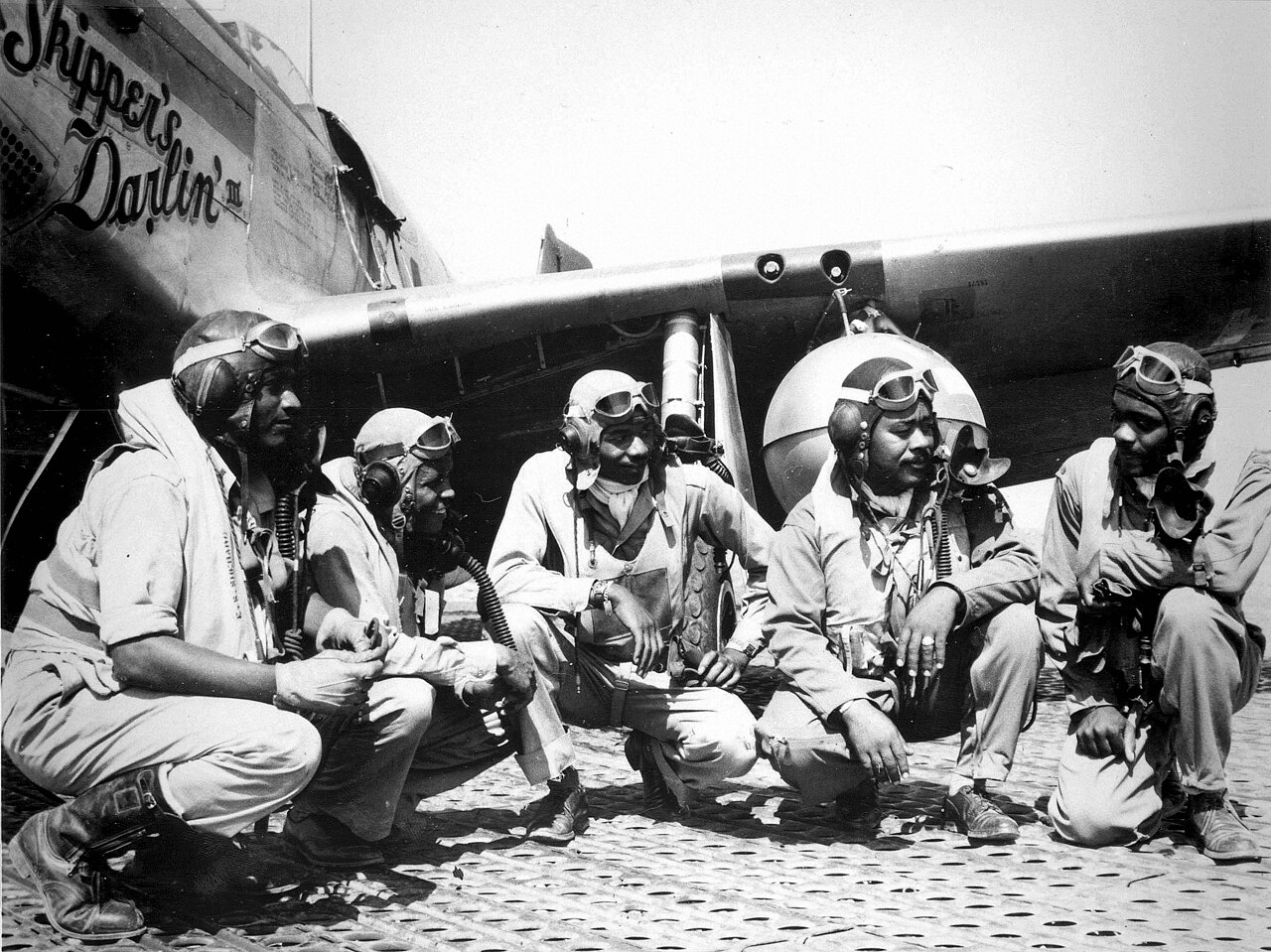
The 332nd used several aircraft types during the war, including P-39s, P-47s and P-51 Mustangs. Identifying it exclusively with one airplane from its first deployment would erase the group’s operational evolution. When the P-51s appeared with distinctive red tail markings, the visual identity became associated with the fighter group and its escorts. That historical nickname later entered films, museum exhibits and public memory.
Why the Red Tails became famous
Long-range fighter escort was critical to Allied bombing operations. Bombers flying into defended airspace faced enemy fighters and anti-aircraft fire, and their survival depended partly on escort aircraft maintaining protective formations. The 332nd’s pilots became known for remaining with assigned bombers rather than routinely abandoning them to search for individual aerial victories. Crews valued reliable escort as an important part of completing difficult missions.
The distinctive red tails of the group’s aircraft made them recognizable in photographs and memoirs. The featured picture shows aviators from the 332nd at Ramitelli, Italy, in August 1944. This authentic wartime image is stronger historical evidence than a modern promotional illustration, but it documents a particular group at a particular moment rather than all Tuskegee graduates and support personnel.
Did the Tuskegee Airmen never lose an escorted bomber?
A popular legend holds that no bomber escorted by the Tuskegee Airmen was ever lost to enemy fighters. Historical records contradict the absolute form of that claim. Military historians have identified bombers lost during some 332nd escort missions. The group’s performance was still impressive, but the achievement does not need an inaccurate perfect record to be significant.
The distinction illustrates why source verification matters in military history. An inspiring narrative can become so familiar that correcting it feels like diminishing the people involved. In fact, acknowledging documented losses gives a more accurate picture of their dangerous assignments. The records support a substantial escort contribution and show that the men faced the same lethal risks as other combat aviators while navigating an unequal military system.
Discrimination at home and abroad
Black pilots could demonstrate competence in European combat and still return to segregated bases in the United States. Racism affected housing, transportation, promotions and access to officers’ clubs. The 1945 confrontation at Freeman Army Airfield in Indiana, involving Black officers protesting exclusion from facilities, revealed that discrimination remained a central issue even as the war approached its end.
These conflicts were not incidental to the military achievements. They show the contradiction between a country fighting fascism abroad and maintaining racial barriers within its own institutions. Black newspapers and civil-rights advocates publicized the service of the Tuskegee Airmen as evidence that military segregation lacked justification. Their experience became part of the longer struggle for equal treatment in the armed forces.
Women and civilian supporters in the Tuskegee story
The Tuskegee program included civilian instructors and women who contributed to aviation education, administrative work and support operations. Women such as Willa Brown had earlier pressed for Black opportunities in aviation, while individuals within the Tuskegee community assisted training and airfield operations. These contributions do not mean Black women were admitted as fighter pilots into the segregated military squadrons, which remained male combat units during the war.
The roles should be distinguished from the separate Women Airforce Service Pilots, who performed stateside military flying as civilian employees. Both histories show that wartime demand opened new opportunities while discriminatory policies continued to limit others. Recognizing those differences avoids merging separate programs into one inaccurate story about universal access to military aviation.
The path toward armed-forces desegregation
After the war, veterans and civil-rights leaders argued that the military’s racial divisions were both unjust and wasteful. President Harry Truman’s Executive Order 9981 in 1948 called for equality of treatment and opportunity in the armed services, contributing to a later process of desegregation. This was a distinct postwar policy decision, not something that had fully occurred during the 1941 establishment of the 99th Squadron.
The combat achievements and advocacy surrounding the Tuskegee Airmen helped undermine the rationale for segregated units. They were not the only African Americans fighting discrimination in the military, but their experience was particularly visible because of the prestige attached to pilots and the detailed records of combat missions. Their story connects the wartime armed forces with the early civil-rights movement.
The Tuskegee Airmen’s historical legacy
The Tuskegee Airmen demonstrated exceptional professional skill under conditions shaped by racial discrimination. Their training and wartime service challenged exclusionary assumptions and helped change public attitudes, while the movement toward integration unfolded over subsequent years. The National Park Service preserves key sites so that visitors can understand both aviation techniques and the barriers their participants faced.
The strongest account neither treats the aviators as infallible heroes nor reduces them to symbols without individual experience. Their actual missions, losses, teamwork and fight against segregation are sufficiently remarkable. The verified record belongs within the wider history of World War II and the ongoing effort to make equal citizenship meaningful in American military life.
Timeline
- 1939: Civilian pilot training expands
- 1941: 99th Pursuit Squadron established
- 1942: First Tuskegee military pilots graduate
- 1943: 99th enters combat in North Africa and Mediterranean
- 1944: 332nd Fighter Group escorts bombers from Italy
- 1945: Freeman Field confrontation and war’s end
- 1948: Truman issues Executive Order 9981
Frequently asked questions
Who were the Tuskegee Airmen?
Black American wartime aviators and supporting personnel trained through the Tuskegee military aviation program.
Where did they train?
At sites around Tuskegee, Alabama, including Moton Field and Tuskegee Army Air Field.
What were the Red Tails?
A nickname associated with the red-painted tails of P-51 fighters flown by the 332nd Fighter Group.
When did they first fight?
The 99th Fighter Squadron entered combat in 1943.
Did they never lose a bomber?
No. That absolute claim is a myth; official records document bomber losses during some escort missions.
Was the U.S. military integrated at the time?
No. The Army Air Forces remained segregated during WWII.
How did they affect civil rights?
Their service challenged racist exclusions and became evidence supporting later military desegregation.