Presidential Election of 1928: Hoover vs. Al Smith, Results and Prohibition
Why Herbert Hoover defeated Al Smith in 1928, how Prohibition and anti-Catholic prejudice shaped the campaign, and what the results revealed.
Quick answer
Republican Herbert Hoover defeated Democrat Al Smith in the presidential election of November 6, 1928, winning 444 electoral votes to Smith’s 87. Hoover received about 58.2% of the popular vote and Smith approximately 40.8%. The campaign was shaped by Republican economic confidence, debate over Prohibition and hostility to Smith’s Roman Catholic religion. Smith was the first Catholic presidential nominee of a major U.S. party. The election occurred before the Wall Street crash of 1929.
Key facts
On this page
- The United States approaching the 1928 election
- Herbert Hoover’s path to the Republican nomination
- Al Smith’s campaign and political background
- Why Smith’s religion became a campaign issue
- Prohibition and the ‘wet’ and ‘dry’ divide
- Hoover’s appeal to economic confidence
- Radio, newspapers and modern campaigning
- Election results: 444 to 87
- The shifting political map
- Why the turnout and electorate mattered
- From the 1928 election to the 1929 crash
- What makes the 1928 election historically important
- Timeline
- FAQs
- Sources
The United States approaching the 1928 election
The presidential race of 1928 unfolded after several years of Republican leadership and widespread public discussion of economic growth. New consumer goods, automobiles, radio and construction contributed to the image of a prosperous decade. Yet economic advantages were not shared equally. Many farmers faced continuing difficulties, and industrial workers and urban communities experienced different conditions. This mixture helps explain why voters could feel confident about the economy while still debating poverty, labor and the role of federal regulation.
President Calvin Coolidge decided not to seek another term. His choice opened the Republican nomination to other contenders while the party retained an advantage associated with the economic record of his administration. Democrats saw an opportunity to build a coalition around a prominent urban reformer. The resulting election was not a referendum on the Great Depression, which had not yet begun. Its central issues arose from the politics and social changes of the 1920s.
Herbert Hoover’s path to the Republican nomination
Herbert Hoover had gained national recognition as an engineer, businessman and organizer of humanitarian relief efforts. He played important roles in European food relief during and after the First World War and served as commerce secretary under Harding and Coolidge. In 1927 he became a highly visible coordinator of relief after the Great Mississippi Flood. Those responsibilities helped create his image as an experienced administrator capable of managing large practical problems.
Republicans nominated Hoover at their June 1928 convention in Kansas City. They selected Charles Curtis, a senator from Kansas, as his running mate. Curtis had Kaw ancestry and later became the first U.S. vice president with acknowledged Native American ancestry. The ticket combined Hoover’s reputation for technical and administrative competence with Curtis’s political experience and ties to Congress. Its appeal also benefited from public confidence in the Republican administrations of the preceding years.
Al Smith’s campaign and political background
Alfred E. Smith was a four-term governor of New York with a strong record in state politics and social reform. He had pursued changes involving government administration, labor protections and public services. Smith was a Catholic from an urban, working-class background, and his political identity differed sharply from the image of many earlier national party nominees. He attracted support among immigrants, urban workers and voters dissatisfied with aspects of Republican leadership.
The Democrats nominated Smith at their 1928 convention in Houston. His running mate was Senator Joseph T. Robinson of Arkansas, a leading national Democrat. Smith’s supporters argued that his executive experience and reform record qualified him for the presidency. Opponents questioned his positions on Prohibition and sometimes attacked his religion. A balanced history distinguishes legitimate disagreements over policy from the prejudicial treatment he encountered as a Catholic candidate.
Why Smith’s religion became a campaign issue
Smith was the first Roman Catholic to win the presidential nomination of a major U.S. political party. Although American law did not require a Protestant president, anti-Catholic sentiment remained influential in some communities. Critics circulated claims that Smith would be directed by the pope or place Catholic authority above the Constitution. Such allegations reflected religious prejudice rather than evidence about Smith’s actual commitment to constitutional government.
Smith addressed the issue directly and argued that citizens should be judged by their qualifications and policies rather than religious affiliation. His candidacy exposed the distance between a formal prohibition on religious tests for office and the persistence of social hostility toward certain religious groups. It also showed changing electoral coalitions. Urban Catholic and immigrant communities could see his nomination as evidence of expanding representation, while some voters treated the same identity as a reason for rejection.
Prohibition and the ‘wet’ and ‘dry’ divide
Prohibition was a major dividing issue. The Eighteenth Amendment and Volstead Act established and enforced national restrictions on beverage alcohol. By 1928 enforcement problems, illegal markets and disagreements about personal liberty had created intense debate. Smith was identified with the ‘wet’ side, favoring changes to Prohibition, while Hoover generally supported maintaining and enforcing the constitutional arrangement, although he recognized the need to improve enforcement.
The shorthand labels wet and dry did not capture every voter’s preferences. Some supported Prohibition in principle but disliked corruption or ineffective enforcement. Others opposed the amendment for reasons involving civil liberties, policing or economic effects. Religious and regional divisions overlapped with these positions but were not identical. The controversy became particularly visible because Smith’s opposition to Prohibition was linked by opponents to stereotypes about urban Catholics and immigrant communities.
Hoover’s appeal to economic confidence
Hoover presented himself as a capable manager who could continue the economic accomplishments associated with Republican leadership. His previous service at the Commerce Department and his reputation for organization supported that message. Many voters believed the existing economic system was functioning well and preferred stability over a political change. The campaign used the promise of continued prosperity, even as critics raised concerns about agriculture and economic inequality.
It is easy to read the campaign through the later stock market collapse, but that would distort what most voters knew on November 6, 1928. The crash came the following year, and the deepest effects of the Depression emerged later. The election result therefore cannot be explained by voters knowingly accepting or rejecting Hoover’s response to a crisis that had not yet happened. Historians may examine economic vulnerabilities that existed in 1928 without pretending their future course was settled.
Radio, newspapers and modern campaigning
By 1928 radio had become a powerful campaign medium, allowing politicians’ speeches and election coverage to reach audiences beyond physical rallies. Newspapers continued to shape perceptions of the candidates, but the growth of broadcasting changed how people followed national politics. Smith and Hoover used differing styles, and their supporters tried to present each man as qualified to lead a country affected by rapid technological and social change.
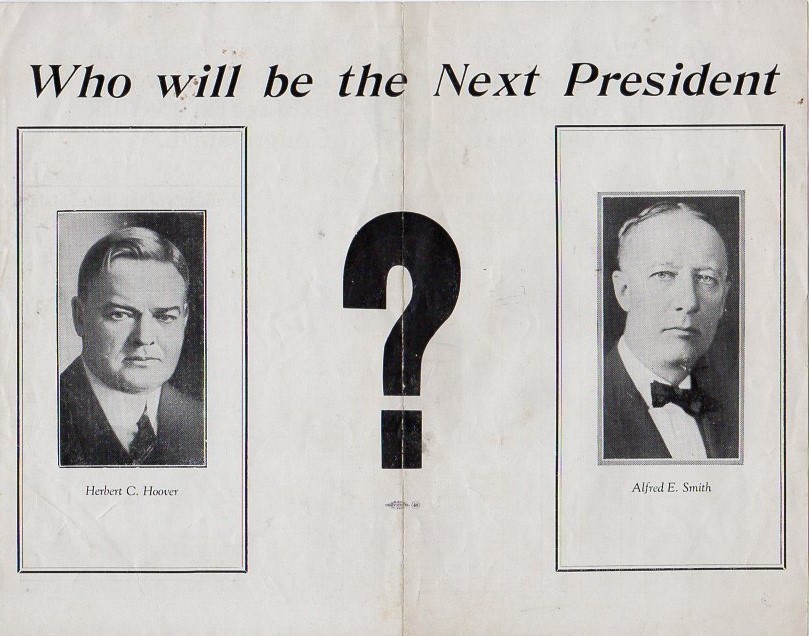
Campaign materials also reveal the period’s prejudices and assumptions. Original flyers, posters, political cartoons and news photographs can show how voters were encouraged to understand economic issues and religious identity. The 1928 flyer accompanying this article is historical campaign material, not an objective summary of the two candidates. It should be interpreted as a source demonstrating political messaging rather than adopted as a factual judgment about which candidate was superior.
Election results: 444 to 87
Hoover won the Electoral College by 444 votes to 87, carrying forty states to Smith’s eight. The National Archives confirms the electoral tally. Hoover received approximately 58.2% of the popular vote, while Smith won roughly 40.8%. Published exact vote totals can differ slightly between compilations, but the percentages and scale of the victory are clear. Hoover’s margin was substantial, though Smith still received millions of votes and built support in important urban areas.
The popular vote and the Electoral College describe different dimensions of the election. A strong national vote lead could translate into an especially lopsided electoral margin when many states were carried decisively. Yet a single total does not explain how different groups voted. Regional patterns reveal changes among Southern Democrats, urban voters and immigrant communities. The results are therefore a starting point for analysis rather than a complete explanation of the country.
The shifting political map
Smith carried Massachusetts, Rhode Island and six Southern states, while Hoover broke through in several states that had traditionally voted Democratic, including Texas and Virginia. This was a striking change in the so-called Solid South and reflected divisions over religion, Prohibition and party loyalty. Anti-Catholic appeals and local political concerns influenced some Southern campaigns. The fact that Smith lost certain Democratic strongholds did not mean every Southern voter shared one motive.
At the same time, Smith attracted substantial support in urban areas, previewing parts of the coalition Democrats would develop more fully in later decades. The 1928 result combined a Republican landslide with meaningful changes in Democratic electoral geography. Political historians examine local voting records, campaigns and demographics to understand those shifts rather than assuming the national result had one cause everywhere.
Why the turnout and electorate mattered
Participation rose substantially compared with the 1924 election. The growth reflected mobilization around religious identity, Prohibition, party competition and other issues. Women had been constitutionally protected against exclusion on account of sex since the Nineteenth Amendment, although discriminatory voting restrictions continued to limit participation among many Americans, particularly Black voters in the South. The electorate was therefore larger and more diverse than in earlier decades but still far from universally accessible.
The changing electorate complicated party strategies. Smith’s urban supporters included immigrant families and working-class voters, while Hoover retained broad appeal in many rural and suburban communities. These descriptions indicate tendencies rather than universal patterns. Individuals could vote for a candidate for economic, religious, regional or personal reasons, and political organizations varied in their ability to mobilize them. The 1928 election shows how social change could influence turnout without guaranteeing a victory for the candidate most identified with new groups.
From the 1928 election to the 1929 crash
Hoover was inaugurated on March 4, 1929. Later that year the stock market collapsed, and the United States entered the severe economic crisis remembered as the Great Depression. Those events reshaped the meaning of his presidency and his historical reputation. However, the date of the crash is essential: it happened after the election. Hoover won during a period when many voters associated Republican leadership with prosperity rather than with the future economic downturn.
The distinction helps historians avoid hindsight bias. An election outcome can be decisive without settling the later performance of an administration. Hoover’s policy decisions during the Depression are important subjects for separate analysis, while his 1928 campaign must be evaluated in its own context. The Great Depression overview explains the subsequent crisis and its broader causes.
What makes the 1928 election historically important
The election joined economic confidence, technological change, religion and national political identity in a contest that produced a clear Republican victory. Smith’s candidacy challenged longstanding assumptions about who could lead a major party, while the Prohibition issue exposed divisions within and between political coalitions. Hoover’s administrative reputation helped him secure a sweeping result, but the campaign also revealed changing urban and regional voting patterns.
The 1928 contest is most useful when compared with the 1920 presidential election and the political developments of the following decade. The earlier vote had marked a turn away from Wilson’s wartime leadership; the later election showed the appeal and limitations of the Republican 1920s coalition. The historic result, confirmed by the National Archives, belongs to 1928—not to the Depression voters could not yet foresee.
Timeline
- 1927: Herbert Hoover coordinates major flood relief
- June 1928: Republicans nominate Hoover and Curtis
- June 1928: Democrats nominate Smith and Robinson
- November 6, 1928: Hoover wins 444–87 electoral victory
- March 4, 1929: Hoover becomes president
- October 1929: Stock market crash begins severe financial crisis
Frequently asked questions
Who won the 1928 presidential election?
Republican Herbert Hoover defeated Democrat Al Smith.
What was the Electoral College vote?
Hoover received 444 electoral votes and Smith received 87.
What were the popular-vote percentages?
Approximately 58.2% for Hoover and 40.8% for Smith.
When was the election held?
November 6, 1928.
Why was Al Smith’s religion important?
He was the first Catholic major-party presidential nominee and faced significant anti-Catholic prejudice.
What was the Prohibition dispute?
Smith favored changes to national Prohibition, while Hoover generally supported the existing framework and enforcement.
Who were the running mates?
Charles Curtis ran with Hoover and Joseph T. Robinson with Smith.
Did the stock market crash happen before the election?
No. The election was in November 1928; the crash came in October 1929.