Sherman’s March to the Sea (1864): Route, Destruction and Savannah
After capturing Atlanta, Sherman marched through Georgia to the Atlantic while disrupting Confederate resources and transport.
Sherman’s March to the Sea took place from mid-November to late December 1864. Union general William T. Sherman led roughly 60,000 soldiers from Atlanta across Georgia toward Savannah, cutting railroad lines and destroying military infrastructure and supplies. Many civilians experienced severe property losses and forced requisitions. Confederate forces could not stop the march, and Union troops entered Savannah in December.
A source-based guide to the sequence, commanders, decisions and historical consequences.
On this page — 20 topics
What was Sherman’s March to the Sea?
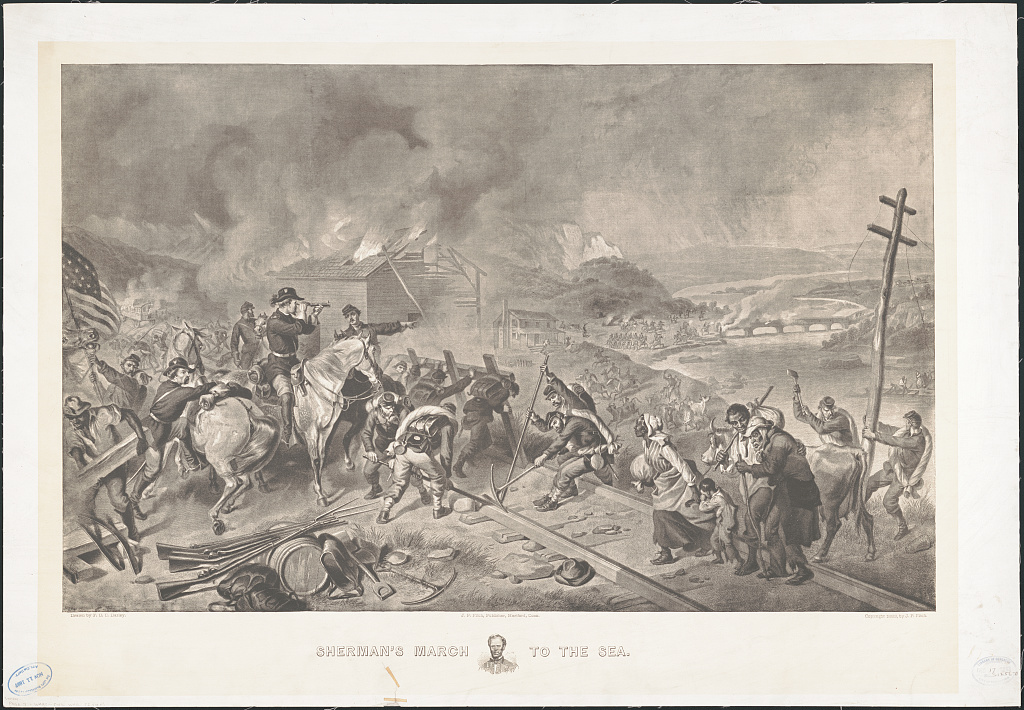
The March to the Sea was a Union campaign through Georgia after the capture of Atlanta in September 1864. Sherman moved his army toward the Atlantic without maintaining the same continuous railroad supply line back to Chattanooga. Soldiers marched in separate columns, gathered food and forage locally and damaged Confederate infrastructure.
The purpose was military and psychological. By demonstrating that federal troops could move through the Confederate interior, Sherman hoped to weaken the resources and confidence supporting continued resistance. The march ended with the occupation of Savannah, not with the surrender of every Confederate army. It is best studied as a distinct campaign after the Atlanta fighting.
Why did Sherman march through Georgia?
Atlanta’s fall deprived the Confederacy of an important rail and manufacturing center, but Confederate forces remained active and the war continued. Sherman decided that moving across Georgia could further disrupt communications and undermine the enemy’s ability to sustain soldiers in the field. The plan also avoided remaining tied to a vulnerable railroad supply line.
Grant’s armies were pressing Lee in Virginia, while Sherman could apply pressure across the Confederate interior. That coordinated strategy made separate Confederate commands less able to support one another. The March to the Sea therefore belonged to a wider effort to bring the war to an end through simultaneous military and economic pressure.
Where did the march begin and end?
Union columns departed Atlanta in mid-November 1864 and moved southeast toward Savannah. They did not follow one narrow road as a single mass of soldiers. Multiple routes allowed the army to cover a broad region, obtain food and confuse Confederate leaders about its precise destination.
The march crossed farms, railroads, towns and river systems in Georgia. Savannah lay near the Atlantic coast and could be connected to Union naval operations. Capturing the city would give Sherman a valuable base and show that Confederate defenses could not prevent his army from reaching the coast. Maps should display several columns rather than a straight line.
How many troops took part?
Sherman led roughly 60,000 Union soldiers, though precise figures vary with the formations and dates included. His force contained infantry, cavalry and artillery and was divided into organized wings. Commanders had to keep separate columns moving toward common objectives without the instant communications available to modern armies.
The size of the force made local resistance difficult. Confederate cavalry and small units harassed detachments, but there was no comparable field army positioned to defeat Sherman in a major battle during most of the march. Numbers alone were not sufficient, however: discipline, route planning, river crossings and food supply were critical to keeping such a large force moving.
What were Sherman’s military objectives?
The Union aimed to destroy or disrupt infrastructure that supported Confederate armies, including railroads, depots, bridges and stores of military value. Moving through the interior would also demonstrate the limits of Confederate protection for its own territory. The intended effect was to make continued war more costly and less feasible.
Sherman’s soldiers did not need to capture every village permanently. Their mission was to move, deny resources and then reach a coastal base. That distinction explains why the campaign included destruction and foraging without establishing continuous occupation across the whole route. It also raises important questions about how military necessity was defined and how civilians were affected.
What did ‘living off the land’ mean?
Union troops gathered food, fodder and supplies from farms and communities along the route. Organized foraging parties operated under military instructions, but the process could involve coercion, property seizure and abuse. Residents could lose animals, grain and other goods essential for surviving the winter.
The phrase should not be romanticized as soldiers simply accepting voluntary gifts. Foraging was often imposed on civilians with little power to refuse. Commanders attempted to regulate collections, but enforcement was uneven. The practice reduced dependence on long supply lines while transferring part of the army’s logistical burden onto the communities it passed through.
How were railroads destroyed?
Railroads were essential to Confederate transport, so Union troops tore up tracks, burned ties and heated or bent rails to make repairs difficult. Soldiers also targeted bridges, depots and other infrastructure with military value. The campaign became associated with twisted iron rails sometimes called Sherman’s neckties.
Not every track or bridge along the route was destroyed, and damage varied by location. Reconstruction of transportation took time and labor after the army departed. The military logic was clear: an enemy that could not move supplies efficiently would have less capacity to continue fighting. The civilian consequences were also substantial because railroads served commerce and communities.
Did Sherman burn every town in Georgia?
No. The familiar image of a single continuous wall of fire is misleading. The Union army damaged infrastructure, destroyed military stores and inflicted severe local property losses, but the scale and nature of destruction varied widely. Many buildings and settlements survived while others suffered heavily.
Claims about the march should distinguish Atlanta’s fires, actions along the route and later Confederate evacuations. Contemporary testimony can be vivid but sometimes partisan or incomplete. Comparing maps, military orders, photographs and local records gives a more accurate account than repeating the assertion that everything between Atlanta and Savannah was reduced to ashes.
What happened to enslaved people during the march?
The movement of a large Union army through slaveholding Georgia created opportunities for enslaved people to seek freedom. Many followed the columns or approached soldiers, hoping to escape bondage. Their decisions were acts of agency in conditions of uncertainty, not passive responses to generals’ plans.
The army could not guarantee safety or food to everyone who joined it. Some refugees were left behind at river crossings or separated from soldiers as the columns moved. These experiences expose both the liberating potential of Union military action and its severe limits. The history of the march cannot be told accurately without including Black Georgians’ decisions and hardships.
How did civilians experience the campaign?
Rural families faced the loss of livestock, food stores, fences, outbuildings and transportation. Confederate supporters and people who did not support secession could both suffer property damage when armies moved through their districts. Some civilians fled, while others stayed to protect their homes and remaining resources.
The historical record includes accounts of intimidation, destruction and attempts by some soldiers to limit unnecessary harm. Different witnesses remembered the same events differently. A responsible history should acknowledge the widespread civilian impact without assuming every reported incident occurred exactly as described or that every soldier acted the same way.
Who resisted Sherman’s army?
Confederate cavalry under Joseph Wheeler harassed Union foragers and detachments, while local defenders and troops assigned to protect key positions resisted where possible. Yet the Confederacy could not readily concentrate a field army strong enough to stop the main Union columns during the march.
Resistance had local effects and sometimes inflicted casualties, but it did not overturn Sherman’s advance. The contrast between scattered opposition and the organized Union army was part of the campaign’s strategic significance. It demonstrated how much Confederate military capacity had been weakened after years of warfare and the loss of Atlanta.
What happened at Fort McAllister?
Fort McAllister guarded an approach connected to the Savannah area. Union troops attacked and captured the fort on December 13, 1864, helping open communication with Union naval forces. The success was important because the marching army could secure supplies and coordinate with the fleet near the Atlantic coast.
The capture is sometimes overshadowed by Savannah’s occupation, but it was a distinct military engagement that helped bring the campaign to its conclusion. It connected a land army that had moved deep through Georgia with maritime support. The combination of land and sea operations increased the pressure on Confederate defenders near Savannah.
How did Savannah fall?
Confederate defenders under William J. Hardee eventually evacuated Savannah rather than remain trapped as Union forces closed in. Union troops entered the city around December 21, and Sherman reported the result to President Abraham Lincoln. The city was an important coastal and transportation prize.
Savannah’s occupation did not mean every building had been destroyed, and the widely repeated idea that Sherman spared it solely because he admired its beauty is an oversimplification. Military circumstances, Confederate withdrawal and the city’s usefulness all mattered. The event ended the march through Georgia and prepared the way for Union operations in the Carolinas.
Why is the Christmas present story famous?
Sherman sent Lincoln a message describing Savannah’s capture as a Christmas gift. The phrase became one of the best-known lines associated with the campaign and helped present the victory as a welcome sign of progress after years of war. It also gave political meaning to a military success achieved far from Washington.
However, the phrase should not eclipse the experience of people living along the route. The march involved confiscation, upheaval and destruction, along with the weakening of a slaveholding Confederacy. Celebratory language and the reality of the campaign must be considered together to understand why memories of Sherman remain contested.
What happened after the March to the Sea?
After reorganizing and resupplying around Savannah, Sherman’s armies moved north through the Carolinas in early 1865. The later campaign aimed to weaken remaining Confederate resistance and ultimately connect pressure across the eastern theater. It brought further fighting, damage and civilian hardship.
Those operations eventually contributed to Joseph E. Johnston’s surrender to Sherman in North Carolina after Lee had already surrendered in Virginia. The March to the Sea was therefore not the last Union campaign. It was a major transition between the conquest of Atlanta and the final collapse of Confederate armies.
How should Sherman’s campaign be assessed?
Military historians emphasize the strategic impact of destroying transport infrastructure and demonstrating that Confederate forces could not defend their interior. Social historians examine the consequences for civilians and enslaved people. The two approaches are complementary: the campaign’s military success depended partly on actions that brought the costs of war into civilian communities.
Avoid claims that every acre was burned or that all foraging was orderly and harmless. The truth lies in detailed accounts of different places, actions and people. Understanding both the military rationale and its human cost produces a more complete account of the march and why its reputation remains powerful.
Sherman’s March to the Sea 1864 timeline
These dates distinguish the main stages of the operation; the consequences often continued beyond the moment of battle.
| Date | Event |
|---|---|
| September 2 | Sherman occupies Atlanta. |
| November 15–16 | Union columns depart Atlanta. |
| Late November | Foraging and systematic destruction of selected railroads and infrastructure. |
| December 13 | Union troops capture Fort McAllister. |
| December 20–21 | Confederates evacuate Savannah; Union troops enter the city. |
| December 22 | Sherman announces Savannah’s capture to Lincoln. |
| Early 1865 | Sherman’s army begins the campaign through the Carolinas. |
Frequently asked questions
When did it happen? Nov–Dec 1864.
Where did it take place? Atlanta to Savannah, Georgia.
Who commanded the principal forces? Sherman, Hardee, Wheeler.
What was the outcome? Union occupies Savannah. The sections above explain the tactical result and the wider consequences.
How does it fit into the Civil War? For a broader chronology see the American Civil War guide.
Historical sources and further reading
The account uses National Park Service historical interpretation and Library of Congress records. Images are identified as contemporary photographs or later historical representations where applicable.