Red Summer of 1919: Racist Violence in Chicago, Washington and Elaine
Why widespread anti-Black violence erupted after World War I and what happened in Chicago, Washington, Omaha and Elaine.
Quick answer
The Red Summer of 1919 refers to a period of deadly racial violence across the United States, with major outbreaks in Chicago, Washington, D.C., Omaha and Elaine, Arkansas. White mobs attacked Black communities amid racist fear, postwar labor and housing conflicts and resistance to Black political and economic advancement. Black residents also organized resistance and self-defense. The events revealed that the end of World War I had not produced equal protection for African Americans.
Key facts
On this page
- What historians mean by Red Summer
- Why violence escalated after World War I
- Washington, D.C., in July 1919
- The Chicago violence and Eugene Williams
- Deaths, injuries and displacement in Chicago
- The Omaha attack and Will Brown
- The Elaine massacre in Arkansas
- Black self-defense, organizing and the press
- Why the phrase ‘race riot’ needs care
- Investigations and the limits of reform
- Legacy of the Red Summer of 1919
- Timeline
- Frequently asked questions
- Sources
What historians mean by Red Summer
The phrase Red Summer describes a series of racist attacks and violent confrontations in U.S. communities during 1919. It was not a single riot, a coordinated military campaign or an event confined to the South. Episodes occurred in northern industrial cities, the national capital and rural southern communities. The name is associated with the Black writer and civil-rights leader James Weldon Johnson, who used it to describe the extraordinary bloodshed. It captures a period in which local conflicts unfolded against national patterns of racial inequality.
Some contemporary newspapers called these events ‘race riots,’ a label that can obscure who initiated violence and who was targeted. Many incidents involved white mobs attacking African Americans and their neighborhoods, while Black residents resisted and sometimes defended themselves. Historians therefore look closely at the sequence and local context of each outbreak rather than assuming two equally powerful sides caused the violence in identical ways. The National Archives documents how the year’s attacks reached many different parts of the country.
Why violence escalated after World War I
American society changed rapidly during and after the First World War. The war drew workers into industrial employment, and the Great Migration brought many African Americans from the South to northern and midwestern cities. Some white residents and workers responded with hostility to changing neighborhoods, workplaces and political influence. Housing discrimination concentrated Black families in crowded districts, intensifying disputes about residential boundaries. Economic uncertainty after the war made competition for work and housing more bitter.
Returning Black veterans had served in the U.S. military and expected their citizenship and contributions to be respected. Many instead encountered segregation and racist hostility. White supremacists could view demands for equal treatment as threats to an established hierarchy. These conditions did not make mob violence inevitable or excusable; they help explain the social conflicts through which racist actors chose to use intimidation and force. The history demands attention to the decisions of attackers and officials, not merely to vague tensions.
Washington, D.C., in July 1919
Violence in Washington, D.C., broke out in July 1919, when white servicemen and other participants attacked Black residents in the nation’s capital. Reports and rumors fueled mobs, while police response and official actions became matters of criticism and debate. Black communities organized to defend homes and neighborhoods. The presence of violent attacks in the seat of federal government made the contradiction between national democratic ideals and racial inequality especially visible.
Newspapers reported the events differently, and racial bias shaped some contemporary coverage. Researchers therefore compare official records, Black press accounts and later historical investigations rather than treating every initial rumor as fact. The Washington violence showed that even where African Americans had community organizations and political connections, authorities could struggle or fail to ensure effective protection. It also demonstrated the importance of local Black efforts to oppose attackers.
The Chicago violence and Eugene Williams
One of the best-known incidents began in Chicago on July 27, 1919. Eugene Williams, a Black teenager, drowned after white men threw stones toward him and other Black youths at an unofficially segregated beach boundary on Lake Michigan. The response of police to the incident sparked anger, and violence spread through parts of the city. White mobs attacked Black residents, while many Black Chicagoans defended themselves. The unrest continued for days and required intervention by state authorities.
Chicago’s industrial growth and Great Migration population changes formed an important background, but the immediate tragedy at the beach matters in its own right. Describing Williams’s death only as a generic spark for a race riot can erase the actions that led to it and the failure to protect him. The city had discriminatory residential patterns and contested employment opportunities; those conditions created a climate in which the killing escalated into wider violence. The historical record shows victims, attackers and responses that should not be made morally interchangeable.
Deaths, injuries and displacement in Chicago
Chicago’s 1919 violence killed dozens of people and injured hundreds. A frequently cited figure is thirty-eight deaths, including twenty-three Black people and fifteen white people. Hundreds more were injured, and many residents experienced destroyed property, displacement or threats. Those totals relate to the Chicago events rather than all incidents across the country. The national death toll is harder to calculate, in part because the documentation for some southern massacres is incomplete.
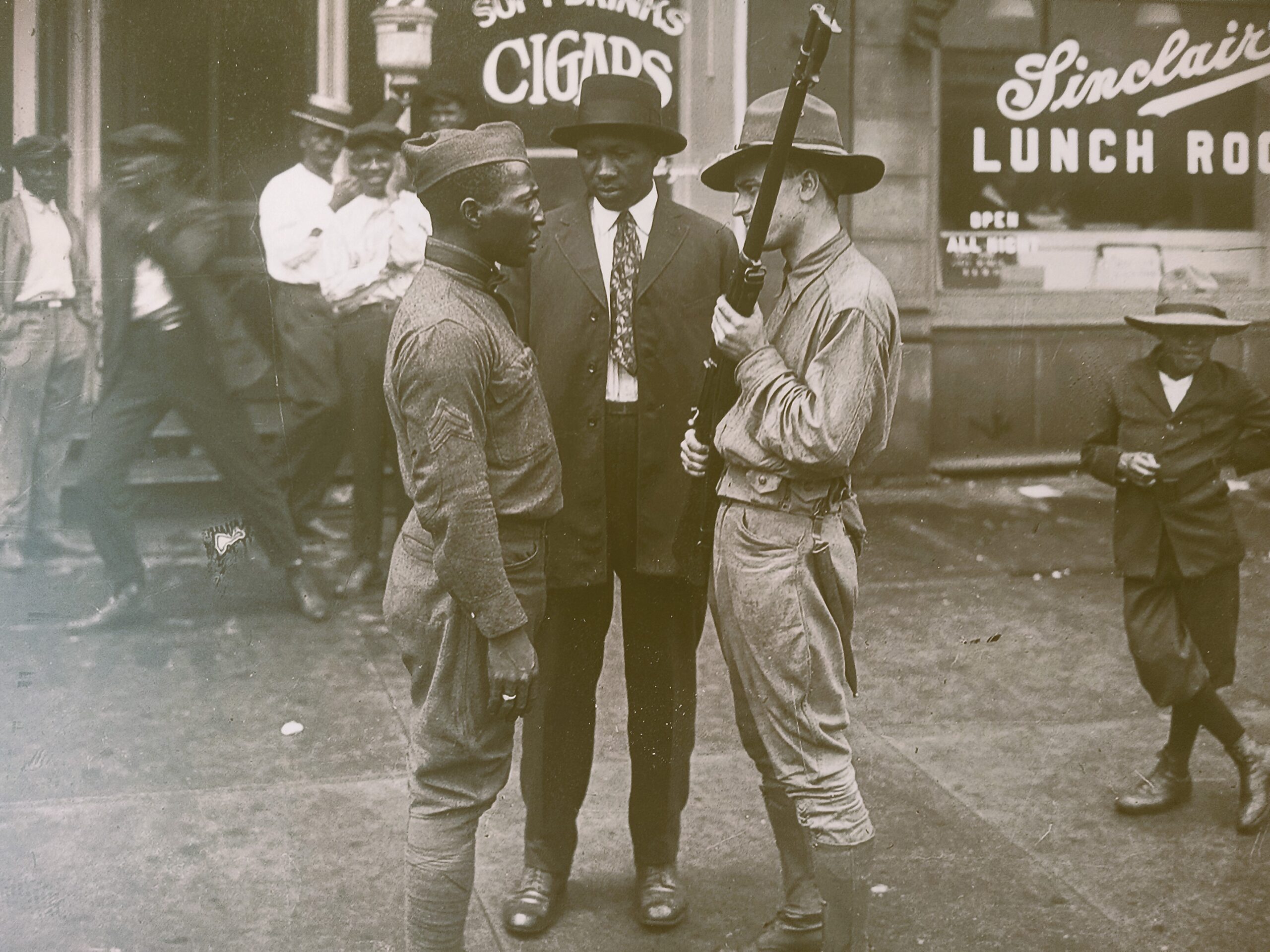
The photograph accompanying this article shows a Black man in conversation with members of the National Guard during the Chicago unrest. It is a period image, not an illustration made later to dramatize the events. It also does not depict Eugene Williams’s death. Precise image captions matter, especially for a subject in which photographs have sometimes been used without a clear location or date. Local commissions, newspapers and archives provide sources for reconstructing the violence beyond a single photograph.
The Omaha attack and Will Brown
In September 1919 white mob violence erupted in Omaha, Nebraska. The most notorious incident was the lynching of Will Brown, a Black man accused of a crime, after a mob attacked the courthouse and overwhelmed authorities. The episode exposed the danger faced by Black defendants when accusation and racial hostility displaced due process. The attack on the courthouse was also a dramatic assault on the ability of the local legal system to protect an accused person’s life.
The Omaha events form part of the Red Summer but were not identical to the Chicago conflict. Their immediate circumstances, local leaders and sequence were different. Studying these episodes separately prevents the mistaken idea that all 1919 violence followed one uniform pattern. What connects them is the use of racial terror and the repeated failure of institutions to protect equal citizenship. The experience of Will Brown also shows why legal rights are meaningful only when authorities enforce them.
The Elaine massacre in Arkansas
One of the deadliest episodes occurred near Elaine in Phillips County, Arkansas, beginning in late September 1919. Black sharecroppers and farmers were organizing to challenge exploitative cotton-payment arrangements when conflict and white violence escalated. White posses and armed groups killed large numbers of African Americans, and federal troops were sent to the area. Historians differ over the exact number of Black victims because records are incomplete; estimates of more than one hundred deaths are common, and some run substantially higher.
The broader setting involved rural land tenure, debt and efforts by Black workers to gain economic independence. The sharecropping and crop-lien systems explain why disputes over crop payments could involve significant inequality and intimidation. Elaine was not simply an urban job competition. Its roots lay in the political and economic power of landowners and the danger faced by Black agricultural organizers who demanded fair treatment.
Black self-defense, organizing and the press
Black residents and organizations did not respond to racist violence only with appeals for sympathy. People defended families, neighborhoods and businesses, sometimes while local authorities failed to intervene effectively. Community leaders and newspapers publicized attacks, documented victims and demanded investigations. The NAACP collected evidence and pressed for federal action, continuing work that had motivated its Silent Protest Parade in 1917 after the East St. Louis killings.
The Black press challenged misleading reports that portrayed targeted communities as primarily responsible for their own victimization. African American journalists and activists placed individual outbreaks within a national history of lynching, segregation and disenfranchisement. Their accounts are indispensable, although like all historical sources they benefit from comparison with other records. Organized protest and self-defense showed that Black Americans demanded protection and citizenship rather than accepting white supremacist violence as a normal condition.
Why the phrase ‘race riot’ needs care
Contemporary officials and newspapers frequently used ‘race riot’ for many different incidents. That language may suggest spontaneous conflict between two equally placed groups, when a more detailed account often reveals planned attacks by white mobs against Black residents. Historians therefore use specific descriptions such as massacre, lynching, mob attack or violent confrontation where they fit the evidence. The aim is not to impose a label without research but to describe agency and responsibility as accurately as possible.
The term Red Summer provides a useful grouping, but it also requires caution. Chicago involved urban segregation and a death at a lakeside beach; Elaine involved rural labor organizing and large-scale killings; Omaha involved mob violence around an accused prisoner. These histories overlap through racial injustice but cannot be collapsed into one event. Accurate accounts preserve the experiences of particular communities while explaining the wider national pattern.
Investigations and the limits of reform
After major outbreaks, public officials and private organizations collected testimony and proposed reforms. Chicago established a commission that investigated the causes of the violence and published findings in the early 1920s. Those inquiries documented discriminatory practices and social conditions, but collecting evidence did not automatically bring prosecutions or end segregation. Some communities faced continuing fear and material loss long after the news coverage faded.
The NAACP and other civil-rights groups used the events to advocate for federal action against lynching and for stronger protection of civil rights. Congressional debates continued, yet proposed measures encountered political resistance. The persistence of racist violence shows why the period cannot be understood as a straightforward march toward improvement following the First World War. Institutional changes were limited and uneven, while local organizing and legal challenges remained important.
Legacy of the Red Summer of 1919
The Red Summer reveals the national reach of white supremacist violence during a time of demographic and political change. Returning soldiers, industrial growth and Black migration created new opportunities, but racist movements sought to restrict Black advancement. The violence also demonstrates the importance of distinguishing a broader pattern from the distinct causes and consequences in each city or rural county. Detailed local history prevents national summaries from erasing individual victims and communities.
The events helped shape civil-rights organizing, Black journalism and later struggles over equal protection. They also connect to debates about federal responsibility and the role of local law enforcement. Studying 1919 alongside the Great Migration, the NAACP’s early work and subsequent legal campaigns shows how demands for full citizenship developed under intense threat. The Red Summer was not one isolated crisis; it was a warning about the fragility of rights where violence and discrimination were tolerated.
Timeline
- 1917: East St. Louis violence and NAACP Silent Parade
- Spring 1919: Racial conflicts and attacks in various U.S. communities
- July 1919: Washington, D.C., racial violence
- July 27–August 1919: Chicago race riot
- September 1919: Omaha lynching and Elaine massacre
- 1922: Chicago Commission report published
Frequently asked questions
What was Red Summer in 1919?
A series of racist attacks and violent confrontations across the United States in 1919, including major events in Chicago, Washington, Omaha and Elaine.
Why is it called Red Summer?
The term is associated with James Weldon Johnson and refers to the extraordinary bloodshed of the period.
What triggered the Chicago violence?
The drowning of Eugene Williams after white men threw stones at Black youths near an unofficially segregated beach, followed by failures and disputes over police response.
What happened in Elaine, Arkansas?
White violence against Black agricultural communities escalated after organizing over crop payments; large numbers of Black people were killed.
How many people died in Red Summer?
There is no single reliable national count. The Chicago death toll is often cited as 38; estimates for Elaine alone exceed 100.
Did the violence occur only in the South?
No. Major outbreaks also took place in Northern and Midwestern cities and in Washington, D.C.
Sources and further reading
Government historical records and specialist institutional sources support the main claims in this article.