Sharecropping After the Civil War: How It Worked and Why Debt Grew
How crop shares, land ownership and merchant credit shaped Southern farming after emancipation.
Sharecropping was a tenancy arrangement in which a household cultivated another person’s land and paid rent with a share of the harvest. It spread after 1865 because freedpeople lacked land and owners lacked cash wages. It provided some day-to-day autonomy but often created dependence on landlords and merchants through the crop-lien credit system.
This article explains what families agreed to, why debt accumulated and how sharecropping differed from slavery and other tenancy.
On this page — 21 topics
What was sharecropping after the Civil War?
Sharecropping was a system of agricultural tenancy in which a family worked land belonging to someone else and paid the owner with an agreed share of the harvest. It spread across the Southern United States after the Civil War, especially as formerly enslaved people sought independent households and plantation owners struggled to find cash to pay wages. The arrangement could provide more control over daily work than slavery’s gang-labor system, but ownership of land, tools and credit remained highly unequal. Many families became dependent on landlords and merchants for supplies. Sharecropping was practiced by both Black and white families, and conditions varied greatly among regions, crops and individual contracts. It was not a federal program or one law passed in 1865.
Why did sharecropping develop?
The war devastated Southern agriculture, damaged infrastructure and reduced the availability of cash and credit. Emancipation ended the slave labor system, but landowners still possessed large plantations while many freedpeople had little or no land. Employers needed a way to continue planting without paying every laborer in cash throughout the year. Workers wanted greater autonomy and often resisted returning to closely supervised gang labor. Sharing the harvest offered a compromise: families supplied labor and received part of what they grew, while owners provided access to fields and sometimes equipment. The system was not designed by one person. It emerged through bargaining, local custom, economic shortages and the unequal power left by slavery’s legacy.
How did a typical sharecropping agreement work?
A landowner allowed a family to cultivate a specified plot for a growing season. The agreement established how the harvest would be divided, commonly with a substantial portion going to the owner. The exact percentage depended on who provided land, animals, seed, tools, housing and other supplies. If the owner supplied nearly everything, the worker’s share was often smaller than that of a tenant supplying equipment independently. Many agreements were written, while others relied on oral understandings or informal local practice. The terms are important because “half the crop” was not a universal rule in every contract. Researchers should distinguish a sharecropper, who usually contributed primarily labor, from a cash tenant or share tenant with more resources of their own.
Could families decide what to plant?
Some families exercised greater control over the timing and organization of work than they had under slavery. They could manage household labor and, in certain agreements, cultivate food gardens alongside cash crops. However, landlords and creditors often influenced or dictated what to plant, particularly where cotton or tobacco could be sold to repay debts. A crop that promised cash at harvest might be preferred by merchants even if a family needed more food for its own use. Independence therefore existed on a spectrum. A household might choose daily work arrangements while still having little say over marketing or credit. The extent of autonomy depended on the contract, landowner and local markets.
How was sharecropping different from slavery?
Sharecroppers were not legally owned by landlords, and families could make contracts, maintain homes and claim compensation for their work. Emancipation created profound changes in family autonomy, legal status and the ability to organize religious and community life. Those differences should never be erased by calling sharecropping simply identical to slavery. At the same time, poverty and unequal economic power could make leaving a workplace very difficult, especially when debts were enforced through courts or threats. Some coercive practices amounted to illegal forced labor. The correct historical comparison recognizes both the fundamental change of legal freedom and the persistence of exploitative relationships that restricted its economic benefits.
What did formerly enslaved families want?
Many freedpeople hoped to own land, work in family groups, educate their children and avoid close supervision by former enslavers. Land ownership promised independence because it could reduce reliance on plantation landlords and provide a home secure from arbitrary eviction. The failure of broad land redistribution left these goals difficult to achieve. Sharecropping offered one possible route toward greater daily control and, in some cases, eventual savings. But high costs, uncertain cotton prices and restricted credit often prevented families from accumulating enough to purchase farms. Petitions, letters and records of labor agreements show that formerly enslaved people were active negotiators in this transformation, not passive recipients of a system created entirely by landowners.
Did sharecropping involve only African Americans?
No. Both Black and white Southern families entered sharecropping arrangements. Many white farmers also lacked land or had lost resources during the Civil War. The distribution of tenants differed across states and decades, and the majority of sharecroppers in some broader statistical accounts were white. Nevertheless, Black families often faced additional barriers through racism in credit, schooling, property markets and law enforcement. The experiences of sharecroppers should therefore not be generalized entirely from one group. A poor white tenant could face severe exploitation, while Black workers might encounter those same economic problems plus racial intimidation. Understanding these overlapping but distinct pressures is important for a complete social history of the postwar South.
What was the crop-lien system?
A crop lien was a legal claim on a future harvest used to secure credit. Farmers who lacked money before planting borrowed food, seed, tools or other supplies from merchants or landowners, promising repayment when the crop was sold. The system became widespread because rural banks offered little affordable credit. It allowed planting to continue but could create a cycle of dependence. Merchants sometimes charged high prices or interest, and poor harvests left households owing more than they could repay. Landowners and tenants could both become indebted, although sharecroppers generally had fewer assets with which to negotiate. The crop-lien system deserves separate study because it affected many farmers beyond those technically classified as sharecroppers.
Why did debt become so difficult to escape?
A sharecropping household often began the season needing food, clothing, seed or equipment but received payment only after harvest. Borrowing covered these expenses, with the future crop used as security. When cotton prices fell, pests damaged fields or the harvest was small, the family’s share might not cover the amount owed. The next season then began with a debt carried forward. Some merchants controlled the accounts and charged unfavorable prices, while tenants had little access to competing lenders. The resulting dependence could discourage movement or keep families working for the same creditor for years. The cycle was not inevitable in every case, but structural imbalances made it a persistent feature of the system.
How were profits and losses divided?
A family generally received its contractual portion only after the crop was measured, marketed and relevant charges calculated. The landowner might deduct advances, tools, seed or other expenses. Merchants with crop liens could claim repayment before a tenant received cash. Disputes arose over weighing cotton, bookkeeping and the prices assigned to supplies. Because some workers had limited literacy or access to independent records, challenging a calculation could be difficult. The risk of loss therefore extended beyond weather and crop prices to the reliability of accounting. A useful way to evaluate an individual contract is to ask who selected the buyer, who recorded the harvest, what deductions were permitted and whether the worker could inspect those records.
What was the role of cotton?
Cotton remained central to Southern agriculture because it could be sold in national and international markets and provided a product against which merchants could lend. Creditors often preferred tenants to plant cotton rather than food crops because the cash harvest offered a clearer route to repayment. This emphasis could increase vulnerability when cotton prices declined. Families with inadequate food production then had to borrow more goods from stores, deepening their dependence. Regions growing tobacco, rice or other crops developed related but not identical arrangements. The connection between sharecropping and cotton was therefore important, but the system should not be described as existing only in cotton fields or following exactly the same rules in every Southern county.
How did sharecropping affect family life?
Working a plot as a household could allow parents to spend more time with their children and organize tasks around family priorities, a sharp contrast with slavery’s forced labor arrangements. However, planting and harvesting remained physically demanding, and children’s labor often contributed to a family’s ability to survive. Schools might be attended irregularly during busy agricultural seasons. Debt and possible eviction made housing insecure. Women often performed field work as well as domestic labor, while family members negotiated responsibilities according to circumstances. Community churches, mutual aid and schooling offered support beyond the farm. The historical record includes moments of autonomy and resilience alongside exploitation, and both must be represented when describing ordinary lives.
Could sharecroppers legally leave a farm?
Sharecroppers were legally free workers or tenants, not property. But contracts, outstanding debts and local practices could restrict when or how they changed employers. Landlords might claim that a tenant could not depart before obligations were settled, while some communities faced threats or violence if workers challenged prevailing arrangements. Legal protections and enforcement varied over time. The distinction between a lawful debt claim and illegal coercion is essential. It would be inaccurate to say every sharecropper was physically imprisoned on a farm, just as it would be inaccurate to suggest that every person could move without consequence. Economic dependence could severely limit practical choice even in the absence of formal enslavement.
How was sharecropping connected to the Black Codes?
The Black Codes emerged immediately after the war and attempted to restrict freedpeople’s labor and independence. Some provisions penalized unemployment or departure from contracted employment. Sharecropping spread within the larger postwar environment in which land ownership was highly unequal and local officials often favored landowners. But Black Codes were not the only cause of sharecropping, and the system continued long after many early laws had been challenged or superseded. Shortages of cash, credit markets and agricultural risk also shaped it. Separating law from economic practice makes the history clearer and avoids implying that one statute created every tenancy arrangement in the South.
Did some sharecroppers become landowners?
Yes. Some tenants accumulated savings, improved their bargaining positions or acquired farms, although many remained trapped by debt and poverty. Outcomes differed by soil quality, crop prices, family circumstances and access to fair contracts. The existence of successful farmers does not erase the systemic problems faced by others. In areas with better opportunities, families might move from sharecropping to share tenancy, then cash rental or ownership. Elsewhere repeated bad harvests prevented progress. Historians use agricultural censuses, property records and individual family histories to investigate these trajectories. Such research reveals changes over time that are invisible in simple depictions of all sharecroppers as permanently dependent.
How long did sharecropping continue?
Sharecropping expanded after the Civil War and remained a major feature of Southern farming for decades. It persisted into the twentieth century, surviving the end of Reconstruction and the arrival of new labor and political systems. Mechanization, agricultural policy, urban employment and migration gradually reduced its importance. During the Great Depression, many tenant families faced worsening conditions, and New Deal policies affected landowners and tenants differently. The system therefore cannot be confined to 1865–1877 alone. Its long history illustrates how the economic consequences of slavery and the failure of broad land redistribution shaped Southern society across generations. Readers interested in the later period can compare the history of the Dust Bowl and agricultural migration, while keeping regional distinctions in mind.
What historical sources explain the system?
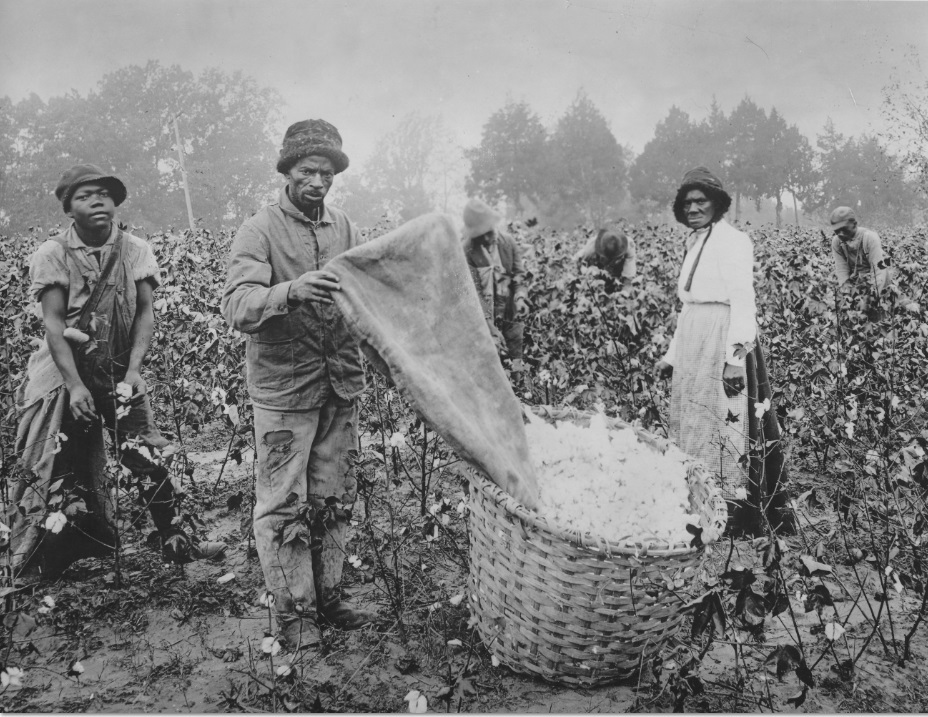
The National Park Service’s labor history studies trace the development of sharecropping and the crop-lien system, including the roles of landlords and merchants. Labor contracts, plantation account books, censuses and land records offer local evidence. Photographs of cotton workers help document farming conditions but do not necessarily identify whether the pictured people were sharecroppers, paid laborers or landowners. The image accompanying this article is captioned cautiously for that reason. A photograph alone cannot establish a household’s contract. Comparing documents, oral histories and later studies provides a more reliable account of economic relationships. The National Park Service labor-history project is a useful starting point for the broader context.
Why is sharecropping important to Reconstruction?
Sharecropping reveals the limits of emancipation as an economic transformation. Legal freedom gave families new rights and opportunities, but most formerly enslaved people did not receive farmland and had little access to capital. Landowners, merchants and credit systems continued to influence their work and income. Sharecropping offered some families greater autonomy than slavery while exposing them to serious risk and exploitation. The resulting system shaped racial inequality, migration, education and agricultural politics for generations. Understanding it complements the constitutional history of Reconstruction: the Thirteenth, Fourteenth and Fifteenth Amendments changed legal and political status, but they did not by themselves redistribute the land and wealth on which economic independence often depended.
Sharecropping timeline
| Period | Development |
|---|---|
| 1865 | Emancipation and the end of the plantation slave-labor system. |
| Late 1860s | Sharecropping and crop-lien credit spread across Southern farming. |
| 1870s–1890s | Many tenant families experience debt cycles and insecure tenure. |
| 1900s | Sharecropping remains important in the rural South. |
| Mid-1900s | Mechanization, migration and other changes reduce the system’s scale. |