1918 Influenza Pandemic in America: Three Waves, Deaths and Responses
How the 1918 flu spread through American cities and military camps, why it was unusually deadly and what governments attempted.
Quick answer
The 1918–1919 influenza pandemic killed an estimated 675,000 people in the United States and at least 50 million worldwide, according to historical estimates used by the CDC. A new influenza A (H1N1) virus spread in three major waves, with the deadliest U.S. outbreak during autumn 1918. Cities used different measures including restrictions on gatherings, school closures and masks, while World War I mobilization made control especially difficult.
Key facts
On this page
- What was the 1918 influenza pandemic?
- Why the name Spanish flu is misleading
- The first wave in spring 1918
- The deadly second wave in autumn 1918
- World War I and the spread of disease
- Why Philadelphia became a dramatic example
- St. Louis, Seattle and different city policies
- Health care and scientific limits in 1918
- Who bore the burden of the pandemic?
- The third wave and the end of the emergency
- Historical impact and lessons of the 1918 pandemic
- Timeline
- Frequently asked questions
- Sources
What was the 1918 influenza pandemic?
The influenza pandemic of 1918–1919 was a global outbreak that caused extraordinary sickness and death. The disease is frequently called the Spanish flu, although Spain has not been established as its place of origin. Historical epidemiologists generally describe three principal waves during 1918 and early 1919. The outbreak occurred while the First World War was moving soldiers, workers and civilians through crowded camps, ports, rail stations and ships. Those conditions helped spread infection and complicated public-health decisions.
The virus is now classified as an influenza A (H1N1) strain, a conclusion established by research long after the original outbreak. Doctors in 1918 did not have the modern laboratory tests, vaccines or antiviral medications associated with contemporary influenza response. They observed sudden fever, coughing, severe respiratory illness and many cases of pneumonia. Public officials had to make decisions with incomplete scientific knowledge and uneven systems for reporting cases and deaths.
Why the name Spanish flu is misleading
The name ‘Spanish flu’ became popular during the First World War, but it does not establish where the virus first infected people. Spain was a neutral country, and its newspapers reported widespread illness, including the sickness of King Alfonso XIII, while wartime censorship and propaganda affected reporting in some belligerent countries. That difference in news coverage contributed to the impression that Spain was especially connected with the outbreak. Historical reporting and the location of the pathogen’s origin are two separate issues.
Researchers have investigated several possible locations for early transmission, including parts of North America, Europe and Asia, but the evidence does not identify a universally accepted starting point. The CDC notes that there is no consensus about the virus’s geographic origin. A history article should therefore avoid claiming that the outbreak began in Spain or assigning a definite original city without evidence. The term is useful for identifying the pandemic in period sources, not for determining its origin.
The first wave in spring 1918
Influenza was reported in American military settings and civilian communities during the spring of 1918. The early wave spread widely but, in many places, caused a smaller proportion of severe outcomes than the devastating autumn surge. Camp Funston at Fort Riley in Kansas is often discussed because substantial early military illness was documented there in March. That does not prove it was the pandemic’s first case anywhere on earth. Multiple outbreaks were recorded, and gaps in contemporary surveillance make definitive origin claims unreliable.
American military camps were vulnerable because soldiers trained in close quarters and moved between installations and ports. Civilians and military personnel were connected through transport, suppliers and families. The spring outbreaks showed that influenza could travel quickly, but the later scale of mortality was not yet apparent to every official. The transition to the far deadlier second wave remains a subject of historical and scientific study. What is clear is that illness was already widespread before the autumn crisis.
The deadly second wave in autumn 1918
The second major wave during autumn 1918 produced catastrophic mortality. In the United States October was especially deadly; the CDC estimates approximately 195,000 American influenza deaths during that month alone. Hospitals faced overwhelming numbers of patients, and medical staff were sometimes sick themselves. Schools, theaters, churches and businesses confronted closures or changing rules. Communities also struggled to bury the dead and maintain essential services.
Mortality was striking because the pandemic affected healthy young adults to a degree unusual for seasonal influenza. Many deaths involved severe pneumonia, sometimes complicated by bacterial infections. Historical studies show an unusual age pattern, often described as a W-shaped mortality curve, with elevated risk among young adults as well as children and older people. The exact mechanisms of the virus’s severity are complex and still studied; it is not accurate to reduce every death to one simple cause.
World War I and the spread of disease
Troop transport was an important factor in the movement of influenza within and between countries. Soldiers lived in barracks, trained in groups and traveled by train and ship. Crowded transport allowed infections to spread quickly, while governments also considered the military consequences of changing movement schedules. Wartime communication and censorship affected information in some places, and demands of mobilization often conflicted with public-health priorities. The influenza pandemic and the war became overlapping emergencies.
Armistice celebrations in November 1918 created public gatherings during a period when influenza had not disappeared. It would be misleading to say that the pandemic ended the day fighting stopped. Deaths continued during the winter and spring of 1919, and some communities faced additional outbreaks after the most intense autumn peak. Our World War I timeline covers the military events separately; the influenza crisis shows how disease transformed the same years for civilians and soldiers.
Why Philadelphia became a dramatic example
Philadelphia suffered a major outbreak in the autumn of 1918. On September 28 the city went ahead with a large Liberty Loan parade amid warnings and increasing influenza cases. Within the following weeks hospitals, doctors and municipal services confronted a severe epidemic. The timing of the parade has made Philadelphia a prominent case in histories of how mass gatherings could aggravate transmission. It should not be described as the sole source of every infection in the city, since influenza was already circulating.
The Philadelphia experience illustrates the difficulty of acting quickly when health warnings competed with wartime patriotic campaigns and economic activity. Officials later imposed restrictions as the emergency worsened. Historians studying responses in different cities often contrast the timing and duration of public-health interventions. Such comparisons are informative but need to account for differences in population, record keeping, local spread and the exact measures used.
St. Louis, Seattle and different city policies
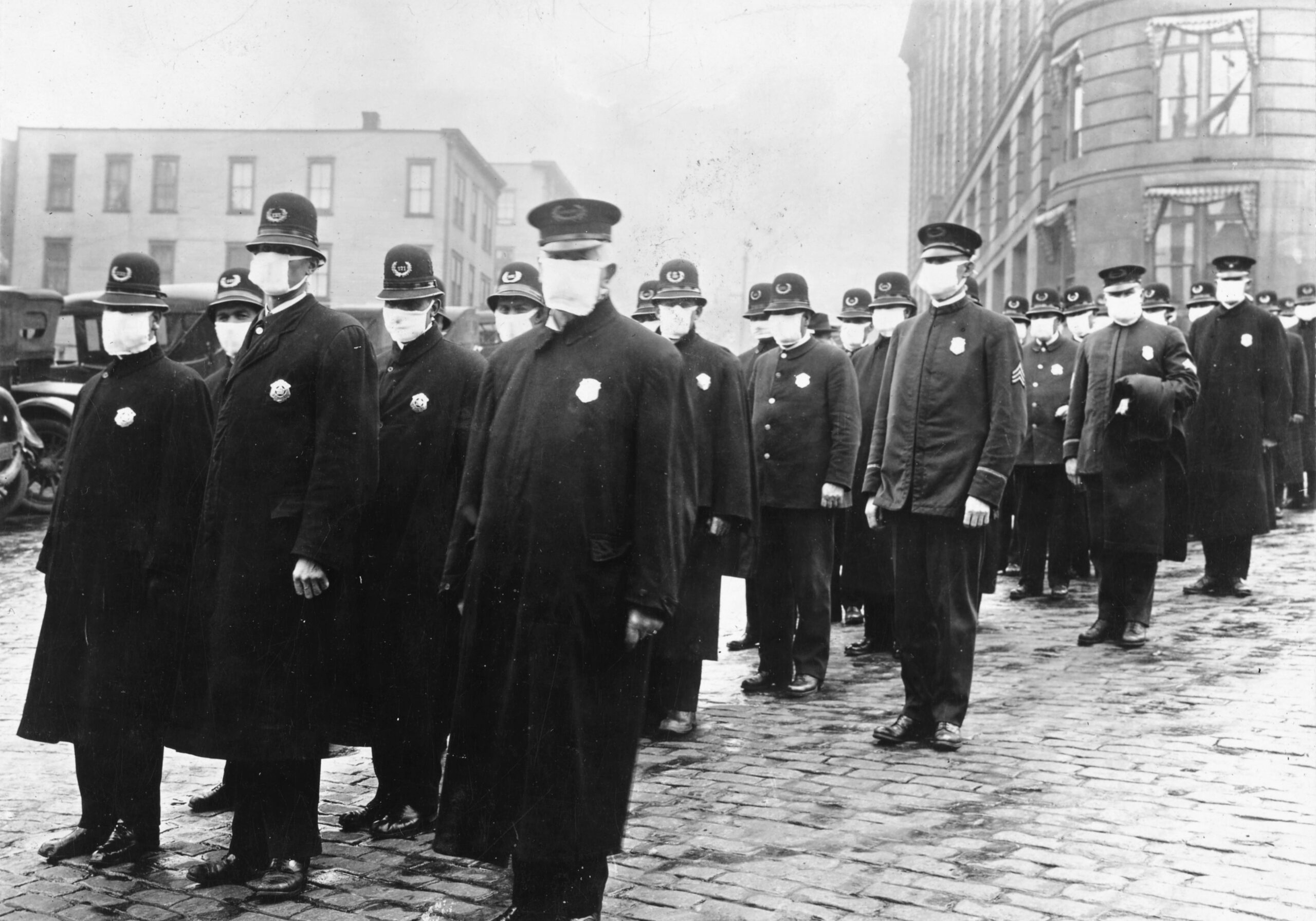
St. Louis became another widely discussed example because local leaders adopted restrictions on gatherings relatively early in the severe autumn wave. Different cities used closures of schools, theaters and public events, limits on meetings, isolation practices and public messaging. Seattle’s masked police officers, pictured with this article, show that some communities also required or encouraged face coverings for particular groups. But it is inaccurate to say every American city introduced the same mask rules at the same time.
Rules changed as public pressure, economic costs and disease conditions shifted. Enforcement could vary among neighborhoods and workplaces, and public compliance was not uniform. Some communities relaxed restrictions before transmission was fully controlled and faced additional illness. The historical record demonstrates both the potential of organized public-health action and its practical limits under conditions of incomplete information and public fatigue.
Health care and scientific limits in 1918
Physicians and nurses cared for patients without a vaccine targeted at the pandemic influenza virus. Antibiotics that would later treat many secondary bacterial pneumonias were not yet available. Some practitioners experimented with vaccines aimed at bacteria because viruses had not yet been identified as the cause of influenza. The existence of those historical experiments does not mean that a proven 1918 influenza vaccine existed. It shows the scientific uncertainty confronting clinicians at the time.
Care depended heavily on nursing, isolation, supportive measures and attempts to prevent spread. Hospitals could become overcrowded, while doctors, nurses and volunteers worked under serious risks of infection. Public recommendations in 1918 also included practices that later research questioned or replaced. These are historical facts about medical limitations, not instructions for treating modern illness. Contemporary influenza prevention and care must rely on current clinical evidence rather than reproducing century-old advice.
Who bore the burden of the pandemic?
Influenza affected people across age groups and social classes, but risk and access to care were not equal. Crowded housing, poverty, working conditions and unequal access to medical services could influence exposure and outcomes. Many industrial and service workers could not avoid contact with others or easily replace lost wages. Rural communities might face shortages of doctors and supplies, while cities confronted surges of patients over a short period. The pandemic magnified vulnerabilities already present in society.
The data are incomplete for some groups, and historical death registration did not provide consistent detail everywhere. It would be misleading to assume that all Americans faced identical circumstances because the virus was widespread. The experience of Black communities, immigrant workers, Indigenous people and poorer families was shaped by wider conditions of segregation and inequality. Researchers reconstruct those experiences from local health records, newspapers, oral histories and institutional archives.
The third wave and the end of the emergency
A third significant wave occurred during the winter and spring of 1919. It caused further illness and deaths, although the worst national mortality had already occurred in the autumn of 1918. Some communities experienced additional influenza activity through 1920. There was no single nationwide ceremony or universally agreed calendar date when the pandemic suddenly stopped. The familiar period 1918–1919 refers to the main waves rather than proving that the virus disappeared permanently at the end of 1919.
Scientists later studied the pandemic in part by recovering historical specimens and reconstructing its viral genome using specialized laboratory methods. Those investigations improved understanding of influenza evolution and disease severity decades after the events. For historians, the main lesson concerns what communities faced with the tools available at the time and how responses varied across the country. The 1918 pandemic did not create every modern public-health institution, but it became a lasting reference point for emergency planning.
Historical impact and lessons of the 1918 pandemic
The pandemic killed an estimated 675,000 people in the United States, a toll that affected families, workplaces and communities on an enormous scale. The CDC’s estimate of at least 50 million deaths worldwide places it among the deadliest infectious-disease disasters in recorded history. Because record keeping and attribution differed, these are estimates rather than a perfectly counted list of victims. The loss was especially painful in a period already marked by mass casualties in the First World War.
Understanding 1918 means separating documented responses from assumptions that the authorities knew everything later science would discover. The disease spread in waves, public policies differed and medical resources were constrained. Archival photographs, such as Seattle officers wearing masks in December 1918, reveal particular practices without representing the whole country. The resulting history is not a simple success or failure story; it is an account of communities responding under severe uncertainty and learning from the consequences.
Timeline
- March 1918: Large outbreaks observed in American military settings
- Summer 1918: Influenza spreads through international troop movement
- September 1918: Severe second wave expands
- October 1918: U.S. records exceptionally high mortality
- November 1918: Armistice; influenza remains active
- Winter–spring 1919: Third major wave
- Later decades: Scientific investigations clarify the viral cause
Frequently asked questions
How many Americans died in the 1918 influenza pandemic?
The CDC commonly cites an estimate of approximately 675,000 deaths in the United States.
How many waves occurred?
Three major waves are usually described: spring 1918, autumn 1918 and winter/spring 1919.
Did the flu start in Spain?
Its geographic origin remains uncertain. The term Spanish flu reflects historical reporting patterns, not a proven origin.
Why did so many young adults die?
The pandemic had an unusually severe age pattern, including high mortality in healthy young adults; its mechanisms remain complex.
Was there an influenza vaccine in 1918?
No proven vaccine against the pandemic influenza virus existed.
Did masks and closures happen everywhere?
No. Public-health measures and the timing of their use varied between communities.
Sources and further reading
Government historical records and specialist institutional sources support the main claims in this article.