Home / Modern History / World War I
World War I Timeline: 1914–1918, Major Battles and Key Events
Follow World War I year by year—from the assassination of Archduke Franz Ferdinand and the July Crisis to Verdun, the Somme, U.S. entry, the Russian Revolution and the Armistice of 11 November 1918.
Published 29 September 2026
World War I transformed Europe and the wider world between 1914 and 1918. What began as a crisis between Austria-Hungary and Serbia expanded within weeks into a war involving the major European powers and, eventually, states and colonies across the globe.
The conflict introduced industrialized killing on an unprecedented scale. Artillery, machine guns, poison gas, submarines, aircraft, tanks and mass conscription reshaped warfare while millions of soldiers endured trenches stretching from the North Sea to Switzerland.
This timeline follows the war year by year, focusing on the major political decisions, campaigns and battles that changed its direction. For the deeper background to the alliance system and prewar crisis, see The First World War: Causes, Alliances and Key Figures.
When did World War I begin?
World War I is conventionally dated from 28 July 1914, when Austria-Hungary declared war on Serbia.
The conflict expanded rapidly. Germany declared war on Russia on 1 August and France on 3 August. German forces invaded neutral Belgium, prompting Britain to declare war on Germany on 4 August.
Within days, a Balkan crisis had become a European war.
Why did World War I start?
The immediate trigger was the assassination of Archduke Franz Ferdinand, heir to the Austro-Hungarian throne, in Sarajevo on 28 June 1914.
But the assassination became a general war because Europe was already divided by strategic rivalries, military planning, nationalism, imperial competition and alliance commitments.
The crisis that followed the assassination is known as the July Crisis.
28 June 1914: assassination in Sarajevo
Archduke Franz Ferdinand and his wife Sophie were visiting Sarajevo in Bosnia when they were assassinated by Gavrilo Princip, a Bosnian Serb nationalist.
Austria-Hungary blamed Serbia for supporting the nationalist networks behind the plot.
Germany gave Austria-Hungary strong diplomatic backing, often called the “blank cheque.”
23 July 1914: Austria-Hungary sends an ultimatum
Austria-Hungary delivered a deliberately severe ultimatum to Serbia.
Serbia accepted many demands but rejected or qualified others that it believed infringed its sovereignty.
Austria-Hungary judged the response insufficient.
28 July 1914: Austria-Hungary declares war on Serbia
One month after the assassination, Austria-Hungary declared war on Serbia.
Russian leaders feared the destruction of Serbia and began military preparations.
Mobilization plans quickly pulled other powers toward war.
1–4 August 1914: Europe goes to war
- 1 August: Germany declares war on Russia.
- 3 August: Germany declares war on France.
- 4 August: Germany invades Belgium.
- 4 August: Britain declares war on Germany.
Austria-Hungary and Russia also moved into open conflict, and the war soon spread well beyond the original dispute with Serbia.
The main alliances
The principal coalition fighting Germany and Austria-Hungary became known as the Allies or Allied Powers.
Major Allied powers included France, Britain, Russia and later Italy and the United States, alongside many other states and imperial forces.
The opposing coalition became known as the Central Powers, led by Germany and Austria-Hungary and later including the Ottoman Empire and Bulgaria.
1914: Germany attacks through Belgium
German war planning aimed to defeat France rapidly before concentrating forces against Russia.
German armies advanced through Belgium and northern France.
The invasion violated Belgian neutrality and brought Britain directly into the war.
Belgian resistance and logistical difficulties helped slow the German advance.
August 1914: Battle of Tannenberg
On the Eastern Front, Russian armies invaded East Prussia.
German forces under Paul von Hindenburg and Erich Ludendorff defeated the Russian Second Army at the Battle of Tannenberg in late August.
The victory became one of Germany’s most celebrated military successes of the war.
It did not, however, knock Russia out of the conflict.
September 1914: First Battle of the Marne
German armies approached Paris, but French and British forces counterattacked along the Marne.
Between 6 and 12 September, the German advance was halted and pushed back.
The failure to defeat France quickly ended hopes for a short war in the west.
The Race to the Sea
After the Marne, both sides tried to outflank each other toward the north.
This series of movements became known as the Race to the Sea.
By late 1914, opposing armies had established trench systems from the Belgian coast to the Swiss frontier.
Why did trench warfare develop?
Modern defensive weapons made open attacks extremely costly.
Machine guns, rapid-firing artillery, barbed wire and rifles gave defenders enormous advantages.
Soldiers dug trenches for protection, and temporary field defenses gradually became complex systems of front lines, support trenches, dugouts and communication routes.
The Western Front
The Western Front became the most famous theater of the war.
For most of the conflict, Allied and German armies faced each other across a relatively narrow but heavily fortified zone in Belgium and France.
Huge offensives often gained only limited territory at enormous human cost.
December 1914: the Christmas Truce
In several sectors of the Western Front, British and German soldiers held unofficial local truces around Christmas.
Men exchanged greetings, buried dead and in some areas met in no man’s land.
The truce was not universal and did not end the war.
Commanders discouraged similar fraternization afterward.
1915: the war expands
By 1915, it was clear that the war would not end quickly.
New fronts opened, the Ottoman Empire became a major combatant, Italy entered the war, submarine warfare intensified and poison gas was used on a large scale.
22 April 1915: Second Battle of Ypres and poison gas
German forces released chlorine gas near Ypres in Belgium.
This was not the first use of chemical agents in the war, but it was the first large-scale successful use of lethal poison gas on the Western Front.
Gas became one of the conflict’s most feared weapons, though artillery remained responsible for far more casualties overall.
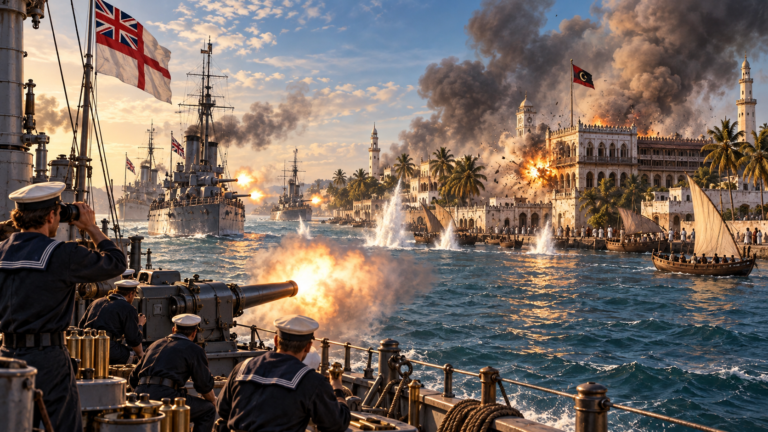
25 April 1915: Gallipoli landings
Allied forces landed on the Gallipoli Peninsula in an attempt to force a route through the Dardanelles and weaken the Ottoman Empire.
British, French, Australian, New Zealand and other troops faced strong Ottoman resistance.
The campaign became a costly stalemate.
Why did Gallipoli fail?
The Allies underestimated Ottoman defenses and faced difficult terrain, inadequate planning, disease and supply problems.
Repeated attacks failed to achieve a decisive breakthrough.
The Allied evacuation was completed in early 1916.
Gallipoli became especially significant in Australian, New Zealand and Turkish national memory.
7 May 1915: sinking of the Lusitania
A German U-boat sank the British passenger liner Lusitania off Ireland.
Nearly 1,200 people died, including more than 100 U.S. citizens.
The sinking angered public opinion in the United States but did not cause immediate American entry into the war.
23 May 1915: Italy enters the war
Italy had been formally allied with Germany and Austria-Hungary before 1914 but initially remained neutral.
After secret negotiations with the Allies, Italy declared war on Austria-Hungary in May 1915.
Fighting concentrated along the mountainous Italian Front.
The Isonzo battles
Italian and Austro-Hungarian armies fought repeated battles along the Isonzo River.
From 1915 to 1917, twelve major battles were fought in this area.
The terrain made offensive operations extraordinarily difficult.
1916: the year of Verdun and the Somme
Two of the most destructive battles of the war dominated the Western Front in 1916.
Verdun became a symbol of French endurance, while the Somme became closely associated with British and Commonwealth sacrifice.
21 February 1916: Battle of Verdun begins
Germany launched a major offensive against the fortified region of Verdun in northeastern France.
The battle lasted for most of the year.
Both sides suffered hundreds of thousands of casualties.
Verdun became one of the longest and most famous battles in military history.
Why was Verdun important?
Verdun had symbolic importance to France and lay within a major fortified zone.
German strategy aimed to place the French army under extreme pressure.
The French command committed enormous resources to holding the area.
The battle became a national symbol summarized by the phrase “They shall not pass.”
31 May–1 June 1916: Battle of Jutland
The British Grand Fleet and German High Seas Fleet fought the largest naval battle of the war in the North Sea.
Germany inflicted heavier ship and personnel losses, but Britain maintained strategic control of the sea and its naval blockade.
The German battle fleet did not break British maritime dominance.
1 July 1916: Battle of the Somme begins
British and French forces launched a major offensive along the River Somme.
The first day became the bloodiest single day in British military history, with roughly 57,000 British casualties, including more than 19,000 dead.
The battle continued until November.
Tanks appear on the battlefield
British forces first used tanks in battle on the Somme in September 1916.
Early tanks were slow, mechanically unreliable and available in small numbers.
They nevertheless pointed toward a new form of mechanized warfare that would become far more important by 1918.
How many died at Verdun and the Somme?
Precise casualty figures vary by source and definition.
Verdun produced roughly 700,000 French and German casualties combined.
The Somme produced more than one million casualties among British Empire, French and German forces.
These totals include killed, wounded and missing rather than deaths alone.
1917: a turning point
In 1917, the strategic balance changed dramatically.
Germany resumed unrestricted submarine warfare, the United States entered the conflict, Russia underwent two revolutions and eventually began withdrawing from the war.
1 February 1917: unrestricted submarine warfare resumes
Germany announced that its submarines would attack shipping around Britain without the previous restrictions that had limited some operations.
German leaders hoped to cut Britain off from essential supplies before U.S. intervention could become decisive.
The policy instead helped bring the United States into the war.
The Zimmermann Telegram
Germany sent a secret message proposing an alliance with Mexico if the United States entered the war.
Britain intercepted the telegram and passed it to the U.S. government.
Its publication further damaged American opinion toward Germany.
6 April 1917: United States enters World War I
The United States declared war on Germany.
President Woodrow Wilson argued that German submarine warfare threatened American rights and international order.
American forces took time to mobilize in large numbers, but U.S. manpower and economic resources increasingly strengthened the Allied position.
The Russian Revolution
Russia suffered severe military losses, economic strain and political unrest.
In March 1917 according to the modern calendar, Tsar Nicholas II abdicated after revolution in Petrograd.
A Provisional Government continued the war.
November 1917: Bolsheviks seize power
The Bolsheviks led by Vladimir Lenin overthrew the Provisional Government.
They had promised to end Russia’s participation in the war.
An armistice with the Central Powers followed.
Passchendaele
The Third Battle of Ypres, often called Passchendaele, took place from July to November 1917.
Heavy rain and artillery fire turned much of the battlefield into deep mud.
The offensive produced major casualties for limited territorial gains and became another enduring symbol of trench warfare.
Caporetto
In October 1917, German and Austro-Hungarian forces broke through the Italian line at Caporetto.
The Italian army retreated more than 100 kilometers before stabilizing along the Piave River.
The disaster forced a major reorganization of Italian command.
20 November 1917: Battle of Cambrai
British forces used tanks in unusually large numbers at Cambrai.
The initial attack demonstrated that tanks, artillery and infantry could sometimes break through prepared defenses when coordinated effectively.
German counterattacks later recovered much of the lost ground.
1918: Russia leaves the war
On 3 March 1918, the Bolshevik government signed the Treaty of Brest-Litovsk with the Central Powers.
Russia surrendered large territories and formally left the conflict.
This allowed Germany to transfer substantial forces from the Eastern Front to the west.
21 March 1918: German Spring Offensive
Germany launched a series of massive attacks on the Western Front beginning with Operation Michael.
New infiltration tactics helped German troops achieve major advances.
For a time, the Allied position appeared extremely dangerous.
Why did the German Spring Offensive fail?
German armies advanced but suffered heavy casualties among experienced troops.
Supply lines became stretched, objectives shifted and the offensives failed to destroy the Allied armies.
Germany could not replace losses as effectively as the Allies, while American troops were arriving in increasing numbers.
American troops arrive in force
By 1918, large numbers of soldiers from the American Expeditionary Forces were reaching France.
U.S. troops fought major actions at places including Cantigny, Belleau Wood, Saint-Mihiel and the Meuse-Argonne.
The arrival of fresh manpower changed the strategic calculation facing Germany.
July 1918: Second Battle of the Marne
The final major German offensive was stopped during the Second Battle of the Marne.
Allied forces then moved increasingly onto the offensive.
The initiative had shifted decisively.
8 August 1918: Battle of Amiens
British Empire, French and other Allied forces launched a coordinated attack near Amiens using infantry, artillery, tanks and aircraft.
The attack achieved a major breakthrough.
Ludendorff later described 8 August as a “black day” for the German Army.
The Hundred Days Offensive
Amiens began a sequence of Allied offensives often called the Hundred Days.
German forces were steadily pushed back through positions that had taken years to build.
The Allies broke through the Hindenburg Line, while Germany’s partners also began collapsing on other fronts.
The Central Powers collapse
Bulgaria agreed to an armistice in September 1918.
The Ottoman Empire followed in October.
Austria-Hungary disintegrated amid military defeat and nationalist movements and signed an armistice in early November.
Germany was increasingly isolated.
Revolution in Germany
Naval mutinies and political unrest spread across Germany in late 1918.
Kaiser Wilhelm II abdicated on 9 November.
A German republic was proclaimed.
11 November 1918: the Armistice
German representatives signed an armistice with the Allies in a railway carriage at Compiègne in France.
The agreement took effect at 11 a.m. on 11 November 1918.
Fighting on the Western Front ceased.
The armistice ended the combat, but it was not the final peace treaty.
How long did World War I last?
From Austria-Hungary’s declaration of war on Serbia on 28 July 1914 to the Western Front armistice on 11 November 1918, the war lasted a little over four years.
Fighting and political violence continued in some regions after the armistice as empires collapsed and new states fought over borders.
1919: Treaty of Versailles
The Paris Peace Conference opened in January 1919.
The Treaty of Versailles with Germany was signed on 28 June 1919, exactly five years after the assassination of Franz Ferdinand.
The treaty imposed territorial losses, military restrictions and reparations obligations on Germany.
Did the Treaty of Versailles cause World War II?
The treaty contributed to political resentment in Germany, but World War II cannot be explained by Versailles alone.
The later rise of Nazism also depended on the Great Depression, political instability, nationalism, the weakness of international institutions and deliberate choices made by Adolf Hitler and his supporters.
For the economic crisis that destabilized the interwar world, see our guide to the Great Depression.
What was life like in the trenches?
Front-line soldiers lived with artillery fire, snipers, mud, rats, lice, disease and the constant possibility of attack.
Trench systems could include front lines, support lines, communication trenches, dugouts and fortified strongpoints.
Soldiers usually rotated between front-line positions and areas farther behind the battlefield rather than spending the entire war continuously in the same trench.
No man’s land
The exposed ground between opposing trench systems became known as no man’s land.
It could contain shell craters, barbed wire and bodies.
Infantry assaults often required soldiers to cross this open ground under machine-gun and artillery fire.
Artillery: the dominant killer
Machine guns became an iconic weapon of trench warfare, but artillery caused a very large proportion of battlefield casualties.
Heavy guns could bombard trenches from kilometers away.
Shelling destroyed landscapes, communications and morale and created the cratered terrain associated with the Western Front.
Machine guns
Modern machine guns could fire rapidly and make frontal infantry attacks exceptionally dangerous.
They were especially effective when combined with barbed wire and artillery.
Armies gradually developed new tactics to overcome these defenses.
Poison gas
Chemical weapons included chlorine, phosgene and mustard gas.
Gas caused terror and terrible injuries, but protective masks improved during the war.
Chemical weapons did not become the decisive weapon some commanders initially hoped they would be.
Aircraft
Aircraft began the war mainly as reconnaissance tools.
Pilots observed enemy movements and helped direct artillery.
Fighter aircraft, bombers and specialized air units developed rapidly as both sides tried to control the skies.
Submarines
German U-boats threatened Allied shipping in the Atlantic.
Unrestricted submarine warfare came close to creating a severe shipping crisis for Britain in 1917.
The Allied introduction of convoy systems helped reduce losses.
The global war
World War I was not limited to France and Belgium.
Major campaigns also occurred in:
- Eastern Europe;
- the Balkans;
- Italy;
- the Ottoman Empire;
- the Middle East;
- Africa;
- the Caucasus;
- the Pacific and colonial territories.
Millions of soldiers and laborers from European empires served far from their homes.
Colonial troops and imperial armies
Britain and France drew heavily on their empires.
Soldiers from India, Canada, Australia, New Zealand, Africa, the Caribbean and other regions served in multiple theaters.
French forces also included large numbers of troops from North and West Africa.
The war’s global manpower makes the phrase “European war” inadequate.
The Ottoman front
The Ottoman Empire fought Russia in the Caucasus and Allied forces at Gallipoli, in Mesopotamia, Palestine and elsewhere.
The war contributed to the eventual collapse of the Ottoman Empire.
It was also the context for the mass deportation and killing of Armenians beginning in 1915, recognized by many historians and governments as the Armenian genocide.
Women and the war
Women took on expanded roles in factories, transport, agriculture, offices and medical services as millions of men entered the armed forces.
Women already worked before 1914, but wartime mobilization changed the scale and visibility of female labor in many sectors.
The war contributed to political arguments over women’s citizenship and voting rights, though suffrage reforms differed greatly by country.
How many people died in World War I?
Exact totals vary.
Roughly nine to ten million military personnel died as a direct result of the war, while millions of civilians also died from violence, hunger, disease and displacement.
Tens of millions more were wounded.
The human consequences extended far beyond the battlefield.
The Spanish flu and the end of the war
The influenza pandemic of 1918–1919 killed millions worldwide.
Military camps, troop transports and mass movements of people helped disease spread rapidly.
The pandemic was not caused by World War I, but wartime conditions shaped its transmission and made the final year of the conflict even more deadly.
What empires collapsed because of World War I?
Four major imperial systems collapsed or were fundamentally transformed:
- the German Empire;
- Austria-Hungary;
- the Russian Empire;
- the Ottoman Empire.
New states emerged, borders changed and nationalist conflicts continued after 1918.
World War I timeline: key dates at a glance
- 28 June 1914: Archduke Franz Ferdinand assassinated in Sarajevo.
- 28 July 1914: Austria-Hungary declares war on Serbia.
- 1 August 1914: Germany declares war on Russia.
- 4 August 1914: Britain declares war on Germany after the invasion of Belgium.
- 6–12 September 1914: First Battle of the Marne.
- 22 April 1915: major poison-gas attack at Second Ypres.
- 25 April 1915: Gallipoli landings.
- 7 May 1915: Lusitania sunk.
- 21 February 1916: Battle of Verdun begins.
- 31 May 1916: Battle of Jutland begins.
- 1 July 1916: Battle of the Somme begins.
- 6 April 1917: United States declares war on Germany.
- 1917: Russian Revolutions transform the Eastern Front.
- 3 March 1918: Treaty of Brest-Litovsk.
- 21 March 1918: German Spring Offensive begins.
- 8 August 1918: Battle of Amiens begins the Hundred Days.
- 9 November 1918: Kaiser Wilhelm II abdicates.
- 11 November 1918: Armistice ends fighting on the Western Front.
- 28 June 1919: Treaty of Versailles signed.
World War I FAQ
What started World War I?
The immediate trigger was the assassination of Archduke Franz Ferdinand, followed by the July Crisis. Alliance commitments, military planning, nationalism and strategic rivalry helped turn the crisis into a general war.
Who won World War I?
The Allied powers defeated the Central Powers. Germany accepted an armistice in November 1918 after its partners had collapsed and Allied armies were advancing.
When did the United States enter World War I?
The United States declared war on Germany on 6 April 1917.
What was the deadliest battle of World War I?
The answer depends on how casualties and battle boundaries are defined. Verdun and the Somme were among the most costly, while campaigns on the Eastern Front also produced enormous losses.
When did World War I end?
Fighting on the Western Front ended when the armistice took effect at 11 a.m. on 11 November 1918. Formal peace settlements followed later.
Why was it called the Great War?
Before World War II, the conflict was commonly known as the Great War because of its unprecedented geographic scale, mobilization and casualties.
Was World War I only fought in Europe?
No. Fighting occurred in Europe, the Middle East, Africa, Asia and the Pacific, and imperial troops from across the world took part.
Sources and further reading
- Imperial War Museums — First World War
- Imperial War Museums — What You Need to Know About the First World War
- Encyclopaedia Britannica — World War I
- Hew Strachan, The First World War.
- David Stevenson, 1914–1918: The History of the First World War.
CONTINUE EXPLORING
More Modern History
Stories, people and events that shaped our world. Explore history with context, clarity and curiosity.
© 2026 Passion for History. All rights reserved.
Some content is created with AI assistance and may contain errors. We aim to review, verify and improve our articles over time.