Bonus Army March of 1932: Veterans, Hoover, MacArthur and the Eviction
Why World War I veterans demanded early bonus payments in 1932, what happened on July 28 and how the episode affected Hoover’s reputation.
Quick answer
The Bonus Army was a protest movement of World War I veterans who gathered in Washington, D.C., in 1932 to demand immediate payment of service compensation scheduled mainly for 1945. Thousands camped in and around the city while Congress considered an early-payment bill. After police confronted marchers on July 28, President Herbert Hoover ordered federal troops to restore order. General Douglas MacArthur pushed the operation beyond Hoover’s intended limits, and soldiers cleared the Anacostia encampment using force; shelters burned. Congress approved early payment in 1936.
Key facts
On this page
- Why World War I veterans demanded the bonus
- The Adjusted Compensation Act of 1924
- The march begins and reaches Washington
- Living in the Bonus Army encampments
- Black and white veterans marching together
- The Patman bill and the congressional vote
- The confrontation of July 28, 1932
- Douglas MacArthur and the Army’s response
- The burning of the camps
- How Hoover’s reputation was affected
- The return of veterans under Roosevelt
- The bonus is paid early in 1936
- Why the Bonus Army remains important
- Timeline
- FAQs
- Sources
Why World War I veterans demanded the bonus
Americans who served in the First World War had experienced years of disrupted employment and family life. When the Great Depression deepened, many veterans were unemployed or struggling to support their households. Congress had provided adjusted service compensation in the World War Adjusted Compensation Act of 1924, but much of the benefit was embodied in certificates due for payment in 1945 rather than immediate cash. For a family facing hunger or eviction in 1932, a future payment could seem of little immediate use.
Veterans therefore demanded that the government redeem their compensation early. This was not a request for an entirely new reward invented during the march; it concerned benefits already promised under an earlier law. Supporters believed that immediate payment would help families survive the Depression and stimulate spending. Opponents warned that accelerating payments could worsen federal financial pressures. The controversy reflected the broader struggle over how government should respond to mass unemployment.
The Adjusted Compensation Act of 1924
The 1924 law responded to long-standing debates about compensation for wartime service. Benefits depended on service and other statutory conditions, and many veterans received adjusted service certificates with future value rather than an immediate full cash settlement. The maturity date commonly cited for those certificates was 1945, a significant distance from the crisis of 1932. Some loans against certificates were allowed under later provisions, but that did not provide every veteran with the entire promised sum.
Understanding the 1924 arrangement prevents a common historical mistake: protesters in 1932 did not simply demand that Congress create compensation out of nothing. They wanted a change to the timing of payment. The legal claim and the practical hardship were different aspects of the same issue. Veterans could argue that the nation had already acknowledged its obligation while officials could question whether an early payout was financially manageable.
The march begins and reaches Washington
Groups of veterans began traveling toward Washington in spring 1932. Some rode freight trains or shared transportation, while others walked or drove as resources permitted. They hoped to make their demands visible to Congress and the president. The movement became known as the Bonus Expeditionary Force, a name that echoed military service while describing a protest rather than an official army unit.
The marchers included veterans from different regions and backgrounds, and some traveled with wives and children. Contemporary estimates of attendance vary because people arrived, left and moved between camps over time. A frequently cited range is roughly 15,000 to 20,000 veterans, with larger totals when families and supporters are included. These were not fixed membership figures verified by a single roll call, so totals should be presented as estimates tied to their source.
Living in the Bonus Army encampments
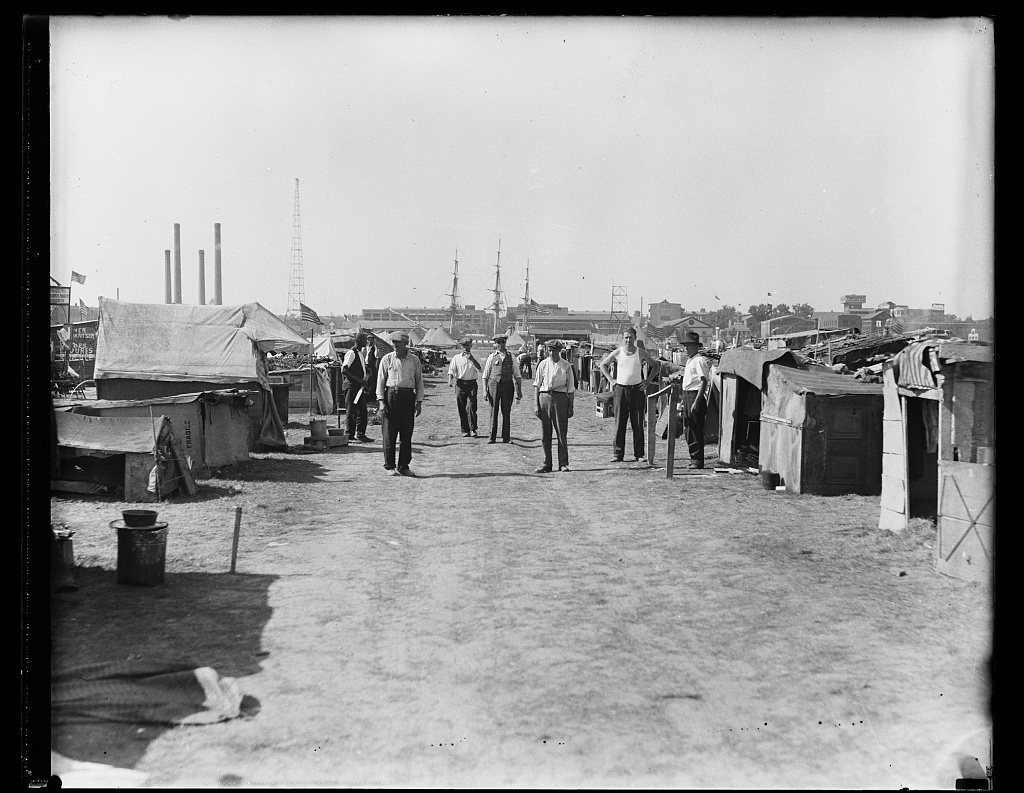
Veterans established temporary camps in and around the capital, notably on Anacostia Flats. Some shelters were made from scrap lumber or other available materials, and camps included kitchens, improvised services and organized routines. The Library of Congress photograph accompanying this article records part of an Anacostia camp in 1932. It shows the protest community before military eviction, not the fire that later destroyed many structures.
Life in the camps was difficult. Food, sanitation and medical care required collective organization and support from volunteers and local residents. Veterans sought to demonstrate that they could assemble peaceably and make a disciplined appeal to lawmakers. Their military backgrounds helped some leaders establish internal routines, but the movement was still a civilian petition. The camps became a public symbol of the severity of Depression-era unemployment and of former soldiers asking the government to honor promised compensation sooner.
Black and white veterans marching together
The Bonus Army included African American as well as white veterans, and the National Archives emphasizes the unusual cooperation that occurred in parts of the movement. In a segregated society, Black and white former soldiers shared some protest spaces and a common demand for compensation. This should not be exaggerated into a claim that the entire encampment was free of prejudice or that wartime racial divisions disappeared. Conditions and attitudes varied among participants.
The presence of Black veterans is nevertheless historically significant. They had served a country that continued to deny equal treatment in employment, public institutions and political rights. Their participation linked the demand for veterans’ compensation to wider questions about citizenship and economic security. The Great Migration and the Red Summer of 1919 provide context for inequalities that Black veterans faced before arriving in Washington.
The Patman bill and the congressional vote
Representative Wright Patman of Texas supported legislation to pay the bonus certificates early. The House of Representatives approved an early-payment bill, which encouraged many marchers to believe that their demands might succeed. The Senate rejected the proposal in June 1932. After that defeat, some veterans returned home, but thousands remained in Washington, hoping to sustain pressure or lacking money to travel elsewhere.
The defeat created a turning point because the protest continued without the immediate prospect of legislative success. Public officials increasingly regarded the camps as a problem of housing, public order and political tension. Many marchers remained focused on petitioning peacefully, while officials feared disorder and possible radical agitation. Historians should distinguish evidence of actual violence from claims that the whole protest movement was secretly directed by revolutionaries.
The confrontation of July 28, 1932
On July 28, Washington police moved to clear protesters from buildings in the city that authorities intended to demolish. Confrontations occurred, and two veterans were fatally shot by police. The violence prompted city officials to seek federal military assistance. President Hoover ordered the Army to help restore order. This sequence is important: the initial fatal shootings occurred in a police confrontation before the subsequent Army operation, not as an established consequence of soldiers firing into the Anacostia camp.
The atmosphere was tense and confused, and government accounts defended the need to restore civil authority. Protesters and observers described the use of force as disproportionate against veterans seeking benefits. The National Archives and Hoover Presidential Library preserve accounts from differing perspectives. A clear chronology makes the dispute understandable without treating the entire crowd as violent or claiming that government officials had no public-safety concerns.
Douglas MacArthur and the Army’s response
General Douglas MacArthur, the Army’s chief of staff, commanded the military operation. Troops including cavalry and infantry, supported by armored vehicles, moved against protesters, and tear gas was used. Some accounts describe future military leaders Dwight Eisenhower and George Patton as involved in the operation; Patton commanded cavalry, while Eisenhower served on MacArthur’s staff. Their presence later became notable because of their subsequent careers.
MacArthur regarded the situation as dangerous, partly because he feared revolutionary activity. The Hoover Presidential Library and National Archives describe how he went beyond Hoover’s intention to avoid pushing fleeing protesters across the bridge into Anacostia. Troops advanced and cleared the main encampment. The distinction between the president’s initial order and the subsequent decisions by the field commander is central to historical accountability; neither should be erased by placing all actions on one person.
The burning of the camps
By the end of the operation, shelters on Anacostia Flats were burning and protesters had been driven out. Photographs and newsreel footage documented smoke, destroyed dwellings and soldiers occupying areas where veterans had lived. The destruction became an indelible image of the federal response to Depression-era petitioners. Families who had already endured poverty and traveled to Washington lost their temporary shelters and were forced to seek other places to stay.
The photograph selected for this article shows a Bonus Army camp before the clearing. It is a dated archival image of living conditions, not a photograph of July 28’s flames. Preserving that distinction is part of responsible historical publishing. National Archives photographs of burning shacks are available for readers investigating the aftermath, but they should also be tied to their original catalog information rather than reused without captions.
How Hoover’s reputation was affected
The eviction produced a public backlash against Hoover, whose administration was already under intense criticism for the continuing Depression. Newspapers and political opponents portrayed the use of troops against former soldiers as evidence of a government lacking sympathy. Hoover defended the need for federal action and maintained that officials faced threats to public order. The clash between those accounts became a central feature of the 1932 political debate.
The Bonus Army was not the only reason Hoover lost support. Bank failures, unemployment and economic contraction had already damaged public confidence. But the photographs and reporting made the veterans’ suffering highly visible. The Reconstruction Finance Corporation illustrates another Hoover-era response to the Depression, directed toward credit institutions rather than veterans seeking immediate cash. Reading both topics together helps explain competing expectations of government responsibility.
The return of veterans under Roosevelt
Some veterans returned to Washington during Franklin Roosevelt’s administration in 1933. Their reception differed in important ways from the previous summer’s eviction. Roosevelt offered alternatives, including opportunities for eligible veterans to join Civilian Conservation Corps work projects. The National Archives documents how veterans participated in such programs. But Roosevelt did not immediately grant the full early-payment demand, and the controversy remained unresolved.
The New Deal’s employment and relief programs broadened federal activity, yet they were not an automatic substitute for veterans’ claims under the adjusted compensation law. Veterans still sought the value of their certificates and continued political pressure. Their experience shows that social assistance, public employment and earned compensation were related but distinct policy questions. The New Deal programs guide describes the wider federal response.
The bonus is paid early in 1936
In 1936 Congress passed legislation authorizing early payment of the adjusted service certificates. President Roosevelt vetoed the measure, citing fiscal objections, but Congress overrode the veto. Veterans were thus able to receive their benefits years before the original 1945 maturity date. The outcome resulted from a continued political campaign and congressional decisions, rather than an immediate concession to the 1932 encampments.
This final stage is sometimes omitted from accounts that stop with burning shacks. The movement’s short-term legislative defeat in 1932 did not end the question of compensation. Support persisted through several administrations, and the payment law changed the practical outcome for eligible veterans. The distinction between immediate protest results and longer-term political effects helps explain how movements can influence policy even after a visible setback.
Why the Bonus Army remains important
The Bonus Army march revealed how the Great Depression exposed the vulnerability of people who had previously served their country. It brought veterans, families, police, Congress and the federal military into a direct confrontation over economic promises and public protest. The encampments demonstrated disciplined collective action and hardship, while the July 28 eviction showed the potential consequences of using armed forces in a domestic political crisis.
The historical significance extends beyond Hoover’s reputation or MacArthur’s later fame. It concerns the status of veterans’ benefits, the right to petition government and the responsibilities of officials when large protests occupy public places. The episode also illustrates how legal obligations and fiscal decisions can become urgent human questions during a depression. Its eventual resolution in 1936 is part of the story, alongside the tragedy and conflict of 1932.
Timeline
- 1924: Adjusted Compensation Act provides certificates
- Spring 1932: Veterans travel to Washington
- June 1932: Senate rejects early-payment bill
- July 28, 1932: Police confrontation and Army eviction
- 1933: Veterans return; CCC opportunities offered
- 1936: Congress overrides veto and authorizes early payment
Frequently asked questions
What was the Bonus Army?
A movement of World War I veterans, also called the Bonus Expeditionary Force, demanding early payment of promised adjusted service compensation.
When did the march occur?
Mainly spring and summer 1932, with a major eviction on July 28.
Why was the bonus not due until 1945?
The 1924 compensation legislation provided certificates that generally matured in 1945 rather than immediate full payment.
Who ordered soldiers into Washington?
President Hoover authorized military assistance after police confrontations, and General Douglas MacArthur commanded the operation.
Did MacArthur exceed Hoover’s instructions?
The National Archives and Hoover Presidential Library describe MacArthur’s advance into Anacostia as beyond the president’s intended limits.
Did the Army kill the veterans on July 28?
Two veterans were fatally shot in the preceding police confrontation; the later Army operation cleared and burned encampments.
When was the bonus paid?
Congress authorized early payment in 1936 by overriding President Roosevelt’s veto.