Chicago World’s Fair of 1893: White City, Ferris Wheel and Legacy
The architecture, technology, visitors and contradictions of America’s celebrated White City.
Chicago’s World’s Columbian Exposition ran from May 1 to October 30, 1893, drawing more than 27 million paid admissions. It showcased monumental White City buildings, electric lighting, new machinery and the original giant Ferris wheel. The event influenced architecture but also reflected racism and colonial attitudes.
Explore the layout of Jackson Park, the Ferris wheel, the Woman’s Building, cultural representation and surviving historical evidence.
On this page — 23 topics
What was the Chicago World’s Fair of 1893?
The World’s Columbian Exposition was a large international exhibition held in Chicago in 1893, drawing more than 27 million paid admissions. Organizers presented achievements in architecture, manufacturing, transportation, science, art and consumer goods. The fair occupied extensive grounds near Lake Michigan, chiefly in Jackson Park and the adjoining Midway Plaisance. Its grand white exhibition buildings earned the main area the nickname White City. Although it celebrated modern technology and helped shape American public design, the exposition also reflected racial hierarchy, colonialism and unequal access to cultural representation. A complete history considers both its engineering spectacle and the political assumptions that organized the displays.
Why did Chicago host the exposition?
American cities competed for the right to host an international fair marking the four-hundredth anniversary of Christopher Columbus’s first voyage to the Americas in 1492. Chicago was selected by Congress in 1890, overcoming competing bids from cities such as New York, St. Louis and Washington. Its backers emphasized the city’s booming railroad connections, industrial wealth and ambition after rebuilding from the 1871 fire. The fair was scheduled in relation to the 1892 anniversary but opened to the public in 1893 after extensive planning and construction. This explains the apparent mismatch between the anniversary year and the year associated with the exhibition’s famous photographs.
When did the fair open and close?
The principal exhibition opened to the public on May 1, 1893, and closed on October 30. Planning, dedication ceremonies and certain preliminary events occurred at other times, so dates in period publications can differ depending on the occasion being described. The six-month run attracted extraordinary crowds despite the financial depression that began in 1893. Attendance exceeded 27 million admissions according to the Library of Congress and University of Chicago, but that number counted visits rather than necessarily 27 million distinct individuals. Visitors sometimes attended more than once. Accuracy requires making this distinction when comparing fair attendance with the population of the United States at the time.
Where were Jackson Park and the Midway?
Jackson Park on Chicago’s South Side provided the core exhibition landscape near Lake Michigan, with lagoons, broad avenues and large temporary halls. The Midway Plaisance, a long stretch connecting park areas, accommodated entertainment and cultural attractions. The arrangement helped separate grand formal exhibition buildings from a more commercial and spectacular entertainment zone. It also reflected planners’ ideas about ordering public space and the relative status of different cultures. Today’s Jackson Park has changed considerably, but its surviving landscape and historical maps make it possible to trace the exposition’s footprint. The location should not be confused with downtown Chicago’s business district.
Who planned the White City?
Architect and organizer Daniel Hudson Burnham was central to the fair’s development and coordination of its monumental buildings. Landscape architect Frederick Law Olmsted helped design the grounds, waterways and park relationships, working with other architects and engineers. The design emphasized neoclassical architecture, symmetrical public spaces and coordinated facades that looked remarkably uniform when painted white. The buildings were not all made of permanent marble. Many used temporary construction materials such as staff, a plaster-based mixture, over structural frames. Their apparent permanence was part of the visual effect. The achievement was collaborative and should not be attributed exclusively to one famous designer.
Why was it called the White City?
The name came from the dominant light-colored facades of the main fair buildings, their formal classical styling and the dramatic effect of illumination at night. Visitors encountered a landscape designed to impress with order, spaciousness and architectural scale. The whiteness was a surface treatment and artistic decision rather than evidence that every building was a durable stone monument. Modern accounts sometimes connect the term with the fair’s broader racial politics, a context worth examining without assuming the nickname alone explains every motive. The White City became an influential model for later civic design, but its temporary buildings could not all survive the wear, fire and redevelopment that followed.
What was the Court of Honor?
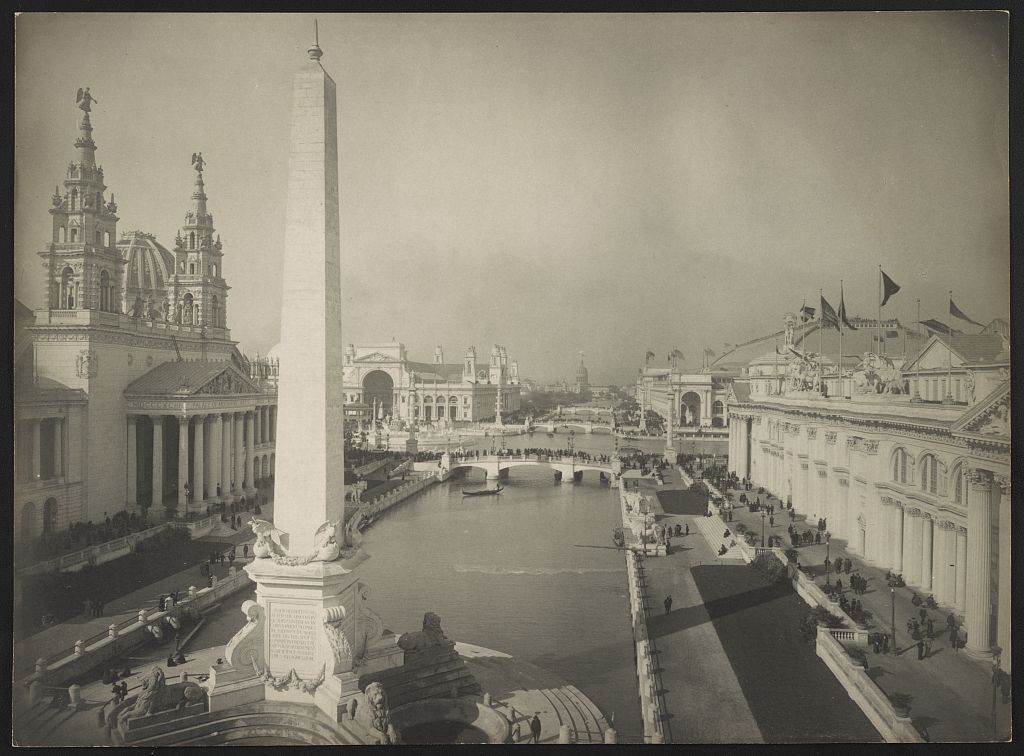
The Court of Honor was the exposition’s ceremonial heart, framed by major exhibition buildings, a broad basin and monumental sculpture. It offered dramatic views of the Administration Building and nearby structures. Photographers such as Frances Benjamin Johnston documented this carefully planned setting, and her period photograph accompanies this article. The Court of Honor made the fair appear like an ideal city organized around beauty and progress. Yet its scale also concealed the work of constructing temporary foundations, arranging transportation and maintaining daily services for immense crowds. The famous views are valuable evidence of the fair’s visual program, but they do not represent all spaces or communities who participated.
How did electric lighting impress visitors?
Electric illumination transformed the fair’s buildings and walkways after dark. Large numbers of lamps helped make the White City appear unlike ordinary nineteenth-century streets, and visitors could examine electrical devices and machinery as part of the exhibition. The fair became associated with the expanding public presence of alternating-current electrical systems and broader industrial innovation. It was not the first occasion on which electric lights were demonstrated, but its scale helped make electrified public spaces familiar to millions. Claims that one inventor personally supplied all the fair’s electricity oversimplify the involvement of companies, engineers and contractors. The real achievement was the coordinated application of new systems across an enormous temporary site.
What was the first Ferris wheel?
Engineer George Washington Gale Ferris Jr. designed the giant wheel built for the 1893 exposition, a major mechanical attraction intended to rival the impact of the Eiffel Tower at the 1889 Paris exposition. The wheel carried passengers in enclosed cars and offered views across the city, lake and fairgrounds. It became one of the best-known attractions on the Midway Plaisance and inspired later Ferris wheels around the world. The original machine was not a small carnival ride and should not be confused with modern wheels of similar name. Its size and engineering drew attention because rotating a large passenger structure reliably was a formidable challenge at that time.
Where was the Midway Plaisance?
The Midway was an elongated entertainment and exhibition area adjoining Jackson Park. It held rides, restaurants and attractions representing cultures from different parts of the world. The famous Ferris wheel stood there, along with displays organized around contemporary assumptions about foreign peoples. Some attractions offered music, performances and encounters with unfamiliar traditions, but their presentation frequently relied on stereotypes and unequal power relationships. The Midway should not be remembered only as harmless amusement. It also illustrates how world’s fairs packaged cultures for commercial consumption and claimed authority to categorize people within a hierarchy of civilization. Modern historians study these exhibits critically and incorporate perspectives of the communities represented.
What was exhibited in the major buildings?
Large exhibition halls displayed agriculture, machinery, electricity, manufacturing, fine arts, transportation and other fields. Visitors saw industrial equipment, models, consumer products and objects presented as evidence of national or international accomplishment. Companies promoted their latest inventions, while governments and cultural institutions staged displays to attract interest and prestige. The halls were so extensive that many visitors could not see everything in a single day. The range of material helps explain why attendance was high and why the fair influenced American visual culture. It should not be reduced to a Ferris wheel and a few elaborate palaces, even if those attractions now dominate photographs and popular accounts.
What was the Woman’s Building?
The Woman’s Building was designed by architect Sophia Hayden, one of the first women to graduate in architecture from the Massachusetts Institute of Technology. It displayed work associated with women’s achievements in art, literature, craft and other fields. Organizers intended to demonstrate women’s contributions in a society where many professions and political rights were restricted. The building also revealed disagreements over which women’s experiences were represented and how their accomplishments were framed. Celebrating a woman architect’s role is important but should not obscure tensions over class and race in the selection of exhibits. The building remains a major subject in histories of American women’s professional opportunities in the nineteenth century.
Were African Americans equally represented?
No. Black Americans confronted exclusion and unequal access to official representation. Ida B. Wells and others criticized the organizers for failing to provide a fair and meaningful portrayal of African American achievements. Wells, Frederick Douglass and collaborators circulated a pamphlet titled The Reason Why the Colored American Is Not in the World’s Columbian Exposition. Douglass also appeared in connection with Haiti’s exhibit, which offered a platform for important political and cultural commentary. The contrast between the exposition’s claims of national progress and racial exclusion is central to its history. The fair occurred in the era of Jim Crow laws and intensifying political disenfranchisement following Reconstruction.
How were Indigenous peoples represented?
Displays involving Native American cultures were shaped by colonial assumptions, government policies and commercial demands. Exhibitors often presented Indigenous people and objects as remnants of a supposedly vanishing past, even as Native nations remained active and resilient. The fair coincided with efforts to assimilate Native children through institutions such as Carlisle Indian Industrial School and to divide tribal land under the Dawes Act. These policies profoundly affected the people displayed or discussed. Researchers should distinguish the fair organizers’ claims from Indigenous participants’ own identities and experiences. World’s fairs were not neutral museums; they organized cultural knowledge within political relationships of the time.
What was the fair’s relationship to the Panic of 1893?
The exposition opened as the United States entered the Panic of 1893, a severe financial crisis involving bank failures, railroad insolvencies and rising unemployment affecting ordinary families. The spectacular fair offered a public image of technological confidence at a time of economic uncertainty. Its own financing and attendance were affected by the depression’s conditions, although the event still attracted millions of visits. The tension between grand displays of prosperity and the hardship of the wider economy is an important part of its historical setting. The Panic of 1873 provides an earlier example of how speculative railroad investment could destabilize the national economy, but it is not the same financial crisis as the one that struck in 1893.
What foods and products became associated with the fair?
Later popular stories connect the 1893 exposition with the introduction of many familiar foods and household products. Some products were indeed demonstrated or promoted there, while other origin claims are exaggerated or impossible to establish. A company exhibiting an item at Chicago does not automatically mean it invented the product that year. For example, fairgoers encountered new forms of consumer advertising, packaged goods and industrial machinery, but the history of a particular food requires separate documentation. The broader impact was the opportunity for manufacturers to demonstrate products before an enormous audience. That influence on marketing is better supported than lists of supposedly invented everyday foods without reliable contemporary records.
How did the fair affect architecture?
The White City’s coordinated classical architecture influenced civic planning, public buildings and the City Beautiful movement. Its orderly boulevards, monumental vistas and landscape design suggested how public space might express civic ambition. Critics also questioned the emphasis on classical forms and the social assumptions behind elite planning. Chicago’s architectural future was not simply a copy of the fair: the city was also developing innovative commercial skyscrapers and other structural approaches. The exposition’s influence was strongest in civic monuments, museums, government buildings and urban design discussions. Its temporary structures became photographs and memories, while their style persisted in other cities long after the fairgrounds were cleared.
What remains of the exposition today?
Most principal exhibition structures were temporary and were demolished, destroyed by fire or transformed after the fair. The former Palace of Fine Arts, rebuilt and altered, became the home of Chicago’s Museum of Science and Industry. The surviving park landscape, lagoons and historic photographs help visitors understand the overall site. The original Ferris wheel did not remain in Jackson Park as a permanent landmark. Modern buildings on the South Side should not automatically be labeled surviving fair halls without documentation. University of Chicago archival collections and Chicago’s architectural history resources provide maps that distinguish the 1893 ground plan from the present environment.
Did the fair cause the City Beautiful movement?
The fair gave remarkable visibility to monumental planning and the aesthetic program associated with the City Beautiful movement, but the movement drew on earlier architectural and urban-planning traditions. Designers, municipal reformers and civic organizations developed these ideas through later projects and debates. Calling the fair the single origin of every classical courthouse or city park built afterward would exaggerate its role. Its impact was to show what coordinated design could achieve at an immense scale, inspiring supporters to seek similar order and grandeur in permanent cities. The same planning approach also attracted criticism when beauty and monumentality took precedence over housing, labor and the needs of less wealthy residents.
Where can readers research the 1893 fair?
The Library of Congress historical essay describes the White City and its cultural impact. The University of Chicago Library preserves an extensive World’s Columbian Exposition collection with guides to architecture, exhibits and attendance. Period photographs from the Library of Congress reveal structures and people with far greater reliability than later reconstructions, although photographers’ choices still shape what viewers see. PBS American Experience supplies broader interpretive context, including the Ferris wheel and the fair’s legacy. Comparing sources allows readers to enjoy the spectacle without overlooking unequal representation and the contested meaning of American progress.
1893 Chicago World’s Fair timeline
| Date | Development |
|---|---|
| 1890 | Congress chooses Chicago to host the fair. |
| 1891–1893 | Temporary buildings and grounds are constructed. |
| May 1, 1893 | Fair opens to the public. |
| Summer 1893 | The Ferris wheel and exhibits attract large audiences. |
| October 30, 1893 | Exposition closes after more than 27 million paid admissions. |
| Later decades | Legacy continues in civic design and museum history. |