Transcontinental Railroad (1869): Golden Spike, Chinese Workers and Route
The first American transcontinental railroad was completed on May 10, 1869, when the Central Pacific and Union Pacific connected at Promontory Summit in Utah Territory. T
The first American transcontinental railroad was completed on May 10, 1869, when the Central Pacific and Union Pacific connected at Promontory Summit in Utah Territory. The golden-spike ceremony symbolized a faster rail connection across the country. Chinese immigrants were essential to construction of the western route, while other workers built the eastern section. The railroad transformed travel and commerce while accelerating dispossession on Indigenous lands.
A historical guide to the legislation, experiences and longer-term consequences, with primary sources and contextual links.
On this page — 23 topics
What was the first transcontinental railroad?
The first transcontinental railroad connected existing eastern rail networks to the Pacific Coast through the work of two major companies. The Union Pacific built westward from Omaha, Nebraska, while the Central Pacific built eastward from Sacramento, California. On May 10, 1869, their rails met in northern Utah Territory. The completion radically reduced the time required to cross the continent compared with long wagon journeys and complicated combinations of ships and overland travel. But the line was a commercial and political project involving government subsidies, immigrant labor, major engineering problems, and the transformation of lands belonging to Native nations.
Where did the two railroads meet?
The famous final joining took place at Promontory Summit in Utah Territory, not Promontory Point on the shore of Great Salt Lake. Newspapers and later retellings sometimes used the wrong location. The National Park Service explicitly distinguishes the two. The western company reached the site from Sacramento across the Sierra Nevada and Nevada; the Union Pacific approached from Omaha across the Plains and Wyoming. Promontory became famous because ceremonies and photographers recorded the moment. It was not intended to be the permanent national transportation center: railroad junctions and routes changed as companies developed more efficient connections after 1869.
Who were the Union Pacific and Central Pacific?
The two companies received federal encouragement through Pacific Railway legislation during the Civil War. Central Pacific directors and engineers organized construction eastward from California. Union Pacific officials oversaw the line westward across the Plains. Both relied on private capital supported by public land grants and government-backed bonds, making the venture neither wholly private nor a simple government railway. Completion required negotiating contracts, obtaining supplies, surveying terrain, and coordinating large workforces over long distances. The companies also competed to lay track and claim federally supported construction mileage, creating incentives for rapid work and sometimes questionable financial practices.
Why did the government fund a railroad during the Civil War?
Federal leaders had long debated how to link western territories with the older states. The Civil War increased the strategic value of maintaining communication and strengthening national authority across the continent. With Southern congressional opponents absent after secession, Congress passed Pacific Railway legislation in 1862 and additional measures afterward. The laws provided substantial land and financial support to the companies. A cross-country connection promised military mobility, movement of mail, settlement, and trade. These aims were not equally beneficial to every population: railroad expansion also supported federal power over Indigenous territories and intensified pressure on established Native ways of life.
Who built the Central Pacific section?
Chinese immigrants formed the core of the Central Pacific construction workforce during its most demanding years. Laborers cleared routes, built embankments and bridges, blasted rock, and laid track through the Sierra Nevada and across deserts. Historical research places their numbers in the thousands, often around ten thousand at peak periods, though workforce estimates vary depending on date and source. They received lower pay or different employment arrangements than many white workers and faced prejudice. Their essential contribution was long minimized in popular celebration photographs and histories. The National Park Service’s Chinese labor study helps recover their work and presence along the route.
Who worked on the Union Pacific?
The Union Pacific recruited crews from diverse backgrounds, including Irish immigrants, Civil War veterans, and other European and American laborers. Its workers faced demanding physical conditions while building across the Great Plains and the Rocky Mountain region. The company also depended on surveyors, teamsters, cooks, blacksmiths, and suppliers whose work was less visible than the tracklayers at a final-spike ceremony. Popular accounts sometimes contrast an exclusively Irish eastern workforce against an exclusively Chinese western one; the actual labor systems were more varied. The project’s success depended on thousands of people whose individual names rarely appeared in official commemorations.
How did workers cross the Sierra Nevada?
The Central Pacific confronted steep mountain grades, deep winter snow and rock that required extensive cutting and tunneling. Crews drilled and blasted through granite, built retaining walls and protected sections of line from avalanches. Snow sheds became an important later part of keeping trains moving through the mountains. The work required organizational skill and considerable danger. Some vivid popular stories about men hanging in baskets above cliffs are difficult to document precisely, so historians distinguish verified construction methods from later legend. Archaeological remains of Chinese workers’ camps have become particularly important because relatively few personal written accounts survive.
How did the Union Pacific cross the Great Plains?
The Union Pacific’s route traversed long distances with challenging water supplies, river crossings, winter weather and limited established infrastructure. Surveyors identified grades while crews built bridges, laid ties and rails, and moved construction camps westward. Trains had to transport increasing amounts of material over newly completed track. Temporary towns and service centers developed along the route, some of them short-lived. Workers also traveled through territories where Native nations retained strong political and cultural connections. Railroad promoters often described the Plains as empty land awaiting improvement, a misleading assumption that erased the people already living and moving there.
What was the Golden Spike?
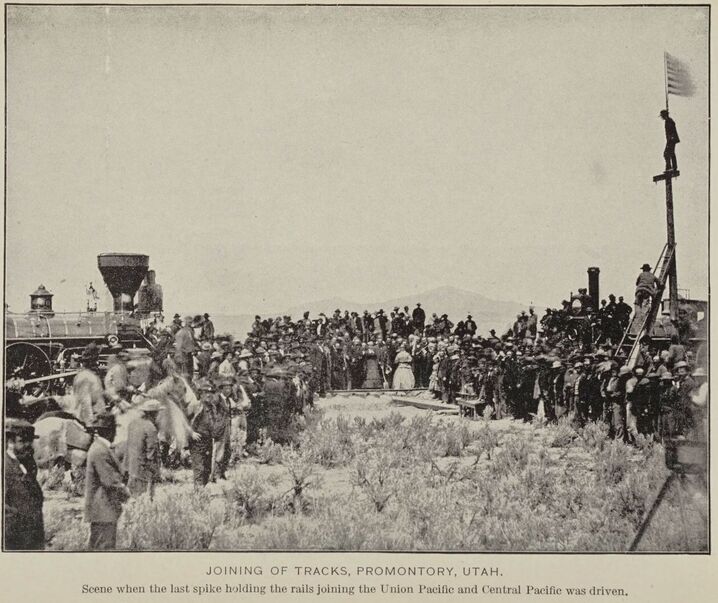
The Golden Spike was a ceremonial object used to mark the meeting of the Central Pacific and Union Pacific rail lines on May 10, 1869. Leland Stanford, an important Central Pacific figure and California politician, was involved in the formal completion ceremony. Multiple commemorative spikes and related artifacts are associated with the event, while ordinary iron spikes secured the operational track. The ritual was reported by telegraph, generating celebrations across the country. The famous photographs show locomotives and crowds, but they do not represent all the workers who made the project possible. The golden spike symbolized completion; it did not literally build the final miles.
What were the locomotives Jupiter and No. 119?
Two locomotives became iconic symbols of the ceremony: Central Pacific’s Jupiter and Union Pacific’s No. 119. They approached from opposite directions and stood facing one another as crews and dignitaries assembled. Modern visitors to Golden Spike National Historical Park can see carefully researched replica locomotives. These displays are not surviving originals and should be described accurately. The image of engines touching pilots helped create an enduring national story of connection. Yet rail operations after 1869 required regular schedules, maintenance, stations and later improvements, far more than a single dramatic moment captured by a camera.
How many miles did the railroad cover?
The exact distance depends on whether a source counts the two companies’ original completed lines, connecting segments or later alignments. The initial joining involved roughly 1,900 miles of track connecting Omaha and Sacramento, though measurements vary in different accounts. It was not one continuous track laid at once between New York and San Francisco: eastern rail networks already existed, and western connections continued to develop. A traveler still depended on additional lines or transportation to reach particular cities. Precise distances are best taken from dated railroad maps that define start and end points rather than repeated as a universal number.
Did the railroad immediately make coast-to-coast travel easy?
The new connection shortened journeys dramatically, but travel remained expensive for many people and could still involve transfers, delays and uncomfortable conditions. Connections to the eastern rail network and Pacific coastal routes were improved over time. Passenger service, mail delivery and freight transport nevertheless became much more predictable than the old overland wagon routes. Business owners could ship goods between distant markets, and newspapers and information moved more quickly. These gains were unevenly distributed: railroad fares, land prices and company practices could exclude people who lacked sufficient money. The line created a new transportation system rather than universally inexpensive movement.
How did railroads change farming and settlement?
Rail connections opened markets for grain, cattle and other products and encouraged the formation of towns along stations and branch lines. Companies actively promoted settlement and sometimes sold lands obtained through federal grants. People seeking farms under the Homestead Act could benefit from rail transport to reach claims and ship crops. But railroad access also gave companies influence over freight rates and local economic prospects. Towns bypassed by new tracks could decline, while those favored by a junction might grow rapidly. The expansion created opportunities while tying rural producers to powerful transportation businesses.
What were the effects on Native American nations?
Railroads crossed the territories of Indigenous peoples whose rights and lifeways had developed long before federal surveyors marked routes on maps. Construction and associated settlement increased military presence, hunting pressure and conflict over land. The expansion of markets for buffalo hides and new transportation networks contributed to the destruction of bison populations on the Great Plains. Native nations did not uniformly oppose every railroad for the same reasons, but federal policies often subordinated their sovereignty to settlement and transportation goals. A complete history must recognize dispossession and conflict alongside the engineering achievement of connecting the coasts.
Did the railroad cause the Chinese Exclusion Act?
There is no simple one-event causal chain from completion in 1869 to the exclusion law of 1882. Chinese immigrants had been working in California for years, and anti-Chinese hostility grew from multiple labor, racial and political conflicts. However, railroad construction made Chinese labor central to western development, and workers faced discrimination even after their contribution became indispensable. In subsequent years they moved into other industries and communities and became targets of exclusion campaigns. Our Chinese Exclusion Act guide explains how that political movement became federal immigration law. The contrast between dependence on Chinese workers and later restrictions is an important part of American history.
What does the photograph at Promontory show?
The 1869 photograph depicts the public ceremony around the meeting of rails and locomotives at Promontory Summit. It is evidence of how railroad officials wished completion to be celebrated and of the people recorded at that moment. It does not show everyone who constructed the line, and Chinese workers were underrepresented in the best-known ceremonial images. Historians therefore combine photographs with payrolls, archaeological studies, contemporary newspapers and family histories. Treating one iconic picture as a complete portrait of the workforce would obscure the diversity and unequal status of those who performed the construction labor.
Why is Promontory Summit not Promontory Point?
Promontory Summit is the upland location in northern Utah where the rails met. Promontory Point lies farther south on a peninsula extending into the Great Salt Lake. The two names became confused in some contemporary publications, and the error persisted in textbooks and popular commemorations. The National Park Service’s official frequently asked questions directly addresses this common mistake. Getting the location right matters to understanding historical maps, the changing rail junction, and the landscape preserved by today’s national park. Accuracy in place names is especially important for readers planning a visit or researching ancestral travel routes.
How did the railroad affect federal power?
A faster rail route allowed federal troops, mail and officials to move more efficiently between distant regions. It also supported broader commercial integration and a sense of national unity after the Civil War. Yet the federal government exercised that power through subsidies, land policies and military action that did not always respect Indigenous nations. Construction also generated debates over corporate influence and public finance. The railroad is therefore part of the history of state-building as much as engineering. It shows how nineteenth-century infrastructure could connect markets and communications while intensifying disputes over land, sovereignty and economic privilege.
What can visitors see at Golden Spike National Historical Park?
The park at Promontory Summit interprets the construction, workers and May 1869 ceremony, with reconstructed track, historic landscapes and replica locomotives. Visitors can study the terrain where Chinese labor crews and other workers completed the final approaches. The National Park Service provides maps and original sources that distinguish the genuine historical setting from later reconstructions. The site is not an operating station on the original national passenger route today. It is a place to explore the meaning and limitations of the famous completion ceremony, including the experiences of workers whose names were left out of official photographs and speeches.
Timeline
| Date | Event |
|---|---|
| 1862 | Pacific Railway Act authorizes federal support. |
| 1863 | Construction begins under the railroad program. |
| 1865–1868 | Track crews cross Sierra Nevada and Great Plains. |
| May 10, 1869 | Golden Spike ceremony at Promontory Summit. |
| Late 1869 onward | Junctions and operations reorganized and expanded. |
Key questions
Why does this matter? The first American transcontinental railroad was completed on May 10, 1869, when the Central Pacific and Union Pacific connected at Promontory Summit in Utah Territory. The golden-spike ceremony symbolized a faster rail connection across the country. Chinese immigrants were essential to construction of the western route, while other workers built the eastern section. The railroad transformed travel and commerce while accelerating dispossession on Indigenous lands.
Where can readers confirm the facts? The cited federal and historical sources below provide the original record and explanatory research.