Tehran Conference of 1943: The Big Three, Operation Overlord and Postwar Plans
What Roosevelt, Churchill and Stalin agreed at Tehran in 1943, how they planned the Normandy invasion and why Poland and Iran mattered.
Quick answer
The Tehran Conference took place in Iran from November 28 to December 1, 1943, bringing Franklin D. Roosevelt, Winston Churchill and Joseph Stalin together for their first joint wartime summit. The leaders coordinated plans for a western Allied invasion of France in 1944 and Soviet operations against Germany, while debating Mediterranean strategy, Poland’s future borders and postwar security. Tehran advanced Allied military cooperation but did not settle every future political dispute, including those that would emerge in Eastern Europe after the war.
Key facts
On this page
- Why Tehran was a turning point in Allied diplomacy
- Why Iran hosted the meeting
- Roosevelt, Churchill and Stalin finally meet together
- Operation Overlord and the second front
- Soviet coordination with western operations
- Churchill’s Mediterranean arguments
- The future of Poland’s borders
- The question of Germany after defeat
- Roosevelt’s ideas for a postwar world organization
- The Tehran Declaration and Iran
- Why the conference mattered to D-Day
- Tehran as a precursor to Yalta and the Cold War
- Timeline
- FAQs
- Sources
Why Tehran was a turning point in Allied diplomacy
By late 1943 the military balance in World War II had begun to shift. Soviet forces had survived the critical battles of Stalingrad and Kursk, while American and British armies had advanced through North Africa and invaded Italy. Yet Germany still occupied much of Europe, and the Soviet Union continued bearing immense losses on the Eastern Front. Coordinating a major western attack on occupied France became increasingly important to the coalition’s strategy.
The Tehran Conference offered the leaders of the three principal Allied powers a chance to negotiate directly. Roosevelt had met Churchill frequently, but this was his first face-to-face wartime summit with Stalin in the presence of the British prime minister. Military decisions could not be separated from political questions because each government sought a favorable postwar position. Tehran therefore connected immediate operations to the future balance of power in Europe.
Why Iran hosted the meeting
Tehran was selected partly because Stalin was reluctant to travel far from the Soviet Union while military operations continued. Iran was under Allied occupation and influence following the Anglo-Soviet invasion of 1941, which had secured supply routes to the Soviet Union. The conference therefore occurred in a country whose sovereignty and political circumstances were directly affected by the wartime coalition.
The location was not simply a neutral hotel chosen for convenience. Allied authorities maintained security controls, and the Soviet embassy served as the setting for important meetings and photographs. Iran’s position on the Persian Corridor made it strategically significant for shipping material to Soviet forces. The leaders later issued a declaration affirming respect for Iran’s independence and support for its economic assistance, although tensions over foreign troops would persist.
Roosevelt, Churchill and Stalin finally meet together
The leaders began their formal discussions on November 28, 1943. Roosevelt hoped to establish personal rapport with Stalin and encourage confidence in postwar cooperation. Churchill brought experience from Britain’s continuing defense and Mediterranean campaigns, while Stalin pressed for a western invasion that would force Germany to divide its land armies. They did not approach every question with the same military priorities or political assumptions.
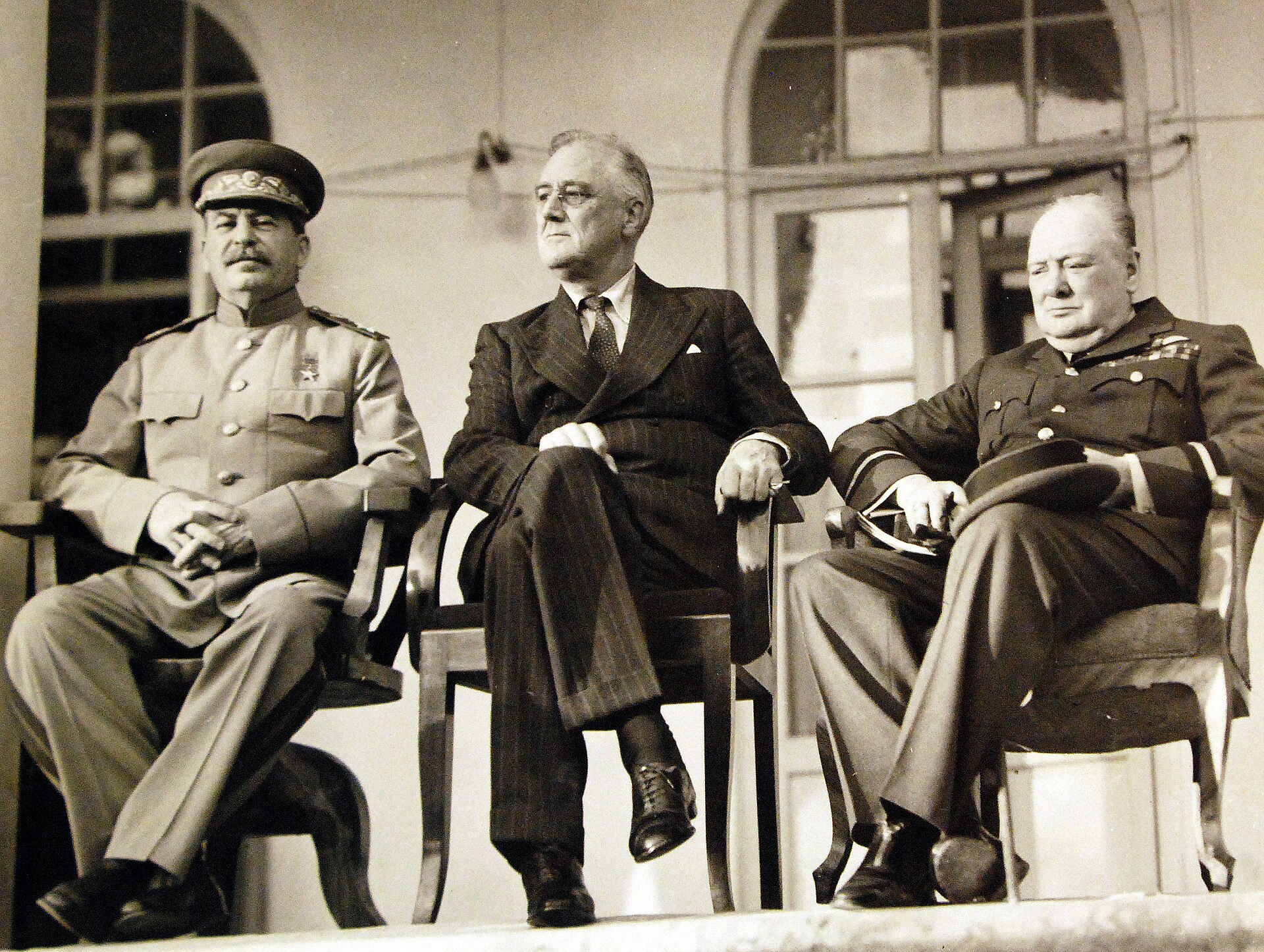
The featured photograph shows all three men together at Tehran, making it a direct visual record of the summit. Such images communicated unity to the public, but private discussions reveal disagreements beneath the surface. Studying the official records helps explain how the leaders reached specific compromises without assuming friendship or identical goals. Personal diplomacy was influential, but military logistics and national interests continued to shape the choices.
Operation Overlord and the second front
The central military issue was the long-promised cross-Channel invasion of Nazi-occupied France. Stalin had repeatedly sought a substantial western front to draw German forces away from Soviet armies. American officials argued that a decisive invasion required concentrating men, landing craft and aircraft in Britain, while some British planners remained interested in Mediterranean opportunities. Tehran provided an opportunity to confirm the priority of Operation Overlord.
The leaders agreed to undertake the invasion in May 1944, alongside a supporting southern France operation as resources permitted. The actual Normandy landings occurred on June 6, 1944, after preparations and weather decisions delayed the original timetable. Tehran established political and strategic commitment, not the final day or details of every assault. Those operational choices continued to develop under Allied military commanders.
Soviet coordination with western operations
Stalin promised that Soviet forces would mount offensive operations that would help prevent German armies from concentrating against the western landing. The concept of simultaneous pressure was important because Germany had to defend a vast eastern front and occupied western Europe. Coordinating offensives across different fronts offered the Allies a way to exploit their combined military resources.
These assurances did not mean that Roosevelt, Churchill and Stalin commanded a single unified army. Each power maintained its own command structure, logistics and strategic objectives. Soviet operations were influenced by conditions on the Eastern Front, while western invasions depended on transport, weather and training. The leaders established the principles of coordination, with military staffs responsible for the difficult work of implementation.
Churchill’s Mediterranean arguments
Churchill remained concerned about opportunities in the Mediterranean, including pressure on German positions in Italy and the Balkans. British leaders believed operations there could weaken the Axis and exploit troops already engaged in the theater. Stalin and many Americans feared that expanding Mediterranean commitments might delay the cross-Channel invasion. Those differences reflected geography and the interests of governments with distinct wartime experiences.
The debate was not simply a contest of ambition. Landing craft, shipping, aircraft and trained personnel were scarce resources. A vessel used for one operation might be unavailable for another months later. Tehran clarified the priority of Overlord while leaving room for some supporting operations. Comparing the conference with the Casablanca Conference shows how the Allied planning emphasis shifted from Mediterranean campaigns toward a decisive invasion in northwest Europe.
The future of Poland’s borders
Poland was a central and sensitive subject because it had been invaded by both Germany and the Soviet Union in 1939. Soviet authorities wanted to retain territory acquired in eastern Poland, while Britain had entered the war in defense of Polish independence. Discussions at Tehran considered the possibility of shifting Poland’s territory westward, including the Curzon Line as a basis for its eastern frontier.
The leaders did not finalize every Polish border decision or create a genuinely representative postwar Polish government at Tehran. Later agreements and Soviet military control would determine much of the outcome. The prospect of moving borders also raised the future of millions of civilians living in affected areas. The negotiations foreshadowed disputes that became prominent at Yalta and after the war, illustrating the difference between wartime diplomacy and democratic self-determination.
The question of Germany after defeat
The leaders also discussed how Germany should be treated once Nazi rule was defeated. Ideas included dividing Germany into separate states or regions, preventing renewed military aggression and establishing mechanisms for security. None of the proposals discussed informally became a completed postwar constitution at Tehran. The discussions reveal the difficulty of planning an occupation before the war’s outcome was assured.
Roosevelt, Churchill and Stalin shared the goal of defeating Nazi Germany but differed over future political arrangements. The challenge was to prevent another major European war without creating fresh conflict among the victorious powers. Later meetings, occupation decisions and the emergence of two German states resulted from a longer chain of negotiations and events. Tehran was an early stage in that process rather than its final blueprint.
Roosevelt’s ideas for a postwar world organization
Roosevelt outlined concepts for an international organization to maintain security after the war. The leaders considered the need for major powers to cooperate in enforcing peace and responding to aggression. These ideas developed from earlier Allied declarations, including the Atlantic Charter, but the exact institutional design had not yet been negotiated in final form.
The United Nations was formally founded in 1945 through a separate charter and ratification process. It would be incorrect to say the Tehran Conference itself established the UN Security Council or decided every voting procedure used afterward. Its relevance lies in moving discussions of collective security forward while the war was still being fought. The distinction between an idea proposed at a conference and an institution legally created later is important.
The Tehran Declaration and Iran
At the conclusion of the conference the leaders issued statements expressing common objectives, including determination to fight the war to victory and recognition of Iran’s assistance to Allied logistics. The Declaration Regarding Iran pledged respect for Iranian independence and support for economic needs associated with the wartime burden. These commitments placed the host nation in the written diplomatic record.
Iran had already experienced foreign occupation and serious disruption. The transport corridor aided the Soviet war effort, but local resources and political autonomy were affected. After the war the presence of Soviet forces in northern Iran contributed to an international crisis. This later development shows that public wartime promises did not eliminate tensions over regional influence. Tehran’s Iranian setting matters beyond its appearance in Allied photographs.
Why the conference mattered to D-Day
The eventual Allied invasion of Normandy succeeded through extensive preparation, deception, air superiority and enormous naval and land resources. Tehran helped secure top-level political commitment to proceed with the invasion rather than devote the next major effort solely to the Mediterranean. That strategic agreement was a necessary contribution but not an operational guarantee.
Military commanders still faced difficult choices about landing beaches, weather, command assignments and the threat of German resistance. The invasion date changed, and Allied casualties were substantial. The conference should therefore be described as one important planning milestone rather than the moment victory became inevitable. Coordination between western and Soviet fronts remained crucial as German forces attempted to defend occupied Europe.
Tehran as a precursor to Yalta and the Cold War
Tehran demonstrated the potential for cooperation among powers with deeply different political systems. The leaders reached agreement on urgent military priorities while deferring some of the most divisive postwar questions. The Soviet Union’s role as a military partner was indispensable, but Poland, Germany and regional influence would become sources of serious tension.
The Yalta Conference in February 1945 revisited several issues once the defeat of Germany appeared much closer. Tehran’s legacy lies in both practical military coordination and the unresolved political problems carried forward. Reading the conferences in order helps explain why the wartime alliance could win the war yet struggle to preserve cooperation afterward.
Timeline
- 1942–1943: Soviets press for western second front
- January 1943: Roosevelt and Churchill meet at Casablanca
- November 28, 1943: Tehran Conference opens
- December 1, 1943: Conference concludes
- June 6, 1944: Operation Overlord lands in Normandy
- February 1945: Big Three meet at Yalta
- 1945: Allied victory and occupation decisions
Frequently asked questions
When was the Tehran Conference?
November 28 through December 1, 1943.
Who were the Big Three?
Franklin D. Roosevelt, Winston Churchill and Joseph Stalin.
What did they agree about D-Day?
They committed to a cross-Channel invasion of France in 1944, with coordinated Soviet operations.
Did D-Day happen in May 1944 as planned?
No. The invasion occurred June 6, 1944.
Was Poland’s future settled?
No. Borders and political arrangements remained disputed and evolved through later conferences and occupations.
Why was Tehran chosen?
Its location was accessible to Stalin and significant within Allied supply routes through Iran.
Did Tehran create the United Nations?
No. Postwar organization was discussed, but the UN was established in 1945.
What meeting followed the Tehran summit?
The Big Three met again at Yalta in February 1945.