Battle of Little Bighorn (1876): Custer, Lakota and Cheyenne Victory
How Lakota and Cheyenne defenders defeated the Seventh Cavalry, and what followed.
Lakota and Northern Cheyenne fighters defeated U.S. Seventh Cavalry detachments on June 25–26, 1876, in Montana Territory. Custer and his immediate command were killed, while Reno and Benteen’s men survived. The battle was a Native military victory, followed by severe federal pressure on Indigenous communities.
The battle is explained here through military evidence, treaty history and Indigenous perspectives rather than only the legend of Custer’s Last Stand.
On this page — 19 topics
What happened at the Little Bighorn?
On June 25 and 26, 1876, U.S. Seventh Cavalry troops fought Lakota and Northern Cheyenne warriors near a large Indigenous encampment beside the Little Bighorn River in Montana Territory. Lieutenant Colonel George Armstrong Custer divided his regiment, and the detachment he led was destroyed. Other soldiers under Marcus Reno and Frederick Benteen defended themselves on nearby high ground. The Native victory protected the encampment from the immediate federal attack, though later U.S. campaigns intensified pressure on the communities involved. Popular accounts that focus only on Custer’s death obscure a much larger conflict over Native territorial rights and federal expansion.
What caused the military campaign?
The 1868 Fort Laramie Treaty recognized important Lakota territories, including the Great Sioux Reservation, but subsequent federal actions and incursions undermined those arrangements. A gold discovery in the Black Hills in 1874 led to more pressure for access to treaty-protected lands. U.S. officials ordered groups outside reservation agencies to report by a winter deadline difficult for some communities to meet. Military operations followed as federal leaders sought to force compliance. These disputes involved sovereignty, land and survival, not a simple breakdown in relations between Custer and one Indigenous leader. The battle must therefore be placed in the context of treaty violations and attempts to confine Plains peoples.
Who were the Lakota and Northern Cheyenne?
The encampment consisted primarily of Lakota and Northern Cheyenne families and warriors, with some Arapaho participation. Its size reflected the gathering of communities that retained strong connections to hunting, kinship and independent political life. Not everyone at the camp was a warrior; children, elders and people engaged in daily work were present. Many people viewed federal cavalry as a direct threat to their families. The Indigenous force had no single unified command arranged like a U.S. regiment. Different leaders and groups responded to changing threats, and their cooperation was vital to defending such a large village. Historical interpretation benefits from identifying these communities rather than describing them collectively as anonymous opponents.
Who was Sitting Bull?
Sitting Bull was a Hunkpapa Lakota spiritual and political leader whose resistance to federal demands made him an influential figure. His role in bringing people together was significant, but he was not simply a battlefield general issuing commands to every warrior. Historical retellings often exaggerate or simplify his involvement in the day’s tactical movements. Many leaders made decisions, and Indigenous accounts record distinct experiences. Sitting Bull’s later life continued long after June 1876: he traveled to Canada, returned to the United States in 1881 and was killed during an attempted arrest at Standing Rock in December 1890. That later event preceded the Wounded Knee massacre.
What role did Crazy Horse play?
Crazy Horse, an Oglala Lakota war leader, is closely associated with Indigenous resistance during the 1876 campaign. Descriptions of his exact battlefield movements differ among witnesses and later accounts, but he is remembered as an important military figure. He and other warriors were defending a community against a federal force attempting to impose control over their movements and territory. After the victory, federal campaigns placed growing pressure on Native groups. Crazy Horse surrendered in 1877 and was killed that September while in U.S. military custody at Fort Robinson. His life should not be reduced to a single victorious action or an invented heroic speech. Lakota testimony is indispensable to understanding his place in history.
Why did Custer divide the Seventh Cavalry?
Custer separated his regiment into detachments commanded by Marcus Reno, Frederick Benteen and himself. He sought information about the village and the opportunity to strike before its inhabitants dispersed. Dividing troops increased operational flexibility but also made it difficult for groups to reinforce one another across ridges and river crossings. Communication depended on riders traveling through unfamiliar country during a fast-changing battle. Custer’s own detachment was destroyed, leaving no soldier from it to provide a direct account of the final hours. That absence has encouraged speculation about his reasoning and precise movements. A responsible history separates documented orders and geography from scenarios that cannot be established with certainty.
How did the fighting begin?
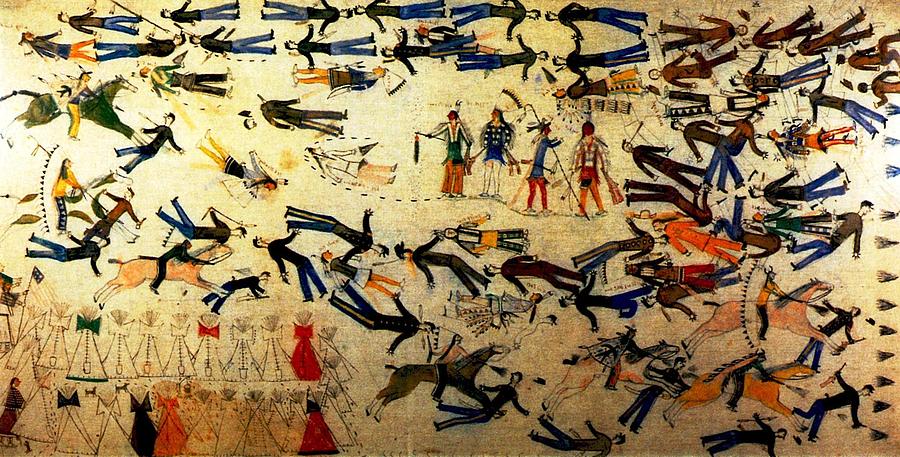
Reno advanced toward the encampment and encountered strong resistance as Lakota and Cheyenne warriors assembled. His troops retreated from the river valley and took up positions on the heights, sustaining casualties along the way. Benteen later joined the survivors. Indigenous fighters also confronted Custer’s separate command to the north along the ridge system. The fighting occurred across multiple areas rather than as one compact engagement witnessed by every participant. Native defenders used mobility, numbers and familiarity with the terrain to respond rapidly to the cavalry attack. The river valley, draws and bluffs constrained the soldiers’ movements and reduced their ability to form a coordinated defense.
What happened to Reno and Benteen?
Reno and Benteen’s combined soldiers defended positions on the bluffs against repeated attacks and survived into June 26. Their experience contradicts the popular claim that the entire Seventh Cavalry was annihilated. Reno’s retreat and Benteen’s response to messages became controversial, with later inquiries and memoirs expressing sharply different judgments. Neither officer had a complete picture of Custer’s predicament while the battle unfolded. It is tempting to assume that a different route or faster movement would certainly have saved the lost detachment, but such outcomes cannot be established. The surviving soldiers’ testimonies illuminate their own sectors while leaving significant uncertainty about events elsewhere.
How did Custer’s command fall?
The detachment under Custer was isolated and defeated along several positions on the hills north of the main encampment. Its exact movements are not fully known because no surviving soldier witnessed the whole sequence from within the detachment. Battlefield archaeology and Indigenous oral accounts have challenged the older picture of one final circle of cavalrymen firing until the last shot. Evidence suggests movement and fighting across a broader area. The defense of the Native camp was an active response to an attack rather than an accidental gathering of warriors. The fatal outcome involved the defenders’ military success, the regiment’s separation and the inability of Custer’s men to regain contact with other battalions.
How many people died?
The National Park Service reports 268 U.S. soldiers, civilians and Native scouts killed, alongside an estimated 60 to 100 Lakota and Cheyenne fatalities. The figures should be understood in their categories: the number of deaths is not the same as all military casualties, and the Indigenous estimate has greater uncertainty because records were kept differently. Many later accounts focus only on the Americans under Custer and disregard Native losses. Neither all cavalry personnel nor the entire Indigenous encampment were killed. The numbers also say little about the subsequent dislocation, poverty and deaths that accompanied federal campaigns and coercive reservation policies during the following years.
Why did the battle become a national sensation?
Reports of Custer’s destruction reached eastern readers near the centennial celebrations of July 1876. Newspapers portrayed the event as a shocking military disaster, and some framed Indigenous defenders through hostile stereotypes. Later paintings, films and commercial products helped turn “Custer’s Last Stand” into a national legend. Those portrayals often omitted the reasons Native nations resisted federal demands. The fame of the defeat does not make every reported final speech, maneuver or individual death scene accurate. Comparing contemporary coverage with archaeological findings and Lakota and Cheyenne testimony reveals how public memory evolved. It also raises the question of whose actions and suffering were valued in traditional commemorations.
Did the Native victory change federal policy?
The battle showed that Lakota and Cheyenne forces could defeat a professional cavalry regiment, but it did not stop U.S. expansion. Federal leaders renewed military pressure and demanded that communities submit to reservation control. Restrictions on movement, dwindling food supplies and threats to landholding undermined Indigenous resistance in the following months. Some groups crossed into Canada or attempted to negotiate better terms, while others eventually surrendered because remaining away from agencies became unsustainable. The contrast between immediate victory and later dispossession is central to the event’s significance. A military triumph did not guarantee recognition of treaty rights or the preservation of sovereignty.
What do Native oral histories contribute?
Lakota and Cheyenne oral accounts describe camp life, decisions, individual fighters and the reasons people defended their families. These perspectives were often minimized in military histories written chiefly from army reports. Oral testimony requires interpretation and comparison like any other evidence, including attention to translation and when memories were recorded. It should not be dismissed because it differs from a later U.S. officer’s account. The most credible reconstructions consider Native histories, surviving military correspondence, the landscape and archaeology together. That combination shifts attention from the question of Custer’s final minutes to the full social and political history of the conflict.
What have archaeologists learned?
Excavations and surveys have documented cartridges, bullets and other material across the battlefield. Researchers have used artifact distributions and topography to reconsider where soldiers and warriors moved and how fighting developed. A cartridge location alone cannot prove the identity of its owner, and later collecting or weather may have affected the evidence. Nevertheless, archaeology has challenged the idea that Custer’s detachment spent the entire last stage in one fixed defensive ring. Physical evidence also gives historians something independent to compare with written recollections. Continued research has made the battle a useful example of how new methods can revise seemingly settled national legends.
What happened to the Native leaders afterward?
Crazy Horse surrendered in 1877 and died while in custody. Sitting Bull spent several years in Canada before returning to the United States in 1881, then remained influential in Lakota political and cultural life. He was killed during an attempted arrest in 1890. Many less famous people experienced equally consequential losses of land, mobility and family security. Emphasizing only the biographies of the best-known leaders can obscure those community experiences. The victory did not end Lakota or Northern Cheyenne history, and Indigenous nations continue to assert cultural identity and sovereign rights today. Understanding the decades after 1876 is necessary to interpret the battle responsibly.
Where can visitors learn more?
Little Bighorn Battlefield National Monument in Montana preserves parts of the battlefield and interprets multiple perspectives, including an Indian Memorial honoring Native participants. Historic markers and trails show the positions of surviving and lost cavalry units, while interpretation of the village emphasizes the community that federal soldiers attacked. The National Park Service battle narrative provides chronology, maps and military context. Its materials are a starting point rather than a substitute for Lakota and Cheyenne voices. Visitors should remember that memorial landscapes are places of continuing cultural meaning and that some older monuments reflect the biases of the time when they were erected.
Timeline
| Date | Event |
|---|---|
| 1868 | Fort Laramie Treaty recognizes Lakota territories. |
| 1874 | Black Hills gold discoveries increase intrusion. |
| June 25, 1876 | Custer’s detachment destroyed. |
| June 26, 1876 | Reno and Benteen survive continued fighting. |
| 1877 | Crazy Horse dies at Fort Robinson. |