Battle of Spotsylvania Court House (1864): Bloody Angle and Mule Shoe
A contest for crossroads became nearly two weeks of assaults, earthworks and brutal close-quarter fighting.
The Battle of Spotsylvania Court House took place in Virginia from May 8 to May 21, 1864. Union forces under Ulysses S. Grant and George G. Meade attacked Robert E. Lee’s Confederate army, focusing on a projecting defensive line called the Mule Shoe. The Union’s May 12 assault created prolonged fighting at the Bloody Angle, but Lee stabilized his defenses and neither side won a decisive tactical victory.
Discover what happened, why it mattered, and how historians interpret the military decisions and the human cost.
On this page — 19 topics
Why was Spotsylvania Court House important?
Spotsylvania Court House was a small Virginia crossroads whose roads controlled movement toward Richmond after the Battle of the Wilderness. Grant intended to move southeast around Lee’s army, but Confederate columns using parallel routes arrived at the junction and took up defensive positions. What looked like a maneuver to avoid fighting quickly developed into another major battle.
The term Court House refers to the community, not a building that armies fought to occupy for its own sake. Roads and approaches were crucial because wagons, artillery and marching infantry depended on them. Lee’s ability to reach important junctions first repeatedly disrupted Grant’s strategy, even while the larger Union offensive continued toward Richmond.
How did Grant and Lee reach the battlefield?
As fighting ended in the Wilderness, Union troops moved toward Spotsylvania on the night of May 7–8. The roads were congested, and Confederate cavalry used fallen trees, ambushes and harassment to slow the march. Federal infantry faced exhausting halts and restarts along routes they hoped would lead to more open ground.
Lee recognized the value of Spotsylvania and moved units on shorter routes. Soldiers under Richard Anderson occupied defensive positions ahead of the Union advance. By the time federal formations attacked, Confederate earthworks were taking shape. The first clash revealed how quickly a race to a crossroads could become a battle of entrenched lines.
Who commanded the two armies?
Ulysses S. Grant directed the Union campaign while George G. Meade commanded the Army of the Potomac. Union corps commanders including Winfield Scott Hancock, Gouverneur K. Warren and Horatio G. Wright played key roles. The plan required coordination among formations arriving from separate roads and facing uneven information about Confederate defenses.
Robert E. Lee commanded the Confederate Army of Northern Virginia. Its officers worked to hold the approaches and repair weak points as Union attacks developed. Command responsibilities changed after the Wilderness, where James Longstreet had been wounded, and Confederate decisions relied on corps and division leaders maintaining communication along a curved defensive front.
What was the Mule Shoe salient?
The Mule Shoe was a large outward bend in the Confederate earthworks, projecting toward Union positions. From above it resembled the outline of a horseshoe or an animal’s hoof. The position enclosed important ground but offered attackers a chance to strike its sides and potentially isolate defenders in the protruding section.
A salient is not automatically indefensible; it becomes dangerous when an opponent can attack from multiple directions and concentrate force against its narrow entrances. The Confederates reinforced the Mule Shoe and positioned artillery to protect it, but its shape also invited Union plans for breakthrough attacks. The eventual struggle centered on this engineering and tactical problem.
What happened on May 8?
The opening attacks on May 8 encountered Confederate soldiers already defending useful terrain. Union troops suffered from fatigue after the night march and from difficulty locating the strongest positions. Charges made against earthworks did not gain the crossroads, and commanders had to adjust to the prospect of a longer engagement.
The result was not simply that one army marched faster than the other. Lee had correctly anticipated the strategic importance of the location, while Union delays gave defenders time to prepare. By the evening, both armies understood that the immediate opportunity for a quick passage south had been lost.
Why did Emory Upton’s May 10 attack matter?
On May 10, Union colonel Emory Upton led a tightly organized assault against a portion of the Confederate salient. Instead of advancing in a broad conventional firing line, the attackers concentrated in columns intended to rush through an opening. They penetrated the works temporarily before Confederate reserves contained them.
Upton’s attack was ultimately unsupported enough to hold the ground permanently, but it influenced subsequent planning. Federal officers concluded that a larger force, if appropriately concentrated, might break into the Mule Shoe. The episode has become a case study in the difference between gaining a trench and exploiting a breach before defenders close it.
What happened in Hancock’s May 12 assault?
Before dawn on May 12, Winfield Scott Hancock’s II Corps advanced toward the apex of the Mule Shoe through rain, darkness and difficult ground. The assault surprised some Confederate defenders and captured many men, including officers. For a short time the Union had achieved the breakthrough its commanders sought.
The Confederates responded rapidly, sending reinforcements to prevent the penetration from rolling up their entire line. The initial success dissolved into close combat along fieldworks and improvised defenses. Instead of a clean advance toward Richmond, the attacking force faced a determined effort to block its movement out of the breached salient.
Why was the Bloody Angle so deadly?
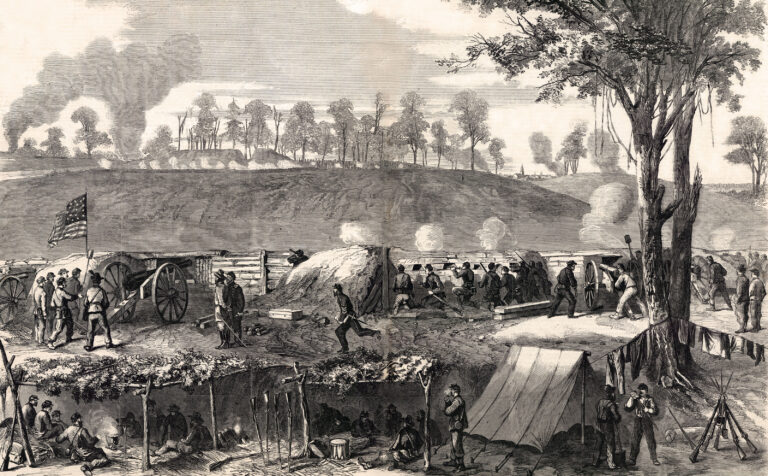
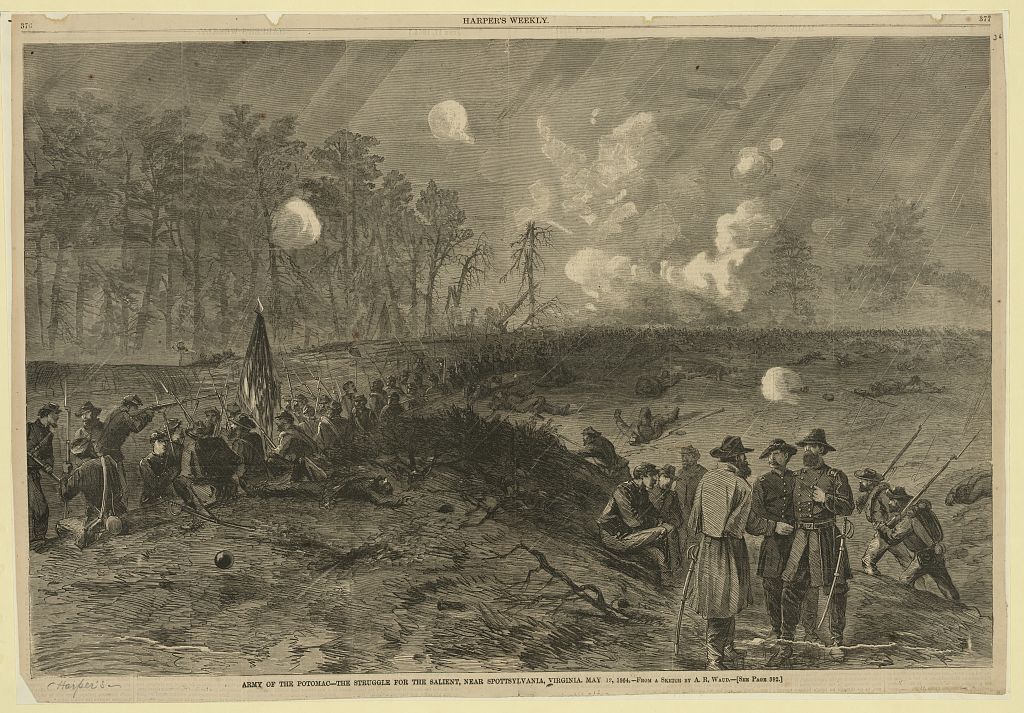
The Bloody Angle became the name given to a section of the Confederate line where opposing soldiers fought for hours at remarkably close range on May 12. Small arms and artillery struck earthworks, trees and men, and defenders and attackers repeatedly replaced depleted units. Mud and rain added to the difficulty of moving or removing wounded personnel.
Accounts describe desperate fighting through parts of the day and night. The name has sometimes encouraged sensational retellings, but the physical evidence of shattered trees, the scale of casualties and soldiers’ testimonies already convey the ferocity. The encounter shows how a successful initial attack could become a costly stalemate when defenders retained enough forces to seal the breach.
What role did earthworks play?
Civil War soldiers increasingly relied on trenches, logs and raised earth to survive rifle and artillery fire. Around Spotsylvania both sides improved fieldworks quickly, creating defensive lines that could be occupied and extended while combat continued. A fortified position reduced exposure and made sudden frontal assaults far more dangerous.
Earthworks also made tactical victories difficult to exploit. Even when attackers entered a trench, defenders could construct another line behind it, counterattack from nearby angles or obstruct movement with felled trees. Spotsylvania was an important stage in the development of continuous fortified warfare that later characterized the Siege of Petersburg.
Did Lee leave the Mule Shoe?
Following the struggle of May 12, Confederate soldiers withdrew from the exposed salient into another prepared position. That movement was a tactical adjustment to a dangerous shape, not a general collapse of the army. Lee continued to hold lines that prevented Grant from passing straight through to Richmond.
The withdrawal is important because popular diagrams sometimes show the Union penetrating the Mule Shoe and imply the entire Confederate defense must therefore have failed. In fact, both armies could retreat short distances, rebuild and resume fighting. Whether a position was strategically useful depended on the wider road network and the capacity to maintain an army.
What did the soldiers experience?
Units fought through wet weather, fatigue and rapidly deteriorating ground. Men crowded behind entrenchments and fired repeatedly at opponents who were sometimes only yards away. Wounded soldiers could be trapped between lines, and medical teams struggled with transportation and limited supplies. Prolonged contact allowed little sleep or relief.
The campaign’s human cost extended beyond the most famous attacks. Engineers dug, wagon drivers moved provisions, nurses and surgeons treated casualties, and civilians lived near destroyed farms and roads. Recognizing those experiences prevents the battle from becoming only a story of two commanding generals and the abstract arrows on a map.
How many casualties were there?
Casualty estimates for Spotsylvania are high, though the exact total varies by source and by the dates included. The number encompasses killed, wounded, missing and captured, not deaths alone. Losses occurred in many engagements between May 8 and May 21, rather than exclusively during the day of fighting at the Bloody Angle.
Both armies suffered the loss of experienced soldiers and officers. Union forces could draw on greater resources, while Confederate replacements were increasingly difficult to secure. Historical comparisons should therefore state the period, definition and source behind a figure instead of treating one number as the final measure of the battle.
Who won the battle?
Neither side achieved a decisive tactical victory at Spotsylvania. Lee’s defense prevented Union forces from breaking the army apart or capturing the critical road junction by direct assault. Grant kept moving and refused to abandon the offensive. Each command could point to some successes and some failures depending on the question being asked.
A useful distinction separates the battle’s immediate outcome from the course of the war. Tactically, the battle produced a bloody stalemate. Strategically, continuing Union pressure limited Confederate options and forced Lee to respond to another southward movement. That difference is central to interpreting the Overland Campaign.
What happened after Spotsylvania?
Grant gradually shifted southeast toward the North Anna River rather than keeping the army forever in front of the same entrenchments. The opposing forces maneuvered and fought again at North Anna, Totopotomoy Creek and Cold Harbor. Those movements demonstrate that Spotsylvania was one stage in a continuous operation, not an endpoint.
The later failure at Cold Harbor and the crossing of the James River eventually carried Union forces toward Petersburg. The shift from short battles to prolonged siege-like operations did not happen in a single moment. Spotsylvania contributed to it by demonstrating the defensive power of well-built earthworks against attacks that lacked sufficient coordination or surprise.
Why does the battle remain significant?
Spotsylvania is remembered for the Mule Shoe, Upton’s attack and the Bloody Angle, but these are more than dramatic episodes. They reveal the relationship between road geography, field engineering, tactical innovation and the limits of battlefield success. A temporary penetration did not guarantee the defeat of an entrenched army.
The preserved battlefield lets visitors study ground that shaped the fighting and compare trench lines with contemporary maps. When researching it, look for accounts from different units rather than repeating a single memorable quotation. The story becomes clearer when both Union and Confederate decisions are examined alongside the experiences of the men who fought.
Battle of Spotsylvania Court House timeline
The sequence below separates the main phases instead of treating several weeks or months of operations as a single battle.
| Date | Event |
|---|---|
| May 7–8 | Opposing armies march toward Spotsylvania crossroads. |
| May 8 | Union attacks meet Confederate defenders. |
| May 10 | Upton’s compact assault briefly breaks the salient. |
| May 12 | Hancock’s II Corps strikes the Mule Shoe; Bloody Angle fighting begins. |
| May 13 | Lee withdraws to a newly prepared defensive line. |
| May 18 | Another Union attack fails against strengthened positions. |
| May 19–21 | Remaining actions and Grant’s next southward movement. |
Frequently asked questions
When was it fought? May 8–21, 1864.
Where was it? Spotsylvania, Virginia.
Who commanded the armies? Grant, Meade, Lee.
Who won? No decisive victory. See the analysis above for the difference between tactical and strategic outcomes.
What else should I read? Start with our Civil War timeline and causes and the related guides below.
Historical sources and further reading
Sources include federal battlefield scholarship, campaign research and archival visual material. Interpretations and numerical estimates have been distinguished from direct documentary evidence where necessary.