Guadalcanal Campaign (1942–1943): Henderson Field, Marines and Naval Battles
Why Marines landed on Guadalcanal in August 1942, how the fight for Henderson Field unfolded and why land, sea and air battles lasted six months.
Quick answer
The Guadalcanal campaign began August 7, 1942, when U.S.-led Allied forces landed on Guadalcanal, Tulagi and nearby islands in the Solomon Islands chain. Their chief objective was to stop Japanese expansion and seize an airfield under construction, later named Henderson Field. The campaign lasted until the Japanese evacuation was completed in February 1943. It involved repeated land battles, naval engagements and aircraft operations, as well as disease and supply shortages. Guadalcanal helped shift the initiative in the Pacific toward the Allies, but victory required nearly six months of heavy fighting.
Key facts
On this page
- Why Japan built an airfield on Guadalcanal
- Operation Watchtower and the August 7 landings
- The capture and renaming of Henderson Field
- The Battle of Savo Island and early naval losses
- The Battle of the Tenaru and Japanese attacks on the perimeter
- Edson’s Ridge and the September defense
- The Tokyo Express and the nighttime supply struggle
- Cape Esperance, Santa Cruz and the naval campaign
- The Naval Battle of Guadalcanal in November
- Disease, climate and the human toll
- The Japanese evacuation and February 1943 victory
- Why Guadalcanal changed the Pacific War
- Timeline
- FAQs
- Sources
Why Japan built an airfield on Guadalcanal
In early 1942 Japanese forces expanded through parts of the South Pacific, threatening supply routes linking the United States with Australia and New Zealand. The Solomon Islands occupied a strategically important location for aircraft and naval operations. Japanese engineers began building an airfield on Guadalcanal that could support further operations and complicate Allied movement through the region. American planners saw the unfinished runway as an urgent target.
The Allies had recently won a significant carrier victory at the Battle of Midway, but Japan still held extensive territory and powerful naval forces. Guadalcanal offered a chance to begin sustained offensive operations. Unlike Midway, where the decisive phase centered on carriers at sea, this new campaign would require Marines and soldiers to occupy territory, defend an airfield and survive on an island far from major supply bases.
Operation Watchtower and the August 7 landings
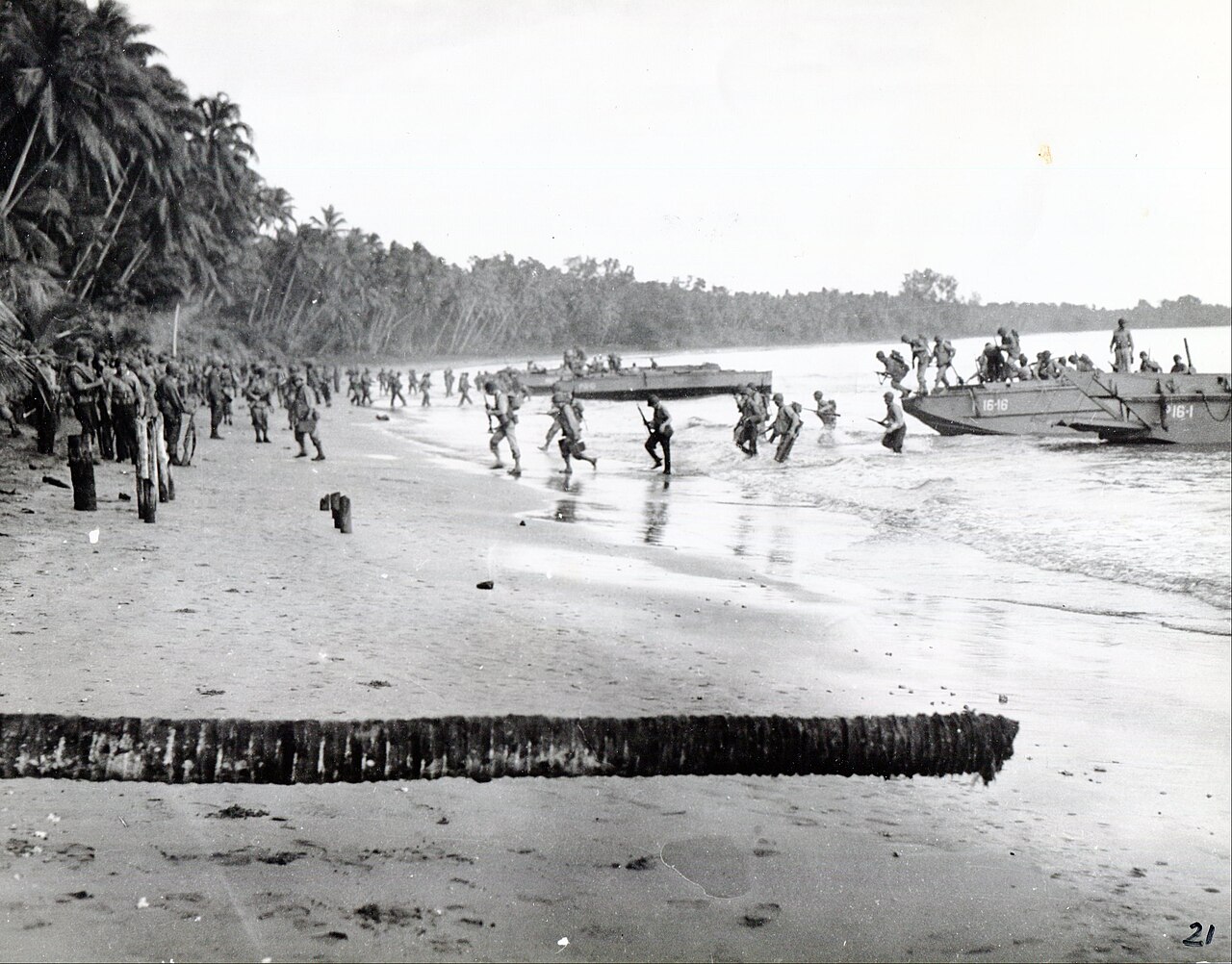
Operation Watchtower began with Allied landings on August 7, 1942. U.S. Marines came ashore on Guadalcanal and attacked nearby Japanese positions on Tulagi and smaller islands. The initial landing on Guadalcanal met relatively limited resistance near the beaches, allowing the Marines to move inland toward the unfinished airfield. Fighting on Tulagi and surrounding islets was much harder from the beginning.
The featured Marine Corps photograph documents a landing on Guadalcanal in August. It does not represent the entire campaign or every beach assault, and its date should not be mistaken for the later naval battles. The landing was only the beginning: once American troops occupied the runway, they became responsible for defending a perimeter against repeated Japanese efforts to retake it.
The capture and renaming of Henderson Field
Marines secured the Japanese-built airfield and named it Henderson Field in memory of Marine aviator Lofton Henderson, killed during the Battle of Midway. The runway became central to the campaign because aircraft based there could attack Japanese ships and troop movements during daylight. The group of Allied flyers operating from the area became known as the Cactus Air Force, using the island’s radio code name.
Keeping the field operational required engineers, fuel, spare parts, ground crews and protection from attack. Rain, mud and Japanese bombardment complicated the work. The airfield was therefore more than a strip of ground seized on August 8; it was a logistical system that had to function under constant danger. Control of Henderson Field helped prevent Japanese forces from moving reinforcements by sea without facing the threat of Allied aircraft.
The Battle of Savo Island and early naval losses
On the night of August 8–9, Japanese warships surprised an Allied covering force near Savo Island and inflicted a severe defeat, sinking several Allied heavy cruisers. The battle demonstrated Japan’s skill in night surface combat and created additional danger for ships bringing supplies to the Marines ashore. Allied naval commanders had to reconsider how they protected transport and support operations around Guadalcanal.
Although the Japanese victory at Savo Island was significant, the Japanese force did not destroy the remaining Allied transports and the Marines remained on the island. This distinction matters when evaluating tactical victory and strategic outcome. The attack increased American supply difficulties but did not erase the foothold at Henderson Field. Throughout the campaign, local naval engagements had consequences beyond individual ships because they shaped what either army could deliver to its troops.
The Battle of the Tenaru and Japanese attacks on the perimeter
In August Japanese ground units attempted to break the Marine defense line near the Ilu River, commonly associated in American histories with the Battle of the Tenaru. The attacking force suffered severe casualties. Its commanders had underestimated the strength of American positions and the difficulty of assaulting prepared defenses. Other Japanese units continued trying to approach and attack the airfield from different directions.
The terrain favored concealment but also made movement difficult. Dense vegetation, streams, poor maps and heat affected planning and combat on both sides. American forces lacked perfect intelligence about how many Japanese troops were present, while Japanese commanders often faced shortages of heavy weapons and supplies. A narrative focused only on the Marines’ defensive fire risks missing the importance of navigation, intelligence and the decisions that preceded repeated frontal attacks.
Edson’s Ridge and the September defense
In mid-September Japanese troops launched a major attack against positions south of Henderson Field. U.S. Marine units, including forces commanded by Lieutenant Colonel Merritt A. Edson, defended the ridge in heavy nighttime fighting. The American defense prevented Japanese forces from reaching and capturing the airfield. The battle later became known as Edson’s Ridge or Bloody Ridge.
The engagement showed that the campaign’s outcome depended on protecting a small number of strategically important positions. Airplanes could attack ships only if the airfield remained usable and defenders controlled its approaches. The Japanese army continued pursuing the field, while American troops worked to reinforce vulnerable areas. Japanese losses at the ridge weakened one assault but did not end the campaign.
The Tokyo Express and the nighttime supply struggle
Japanese destroyers and other warships ran repeated nighttime missions to carry men and supplies toward Guadalcanal, a pattern Americans called the Tokyo Express. The runs exploited Japanese night-fighting skill and attempted to avoid Allied aircraft operating from Henderson Field during daylight. But destroyers could carry only limited quantities of heavy equipment and food compared with ordinary transport ships.
The Japanese army’s difficulty obtaining supplies became an increasingly serious problem. Food shortages, illness and lack of ammunition affected combat effectiveness. American forces faced their own supply challenges because ships entering nearby waters remained vulnerable to Japanese surface and air attacks. The contrast between what could be delivered at night and what aircraft could attack during daylight made Guadalcanal a continuous contest for logistical access.
Cape Esperance, Santa Cruz and the naval campaign
Several naval battles around the Solomons occurred while ground forces fought ashore. The Battle of Cape Esperance in October produced a tactical American success in a night surface engagement, though losses occurred on both sides. Later that month, the Battle of Santa Cruz Islands resulted in the sinking of USS Hornet and heavy damage to other ships. Japanese aircraft and pilot losses were also consequential.
The naval struggle cannot be summarized as one unbroken series of Allied victories. Japan repeatedly inflicted substantial losses and threatened the American position. The significance of the campaign lies in how the Allies continued defending the airfield despite defeats at sea and on land. Aircraft, submarines and surface fleets remained linked to the fate of troops who depended on supplies arriving over the ocean.
The Naval Battle of Guadalcanal in November
In November 1942 the Japanese attempted major reinforcement and bombardment operations aimed at regaining control of Henderson Field. American and Japanese fleets fought intense actions in the waters around Guadalcanal, including engagements on the nights of November 12–13 and 14–15. Ships were sunk or damaged in battles at very close range, and both sides suffered major losses among crews.
The Japanese effort failed to deliver the resources necessary to retake the airfield. The November battles are often considered a major turning point within the Guadalcanal campaign. The surrounding waters became known as Ironbottom Sound because so many ships sank there. But the nickname captures only part of the cost; the campaign also involved thousands of men fighting or suffering disease on the island itself.
Disease, climate and the human toll
Guadalcanal’s tropical climate, mud, insects and limited infrastructure caused major medical problems. Malaria, dysentery and malnutrition affected both sides, and Japanese troops experienced especially severe deprivation as supplies diminished. Combat forces had to maintain defenses while coping with illness and exhaustion. Medical evacuation, sanitation and the ability to move food and medicine were as important to endurance as weapons.
Casualty figures vary according to whether historians count the campaign’s land fighting, naval battles, air operations and disease deaths. A single headline number can conceal those differences. Official histories document severe losses among Japanese troops and substantial American casualties at sea and ashore. Remembering this wider cost helps explain why Guadalcanal was a campaign of attrition rather than one dramatic amphibious landing followed by immediate success.
The Japanese evacuation and February 1943 victory
By early 1943 Japanese commanders concluded that retaking Guadalcanal was not feasible under the existing conditions. Their forces conducted an organized withdrawal, known as Operation Ke, using destroyers to evacuate thousands of troops. American forces initially did not fully recognize the evacuation’s purpose, and the Japanese managed to remove many survivors. On February 9 the Allies announced the island secured.
The evacuation did not mean every Japanese soldier had been destroyed or that the campaign ended with a final battle for the airfield. Japan chose to withdraw from a position that had become unsustainable. Allied forces then used Guadalcanal to support further operations through the Solomon Islands. The victory represented the cumulative effect of months of airfield defense, naval fighting and logistical pressure.
Why Guadalcanal changed the Pacific War
Guadalcanal demonstrated that American and Allied forces could seize and hold a strategic position despite strong Japanese opposition. It also exposed the difficulty Japan faced in replacing pilots, ships and supplies during a prolonged campaign. The battle was an important step toward the Allied advances that followed through the Solomons and New Guinea.
Yet the war remained far from over. Operations such as Tarawa, Saipan and later Pacific campaigns required further costly amphibious assaults. The Midway victory had altered strategic expectations; Guadalcanal tested whether that change could be translated into sustained control of contested territory.
Timeline
- August 7, 1942: Allied amphibious landings begin
- August 8–9: Japanese victory at Savo Island
- August 1942: Henderson Field secured and Cactus Air Force established
- August 21: Battle of Tenaru
- September 12–14: Edson’s Ridge defended
- October 1942: Cape Esperance and Santa Cruz naval battles
- November 12–15: Naval Battle of Guadalcanal
- February 1943: Japan evacuates remaining forces
- February 9, 1943: Campaign concludes
Frequently asked questions
When did the Guadalcanal campaign begin?
August 7, 1942.
When did it end?
February 9, 1943, after the Japanese evacuation.
Why was Henderson Field important?
Aircraft operating from it threatened Japanese ships and helped control access to the island.
What was the Cactus Air Force?
The collection of Allied air units operating from Guadalcanal.
What was the Tokyo Express?
Japanese nighttime ship runs carrying troops and supplies toward the island.
What is Ironbottom Sound?
The waters near Guadalcanal where many warships were sunk during repeated naval engagements.
Did the U.S. win immediately after landing?
No. The campaign required roughly six months of intense fighting, supply efforts and naval operations.