Compromise of 1877: Why Reconstruction Ended and What Hayes Agreed
The disputed Hayes–Tilden election, political understandings and the withdrawal of support for Southern Republican governments.
The Compromise of 1877 refers to political understandings surrounding Hayes’s disputed election victory and the withdrawal of federal protection from the remaining Republican governments in Louisiana and South Carolina. Historians debate the exact bargains involved. It was not one formally signed treaty, but its consequences became associated with the end of Reconstruction.
Explore what is documented, what remains debated and why the political settlement changed the lives of Black voters.
On this page — 23 topics
What was the Compromise of 1877?
The Compromise of 1877 is the name historians commonly give to political negotiations and understandings associated with the settlement of the disputed presidential election of 1876 and the end of federal military support for the remaining Republican state governments in the South. Republican Rutherford B. Hayes became president after Congress awarded him contested electoral votes, while Southern Democratic leaders gained greater control over local politics. The name can mislead readers into imagining a single formal treaty signed by both parties. No universally accepted written compact contains every promise later attributed to the compromise. Its significance instead lies in the conjunction of electoral negotiations, Hayes’s stated policy of withdrawing troops from political protection of state governments, and the rapid loss of Republican authority in Louisiana and South Carolina.
Why was the 1876 election disputed?
Samuel J. Tilden, the Democratic nominee, won more popular votes than Republican Rutherford B. Hayes, but the Electoral College result depended on twenty disputed votes. Controversies involved Florida, Louisiana, South Carolina and one Oregon elector. A congressional Electoral Commission ultimately assigned all twenty votes to Hayes, resulting in a narrow 185–184 majority. The dispute unfolded amid allegations of fraud and racial intimidation in Southern elections and disagreement about who could certify rival returns. The possibility of an unresolved presidential succession made negotiations politically urgent. Our separate election of 1876 guide explains the ballots, electoral arithmetic and commission. The Compromise of 1877 concerns what surrounded the conclusion of that process and the consequences for Reconstruction.
Was there a single signed deal?
Historians generally describe informal negotiations and political assurances rather than one official instrument named the Compromise of 1877. Accounts of meetings, correspondence and later recollections provide evidence, but the participants did not all record the same promises in identical terms. Some Democrats sought commitments to withdraw federal military support from Southern Republican governments and provide other policy concessions. Hayes’s advisers wanted a resolution that would permit the presidential transition. Because the surviving documentation is incomplete and interpretations differ, claims that the parties signed a precise enforceable exchange are misleading. It is more accurate to distinguish demonstrable subsequent federal policy from allegations about what was promised privately. The historical label summarizes a cluster of events, not a constitutional amendment or formal statute.
What role did the Electoral Commission play?
Congress created a fifteen-member commission to consider disputed electoral returns from four states. Members included senators, representatives and Supreme Court justices. The commission’s eight-to-seven decisions favored Hayes, and congressional proceedings ultimately confirmed his presidency. The commission did not itself legislate a withdrawal of troops from Southern state capitals. Its formal work concerned electoral votes, while other political discussions addressed the practical acceptance of the result and the course of the next administration. Keeping those functions separate matters. A commission decision may be well documented in congressional records, whereas an alleged private commitment requires different kinds of evidence. The settlement of the election and the end of Reconstruction were related events, but their institutional procedures were not the same.
Why were Louisiana and South Carolina especially important?
By the beginning of 1877, rival claims to state government persisted in Louisiana and South Carolina. Republican administrations relied in part on the presence or potential protection of federal troops, while Democratic opponents claimed authority and sought to consolidate control. Hayes’s eventual decision to withdraw federal troops from positions supporting the Republican governments left them unable to maintain power. These states therefore became central to the political consequences of the election settlement. Their history is also inseparable from organized violence and the suppression of Black political participation. Presenting the conflict merely as two parties disagreeing about officeholders would hide the ways electoral power and civil rights were connected after slavery.
What did Hayes want to achieve?
Hayes advocated a policy of reconciliation between sections of the country and sought to reduce the federal military role in supporting Southern governments. He hoped that local political leaders would respect constitutional rights and that cooperation could replace direct military supervision. Critics argued that such expectations overlooked the record of racial intimidation and discriminatory government. His decisions took place after Republican national support for extended Reconstruction had already weakened, so they were not a sudden reversal of an otherwise uniformly interventionist policy. The withdrawal was nonetheless consequential because the remaining state governments faced organized opponents without comparable federal backing. Hayes’s aims and the practical effects of his policy must be examined separately rather than assuming that reconciliation automatically produced equal protection.
When did federal troops leave political positions?
In April 1877, the Hayes administration ordered federal troops to withdraw from positions protecting the remaining Republican state governments in South Carolina and Louisiana. The withdrawal allowed Democratic claimants to take power, and it became a central event in the conventional ending of Reconstruction. It did not mean that every United States soldier left the entire South in 1877, nor that the federal army ceased to exist in the region. Troops remained at various posts for other missions. The distinction between removing political support from particular statehouses and withdrawing all federal military personnel is important. Historical summaries that claim the South was completely emptied of federal soldiers exaggerate what the April orders actually did.
What happened in South Carolina?
South Carolina had two rival claimants to the governorship following disputed elections: Republican Daniel H. Chamberlain and Democrat Wade Hampton. The state’s large Black electorate had made Republican politics significant during Reconstruction, but intimidation and violence challenged that participation. Federal troops had been associated with protection of state institutions during the conflict. After Hayes ordered their withdrawal from the political confrontation, Chamberlain abandoned his claim, leaving Hampton in control. This change was a political victory for Democrats seeking the removal of the remaining Republican government. For Black voters and officeholders, however, the transition raised fundamental questions about whether their rights would receive effective protection against organized resistance.
What happened in Louisiana?
Louisiana also experienced rival government claims after disputed elections. Republican Stephen B. Packard and Democrat Francis T. Nicholls both claimed authority, and federal troops had helped maintain a fragile situation around state government institutions. The Hayes administration’s withdrawal of support undermined Packard’s position, enabling Nicholls to consolidate power. The precise negotiations involving Louisiana politicians have been interpreted differently by historians, but the change in political control is well established. The state had experienced severe political violence during Reconstruction, including attacks on Black and Republican political participation. The events of 1877 therefore had immediate consequences for the communities relying on federal intervention to protect elections and public institutions.
What concessions have historians identified?
Accounts of the compromise often mention federal troop withdrawal, promises of fair treatment for Black Southerners, economic development or railroad assistance, and the possibility of Southern Democrats participating in a Hayes administration. Not all these proposed concessions were delivered as some contemporaries expected, and the degree to which each was part of a binding bargain remains debated. For example, promises to protect Black rights were not fulfilled in a way that stopped violence and disfranchisement. A reliable history should not list every item as a completed legal obligation. It is safer to explain the reported understandings, identify subsequent decisions, and examine where outcomes diverged from the rhetoric used to secure political cooperation.
Was railroad construction part of the settlement?
Some accounts describe Southern interest in federal support for railroad expansion, particularly a projected Texas and Pacific connection. Economic development was important because Southern politicians wanted investment after the Civil War and the long depression of the 1870s. Negotiators discussed transportation and patronage, but historians disagree about how central those proposals were to the resolution of the electoral dispute. The promised railroad assistance did not simply materialize as one comprehensive federal payment under the label Compromise of 1877. Treating railroad proposals as a completed part of a formal agreement would overstate the evidence. The subject illustrates why descriptions of the compromise should distinguish discussions, political expectations and policy actually carried out.
Did Reconstruction end on one day?
No. Reconstruction is conventionally dated from 1865 to 1877, but it was a long and uneven political process. The Freedmen’s Bureau had already closed in 1872, and Democrats had gained control in several Southern states before the disputed election. Conversely, the Thirteenth, Fourteenth and Fifteenth Amendments remained in the Constitution after 1877, and Black communities continued political organizing. The election settlement and troop withdrawals are useful markers because they changed federal support for the last Republican state governments. They were not a blanket repeal of Reconstruction law. A precise account distinguishes the formal existence of legal rights from the political and institutional capacity needed to enforce them in particular states.
How were Black voting rights affected?
The Fifteenth Amendment still prohibited race-based denial of voting rights, but a constitutional prohibition could not guarantee that eligible voters would be safe from threats or coercion. White supremacist political organizations used intimidation, economic pressure and violence to weaken Black participation during and after Reconstruction. Without sustained federal enforcement, many Black citizens faced increasing obstacles to exercising the franchise. Yet disfranchisement happened at different rates across states, and some Black officeholding and voting continued after 1877. The longer process eventually produced extensive restrictions through poll taxes, literacy tests and discriminatory registration. Our Fifteenth Amendment history explains why its constitutional promise outlasted federal willingness to enforce it consistently.
Did the compromise restore Southern democracy?
Political leaders promoting reconciliation argued that local self-government would reduce conflict and restore normal constitutional administration. But a government could formally claim local autonomy while excluding large numbers of citizens through violence and unequal political rules. Black Southerners who had voted or held office under Reconstruction often lost effective influence as white Democratic organizations consolidated power. Historians therefore distinguish the rhetoric of home rule from the actual distribution of rights and representation. It is inaccurate to assume that removing troops automatically created fair electoral competition. The settlement reduced one form of federal intervention while exposing unresolved conflicts over race and citizenship that would continue for generations.
What was the role of the Democratic Party?
Southern Democrats opposed Republican Reconstruction governments and generally demanded withdrawal of federal political protection as part of the broader campaign for what they called home rule. Party leaders were not identical in their priorities: some emphasized economic development, others state control and many the restoration of white political dominance. National Democratic politicians also faced the question of accepting Hayes after their candidate had won the popular vote. Negotiations therefore involved regional factions and congressional strategy rather than two monolithic parties acting with a single written mandate. Recognizing these differences does not require minimizing the role of white supremacist intimidation in the underlying political struggle. The election outcome changed the incentives of politicians as well as the resources available to threatened voters.
What does the term Redeemer mean?
“Redeemer” was a term adopted by white Southern Democrats who sought to overthrow or replace Reconstruction Republican governments and restore their preferred political order. It conveyed a claim that Southern states were being rescued from illegitimate rule. Historians use the term to describe a movement that frequently combined appeals to local self-government with exclusion of Black political participation. The phrase should therefore be presented as the political language of its supporters, not an objective assessment that the replacement governments were more democratic. By 1877 Redeemer governments had already emerged in several states. The settlement helped complete the transition in the remaining contested states, making the term important to understanding both the election and the subsequent era.
How did this affect later Jim Crow laws?
The collapse of remaining Reconstruction Republican governments contributed to conditions in which white Democratic politicians could increasingly restrict Black political participation and institutionalize segregation. Jim Crow developed over subsequent decades through state and local laws, violence, court decisions and changing political strategies. It did not appear as one complete nationwide legal code signed in March 1877. Nevertheless, the weakening of federal enforcement reduced an important obstacle to discriminatory policies. A causal explanation must account for both the 1877 transition and later developments, including late-nineteenth-century disfranchisement laws. The Compromise of 1877 is therefore a significant turning point, not the sole cause of every discriminatory institution that followed.
Why do historians disagree about the compromise?
The surviving evidence includes political correspondence, reports of meetings, congressional proceedings, memoirs and subsequent government decisions. Some historians emphasize direct bargaining in which Democratic acquiescence was exchanged for federal withdrawal; others place greater weight on Hayes’s preexisting policy aims and the structural decline of Reconstruction. The informal character of discussions makes it difficult to assign one precise list of terms to every participant. Strong evidence supports the electoral settlement and the withdrawal of military protection from remaining Republican Southern governments. More specific claims about secret promises require careful sourcing. The existence of scholarly debate does not make the core events uncertain, but it argues against presenting a tidy fictional contract as though it were a primary document.
Where should readers begin with primary sources?
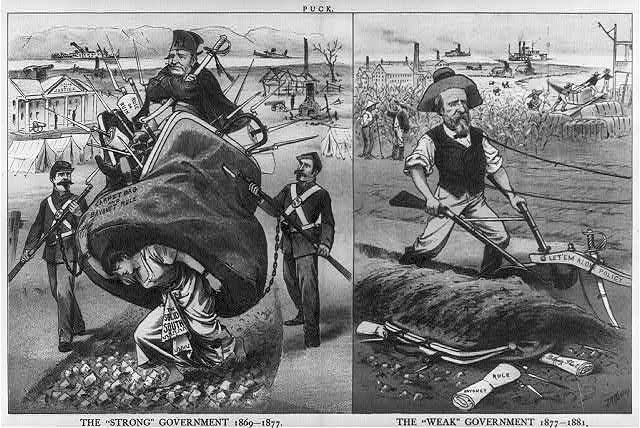
The National Archives’ 1876 electoral record documents the official 185–184 result. The Library of Congress preserves contemporary political cartoons, newspapers and election materials, while the Rutherford B. Hayes Presidential Library provides papers and analyses of the disputed election. Contemporary congressional debates document the Electoral Commission and the final vote count. Those sources should be compared with subsequent withdrawal orders and state government records. The illustration on this page is a retrospective political cartoon printed in 1881, not a photograph of a signed agreement. Its value is evidence of later political interpretation, not proof of what negotiators said in private.
Why is 1877 considered a turning point?
The events of 1877 marked the end of federal military support for the last contested Republican state governments, completing an important transition away from Congressional Reconstruction. Black Americans did not lose all constitutional rights that year, but the weakening of enforcement made many rights harder to exercise. The political settlement also demonstrated how disputes over presidential succession could intersect with local struggles over voting and protection from violence. Understanding the compromise requires more than memorizing that Hayes became president and troops withdrew. Its lasting importance lies in how national choices altered the balance of political power and helped shape the difficult history of citizenship and racial equality after the Civil War.
Compromise of 1877 timeline
| Date | Event |
|---|---|
| November 1876 | Disputed presidential election creates a succession crisis. |
| January–February 1877 | Electoral Commission reviews contested votes. |
| March 2, 1877 | Congress confirms Hayes’s 185–184 Electoral College victory. |
| March 1877 | Political discussions and the presidential transition proceed. |
| April 1877 | Federal troops cease protecting contested Republican governments in Louisiana and South Carolina. |
| Later decades | The erosion of Reconstruction gains continues through disfranchisement and segregation. |