Ku Klux Klan Act of 1871: Enforcement Acts, Grant and Federal Power
How Congress and President Grant attempted to suppress organized violence against citizens’ rights.
The Ku Klux Klan Act became law April 20, 1871. It gave the federal government additional legal and military powers to confront conspiracies and racial terror denying constitutional rights, particularly attacks on Black voters during Reconstruction. Grant used its powers in South Carolina later that year.
This guide explains the three Enforcement Acts, the Klan’s violence, Grant’s response and the limits of federal protection.
On this page — 20 topics
What was the Ku Klux Klan Act of 1871?
The Ku Klux Klan Act was a federal statute enacted on April 20, 1871, during Reconstruction. Formally the Third Enforcement Act, it gave the national government additional tools to confront conspiracies and violence intended to deny constitutional rights. The immediate crisis involved Ku Klux Klan attacks on African American voters, officeholders and supporters of Republican governments in the South. The law authorized federal prosecution of certain conspiracies and gave President Ulysses S. Grant powers to use military force in specified circumstances. It was one of several Enforcement Acts, not the original law that created the constitutional right to vote. Its significance lies in the attempt to make the Fourteenth and Fifteenth Amendments effective against organized intimidation.
Why did Congress consider it necessary?
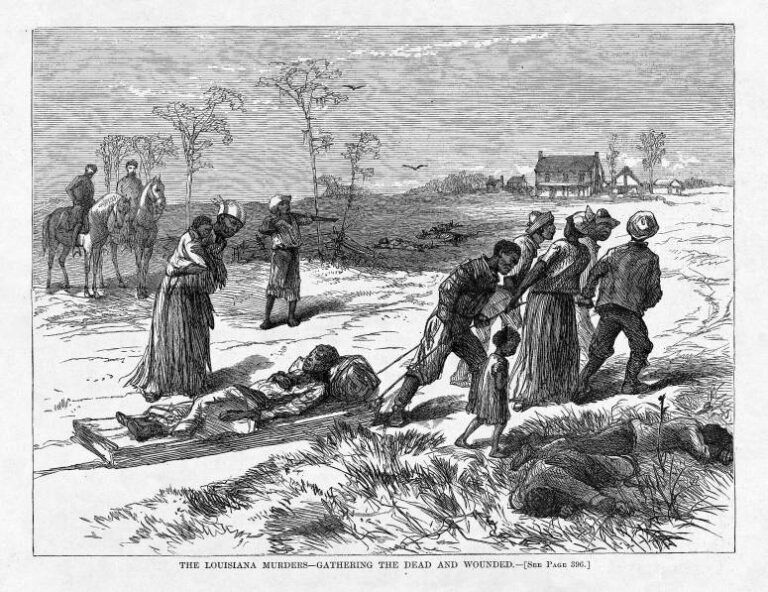
The end of slavery and the establishment of Black political participation provoked violent resistance from white supremacist organizations. Armed groups threatened teachers, politicians, voters and families, often attacking people outside the protection of local courts. Local officials sometimes sympathized with the perpetrators or were unable to challenge them. Congress investigated testimony about organized terror and found that ordinary law enforcement was not preventing these attacks. Black lawmakers and community leaders demanded stronger federal action. The federal government’s dilemma was constitutional as well as practical: it had established rights through amendments, but many citizens could not exercise them safely. The legislation sought ways to intervene where state government failed to provide effective protection.
When did the law become effective?
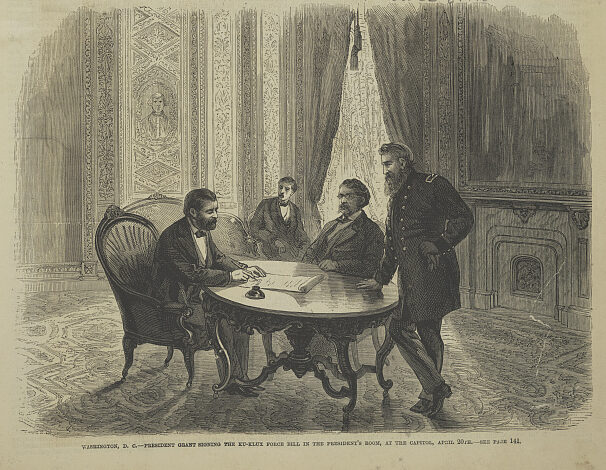
Congress completed the lawmaking process on April 20, 1871, and Grant signed it the same day. A newspaper engraving published shortly afterward depicted the president signing the bill in the Capitol, an image preserved by the Library of Congress. The date matters because earlier federal legislation had already attempted to protect elections. The First Enforcement Act became law in May 1870 and the Second in February 1871. The April measure expanded available powers rather than launching national enforcement from nothing. Several months later the Grant administration acted in South Carolina under these provisions. A chronology distinguishing the three statutes helps readers avoid conflating their powers and the circumstances of their enactment.
How did the Klan use intimidation?
The first Ku Klux Klan emerged in the postwar South and became associated with threats, night rides, beatings and murders intended to maintain white supremacy. Targets included Black citizens asserting political and labor rights and white people supporting Reconstruction. Violence could be directed at a person’s family, workplace or church as well as at a polling place. The organization’s activities varied geographically; its name should not be used as shorthand for every group responsible for Reconstruction violence. Nevertheless, coordinated intimidation could make constitutional rights almost meaningless without federal protection. The law responded to these specific conditions rather than merely expressing a general disapproval of prejudice or partisan disagreement.
How was the Act connected to the Fourteenth Amendment?
The Fourteenth Amendment prohibited states from denying due process or equal protection of the laws. Supporters of federal enforcement argued that conspiracies and the failure of state officials to protect citizens demanded national remedies. The 1871 law created federal causes of action and criminal tools addressing certain deprivations of rights. These legal concepts later became important in civil-rights litigation, although their interpretation changed through subsequent court decisions. It is misleading to describe the amendment as having granted unlimited federal authority over every private offense. The central debate concerned when a state’s failure to protect people and coordinated violence could trigger federal action. The Act was one ambitious answer to that question.
How was it connected to the Fifteenth Amendment?
The Fifteenth Amendment prohibited the denial or abridgment of voting rights because of race, color or previous condition of servitude. It did not prevent gunmen from threatening voters without an enforcement response. Congress therefore adopted measures aimed at intimidation and interference with elections, some before and some after ratification. The 1871 law formed part of that broader effort. A Black citizen could be legally eligible to vote yet face violence on the road to a polling place or consequences for supporting a candidate. Enforcement law tried to address the gap between constitutional language and the actual freedom to participate politically. The distinction remains central to understanding Reconstruction’s achievements and failures.
What were the three Enforcement Acts?
The Enforcement Act of May 1870 targeted discrimination and intimidation affecting voting rights. A second measure in February 1871 increased federal oversight of national elections and strengthened the role of supervisors and marshals. The third, commonly called the Ku Klux Klan Act, was signed April 20, 1871, and expanded powers against conspiracies that denied equal protection. The laws overlapped but were not identical. The U.S. Senate’s historical explanation distinguishes their purposes. Reading them as a sequence reveals how Congress responded to continuing attacks and concluded that earlier measures were insufficient. It also prevents incorrect claims that one single statute both created voting rights and abolished every form of racial violence.
Did the Act give the president military authority?
Yes, under specified conditions the law enabled the president to use the armed forces to suppress conspiracies and disorder that prevented constitutional rights from being protected. This authority was controversial because it involved federal intervention within states during peacetime. Supporters argued that local institutions had failed to stop organized terror, making national action necessary. Opponents raised constitutional objections and concerns about executive power. The statute also permitted suspension of habeas corpus in certain circumstances, a significant and limited power rather than an unrestricted general suspension for the entire country. How and where the administration used these provisions is an important part of its history, separate from what the legislation merely authorized.
What happened in South Carolina in October 1871?
In October 1871 President Grant used the Act’s extraordinary authority in parts of South Carolina where Klan activity had been particularly severe. He suspended habeas corpus in nine counties and sent federal troops to support suppression of organized violence. Officials arrested suspects and initiated prosecutions. The operation disrupted important Klan networks and showed that the national government was willing to act beyond issuing proclamations. The measures were not applied identically across the whole South, however, and the prosecution of one organization did not end all white supremacist violence. The National Park Service’s timeline records the chronology and explains why the South Carolina intervention became a landmark.
Who was Attorney General Amos Akerman?
Amos T. Akerman served as U.S. attorney general under Grant and became closely associated with efforts to prosecute Klan members. The newly created Department of Justice, established in 1870, provided a federal institutional base for coordinating such litigation. Akerman regarded organized racial terror as a serious threat to the rule of law and national citizenship. His work demonstrates that the 1871 statute was not only a set of words on paper; prosecutors and federal officials had to investigate crimes, assemble witnesses and pursue cases. Local juries and the safety of witnesses presented serious challenges. The historical importance of Akerman lies in his role in a broader administration effort that temporarily weakened parts of the Klan’s violent network.
How did Black members of Congress influence the debate?
African American lawmakers elected during Reconstruction did not simply watch federal laws being made. They argued for constitutional protections and greater federal responsibility to prevent terror. Representative Robert B. Elliott of South Carolina was among those who supported strong enforcement. The House of Representatives’ historical essays document how Black members explained the practical danger facing voters and political leaders in the South. Their participation is important because it challenges narratives in which Reconstruction civil rights appear to be gifts bestowed exclusively by white congressional leaders. Black political organization helped identify the failures of local protection and explain what a national response needed to accomplish. Their speeches provide primary evidence about the threats faced by the communities they represented.
Was the Klan permanently eliminated?
No. Federal operations severely disrupted the first Ku Klux Klan in several areas, but racial terror and political intimidation continued under other organizations and local networks. The decline of one particular secret society did not remove the political and economic forces supporting white supremacy. Later movements revived the Klan name, notably during the twentieth century, under different circumstances. It is therefore misleading to claim that the April 1871 statute permanently ended racial violence in the United States. The more defensible conclusion is that federal enforcement achieved important short-term results but lacked the sustained political support and broader social transformation necessary to secure equal rights everywhere.
How did the law relate to the Department of Justice?
Congress established the Department of Justice in 1870, allowing the federal government to coordinate litigation more systematically than before. The Enforcement Acts created important areas of work for federal attorneys and marshals, especially in regions where state officials refused or failed to enforce basic protections. Criminal cases required witnesses, evidence and court proceedings; federal troops alone could not substitute for these processes. The department’s emerging role illustrates how Reconstruction helped shape permanent national institutions. A constitutional amendment did not enforce itself, and the federal government needed lawyers, courts and administrators to translate rights into practice. These institutions operated amid fierce political debate about the proper limits of national power.
Why did federal enforcement weaken?
Enforcement faced legal, political and practical obstacles. Prosecutors had limited resources, witnesses risked retaliation, and federal courts developed narrower interpretations of some powers. As public attention shifted toward economic difficulties and other national issues in the 1870s, support for prolonged Southern intervention declined. Organized white supremacist violence continued to reshape state politics. The conventional end of Reconstruction in 1877 did not repeal the Fifteenth Amendment, but it reflected weakening federal willingness to enforce some of its protections. The history is not a simple movement from total federal power to none. Instead, capacity, legal doctrine and political determination changed over time, contributing to the erosion of gains made during the early Reconstruction years.
Is the 1871 Act still important in legal history?
Yes. Parts of Reconstruction-era civil-rights legislation have long legal histories and contributed to later federal remedies against violations of constitutional rights. The modern use and interpretation of particular provisions cannot be understood from an 1871 summary alone, because Congress has amended statutes and courts have developed extensive precedent. A history article should distinguish the original purpose of suppressing Reconstruction-era terror from contemporary law. The original enrolled act and the legislative debates establish what lawmakers sought to address. Later legal developments show how the federal courts interpreted the statute in different periods. That continuing relevance is one reason the Act remains widely studied by legal scholars as well as historians of postwar America.
What documents can verify the story?
The National Archives’ DocsTeach collection provides access to the enrolled Act, while the House historical office explains its passage. The National Park Service supplies a dated timeline of enforcement, and the Senate historical office distinguishes the three Enforcement Acts. The Library of Congress preserves an 1871 engraving showing Grant signing the bill. These resources should be compared rather than treated as interchangeable: a period illustration conveys how an event was presented to readers, while the enrolled statute supplies the authoritative text. Investigation reports and testimony are also crucial for understanding the violence that made the legislation necessary.
Why is the Act a Reconstruction turning point?
The Ku Klux Klan Act demonstrates that Reconstruction involved more than changes to citizenship and voting law. The central question was whether people could exercise those rights safely when organized violence and hostile local authorities threatened them. The federal response in 1871 marked an important attempt to use national institutions against those threats. Its partial success and later limitations illustrate why constitutional promises require practical enforcement and sustained political commitment. The Act also connects the careers of Black lawmakers, Grant’s presidency, the Department of Justice and the eventual rollback of many Reconstruction gains. Studied in that context, it was a consequential but incomplete effort to protect the new political order after slavery.
Enforcement Acts timeline
| Date | Event |
|---|---|
| May 31, 1870 | First Enforcement Act signed. |
| February 28, 1871 | Second Enforcement Act signed. |
| April 20, 1871 | Grant signs the Third Enforcement Act, called the Ku Klux Klan Act. |
| October 12, 1871 | Grant suspends habeas corpus in nine South Carolina counties to suppress terror. |
| Later 1870s | Federal enforcement weakens amid political and legal changes. |