Pickett’s Charge (July 3, 1863): Gettysburg Assault and Outcome
Pickett’s Charge was the name given to the Confederate infantry assault on the Union center at Gettysburg on July 3, 1863. Ordered by Robert E. Lee and overseen by James
Pickett’s Charge was the name given to the Confederate infantry assault on the Union center at Gettysburg on July 3, 1863. Ordered by Robert E. Lee and overseen by James Longstreet, it involved soldiers from the commands of George Pickett, James Pettigrew and Isaac Trimble. Union infantry and artillery repulsed the attack, inflicting heavy Confederate casualties and ending Lee’s final major effort to break the Gettysburg line.
A sourced historical guide to the chronology, evidence, people and consequences of this event.
On this page — 23 topics
What was Pickett’s Charge?
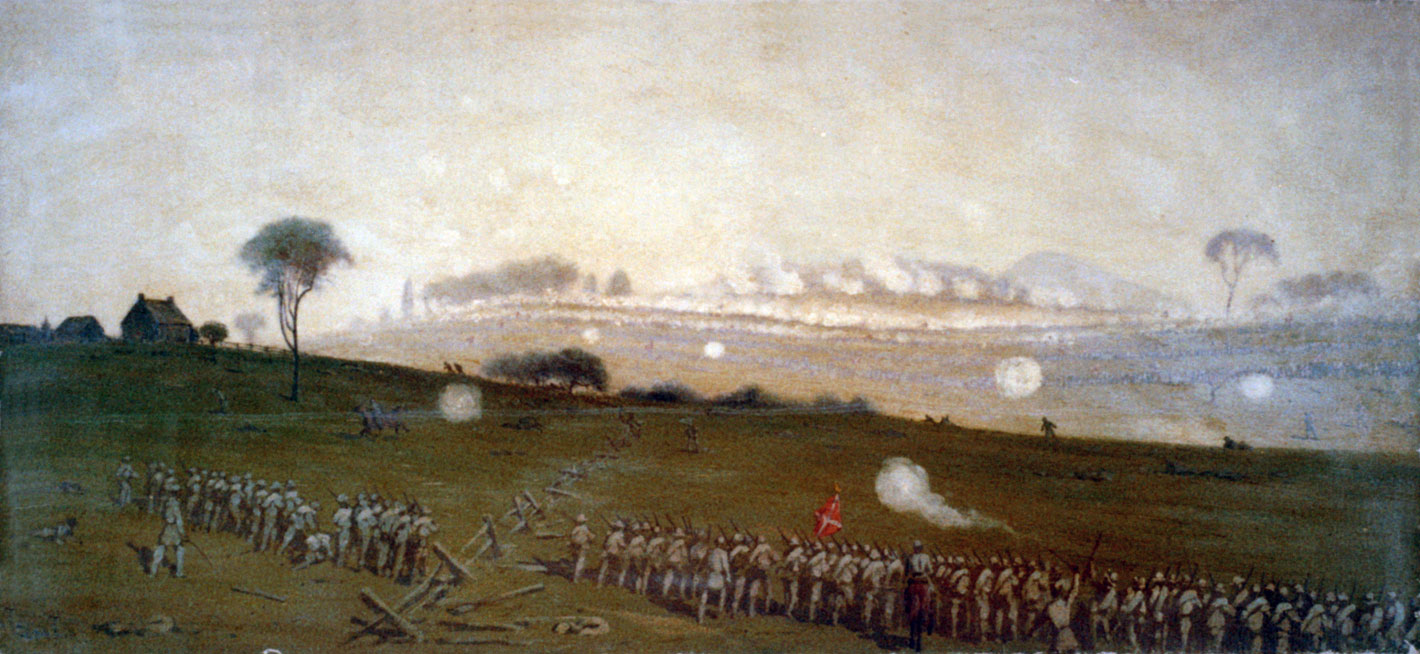
Pickett’s Charge was the climactic Confederate infantry assault against the Union center at the Battle of Gettysburg on July 3, 1863. Robert E. Lee ordered an attack across open ground toward Cemetery Ridge, hoping to break George G. Meade’s defensive line. The assault is named for Confederate Major General George Pickett, but his division was only part of the attacking force. Troops under James J. Pettigrew and Isaac R. Trimble also took part. Union artillery and infantry inflicted devastating casualties, and the attack failed. The episode has become a central symbol of the Confederacy’s defeat at Gettysburg, though the battle involved many other major engagements.
Why did Lee order the assault?
Lee had fought two difficult days at Gettysburg without securing a decisive victory. Confederate attacks on July 2 threatened parts of the Union flanks but did not destroy Meade’s defensive position. Lee believed a forceful attack against the center might exploit a weakness and split the Union army. He also hoped artillery fire would weaken federal guns before the infantry advanced. The decision has long been debated because the attackers would have to cross a wide field under fire. Historians should assess the plan through Lee’s information and objectives rather than assuming either that success was guaranteed or that the attack was obviously impossible to every participant.
Where did Pickett’s Charge begin?
The Confederate assault formed on or near Seminary Ridge west of the main Union position. Its destination was Cemetery Ridge, an elevated line held by federal infantry and artillery roughly three-quarters of a mile or more away depending on the starting unit. The intervening landscape included fences, roads and uneven ground that disrupted attackers and slowed their progress. The famous open field is important, but the terrain was not perfectly flat or empty. Different brigades began from different positions and converged toward the Union center. A map is essential for understanding why the attacking line became compressed and vulnerable to artillery fire.
Who was George Pickett?
George E. Pickett was a Confederate major general whose division belonged to James Longstreet’s corps in Lee’s Army of Northern Virginia. His men had not participated in the heaviest fighting on the first two days at Gettysburg, leaving them available for the July 3 assault. Pickett’s division attacked on the Confederate right of the main formation. He later became closely identified with the failed charge, a reputation intensified by postwar memory and popular films. Naming the entire operation after him can obscure the contributions and losses of troops from the other divisions. The charge was not solely Pickett’s personal initiative.
Who were Pettigrew and Trimble?
James Johnston Pettigrew commanded a division including units that had already suffered heavy losses during earlier fighting, while Isaac Trimble commanded brigades from another formation. Their troops advanced alongside Pickett’s division on July 3. The broader assault therefore involved soldiers from several Confederate formations with unequal fatigue, leadership and battlefield experience. Some postwar narratives emphasized Pickett’s Virginians and gave less attention to North Carolina, Mississippi and other units in Pettigrew’s and Trimble’s commands. A careful history identifies the three divisions and recognizes the different routes and outcomes of the participating brigades rather than treating them as one undifferentiated column.
What was James Longstreet’s role?
James Longstreet commanded the Confederate corps that included Pickett’s division and had responsibility for the July 3 attack’s immediate organization. He was skeptical about the prospects for success, and later memoirs and histories debated his attitude toward Lee’s plan. His doubts did not mean he refused to carry out the order. He coordinated the attack and worked with artillery officers to prepare the bombardment. The famous account of a reluctant nod to Pickett belongs to the battle’s later narrative tradition and must be considered with source criticism. The key military reality is that Longstreet supervised an assault Lee had decided to make.
How did the Confederate artillery bombardment begin?
Before the infantry advanced, Confederate artillery opened a major bombardment against Union positions on Cemetery Ridge. The firing lasted for a prolonged period and filled the battlefield with smoke, noise and shell bursts. Confederate gunners hoped to damage Union batteries and disrupt defending infantry before the charge. Some shots overshot their targets, while others damaged federal positions. The bombardment did not eliminate Meade’s artillery or break the defensive line. Its effectiveness was limited by ammunition supply, smoke and imperfect observation. The failure to silence the Union guns exposed attacking infantry to devastating fire once they crossed the open ground.
Did Union artillery stop firing before the assault?
Union artillery officers reduced firing from some batteries during the Confederate bombardment, conserving ammunition and avoiding unnecessary exposure. Confederate observers sometimes interpreted this reduction as evidence that federal guns had been badly disabled. In fact, numerous Union batteries remained capable of firing when the infantry advanced. The decision to manage ammunition was tactically significant because artillery rounds were needed for the approaching columns. The detail is sometimes simplified into a story in which all Union guns fell silent as a trick. The historical reality involved decisions by individual batteries and commanders across a long line, not one perfectly synchronized deception.
How many Confederate soldiers attacked?
Estimates commonly place the attacking force around 12,000 to 13,000 Confederate soldiers, although figures vary with the inclusion of supporting units, casualties sustained earlier and the timing of counting. The traditional name Pickett’s Charge refers to more men than those in Pickett’s own division. Some brigades had already suffered serious losses, and command structures changed as officers fell. Because exact strength returns were not uniformly available, it is better to use an approximate range than a deceptively exact count. The scale nevertheless makes clear how ambitious the assault was: thousands of infantrymen advanced in lines across exposed ground against a prepared Union center.
What happened as the Confederate infantry advanced?
After the artillery preparation, Confederate infantry moved east from Seminary Ridge toward the federal position on Cemetery Ridge. Units struggled to maintain formation while crossing the Emmitsburg Road, negotiating fences and absorbing long-range artillery fire. As they approached, Union guns used canister and infantry delivered volleys at shorter range. Some brigades veered or compressed as terrain and casualties disrupted their alignment. The result was not a single compact mass of soldiers marching without interruption. Different units experienced the attack differently, and the action spread over a wide front even though its best-known final moments occurred near a small section of stone wall.
Why was the Emmitsburg Road important?
The Emmitsburg Road crossed the field between the Confederate starting positions and the Union line. Fences along the road slowed advancing soldiers, making them vulnerable while officers tried to maintain momentum and order. The road also provided a recognizable geographic reference in accounts of the charge. Crossing it did not automatically mean soldiers would reach Cemetery Ridge; they still faced intense musketry and artillery from the heights. Civil War tactical formations depended on alignment and coordination, which obstacles could disrupt. The road helps explain how the Confederate advance lost cohesion before reaching the final Union positions.
What was the Copse of Trees?
A small group of trees on Cemetery Ridge is closely associated with the Union center and the focal point of the Confederate assault. Postwar interpretation made the Copse of Trees a famous landmark, sometimes called the “high-water mark” of the Confederacy. The trees themselves were not the sole cause or destination of every attacking unit’s movement, but the nearby stone wall and Union positions were central to the fighting. The landmark helps visitors orient themselves on the battlefield. Readers should distinguish the military objective of breaking the Union center from later symbolism attached to one conspicuous group of trees.
What happened at the Angle?
The Angle was a bend in the low stone wall near the Union center on Cemetery Ridge. Some Confederate soldiers, including men under Lewis Armistead, reached this position during the final stage of the assault. Fierce close-range fighting followed as Union soldiers resisted and reinforcements moved toward the threatened sector. The Confederate penetration was brief and limited, not a successful destruction of the federal center. Armistead was mortally wounded, and many other officers and enlisted men were killed, wounded or captured. The fighting at the Angle became emblematic of the charge because it represented the attackers’ deepest temporary advance.
Who was Lewis Armistead?
Brigadier General Lewis A. Armistead led a Confederate brigade in Pickett’s division and advanced with the troops that reached the stone wall near the Angle. He was wounded during the assault and died afterward. Stories of his friendship with Union General Winfield Scott Hancock became central to later popular accounts of Gettysburg, particularly in novels and films. Those relationships should not overshadow the tactical and human circumstances of the fighting. Armistead’s brigade was one part of a wider attack in which numerous officers and soldiers faced the consequences of a difficult objective under concentrated defensive fire.
How did the Union army repel the charge?
Union defenders relied on artillery positions, infantry fire from Cemetery Ridge and movements by nearby units to reinforce threatened sectors. Batteries fired against troops crossing open fields, while infantrymen fought at closer range behind walls and fences. When some Confederates reached the Angle, federal counterattacks and reinforcements prevented them from holding the position. Meade’s army maintained its main defensive line. Union success depended on multiple commanders and units, not just one famous general or regiment. The strength of the position and the ability to bring fire against the attacking formations proved decisive despite the Confederates’ courage and temporary gains.
How many casualties did the charge cause?
The Confederate assault produced devastating casualties, often estimated at roughly half the attacking force when killed, wounded, missing and captured are counted. Exact totals differ because strength figures and post-battle returns are incomplete. It is misleading to say half the men were killed; many survived as wounded or prisoners. The Union also suffered serious casualties while defending the line. The scale of Confederate loss, particularly among officers, reduced Lee’s ability to renew attacks. When quoting numbers, historians should distinguish the losses of Pickett’s division from the broader assault involving Pettigrew and Trimble and from the casualties of all three days at Gettysburg.
Was Pickett’s Charge the end of Gettysburg?
The failed assault on July 3 effectively ended Lee’s hopes of winning a major victory by attacking the Union center. Other fighting occurred on July 3, including cavalry actions and the struggle for Culp’s Hill, so the day cannot be reduced exclusively to Pickett’s Charge. Following the failure, both armies held their positions before Lee began withdrawing toward Virginia. His retreat during the following days did not result in the complete destruction of the Confederate army, but it ended the invasion of Pennsylvania. See the full Gettysburg battle timeline for all three days and related engagements.
What does the phrase ‘high-water mark’ mean?
The “high-water mark of the Confederacy” is a retrospective description of the furthest visible penetration achieved by Confederate attackers near the Angle. The term carries symbolic meaning, suggesting that Confederate hopes reached a peak before a long decline. Historians debate the usefulness of that interpretation because the war continued for nearly two years and Confederate armies later won important battles. The actual military event was a failed frontal assault against Meade’s center, not a mystical moment that determined every later result. Understanding the phrase as part of postwar memory helps separate historical analysis from monument language.
Why did the assault fail?
The attackers crossed a long stretch of ground exposed to Union artillery and infantry fire. Confederate bombardment failed to neutralize enough federal guns, fences and roads disrupted formations, and losses weakened unit cohesion before the final encounter at Cemetery Ridge. Union defenders also maintained reserves and responded to local penetrations. The plan depended on overwhelming a strong center, but the assault could not sustain enough combat power at the decisive point. Explanations that blame a single officer’s personal reluctance or attribute the outcome to one brave unit are inadequate. Terrain, firepower, coordination and relative tactical positions all shaped the failure.
Where can visitors follow Pickett’s Charge?
Gettysburg National Military Park preserves the ground between Seminary Ridge and Cemetery Ridge, with markers for Confederate assembly positions, the Emmitsburg Road, the Copse of Trees and the Angle. Visitors can walk parts of the route, but should use an official map to understand which units moved in which directions. Later roads, monuments and changing vegetation affect the modern view. The National Park Service Gettysburg resources provide broader battle context, while period maps and eyewitness testimony clarify the charge’s military development. This guide focuses on July 3’s assault rather than repeating the entire three-day battle history.
Timeline
| Date | Event |
|---|---|
| July 1, 1863 | First day of Gettysburg; Union army establishes defensive positions. |
| July 2 | Confederate attacks against the Union flanks fail to achieve decisive victory. |
| July 3, midday | Confederate artillery bombards Cemetery Ridge. |
| July 3, afternoon | Pickett, Pettigrew and Trimble’s infantry advance; Union defenders repel the assault. |
| July 4 onward | Lee begins retreat toward Virginia. |