New York City Draft Riots (1863): Causes, Racist Violence and Aftermath
The federal draft law, the violent July unrest and why Black New Yorkers became targets.
The New York City Draft Riots took place July 13–16, 1863, after a federal conscription lottery provoked unrest. Anger over military service and a law seen as favoring wealthy men helped spark protests, which escalated into deadly racist attacks against Black New Yorkers and wider destruction. Police, militia and returning federal troops eventually ended the violence.
This account separates the reasons people opposed the draft from the targeted violence, and explains why estimates of deaths remain uncertain.
On this page — 23 topics
What were the New York City Draft Riots?
The New York City Draft Riots were four days of violent unrest from July 13 to 16, 1863, during the American Civil War. Protests against the new federal conscription system escalated into attacks on government offices, police, Black New Yorkers, abolitionists and private property. The rioters included working-class men angered by military service and economic insecurity, but racial hostility was central to much of the violence. Federal troops eventually helped restore order. The event showed that fierce conflict over slavery, citizenship and wartime policy existed in the Union’s largest city, not only on Southern battlefields.
Why did the riots begin in July 1863?
Congress had passed the Enrollment Act in March 1863 to help raise soldiers for a long and costly war. A draft lottery began in New York in July, making the possibility of compulsory service immediate for men who had previously escaped enlistment. Many residents feared losing wages or leaving families without support. Political opposition to the Lincoln administration intensified these grievances. News of massive casualties after recent military campaigns amplified anxiety. When the draft lottery resumed on July 13, crowds attacked enrollment officials and property. The unrest rapidly spread beyond anti-draft protest into a broader outbreak of violence.
How did the federal draft work?
The Enrollment Act established federal conscription for eligible men and created enrollment districts and quotas. Under its original rules, a drafted man could legally arrange a substitute or pay a commutation fee of $300. The system was widely criticized as favoring men who could afford an alternative to service. Not every rich man could avoid the draft simply by possessing money, and the law’s details changed later, but the impression of class unfairness was politically powerful. Opponents used it to portray wartime government as demanding unequal sacrifice. Explaining these rules helps readers understand the anger that preceded the riots without excusing violence against civilians.
Why was the $300 commutation fee controversial?
Three hundred dollars represented a major sum for many laborers in nineteenth-century New York. The ability to pay a commutation fee appeared to give wealthier households more control over whether men would serve, while poorer workers faced greater immediate uncertainty. Newspapers, politicians and neighborhood leaders argued over the fairness of the law. Some critics emphasized constitutional objections; others focused on the threat to wages and family income. The system became a symbol of wartime class divisions. Nevertheless, the anti-draft argument alone cannot account for the racist killings and assaults that followed, which grew from distinct prejudices and political mobilization.
Where did the violence first break out?
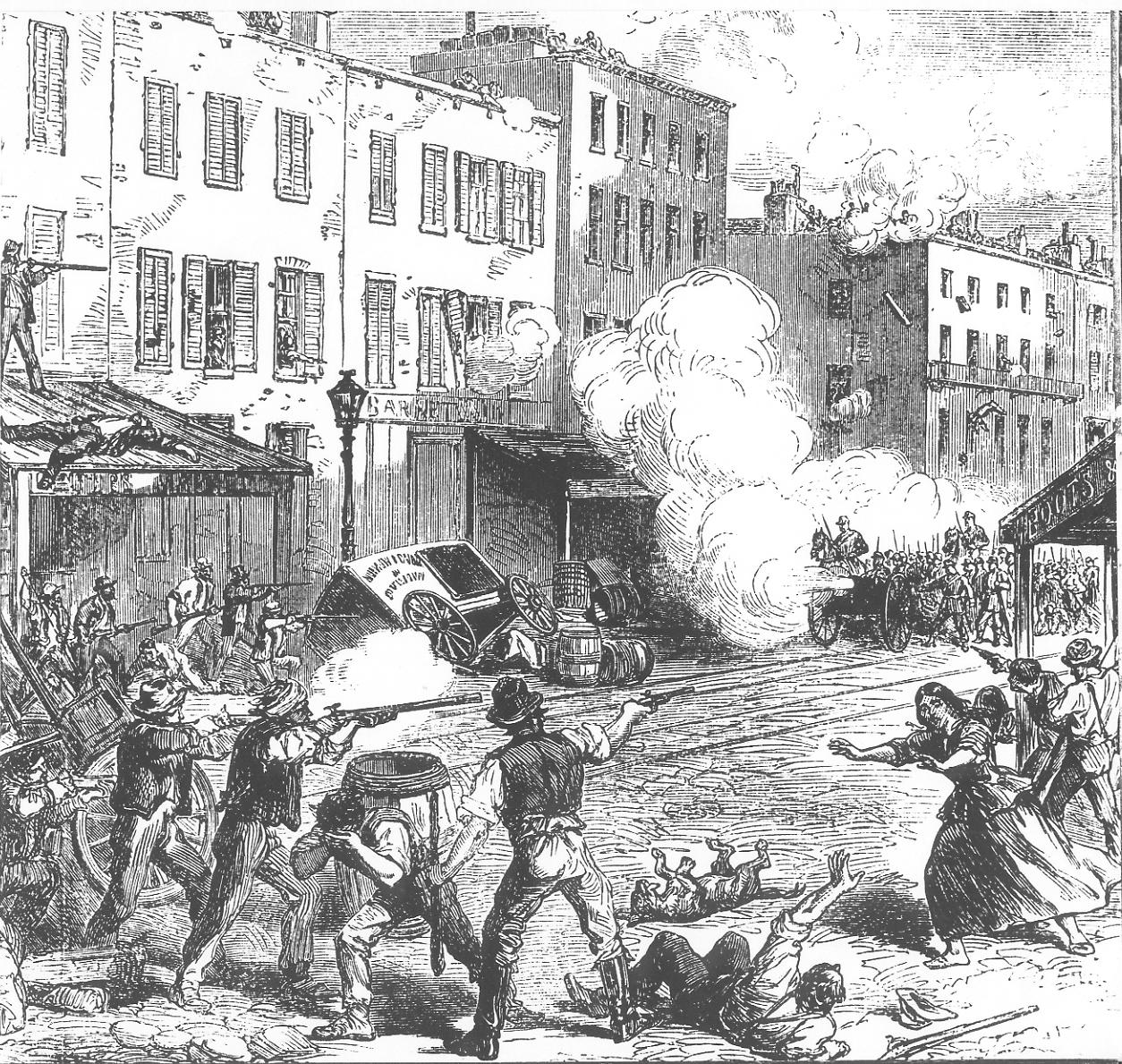
The initial attack focused on the Ninth District draft office on Third Avenue, where a crowd damaged and set fire to the building. Police attempting to respond encountered large numbers of rioters, and disorder spread across parts of Manhattan. Other government buildings, transit facilities and newspapers became targets. The city was particularly vulnerable because many military units had been sent to Pennsylvania during the Gettysburg Campaign. Streets became contested spaces where mobs, police and eventually soldiers fought. Contemporary illustrations show burning buildings and clashes, though each image depicts a selected moment and should not be mistaken for a complete record of the four days.
Why were Black New Yorkers targeted?
White supremacy and fears of economic competition fueled attacks against African Americans. Some rioters blamed emancipation and Black workers for their own insecurity, even though Black New Yorkers had not created the federal draft. Black residents were beaten, threatened, driven from homes and, in several cases, murdered. Their businesses and institutions were attacked. Racist violence was not a side issue separate from an otherwise orderly tax protest; it became a defining feature of the unrest. A credible account must identify the victims and motives rather than use vague descriptions of street fighting that hide who was targeted and why.
What happened to the Colored Orphan Asylum?
A mob attacked and burned the Colored Orphan Asylum, an institution that cared for Black children in Manhattan. Staff and others helped evacuate the children, preventing a far greater tragedy. The destruction became one of the most notorious acts of the riots because it targeted a charitable institution and vulnerable people. The event appears in contemporary wood engravings now held in historical collections. Those images are powerful but still need interpretation: dramatic artwork may not capture every action precisely. The attack shows how racial animosity turned public frustration into deliberate violence against an institution with no responsibility for drafting soldiers.
Were people lynched during the riots?
Yes. Black men were among those murdered by mobs, and historical sources document lynchings during the unrest. Individuals were attacked because of their race, and many Black families fled for safety. The full number of victims is uncertain because contemporary reporting and later investigations did not capture every death with equal reliability. It is important to resist treating all fatalities as identical. Deaths in exchanges of fire involving police or soldiers were different from intentional racist attacks on civilians. This distinction honors the victims and clarifies the social character of the violence rather than compressing everything into one casualty figure.
How many people were killed?
A precise, universally accepted death toll does not exist. Historical estimates vary substantially, often citing at least roughly one hundred deaths and sometimes many more. The National Park Service warns that estimates range from around one hundred to over one thousand in some accounts. Any unusually precise figure should be tied to a clearly identified source and methodology. Missing records, people fleeing, injuries and the different kinds of killing complicate the task. Scholars generally agree that the unrest caused extensive death, displacement and property destruction. The uncertainty should not be used to diminish the documented racial terror.
Who were the rioters?
Crowds included many white working-class men, among them Irish immigrants and Irish Americans, but it is misleading to hold every person of one ethnic group responsible. Participation varied across neighborhoods, and individuals opposed or sheltered victims while others took part in attacks. Local political networks and antiwar rhetoric shaped the climate in which violence spread. Some participants targeted draft offices, while others engaged in looting or explicitly racist aggression. Explaining the social composition requires more care than repeating stereotypes about immigrants. The riot was an event involving decisions by individuals and groups in a rapidly changing urban population.
How did immigration affect the tensions?
New York was a major port of immigration, and its workforce included many recently arrived families facing dangerous employment and unstable incomes. Labor competition and political organizations sometimes encouraged resentment toward Black workers. The federal draft added fear of military service to those pressures. Antiwar newspapers and speakers offered competing accounts of responsibility for the conflict. Yet immigrants did not all respond alike: many served in Union units, and others condemned the riots. Good historical explanation connects urban labor conditions, political rhetoric and racism without describing immigrant identity itself as an automatic cause of violence.
What did the police do?
New York’s Metropolitan Police confronted the mobs but often faced crowds too large for ordinary officers to disperse. Superintendent John A. Kennedy was assaulted and seriously injured. Officers defended buildings, rescued people and took part in violent street clashes. Some police responses have become subjects of debate because controlling the unrest required force under chaotic conditions. The Metropolitan Police’s experience illustrates the limits of a city institution confronted with coordinated attacks, widespread arson and rapidly spreading rumors. Police reports are useful sources, but historians also compare them with testimony from victims, journalists and residents.
When did federal troops arrive?
Military units that had been engaged in the Gettysburg Campaign returned toward New York to help restore order. Soldiers joined militia and police forces in street operations as the riots continued. Their presence shifted the balance of force and contributed to ending the violence by July 16. Federal troops were not a single force appearing at one precise moment; deployments occurred as authorities assembled available units. The use of soldiers inside an American city also showed the wartime government’s willingness to enforce federal law amid grave civil disorder. That intervention should be described alongside, not instead of, the harm already suffered by civilians.
How did newspapers respond?
Newspapers offered sharply different interpretations of the unrest, influenced by party politics, editorial loyalties and competing views of the war. Some emphasized the draft’s unfairness, while others denounced mob rule and racist violence. The offices of prominent newspapers were themselves threatened or attacked. Period reports provide valuable daily detail, but they also contain rumors, exaggerations and partisan claims that require corroboration. Historical research benefits from comparing newspapers with city records, police accounts and Black community testimony. A newspaper engraving might document how an event was represented publicly without proving that every pictured detail occurred in precisely that manner.
Did the draft actually stop?
The riots disrupted conscription in New York, but they did not permanently cancel federal enrollment. Authorities postponed and later resumed the draft under stronger protection and modified arrangements. Resistance had exposed serious political tensions, and the government faced the challenge of enforcing wartime policy while restoring public order. The longer story therefore includes both immediate disruption and eventual continuation of conscription. It is inaccurate to describe the riots as having forced Lincoln to abandon the draft nationwide. Federal manpower policy, volunteering, bounties and conscription remained intertwined for the rest of the war.
What happened to the Black community afterward?
Many Black New Yorkers left their neighborhoods or fled the city temporarily or permanently. Homes, businesses, churches and personal security had been damaged, and rebuilding required support from community organizations and allies. The riots reinforced the reality that Northern states, even while supporting a war that increasingly involved emancipation, contained deep racism. Some charitable efforts provided immediate relief, but long-term damage to trust and economic life remained. Tracking individual families is difficult because records are incomplete. Their displacement and suffering deserve attention equal to descriptions of flames, riots and military movements.
How did the riots relate to Gettysburg?
The Draft Riots began on July 13, 1863, just over a week after the Battle of Gettysburg ended in Pennsylvania. The military victory against Robert E. Lee did not mean everyone in the North supported the war’s costs or the Lincoln administration. Some troops normally available for security had been called into military service, complicating the initial response in New York. The proximity in time also demonstrates two different faces of 1863: Union battlefield success and severe conflict at home. Historians should keep these stories connected without suggesting the riots were caused solely by the Gettysburg result.
What role did emancipation play?
The Emancipation Proclamation had taken effect on January 1, 1863, transforming how many Americans understood the Union war effort. Supporters argued that ending slavery was necessary to defeat the Confederacy and renew the country’s founding ideals. Opponents sometimes portrayed emancipation as a threat to white workers and used racist propaganda to build resistance. Those arguments helped create the climate for attacks on Black New Yorkers during the riots. The event exposes the connection between a wartime fight over slavery and the bitter struggle over racial equality inside the Union states.
What myths should be avoided?
One myth is that the riots were merely a peaceful anti-draft demonstration that briefly got out of hand. They involved days of deadly violence, particularly against Black civilians. Another is that every Irish New Yorker participated; many did not. A third is that the rich could universally avoid military service by paying one fee without restrictions or later changes. Casualty totals also require qualification. Studying the law, city politics and experiences of victims produces a fuller explanation. The event was simultaneously a draft protest, an urban crisis and a racist attack, and none of those dimensions should erase the others.
Where can readers find primary evidence?
The Library of Congress holds period illustrations and newspaper material describing the riot, including the attack on the Colored Orphan Asylum. The National Park Service’s Changing War overview discusses Northern opposition and the violence in New York. The National Archives holds Civil War records and material about conscription, while city archives preserve police and municipal documentation. Read images alongside texts and pay attention to the race and position of the person describing the events. The public history of the riots has changed as scholars have recovered accounts by Black New Yorkers.
New York Draft Riots timeline
| Date | Event |
|---|---|
| March 3, 1863 | Enrollment Act creates federal conscription system. |
| July 11 | New York draft lottery begins. |
| July 13 | Crowds attack draft offices; disorder spreads. |
| July 13–16 | Racist violence, arson and attacks on civilians and property. |
| July 16 | Police, militia and federal troops restore order. |
| Following weeks | Draft arrangements are reorganized and eventually resumed. |