54th Massachusetts Infantry (1863–1865): Black Union Soldiers and Fort Wagner
Recruitment, battlefield service, equal pay and the historical impact of the 54th Massachusetts Regiment.
The 54th Massachusetts was an African American Union infantry regiment formed in 1863 and commanded initially by Colonel Robert Gould Shaw. It became famous for leading an unsuccessful assault on Fort Wagner on July 18, 1863, but its soldiers also served in later campaigns and protested unequal pay. Their service helped expand Black enlistment during the Civil War.
Explore who joined, why the regiment mattered and how its history extends beyond the battle depicted in popular films.
On this page — 24 topics
What was the 54th Massachusetts Infantry?
The 54th Massachusetts Volunteer Infantry was a regiment of African American soldiers organized in 1863 to fight for the United States during the Civil War. Massachusetts Governor John A. Andrew sponsored its formation, and Colonel Robert Gould Shaw commanded it. The unit was among the earliest federally authorized Black regiments raised in the North after the Emancipation Proclamation. Its fame grew following the July 18, 1863 assault on Fort Wagner near Charleston, South Carolina. However, the men served for more than two years, and their importance extends beyond one dramatic battlefield episode to recruiting, equal treatment and the meaning of citizenship.
Why was forming the regiment historically significant?
Before 1863, federal policy had placed serious restrictions on the enlistment of Black soldiers, despite the service of African Americans in earlier American wars and the work of Black volunteers during the Civil War’s opening years. The Emancipation Proclamation authorized the acceptance of Black men into United States armed service. The 54th became a highly visible test of whether Black soldiers would receive training, military responsibility and recognition. Its existence challenged racist assumptions about fitness for soldiering and helped turn military service into a public argument for freedom and civil rights after the conflict.
Who recruited the soldiers?
Recruitment was supported by Black activists, abolitionists and community networks as well as Massachusetts authorities. Volunteers came from Massachusetts and other Northern states; the unit was not composed only of men born or residing in Boston. Frederick Douglass encouraged enlistment, and two of his sons, Charles and Lewis Douglass, joined the regiment. Recruitment involved appeals about patriotism, the abolition of slavery and the prospect that Black Americans could claim a greater place in national life through service. The individual experiences of recruits varied greatly, so the regiment should not be portrayed as a single homogeneous community.
How were the men trained?
The regiment assembled at Camp Meigs in Readville, Massachusetts, where soldiers practiced military drills, weapons handling, marching and the routines needed for coordinated infantry action. Training mattered because skeptics closely watched whether an African American regiment could operate to the standard expected of other Union infantry. Discipline did not remove discrimination elsewhere in the army, but it prepared the regiment to take part in demanding operations. By late May 1863 the 54th had been organized, equipped and sent south. The history of this preparation is essential to understanding the skill and endurance later displayed in battle.
Who was Colonel Robert Gould Shaw?
Robert Gould Shaw was a white Union officer from a prominent abolitionist family in Boston. Governor Andrew selected him to command the 54th Massachusetts. Shaw initially had to weigh the new assignment, but once he accepted, he took the soldiers’ training and reputation seriously. He wanted the regiment to have the opportunity to fight instead of being confined to labor details. Shaw’s name became inseparable from Fort Wagner because he died leading the July 18 assault. Yet making him the sole hero of the story obscures the agency, sacrifices and leadership of the Black enlisted men themselves.
When did the regiment leave Massachusetts?
The 54th Massachusetts departed Boston on May 28, 1863, amid a large public ceremony. The parade through the city was a political statement as well as a farewell: it showed the visibility of Black enlistment in a Union state and the participation of abolitionist supporters. After reaching the South Carolina coast, the unit worked within the Department of the South. Its early duties included labor and military support, experiences that officers and soldiers sometimes regarded as unequal treatment. Later operations around Charleston offered the chance to demonstrate the regiment’s combat ability under difficult conditions.
Was Fort Wagner its first battle?
The regiment saw combat at James Island, South Carolina, on July 16, 1863, two days before the assault on Fort Wagner. This engagement is easy to overlook because the Wagner attack dominates popular memory. On James Island the 54th helped other Union troops withstand Confederate pressure and earned praise for its conduct. The men then moved into the larger operation against Charleston’s defensive works. Understanding the brief interval between the engagements also emphasizes their physical demands: marches, inadequate rest, unfamiliar terrain and uncertain intelligence affected the regiment before the famous assault began.
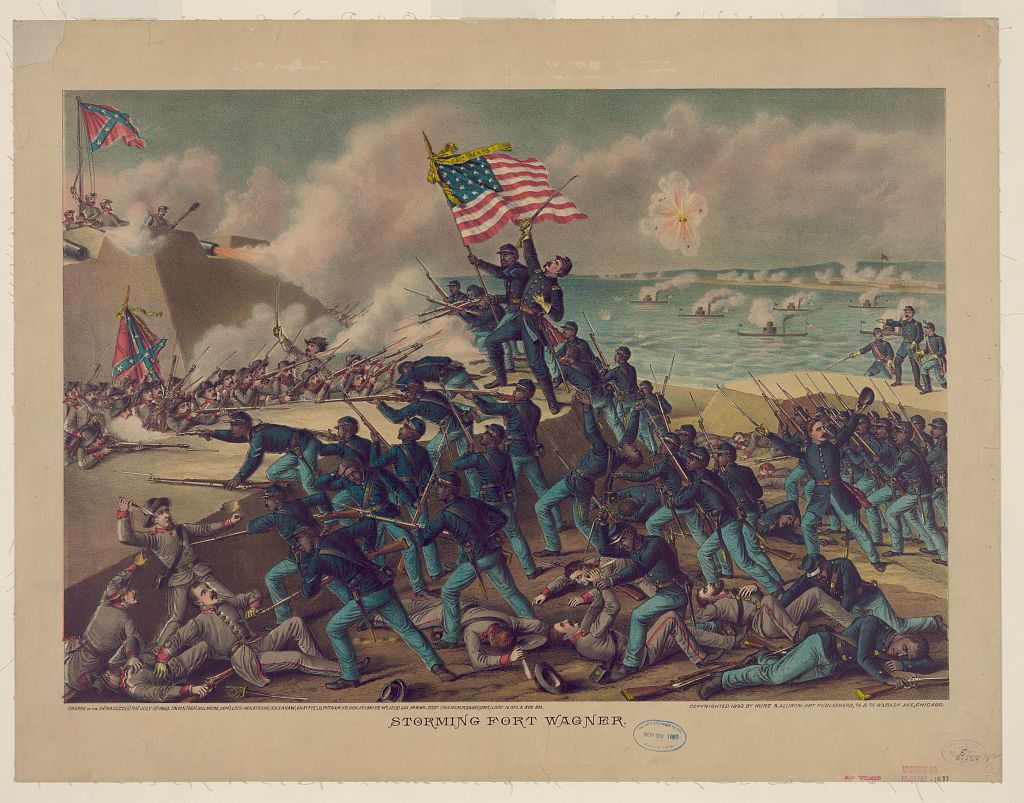
What happened at Fort Wagner on July 18?
Federal commanders attacked Fort Wagner on Morris Island after naval bombardment and earlier unsuccessful fighting. The 54th Massachusetts led one of the assaulting columns at dusk, advancing along a narrow strip of sandy ground toward prepared Confederate fortifications. The defenders had guns, earthworks and favorable fields of fire. Union soldiers reached the parapet and fought at close quarters, but the attack failed to seize the fort. The regiment suffered severe casualties, including Colonel Shaw. The battle itself deserves separate study for the full tactical sequence and results.
Why was the assault so dangerous?
The approach to Fort Wagner offered attackers little room to maneuver, while Confederate defenders could fire from strongly constructed earthworks. Soft sand impeded movement and the assault took place toward evening, complicating communication and reinforcement. The 54th was tasked with leading the attack, making it especially exposed to the first shock of Confederate fire. Once the fighting reached the parapet, confusion increased as units mixed and officers were killed or wounded. The tactical difficulty helps explain the heavy losses without diminishing the soldiers’ courage. A failed assault can demonstrate military professionalism as clearly as a successful one.
Who was Sergeant William H. Carney?
William H. Carney served in the 54th Massachusetts and became famous for his actions carrying the United States flag during the Fort Wagner assault. He was wounded but preserved the flag amid the fighting. In 1900 he received the Medal of Honor for that service. Carney’s story provides an important corrective to accounts focused almost exclusively on Shaw. Black noncommissioned officers carried substantial responsibility within the regiment and earned recognition through their own actions. The award’s late date also reflects the long and uneven process by which Black military achievement entered national commemoration.
How many soldiers were killed or wounded?
The regiment suffered extremely heavy losses at Fort Wagner. Historical counts differ according to the date, the categories included and whether missing soldiers later returned or were confirmed dead. Rather than present one number without explanation, a reliable account distinguishes killed, wounded, captured and missing. National Park Service resources document the scale of the casualties and the death of Shaw. Survivors described a chaotic night under intense fire, and many families received little immediate information. The losses mattered not only to military strength but also to the Black communities that had raised and supported the regiment.
What happened to Robert Gould Shaw’s body?
Confederate defenders buried Shaw in a common grave with Black soldiers who had fallen in the assault. Confederate authorities intended the burial as a humiliation, but Shaw’s family rejected the assumption that burial beside his men was dishonorable. His father, Francis George Shaw, asked that his son remain with the soldiers. Later memorial art treated the grave as a symbol of shared sacrifice. Historians should also remember that the locations of many individual Black soldiers’ remains cannot be confidently identified. The story is about collective loss, not merely a famous officer’s burial.
Did the regiment protest unequal pay?
Yes. Black soldiers faced discriminatory federal pay policies, and the men of the 54th Massachusetts protested unequal compensation. They refused inferior pay even when doing so brought financial hardship to themselves and their families. Their protest should not be mistaken for unwillingness to fight; they continued to serve while demanding equal recognition. In 1864 Congress moved toward equalizing pay for Black soldiers under specified conditions, with changes affecting service dating back to 1863. The dispute shows how Black troops fought both a military conflict against the Confederacy and a struggle for fair treatment inside the Union system.
What other campaigns did the regiment fight?
The 54th Massachusetts continued serving after the attack at Fort Wagner. Its later operations included the Battle of Olustee in Florida in February 1864, fighting at Honey Hill in South Carolina in November 1864, and other engagements around the coastal South. Its activities demonstrate that the regiment’s reputation was not based on a single courageous evening. Soldiers also conducted demanding marches and performed duties essential to Union occupation and campaigning. The regiment was mustered out in August 1865, after the major Confederate surrenders, reflecting the time required to complete wartime service and the transition to peace.
What happened at the Battle of Olustee?
At Olustee in February 1864, Union forces suffered a major defeat while attempting to establish federal control in northern Florida. The 54th Massachusetts was involved in the retreat, helping protect the withdrawal of other soldiers. The broader battle included the 8th United States Colored Troops and revealed the dangers Black soldiers faced in Confederate hands. Some regimental histories describe the 54th’s work in helping move a disabled train after the battle, a detail that should be checked against contemporary testimony when repeated. Olustee reinforced the soldiers’ reputation for endurance well beyond the Fort Wagner attack.
How did Frederick Douglass support Black enlistment?
Frederick Douglass argued that African American participation in the Union armies was both a military necessity and a political claim to citizenship. His sons’ enlistment in the 54th made the connection personal. Douglass’s public advocacy challenged federal policy and sought to secure fair treatment for Black soldiers, especially after reports that captured Black troops were denied ordinary prisoner-of-war protections. The wartime argument was not simply that Black soldiers could help the Union win. It was that military service revealed the inconsistency of demanding Black sacrifice while withholding equal civil and political rights.
Did the 54th Massachusetts end discrimination?
No. The regiment’s record contradicted racist claims about Black soldiers, but military achievement did not bring immediate equality. Federal policy, local prejudice and later failures of Reconstruction continued to restrict Black Americans. Nevertheless, the regiment strengthened the case for enlisting more Black troops. More than 180,000 African American men served in the United States Army during the Civil War. Their contribution helped sustain Union campaigns and weaken the Confederacy’s labor system. It also became important evidence used by activists seeking the legal and political changes pursued during Reconstruction.
What is the Robert Gould Shaw Memorial?
The Robert Gould Shaw and Massachusetts 54th Regiment Memorial stands on Boston Common across from the Massachusetts State House. Sculptor Augustus Saint-Gaudens created a relief depicting Shaw on horseback accompanied by rows of Black soldiers. The monument was unveiled in 1897 and has undergone conservation. It is significant because the soldiers are depicted as individuals rather than anonymous background figures, even though historical criticism has also examined how such memorials frame race and leadership. Visitors can study the names, imagery and context while remembering that memorial art reflects the era in which it was created.
How accurate is the movie Glory?
The 1989 film Glory introduced many viewers to the regiment and its Fort Wagner assault. It was an influential dramatization, but individual characters, conversations and events were adapted for storytelling. Not every character represents a documented individual, and the film emphasizes a particular narrative arc. It can be a valuable introduction if followed by primary sources, soldiers’ letters and careful historical accounts. The regiment’s full service history, unequal-pay protest and later campaigns are necessary to correct any impression that the men fought only one battle and that their collective story ended when Shaw died.
Where can the regiment’s history be researched?
The National Park Service has detailed studies of the 54th Massachusetts, the Fort Wagner assault, and individual soldiers. The Massachusetts Historical Society preserves letters, photographs and regimental material. The Boston memorial and surviving recruitment records help document the identities of enlisted men. Readers should distinguish wartime documents from later paintings and cinematic reconstructions. Photographs of unidentified African American soldiers should never be labeled as members of the 54th without evidence identifying the unit.
54th Massachusetts timeline
| Date | Event |
|---|---|
| Early 1863 | Massachusetts begins recruiting the 54th under Governor John Andrew. |
| May 28, 1863 | The regiment marches through Boston and sails south. |
| July 16, 1863 | The regiment fights on James Island, South Carolina. |
| July 18, 1863 | The 54th leads the unsuccessful assault on Fort Wagner; Shaw is killed. |
| 1864 | The regiment serves in Florida and South Carolina; equal-pay demands continue. |
| August 20, 1865 | The regiment is mustered out of military service. |
| 1897 | The Shaw and 54th Regiment Memorial is unveiled in Boston. |
Frequently asked questions
Was the regiment all Black? The enlisted soldiers were African American, while the commissioned officers were white under the federal policy of the period.
Who was the commander? Robert Gould Shaw commanded until his death at Fort Wagner.
Was Fort Wagner a Union victory? No, the July 18 assault failed to take the fort.
What happened afterward? The regiment served in additional southern campaigns and protested unequal pay.
When did the 54th leave service? August 20, 1865.
Historical sources and further reading
The following National Park Service resources provide context, soldier stories and the battle record.