Appomattox Court House (1865): Lee’s Surrender and Terms Explained
What happened when Grant and Lee met, why the Confederates surrendered and why April 9 was not the last chapter of the war.
On April 9, 1865, Robert E. Lee surrendered the Confederate Army of Northern Virginia to Ulysses S. Grant in the McLean House at Appomattox Court House, Virginia. Grant allowed Confederate officers and soldiers to return home on parole after turning over military arms and property. The agreement effectively ended Lee’s army and made Confederate defeat inevitable, but other armies surrendered later.
This guide explains the last campaign, the April 9 letters, the April 12 stacking of arms, the lives affected and the limits of the surrender.
On this page — 25 topics
What happened at Appomattox Court House on April 9, 1865?
On April 9, 1865, Confederate General Robert E. Lee surrendered the Army of Northern Virginia to Union General Ulysses S. Grant at Appomattox Court House, Virginia. The meeting took place inside the home of Wilmer and Virginia McLean. Their armies had fought across Virginia for years, but Lee’s remaining soldiers were exhausted, short of supplies and cut off from their intended escape route.
The decision brought the largest and most celebrated Confederate field army in the eastern theater out of the war. It was not a surrender of every Confederate soldier, and it did not instantly resolve the political problems left by slavery and secession. Nevertheless, the agreement marked a decisive transition from major military resistance toward reunion and Reconstruction.
Why was Robert E. Lee retreating?
By the beginning of April 1865, the long struggle around Petersburg and Richmond had become untenable for Lee’s army. Union operations had stretched Confederate defenses and endangered vital rail connections. As those defenses collapsed, Lee withdrew westward, hoping to join other Confederate forces or obtain enough supplies to continue fighting.
The Confederate government evacuated Richmond on April 2, and Union soldiers entered the city on April 3. The retreating Army of Northern Virginia followed roads and rail corridors through central Virginia, while Union cavalry and infantry moved to intercept it. Each delay made another organized escape harder. The larger Civil War timeline shows how this final campaign followed years of fighting and the Union’s growing advantage in manpower, transport and logistics.
What happened between Petersburg and Appomattox?
The retreat was not a single uninterrupted march. Confederate formations encountered crowded roads, broken supply arrangements, combat and exhaustion. Union troops pursued closely and repeatedly moved across Lee’s route. At Sailor’s Creek on April 6, substantial Confederate forces were defeated or captured, further weakening the retreat.
Lee hoped to reach food carried by rail, especially supplies expected around Appomattox Station. Yet Union cavalry reached crucial points ahead of him. The remaining Confederate army faced a narrowing choice between another costly attempt to break through and a negotiated surrender. These movements explain why Appomattox was the place of decision: geography, railroad access and the Union pursuit mattered as much as the personalities of the two commanding generals.
What happened at Appomattox Station on April 8?
On April 8, Union cavalry under Philip Sheridan struck Confederate positions around Appomattox Station. George Armstrong Custer’s troopers seized supply trains that Lee’s soldiers urgently needed and fought Confederate artillery nearby. Losing those supplies undermined the hope that the army could feed itself and continue moving toward a new defensive position.
There were still armed Confederate soldiers in and around the village, and the outcome of the campaign was not formally settled that evening. But the situation had changed dramatically. Union forces occupied the routes Lee needed, while federal infantry approached behind the cavalry. The National Park Service’s account of Appomattox Station separates this April 8 engagement from the final fighting and surrender on April 9.
Was there a final battle on April 9?
Yes. On the morning of April 9, Confederate troops led by John B. Gordon attacked Union cavalry west of the village. Although they initially made progress, additional Union infantry blocked a meaningful escape. Gordon could not clear a safe route for the army, and further attacks threatened heavy casualties without a realistic prospect of success.
Lee recognized that continued resistance would accomplish little. The military situation compelled him to seek terms from Grant. This was not simply a courteous decision between two officers who happened to be nearby: Union strategy had trapped an army that could no longer operate effectively. The NPS Appomattox campaign account traces the final movements and explains why Lee’s options disappeared.
Who were Ulysses S. Grant and Robert E. Lee?
Ulysses S. Grant was the Union general-in-chief, responsible for coordinating armies across multiple theaters. He had developed his reputation through western victories, including the 1863 Vicksburg campaign, before assuming overall command. His strategy pressed Confederate forces simultaneously, restricting their ability to shift troops and recover.
Robert E. Lee commanded the Confederate Army of Northern Virginia, the principal eastern field army defending the rebellion against the United States. His military reputation rested on victories and aggressive campaigns, including Chancellorsville, as well as major defeats such as Gettysburg. Their meeting at Appomattox should be understood within those command responsibilities, not as a duel that alone determined the fate of the nation.
Why did they meet in the McLean House?
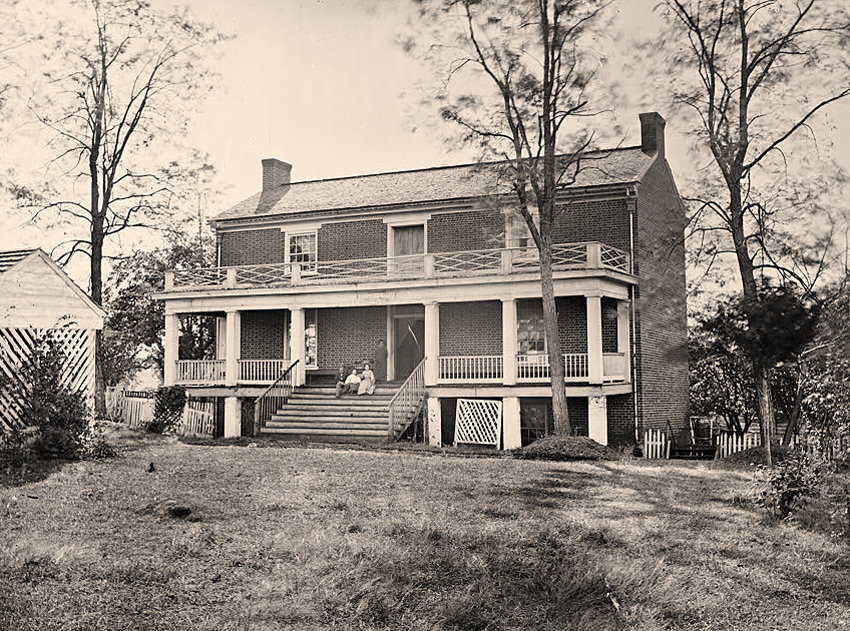
The meeting was held in the parlor of a private brick residence belonging to Wilmer and Virginia McLean in the village of Appomattox Court House. The village name can be confusing: the surrender was not signed inside the courthouse building. The McLean home provided a suitable place for the commanders and their staff to discuss the agreement.
Historical photographs show the house soon after the surrender. The building standing in the national historical park today is a reconstruction rather than the entirely original 1865 structure. The National Park Service explains that the house was dismantled decades later and reconstructed using historical evidence and some surviving material. This distinction matters when comparing present-day visitor photographs with period images.
What were the terms of Lee’s surrender?
Grant required rolls of Confederate officers and soldiers, their promises not to resume fighting unless properly exchanged, and the surrender of government arms and military property. Officers could keep their sidearms, private horses and personal baggage. Soldiers who obeyed their parole and the laws where they lived could return home without being disturbed by United States authorities under the terms of the agreement.
These conditions offered a practical way to disband a defeated army without turning the surrender into a mass imprisonment operation. They did not establish a comprehensive settlement of slavery, voting rights or Southern state governments. The complete text is available from the National Park Service’s surrender documents; the National Archives also preserves the April 10 implementation agreement.
Did Grant let Confederate soldiers keep their horses?
The written surrender terms explicitly protected officers’ private horses. Grant also made a further practical concession to enlisted men who owned horses or mules: they could take the animals home for use on farms. The gesture is remembered because many surrendered soldiers would face economic ruin without the means to cultivate land.
It is important to distinguish what was written into the agreement from what Grant allowed in discussion. The historical record does not mean every horse in Confederate military service became private property. Public animals and military equipment were to be turned over as agreed. Grant’s flexibility was intended to make compliance easier and reduce the likelihood of renewed guerrilla or organized resistance.
Was there a signed surrender document?
There was not one grand ceremonial document jointly signed by both generals in the way popular paintings sometimes suggest. On April 9, Grant wrote the proposed surrender terms in a letter, and Lee accepted them in a separate letter. Officers then worked out detailed arrangements to implement the surrender.
Those additional arrangements were recorded on April 10 in an agreement concerning the movement of troops, the surrender of weapons and the handling of public property. The National Archives preserves this implementation document. Separating the April 9 exchange of letters from the April 10 articles of agreement prevents an important but common misunderstanding about what happened in the McLean parlor and what was completed afterward.
How did the meeting between Grant and Lee unfold?
Grant arrived in a travel-worn uniform, while Lee wore a more formal uniform. The two officers had served in the earlier Mexican-American War, and their conversation initially included recollections of that connection. They then turned to the surrender itself. Accounts of their clothing and manner have become part of the event’s popular memory, but they should not overshadow the written terms.
Lee reviewed Grant’s proposals and accepted them. Grant also arranged food for the hungry Confederate soldiers, an immediate humanitarian and logistical need. The approximately ninety-minute meeting was important precisely because it converted military defeat into an enforceable process: an army would stop fighting, its weapons would be collected, and its soldiers would be permitted to disperse under specific conditions.
What did parole mean for Confederate soldiers?
A military parole was a promise not to resume fighting against the United States until a permitted exchange or other lawful change in status. Officers gave individual paroles, while commanders signed on behalf of men in their units. Written passes helped soldiers travel home without being treated as armed enemies by other Union forces.
The National Park Service reports 28,231 paroles issued through the process at Appomattox. That figure is not a count of every person who had served in Lee’s army, nor is it a universal Confederate casualty figure. Dispersal, straggling and prior losses complicate any attempt to turn the parole total into the size of Lee’s army during earlier campaigns. The significance of the paperwork lies in how it made the disbandment workable.
What happened during the stacking of arms on April 12?
On April 12, Confederate infantry marched through the village and laid down weapons and flags in a formal ceremony supervised by Union troops. Joshua Lawrence Chamberlain oversaw the reception, while John B. Gordon led the first Confederate infantry formations. Other parts of the surrender process had already taken place on April 10 and 11.
Descriptions of a salute or respectful acknowledgment between the opposing formations became an enduring part of the Appomattox story. Later recollections differ in their precise wording and interpretation, so the safest historical conclusion is that both sides completed an organized disarmament under a recognized chain of command. This ceremony, not a handshake alone, represented the physical end of Lee’s army as an armed field force.
Did Appomattox end the entire Civil War immediately?
No. Lee surrendered the Army of Northern Virginia, not all Confederate armies. Joseph E. Johnston’s forces and other commands remained in the field. Further Confederate surrenders occurred over the following weeks, and scattered resistance continued after the Appomattox agreement. That is why historians distinguish the symbolic end of the war from the completion of all military and legal steps.
Appomattox still stands as the best-known surrender because Lee’s army had occupied such an important position in the Confederate war effort. The April 9 event made Confederate independence far less plausible and provided a precedent for later agreements. The National Archives emphasizes that subsequent capitulations and formal declarations did not all occur on the same day.
What happened to other Confederate armies afterward?
General Joseph E. Johnston surrendered a large Confederate force in North Carolina later in April 1865. Other commanders negotiated separately or laid down arms in subsequent weeks. Because military organizations were scattered over a vast territory, there was no single officer at Appomattox who could instantly disband every Confederate unit.
This matters when evaluating claims about the war’s “last day.” April 9 is a memorable milestone; it is not a date on which every soldier everywhere stopped fighting. Later administrative and legal actions continued to determine the status of former rebels and the restoration of civil government. A reliable timeline should show this sequence instead of compressing the end of the conflict into one scene.
Did the surrender free enslaved people?
Slavery was central to the causes and meaning of the Civil War, and Union victory made the destruction of the Confederate slave system possible. Yet the Appomattox letters did not themselves abolish slavery nationwide. Wartime emancipation, the actions of enslaved people seeking freedom, Union occupation and finally the Thirteenth Amendment were all part of that larger transformation.
The National Park Service notes that nine enslaved people associated with the McLean household faced freedom’s opportunities and uncertainties as the surrender occurred nearby. Their experience reminds readers that the event was not only a meeting of famous commanders. It affected people whose rights and lives had been at the center of the conflict. See our guide to what the Emancipation Proclamation did and did not do.
What did Appomattox mean for Reconstruction?
Appomattox resolved the immediate military position of Lee’s army, but it offered no detailed blueprint for the political future of the former Confederate states. Questions about citizenship, suffrage, land, former slaveholders, violence and federal authority became central to Reconstruction after the fighting. Those struggles could not be settled in the McLean House.
The Thirteenth Amendment, ratified in December 1865, abolished slavery in the United States subject to its constitutional exception for criminal punishment. The Fourteenth and Fifteenth Amendments followed amid continuing conflict over equality and political power. Treating surrender as the end of the story hides the long contest over what freedom and restored Union government would mean in everyday life.
Why was Lincoln not at the surrender meeting?
Abraham Lincoln was in Washington rather than at Appomattox when Grant and Lee met. The commanding generals handled the military surrender directly. Lincoln had followed the final campaign closely and understood the importance of ending organized resistance, but the terms were negotiated by the officers in the field.
Only days later, Lincoln was shot at Ford’s Theatre on April 14 and died on April 15, 1865. His assassination abruptly changed the political leadership that would oversee the difficult transition from war to peace. Because these events occurred so close together, accounts sometimes blend them into a single ending. They are distinct episodes with different participants and consequences.
How do historians know what the surrender terms said?
The strongest evidence is documentary: the letters exchanged on April 9, the implementation agreement dated April 10, parole records, contemporaneous military reports and surviving correspondence. Later memoirs can add details about conversation and atmosphere, but they must be compared with documents created at or near the event.
Researchers can inspect the transcriptions maintained by the National Park Service and the National Archives’ original agreement. This source distinction is particularly useful when correcting embellished stories about a single signed treaty, a formal ceremony inside the courthouse or instant legal peace across all Confederate territory.
What can visitors see at Appomattox today?
Appomattox Court House National Historical Park preserves the village landscape where the surrender was negotiated and implemented. Visitors can see the reconstructed McLean House, the courthouse area, the road used in the stacking-of-arms ceremony and exhibits that explain the final campaign. The name “Court House” refers to the village, not the room in which Grant and Lee met.
Modern interpretation also considers civilians, enslaved residents and the lives that continued after the armies departed. The reconstructed residence is useful for understanding the physical setting but should not be presented as an untouched original. The official NPS park website provides current visitor information and background research rather than leaving readers to rely on anachronistic illustrations.
Common myths about Appomattox
Myth: Lee surrendered the whole Confederacy. He surrendered his own army, though its defeat was decisive. Myth: the document was signed in the courthouse. The commanders met in the McLean House, a private residence. Myth: no fighting followed. Other forces remained active and surrendered separately. Myth: the handshake legally ended slavery. Emancipation and constitutional abolition were related but distinct processes.
Such shortcuts are understandable in classroom summaries, yet they erase how military, legal and social change unfolded on different timelines. Appomattox deserves attention not because it solves every question in one afternoon, but because it shows a defeated army passing from battlefield resistance to documented surrender on terms designed to reduce further bloodshed.
Appomattox surrender timeline
The military collapse, negotiation and formal laying down of arms happened on different days. These are the key dates to distinguish.
| Date | What happened |
|---|---|
| April 2–3, 1865 | Richmond is evacuated; Union troops occupy the Confederate capital. |
| April 6 | Union victory at Sailor’s Creek further damages Lee’s retreating army. |
| April 7 | Grant calls on Lee to surrender as pursuit continues. |
| April 8 | Union cavalry takes vital supply trains at Appomattox Station. |
| April 9, morning | Gordon’s attack fails to open an escape route. |
| April 9, afternoon | Grant and Lee agree to surrender terms in the McLean House. |
| April 10 | Officers organize paroles and formal arrangements. |
| April 12 | Confederate infantry stack arms and surrender flags. |
| Late April onward | Other Confederate commands surrender separately; Reconstruction proceeds. |
Frequently asked questions
When did Lee surrender? April 9, 1865.
To whom did he surrender? Ulysses S. Grant, the Union general-in-chief.
Where did they meet? The McLean House in the village of Appomattox Court House, Virginia.
Were Confederate soldiers imprisoned? Most were paroled to return home under the agreed terms.
Did they surrender all private property? No. The agreement protected personal belongings and officers’ private horses; additional arrangements concerned horses used for farming.
Did the Civil War end completely on April 9? No. Other Confederate commands continued to surrender afterward.
Why did Lee surrender? Union forces had intercepted his retreat, cut off supplies and blocked effective escape.
Historical sources and further reading
This guide distinguishes documents produced during the surrender from later recollections, and uses federal historical collections for dates and terms.
- National Park Service — Appomattox Campaign
- National Park Service — Surrender Documents
- National Park Service — McLean House
- National Park Service — Paroles
- National Park Service — Chamberlain–Gordon surrender
- National Archives — Articles of Agreement, April 10
- Library of Congress — 1865 McLean House photo