Zoot Suit Riots of 1943: Los Angeles Violence, Racism and the Pachuco Style
How white servicemen attacked Mexican American youths during June 1943, what zoot suits represented and how police, newspapers and California authorities responded.
Quick answer
The Zoot Suit Riots were a series of racially charged attacks in Los Angeles in June 1943. Groups of mostly white U.S. servicemen, joined by some civilians, targeted Mexican American youths associated with the distinctive zoot-suit fashion, as well as other young people of color. Victims were beaten and their clothing torn; police often arrested the attacked youths rather than their assailants. The violence reflected long-standing racial discrimination, sensational media coverage and tensions intensified by wartime Los Angeles. The term ‘riots’ can obscure the unequal pattern of aggression.
Key facts
On this page
- Los Angeles before the wartime violence
- What was a zoot suit?
- Pachuco youth culture and racial stereotypes
- The Sleepy Lagoon case of 1942
- How the attacks began in early June 1943
- Why police actions attracted criticism
- The role of newspapers and public opinion
- Black and Filipino Americans also faced attacks
- How military authorities helped stop the violence
- California Governor Earl Warren’s investigation
- Why the zoot suit became a lasting cultural symbol
- The Zoot Suit Riots’ place in American history
- Timeline
- FAQs
- Sources
Los Angeles before the wartime violence
Los Angeles grew rapidly during the first half of the twentieth century, attracting workers from different regions and countries. Mexican American communities formed important neighborhoods and cultural institutions, yet discrimination affected housing, schooling, employment and encounters with police. Deportation and repatriation campaigns of the 1930s had already harmed families, including some U.S. citizens of Mexican ancestry. These conditions shaped young people’s sense of identity before World War II.
Wartime shipbuilding, aircraft manufacturing and military installations brought new employment and thousands of servicemen into southern California. The growing population increased competition over public spaces, transport and entertainment. Racial prejudice remained embedded in many institutions, and tensions over youth culture became easy targets for sensational reporting. The June violence cannot be explained simply as an argument over a style of clothing.
What was a zoot suit?
A zoot suit typically featured high-waisted, wide-legged trousers and a long, broad-shouldered jacket, often worn with a distinctive hat and other accessories. The fashion was associated with jazz, dance and youth cultures in several American cities. Mexican American pachucos helped make the style especially visible in wartime Los Angeles, while Black American and other communities also embraced versions of it.
During the war, fabric rationing and appeals for conservative dress made the conspicuous use of cloth a political issue. Critics portrayed the suits as wasteful or unpatriotic, though clothing alone was no evidence of criminal behavior. For young wearers, the style could express independence, pride and belonging. Its meanings varied by person, and it should not be treated as proof that all wearers joined the same organization or held identical attitudes.
Pachuco youth culture and racial stereotypes
The term pachuco became associated with particular Mexican American urban youth identities, including language, music and fashion. Some young people adopted distinctive slang and participated in social groups, while others simply preferred the clothes. Newspapers and police often collapsed these differences into a stereotype of dangerous or delinquent youth. That public image shaped official suspicion before the June 1943 attacks.
The social history of pachucos is more complex than either romantic heroism or criminal labeling. Young people could pursue identity in a society that limited their opportunities, and disputes between peer groups did occur. But recognizing ordinary neighborhood conflicts does not justify collective punishment of an ethnic community. Historians use oral histories and cultural studies to separate documented events from moral panic generated by wartime media.
The Sleepy Lagoon case of 1942
In 1942 the killing of José Díaz near a Los Angeles reservoir became known as the Sleepy Lagoon case. Authorities arrested numerous Mexican American youths, and a controversial trial produced convictions later overturned on appeal. The case attracted intense media coverage and reinforced the public perception that Mexican American youth culture was closely tied to crime. Civil-rights advocates challenged the fairness of the proceedings and the treatment of the defendants.
The Sleepy Lagoon case was separate from the Zoot Suit Riots but helped create the atmosphere in which the violence occurred. Wartime reports often presented Mexican American youths as threatening even when evidence was weak or disputed. Its chronology matters: the prosecution began before the June 1943 attacks, and the appellate reversal came afterward. Linking the events is useful without claiming they were identical incidents.
How the attacks began in early June 1943
Accounts of the immediate trigger differ in detail, but confrontations involving sailors and young Mexican Americans escalated during the first days of June. On June 3 groups of servicemen moved through Los Angeles looking for young people wearing zoot suits. Attackers carried clubs or improvised weapons and beat youths in streets, theaters and other public spaces. Some stripped victims of clothing and destroyed the garments.
The National WWII Museum and PBS histories document the unequal pattern of violence. Not every member of the armed forces participated, and incidents involved civilians as well, but the organized groups of servicemen were conspicuous aggressors. Describing the events as two evenly matched mobs misses the documented asymmetry. The targets often had little ability to defend themselves against groups acting in public with apparent impunity.
Why police actions attracted criticism
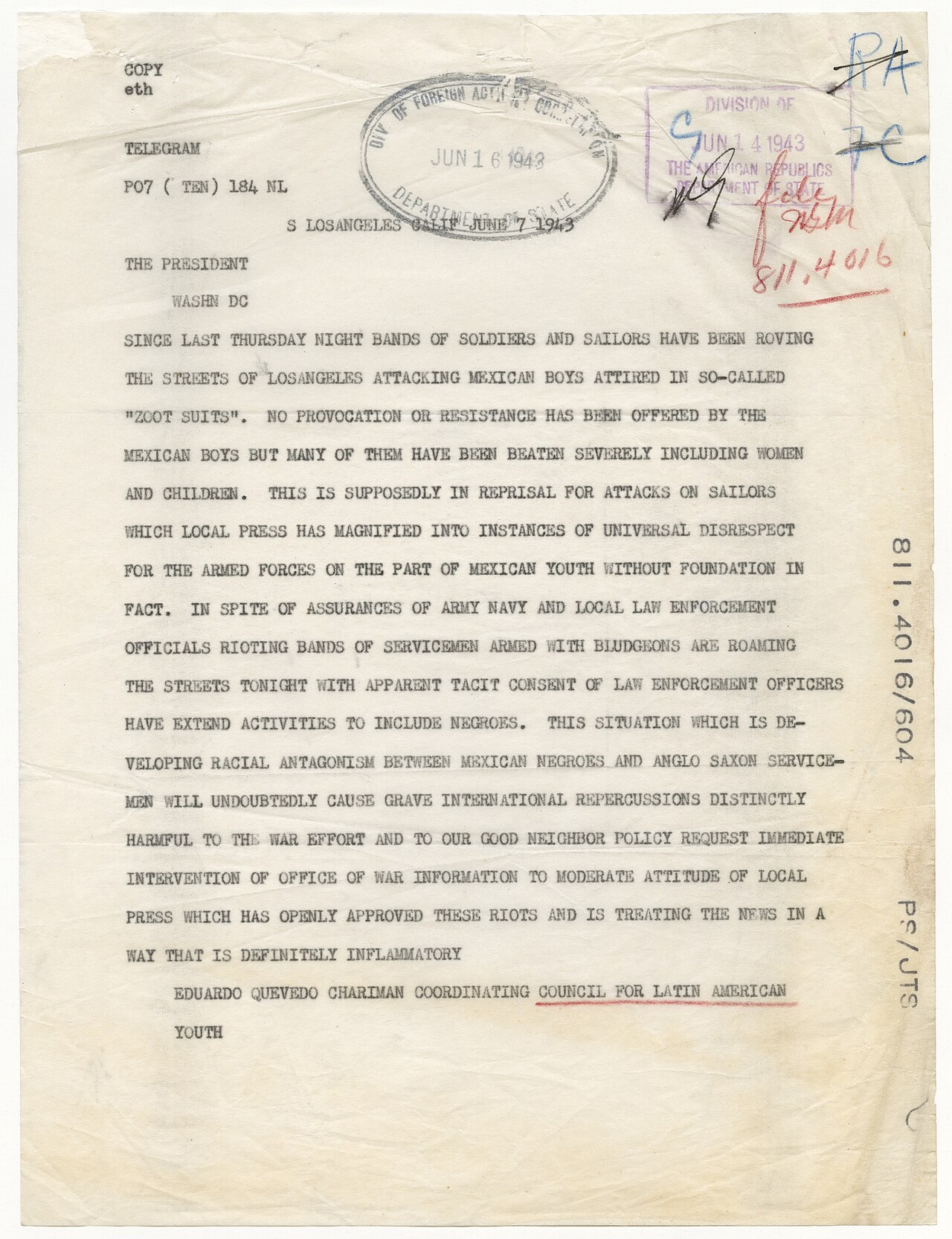
Los Angeles police frequently arrested or detained Mexican American youths during the disturbances while failing to stop attacks by servicemen. Accounts describe law enforcement officers remaining passive as crowds were assaulted. This selective response deepened distrust and helped transform episodes of street violence into a larger civil-rights controversy. The city experienced a crisis not only of public order but also of unequal protection under law.
Police records and press reports should be read critically because their language sometimes portrayed those arrested as the instigators without examining who had attacked them. A detention photograph by itself cannot establish that the arrested person committed a crime. The featured telegram illustrates contemporary criticism reaching the federal government. It is evidence that community advocates demanded protection and recognized the racial nature of events.
The role of newspapers and public opinion
Some local newspapers used sensational language that emphasized youth delinquency and praised servicemen as enforcers of public morality. Coverage could encourage readers to see victims’ clothing as a provocation. Such reporting mattered because it helped normalize collective punishment and shaped political pressure on officials. Other journalists and activists challenged the bias and documented the injuries caused by the attacks.
A responsible history should not adopt historical slurs or stereotypes as objective descriptions. Terms used by 1943 reporters can be quoted or analyzed when necessary, but they are evidence of period attitudes, not reliable labels for whole communities. Comparing multiple contemporary sources with later scholarship shows how the story told to the public could differ from the experiences of those targeted.
Black and Filipino Americans also faced attacks
Although Mexican American youths were the principal targets, violence also affected Black and Filipino Americans and others associated with zoot-suit fashion or nonwhite neighborhoods. This broader pattern makes clear that the issue was not simply a dispute between two specific youth groups. The attackers’ choice of targets reflected racial hierarchies and wartime assumptions about who could occupy public spaces.
Communities sometimes organized efforts to protect residents, gather testimony and press officials to intervene. The experiences of different groups were not identical, and Mexican American activism remained central to the story. Recognizing other victims does not diminish that focus; it helps explain why historians consider the riots part of broader racial violence on the home front.
How military authorities helped stop the violence
As criticism grew, military commanders restricted servicemen’s access to certain areas of Los Angeles and took steps to prevent additional attacks. Those measures helped bring the worst violence to an end after several days. Civilian officials also faced pressure to investigate and restore order, though distrust of police remained strong among affected communities.
The eventual reduction of attacks should not be described as proof that law enforcement had handled the crisis fairly from the beginning. The fact that military restrictions became necessary illustrated failures to stop organized assaults in public places. The episode also raised questions about who held authority over service members off base and how military discipline interacted with local policing.
California Governor Earl Warren’s investigation
Governor Earl Warren appointed a committee to investigate the disturbances. Its work challenged the assumption that zoot-suit clothing or Mexican American ethnicity caused the attacks and examined the roles of prejudice and discrimination. The committee’s conclusions became part of a larger public debate about racial relations in California. The investigation did not erase discriminatory conditions, but it produced official recognition that simple blame of the victims was unacceptable.
Advocates and community leaders used the moment to demand changes in policing, education and public attitudes. The 1943 events showed that military service and wartime patriotism could coexist with racial violence in American cities. The argument over responsibility would continue in journalism, scholarship and popular culture long after the immediate crisis ended.
Why the zoot suit became a lasting cultural symbol
The clothing came to represent more than fashion because it was used to identify people as targets of racial hostility. Later generations interpreted the pachuco image as an expression of cultural resistance, while plays, films and historical studies revisited the riots. The visual style makes the history memorable but can also encourage oversimplification if the social conditions behind the attacks are ignored.
Historically accurate interpretation distinguishes the original youth culture from later symbolic meanings. Not everyone wearing a zoot suit was an activist, and the victims of the violence did not all understand their fashion as a political declaration. Yet the public reaction to the clothing exposed assumptions about citizenship, ethnicity and patriotism. Those questions made the events significant beyond Los Angeles.
The Zoot Suit Riots’ place in American history
The June 1943 violence revealed a home front in which racial tensions could produce serious attacks even as the nation fought abroad for democracy. It exposed deficiencies in police protection and the influence of biased reporting. Mexican American organizations pushed back against stereotypes and demanded recognition of the rights of young people who had been targeted.
The riots belong in the same wider history as the Detroit racial violence of 1943, although the circumstances and communities differed. Comparing the events shows how wartime labor changes and racial discrimination shaped urban life in more than one region. The central lesson of the record is not that distinctive clothing caused violence, but that unequal power determined who could be attacked with impunity.
Timeline
- 1942: Sleepy Lagoon prosecution intensifies attention to Mexican American youth
- Early June 1943: Confrontations involving servicemen and youths escalate
- June 3–8, 1943: Organized attacks spread across Los Angeles
- June 1943: Military authorities impose restrictions; violence subsides
- Summer 1943: Governor Warren orders investigation
- 1944: Sleepy Lagoon convictions overturned
- Later decades: Riots become a central episode in Mexican American cultural history
Frequently asked questions
When were the Zoot Suit Riots?
The main attacks occurred in early June 1943, especially June 3–8.
Where did they happen?
Los Angeles, California.
Who attacked whom?
Groups of mostly white servicemen and civilians attacked Mexican American youths and other people of color.
What was a zoot suit?
A distinctive style of baggy trousers and long-shouldered jacket associated with youth and jazz cultures.
Did clothing cause the riots?
No. Clothing became a pretext in a wider setting of racial discrimination and wartime tension.
What did police do?
Contemporary accounts document arrests of many targeted youths and failures to stop attacks by servicemen.
Who investigated afterward?
A committee appointed by California Governor Earl Warren.