Bennett Place Surrender (April 26, 1865): Sherman, Johnston and the Terms
An evidence-based guide to the final weeks of the American Civil War.
On April 26, 1865, Confederate General Joseph E. Johnston surrendered forces under his command to Union General William T. Sherman at Bennett Place, near Durham, North Carolina. The final military terms followed a disputed earlier agreement and represented one of the largest troop surrenders of the Civil War.
Follow the chronology, participants, military decisions and surviving records to understand what occurred and why it mattered.
On this page — 20 topics
What happened at Bennett Place?
The Bennett Place surrender occurred on April 26, 1865, when William T. Sherman and Joseph E. Johnston concluded an agreement ending the fighting by troops under Johnston’s authority. Their meeting was held at a farmhouse near Durham Station, North Carolina. Because Johnston commanded a broad collection of Confederate forces in the Carolinas and elsewhere, the settlement involved a much larger geographical area than the surrender of Lee’s army in Virginia. The agreement required an end to fighting, parole obligations and the surrender of public military property. It did not, by itself, settle the contested questions of federal Reconstruction policy.
Where was Bennett Place?
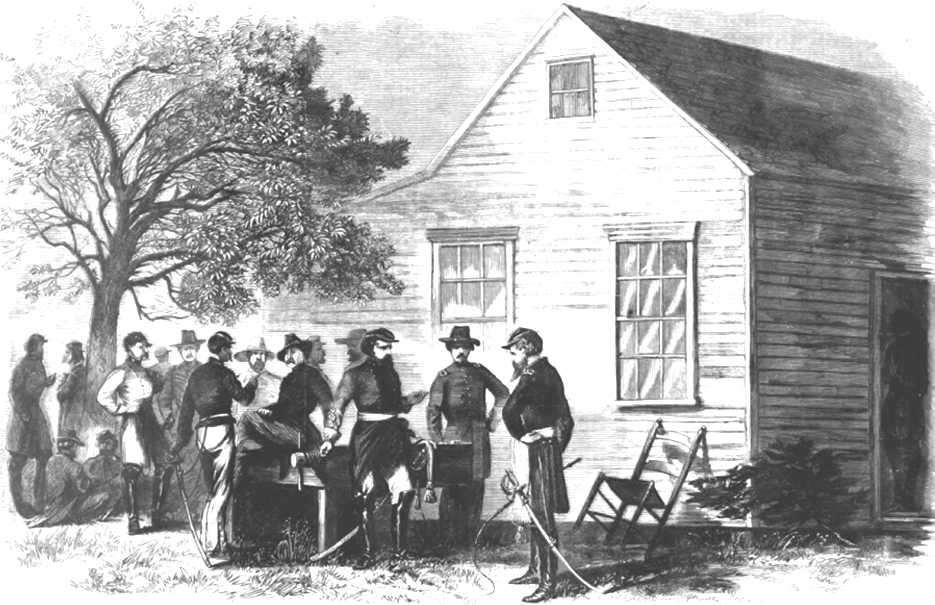
Bennett Place was the small farm of James and Nancy Bennitt near Durham Station in North Carolina. The name is usually written Bennett today, although historical research by North Carolina historic-site staff notes the family’s spelling as Bennitt. The farmhouse stood between the main Union and Confederate positions and provided a neutral-feeling location for talks. The surviving historic site interprets the farm and the negotiations rather than representing a huge military encampment. Knowing its geography helps explain how the generals could meet under a flag of truce while thousands of soldiers remained in separate camps.
Who were Sherman and Johnston?
William Tecumseh Sherman commanded Union armies whose western campaigns had taken Atlanta and then advanced through Georgia and the Carolinas. Joseph E. Johnston commanded Confederate forces attempting to oppose those advances during the final months of the war. Both had extensive military experience, but by April 1865 their strategic situations were radically different. Sherman had the stronger forces, functioning supply arrangements and authority to pursue. Johnston faced the prospect of continued retreat without realistic success. Their negotiation was an attempt to convert that unequal military reality into an orderly disbandment rather than prolonging the fighting.
Why did Johnston decide to surrender?
By April 1865 the Confederacy’s position had deteriorated beyond any realistic prospect of winning the war. Sherman had moved north after his March to the Sea, while Grant’s armies had broken the defense of Petersburg and Richmond. Lee surrendered on April 9, depriving the remaining Confederate commands of their most famous field army. Johnston’s own troops were scattered, weary and increasingly unable to sustain a long campaign. He still had an obligation to consider his soldiers’ safety and their journey home. An agreement offered more protection than a desperate, prolonged retreat.
How did the meetings begin?
Johnston and Sherman first met at the Bennitt farmhouse on April 17, 1865. The two sides discussed surrender in the shadow of news of President Abraham Lincoln’s assassination, which had occurred days earlier. The generals sought a practical way to end hostilities, but their ideas about the permitted scope of an agreement differed. Sherman initially could offer military terms similar to those granted Lee. Johnston wanted a more comprehensive arrangement concerning the political future of the Southern states. That difference became decisive during their negotiations.
Why was Lincoln’s assassination important?
Abraham Lincoln was shot on April 14 and died on April 15, shortly before the Bennett Place discussions. His death changed the political atmosphere in Washington, where many officials feared lenient treatment of Confederate leaders after the assassination. Andrew Johnson had become president and inherited decisions about restoring federal authority. When Sherman negotiated proposals that seemed to reach beyond the surrender of soldiers, officials in Washington evaluated them in this new atmosphere of suspicion and uncertainty. The connection matters because the rejection of the initial agreement cannot be understood only as a military disagreement between two generals.
What did the April 18 agreement propose?
At their second meeting on April 18, Sherman and Johnston drafted a broad memorandum that went beyond the immediate surrender of armed troops. It outlined a truce and measures concerning restoration of state governments, federal courts and civil and political rights. Sherman believed that resolving broader political questions might ease the transition from war to peace. However, decisions of that scope belonged to federal civilian authorities, not simply to battlefield commanders. The North Carolina historic-site transcript allows readers to compare this draft with the final military agreement.
Why was the first agreement rejected?
President Andrew Johnson and his cabinet rejected the expansive April 18 proposal. Washington objected to provisions that appeared to make political commitments or recognize arrangements beyond Sherman’s military authority. General Ulysses S. Grant traveled to North Carolina to supervise the situation and ensure that renegotiated terms matched the military precedent established at Appomattox. The rejection did not mean the Union intended to resume major combat for its own sake. Rather, national leaders insisted that the army should secure surrender while civilian government retained control of political settlement.
How was an acceptable agreement reached?
After the rejection, Johnston and Sherman arranged further discussions. Their third meeting at Bennett Place on April 26 produced a narrower military convention. The final document required Johnston’s troops to cease hostile operations, deposit arms and public property, prepare rolls and promise not to resume fighting. Officers retained private horses, personal baggage and sidearms, and soldiers could return home under the terms of their obligations. Grant approved the arrangement. The change from April 18 to April 26 illustrates the boundary between military capitulation and political reconstruction.
What exactly did the surrender terms say?
The April 26 convention ordered the cessation of acts of war by Johnston’s troops. Arms and public property were to be deposited at Greensboro and delivered to United States authorities. Officers and men were to be recorded on duplicate rolls and bound not to take up arms again until properly released. Personal baggage and officers’ sidearms and private horses were protected. Compliant soldiers could return home without disturbance from United States authorities. These provisions followed the basic structure of the Appomattox agreement. The full signed text is the best starting point for checking popular summaries.
How many Confederate soldiers were included?
North Carolina’s Department of Natural and Cultural Resources describes the surrender as covering nearly 90,000 troops in North Carolina, South Carolina, Georgia and Florida. This is a figure for forces under Johnston’s broad authority rather than a count of soldiers standing at the farmhouse or all being paroled on one day. The actual process of mustering out and issuing papers took place afterward, notably around Greensboro. Such distinctions are important because accounts can confuse the numbers involved in the agreement, those physically with Johnston and the individuals processed through particular parole offices.
What were paroles and why were they used?
Parole arrangements offered a way to release soldiers after organized surrender while requiring them not to resume military operations. Officers and soldiers gave formal undertakings, and military administrators created lists to document the disbandment. A parole was not an unconditional declaration of loyalty or a complete political settlement. It was a practical legal-military instrument that helped former soldiers travel home while federal troops secured arms and installations. The process also reduced the enormous difficulty of imprisoning large numbers of defeated men in a region with damaged transport, ruined farms and scarce food.
How did this differ from Appomattox?
At Appomattox, Lee surrendered the Army of Northern Virginia to Grant on April 9. Bennett Place involved forces operating under Johnston over a broader southern area and culminated on April 26. The later agreement deliberately used the earlier surrender as a model, but negotiations were complicated by an initial proposal containing political guarantees. The location also differed: both settlements were made in private homes, not in capitol buildings or formal courtrooms. Together, they show that Confederate forces were not all disbanded by a single ceremony.
Was Bennett Place the largest Civil War surrender?
Bennett Place is widely interpreted as the location of the largest troop surrender of the Civil War because Johnston’s authority encompassed forces across several Southern states. The figure often given is approximately 90,000. This should not be mistaken for a precise count of people assembled at the Bennitt farm, which hosted the negotiations rather than the mass surrender ceremony. Administrative paperwork and movements took time. North Carolina’s historical agencies specifically identify Bennett Place with the largest troop surrender and preserve the documents used to explain why its scale exceeded that of Appomattox.
Did the Civil War end on April 26?
The agreement marked a major step toward the end of organized Confederate resistance, but not every Confederate command had surrendered. Other military leaders reached separate agreements during May and June 1865. Small engagements and isolated operations continued even as the Confederacy’s effective military defeat became unmistakable. April 26 is therefore an important milestone rather than a universal endpoint. Historians distinguish the collapse of major armies, subsequent regional surrenders and later federal proclamations about the end of rebellion. These events were connected but did not share one date.
How did the surrender affect civilians?
Military surrender helped reduce the immediate danger of ongoing campaigning in communities that had endured troop movements, requisitions and destruction. Families still faced major problems: lost relatives, devastated property, weak transport and uncertainty about the return of civilian government. For formerly enslaved people, the end of Confederate resistance created possibilities of freedom while leaving serious questions about work, safety, citizenship and land. The April 26 terms addressed soldiers’ status, not a comprehensive social settlement. Our Reconstruction guide explains why peace did not immediately bring equal rights or stability.
What happened to the Bennitt family?
James and Nancy Bennitt owned the farm where the generals met. The Civil War had directly affected their household, including the deaths of family members connected with military service. They allowed the officers to use the home for talks and thus became associated with an event far larger than their everyday lives. Modern interpretation of the site includes this civilian perspective because a surrender conference was not conducted in an empty symbolic setting. It was held in a family’s modest home in a part of North Carolina already marked by the war’s suffering.
What can visitors see at Bennett Place today?
Bennett Place State Historic Site near Durham preserves the setting and interprets the surrender negotiations, including reconstructed farm buildings and exhibits. The modern property helps visitors understand the modest domestic environment in which the generals discussed the fate of large armies. Not every present structure is an untouched 1865 original, so signs and historical images help distinguish reconstruction from surviving evidence. The North Carolina Historic Sites website provides background and visitor details. For research, the state’s transcriptions of the April 18 and 26 agreements are especially useful.