Indian Citizenship Act of 1924: Native American Rights and Voting Barriers
What the 1924 federal citizenship law changed for Native Americans, why some were already citizens and why voting remained restricted.
Quick answer
The Indian Citizenship Act, signed by President Calvin Coolidge on June 2, 1924, declared all noncitizen Native Americans born within the United States’ territorial limits to be U.S. citizens. Many Native Americans already held citizenship through earlier laws, marriage or military service. The act expressly protected existing tribal and property rights, but did not automatically remove state voting barriers or guarantee equal political participation.
Key facts
On this page
- What was the Indian Citizenship Act?
- Citizenship before June 1924
- Native American military service and the 1919 law
- The law’s exact language and the date
- Citizenship and tribal affiliation
- Did the act automatically grant the right to vote?
- Why voting restrictions continued
- Other inequalities citizenship did not end
- The Indian Reorganization Act and later policy
- How historians use the original document
- Why June 2, 1924 remains important
- Timeline
- FAQs
- Sources
What was the Indian Citizenship Act?
The Indian Citizenship Act of 1924 was a short but consequential federal statute. It declared that Native Americans who were not already citizens and who had been born within the territorial limits of the United States were citizens of the United States. The legislation used language that reflects the official terminology of its era; today’s article uses Native Americans except when discussing the original legal title. Its brevity can obscure its significance because the meaning of national citizenship had been disputed for generations.
The law did not transform Native American nations into new states, abolish tribal institutions or grant instant equality in every public activity. The statutory wording included an important protection for tribal and other property rights. It also operated in a political system where the rules for voter registration and participation were often controlled by states. To understand the act, the new citizenship rule must be separated from the practical barriers Native Americans still experienced.
Citizenship before June 1924
Native Americans did not share one uniform citizenship status before the 1924 law. Some had gained U.S. citizenship through treaties or particular statutes, and others became citizens under land-allotment provisions or individual legal circumstances. Indigenous people could also be members of their tribal nations while facing uncertainty about their relationship to the U.S. government. These differences arose from federal policy and contested ideas about Indigenous sovereignty rather than a collective unwillingness to participate in political life.
The nineteenth-century Dawes Act linked citizenship for certain Native Americans to allotment and other conditions. This arrangement was part of broader policies that sought to alter communal land ownership and Indigenous institutions. The 1924 statute expanded citizenship without making allotment a universal prerequisite for those still excluded. It is therefore inaccurate to say that not a single Native American possessed U.S. citizenship before 1924.
Native American military service and the 1919 law
Native Americans served in U.S. military forces in the First World War even while questions about their citizenship remained unresolved. In 1919 Congress enacted a law offering citizenship to certain honorably discharged Native American veterans who had served during the war. The Library of Congress describes how this statute recognized service without automatically cancelling tribal rights. The law helped expose the contradiction of expecting military service from people whose full membership in the national political community was legally uncertain.
Military service was not the only reason Native American communities and leaders debated national citizenship. Some regarded it as a tool for gaining protection and participation in federal politics, while others were concerned about policies that used citizenship to weaken tribal sovereignty. There was no single Indigenous viewpoint. The different interests and traditions of Native nations complicate any account that treats citizenship as an unquestioned gift universally welcomed on identical terms.
The law’s exact language and the date
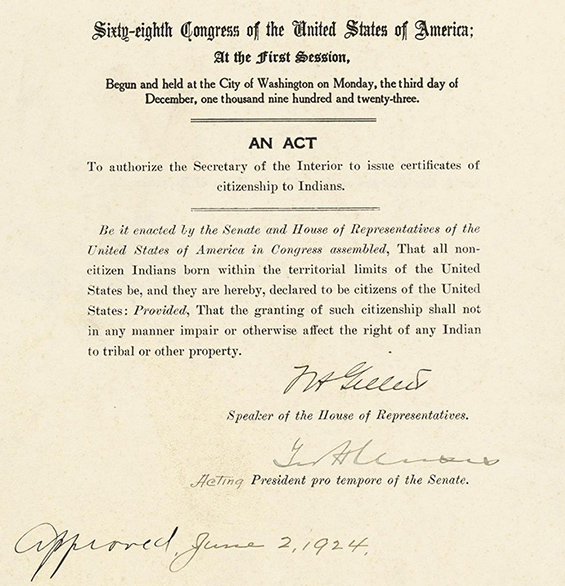
President Calvin Coolidge approved the measure on June 2, 1924. It was introduced in the House by Representative Homer P. Snyder and is sometimes called the Snyder Act. The National Archives preserves the enrolled text, which states that noncitizen Native Americans born within U.S. territorial limits are declared citizens. A brief legal proviso specifies that granting citizenship must not impair or otherwise affect the right of any Native American to tribal or other property.
The original text matters because summaries often add powers or conditions that Congress did not enact. The act did not create a comprehensive new tribal-government framework or a separate system of federal benefits. It made a declaration of citizenship with a particular property safeguard. Its effect depended partly on institutions and laws outside those few lines. Reading the document itself helps distinguish the immediate federal change from later struggles over voting, schools, land and self-determination.
Citizenship and tribal affiliation
The act’s property clause acknowledged that becoming a U.S. citizen did not automatically eliminate tribal or other property rights. That distinction mattered because earlier federal policies had sometimes tied citizenship to assimilation or changes in land ownership. Native Americans could belong to tribal nations with their own histories and responsibilities while also holding United States citizenship. The 1924 legislation therefore did not establish a simple either-or choice between tribal and national identity.
Yet it would be inaccurate to claim the clause solved every conflict involving tribal sovereignty and federal authority. Congress continued to legislate on Indigenous affairs, while courts and agencies interpreted complex treaties and property arrangements. Native nations had differing legal relationships with the federal government. The citizenship act was one important milestone within those broader histories, not a comprehensive settlement of the relationship between the United States and Indigenous peoples.
Did the act automatically grant the right to vote?
National citizenship and the practical ability to vote were not the same thing in 1924. State laws and administration still influenced voter eligibility, registration and access to elections. Some states continued to exclude Native American citizens using classifications about guardianship, residence on reservations or other qualifications. The Library of Congress describes how barriers persisted long after the federal law, and official historical sources differ in the dates they use for the last state restrictions depending on the particular form of exclusion.
This distinction is crucial: the Indian Citizenship Act did not contain a national command to register every eligible Native American voter automatically on June 2. Voting protections under the Fifteenth Amendment were already constitutional law, but discriminatory state requirements and their enforcement remained serious obstacles. Native communities challenged those practices through litigation, organizing and political participation. Granting citizenship was a milestone, but it did not immediately guarantee equal access to the ballot.
Why voting restrictions continued
States relied on different legal arguments to deny registration or voting to Native people, including assertions that living on a reservation or maintaining particular tribal relations affected eligibility. Some officials applied general requirements such as literacy tests or poll taxes in discriminatory ways. Historical accounts need to distinguish a law written as a general condition from the manner in which it was enforced. Barriers sometimes persisted despite a person’s U.S. citizenship and willingness to participate.
Courts gradually rejected a number of state restrictions, while community advocates pressed legislators and election officials to change practices. The long struggle did not unfold on one nationwide timetable. The National Archives preserves records illustrating such barriers into the mid-twentieth century. An article about 1924 must therefore avoid a misleading conclusion that all Native Americans could vote freely the following November or that one federal statute brought every state into immediate compliance.
Other inequalities citizenship did not end
Native Americans continued to face restrictions and discrimination involving schooling, land use, cultural expression and access to services. Federal assimilation policies and residential boarding schools had deep effects on families and communities. Citizenship did not reverse those policies automatically. The fact that a person held national citizenship did not guarantee that authorities respected Indigenous languages, religious practices or community institutions.
The experience varied by nation and region, as did the responses of Native political leaders. Some worked within federal and state political institutions, while others emphasized treaty rights and tribal self-government or combined those approaches. A careful history avoids presenting Native Americans as passive recipients of law. Indigenous advocacy, negotiation and resistance are central to understanding why citizenship was debated and how its potential was pursued after 1924.
The Indian Reorganization Act and later policy
Congress adopted the Indian Reorganization Act in 1934, ten years after the citizenship measure. It altered important aspects of earlier allotment policy and offered mechanisms affecting tribal organization and land. Its provisions and effects differed by Native nation. The 1934 statute should not be projected backward as though it was part of the 1924 citizenship declaration. They addressed related but distinct dimensions of federal Indian policy.
The wider twentieth-century history also included termination policies, campaigns for self-determination and new measures protecting civil rights. Voting rights became the subject of continued legal and political struggle. Understanding the 1924 statute in this sequence reveals both its specific achievement and its limitations. Citizenship could provide a national legal status, while equality in practice depended on further changes and Indigenous political action.
How historians use the original document
The enrolled act is preserved by the National Archives and reproduced by historical institutions, including the U.S. Capitol Visitor Center. It is a compact primary source from which readers can verify the date, the language about citizenship and the protection for property rights. The image accompanying this article shows that actual legal text, not a symbolic photograph of a tribal ceremony falsely presented as the signing of the law.
Primary documents must still be read in context. The words of Congress explain what the statute enacted, but they do not prove that every local official immediately changed registration procedures or that people experienced citizenship uniformly. To investigate those outcomes, historians examine state law, lawsuits, personal accounts, tribal archives and federal correspondence. Combining the act with such evidence produces a fuller explanation than simply repeating its headline achievement.
Why June 2, 1924 remains important
The Indian Citizenship Act established U.S. citizenship for Native Americans who remained outside it under earlier federal law. It did so without explicitly destroying tribal property rights, marking a significant change from earlier policies that often linked citizenship to assimilation. At the same time, voting barriers and other inequalities remained, showing that legal status and the actual exercise of rights are distinct.
The act belongs in a larger history of Indigenous sovereignty and American citizenship. The Dawes Act of 1887 provides earlier context, while subsequent voting-rights struggles show how much work followed the 1924 statute. Its significance is best understood neither as a complete solution nor as an empty gesture, but as an important legal change whose promise was realized unevenly and through persistent Native advocacy.
Timeline
- 1887: Dawes Act links some citizenship rules to allotment
- 1919: Citizenship law for qualifying Native American veterans
- June 2, 1924: Indian Citizenship Act enacted
- 1934: Indian Reorganization Act changes allotment-era policy
- Mid-1900s: State voting barriers challenged
- 1975: Voting Rights Act amendments strengthen language-minority protections
Frequently asked questions
When was the Indian Citizenship Act signed?
June 2, 1924, by President Calvin Coolidge.
Did all Native Americans become U.S. citizens for the first time?
No. Many had already obtained citizenship under earlier laws; the 1924 act extended it to Native Americans not yet citizens who were born within U.S. territorial limits.
Did citizenship end tribal membership?
No. The act expressly protected tribal and other property rights, though wider sovereignty questions continued.
Could all Native Americans vote immediately after 1924?
No. State restrictions and discriminatory practices continued to impede voting in several places.
Was the act also called the Snyder Act?
Yes, after Representative Homer P. Snyder, a House sponsor.
Did the law abolish reservations?
No. It concerned citizenship and included a tribal-property safeguard, not a general abolition of reservations.