Hepburn Act of 1906: Railroad Rates, ICC Powers and Roosevelt’s Reform
Why Congress expanded federal oversight of railroad charges and what the Interstate Commerce Commission gained.
Quick answer
The Hepburn Act, signed on June 29, 1906, strengthened the Interstate Commerce Commission (ICC) by allowing it to set maximum rates for interstate railroad services after investigating unreasonable charges. The law also expanded federal oversight to additional transportation services and restricted free railroad passes. It built on the Interstate Commerce Act of 1887 rather than creating the ICC from scratch.
Congressional railroad regulation did not begin or end in 1906. The Hepburn law illustrates the distinction between announcing a reasonable-rate principle and giving a federal commission the power to enforce it.
Key facts
On this page
- Why railroad rates became a national issue
- What the Interstate Commerce Act of 1887 had already done
- Roosevelt’s view of federal supervision
- The bill and its path through Congress
- The power to prescribe maximum rates
- Which carriers and services came within federal oversight?
- Free passes, favoritism and accounting
- The relationship to rebates and earlier antitrust measures
- What the law changed—and did not change—for shippers
- Later amendments and the long-term regulatory system
- Why the Hepburn Act matters to the Progressive Era
- Timeline
- FAQ
- Sources
Why railroad rates became a national issue
Railroads connected farms, mines, factories, cities and ports across the United States, carrying much of the nation’s long-distance freight before trucks and interstate highways developed. The price of shipping could shape the profitability of a farm far from market or determine whether a manufacturer could compete with rivals in another region. Rail carriers therefore exercised significant economic power over businesses that often had few practical alternatives. Complaints focused not only on the total cost of carriage, but also on differences between rates charged to customers, routes and communities.
Some shippers received preferential terms, while others alleged they paid more than a fair share. Long-distance routes might face more competition than short routes, producing pricing patterns that frustrated local businesses. The underlying concern was not that every railroad was a single monopoly or that all rates were unfair; it was that regulation had difficulty correcting abuses consistently. In this setting, the federal government’s ability to investigate and enforce a reasonable-rate standard became a central Progressive Era question.
What the Interstate Commerce Act of 1887 had already done
The Interstate Commerce Act of 1887 established the Interstate Commerce Commission, the first federal regulatory commission of this kind. It required railroad rates to be just and reasonable and sought to limit discriminatory preferences and rebates. The statute expressed a clear public principle: companies engaged in interstate transport could be subject to federal oversight rather than left entirely to their own contracts. Yet declaring a rule was different from giving officials the power needed to enforce it effectively.
Over time, judicial decisions and procedural obstacles constrained the ICC’s ability to establish the exact rates carriers should charge in future. The commission could examine and condemn unreasonable rates but lacked the broad, clear prospective rate-setting authority that reformers wanted. The 1887 act remained foundational, and subsequent legislation added new tools. Therefore 1906 should not be described as the year federal railroad regulation first existed. The Hepburn Act was a major revision within an already developing system.
Roosevelt’s view of federal supervision
President Theodore Roosevelt advocated stronger public oversight of large enterprises when their operations affected interstate commerce. His broader Square Deal program included a commitment to address unfair corporate practices while accepting that national-scale businesses could provide useful services. Roosevelt did not present regulation as equivalent to public ownership of every railroad. He supported a stronger federal supervisory capacity to place limits on practices he considered harmful and to give users of rail services a more credible forum for complaints.
The Hepburn proposal emerged amid debates among railroad executives, commercial groups, lawyers, reformers and politicians about the proper reach of federal power. Some argued that rate intervention could protect businesses and communities against unequal treatment. Others worried that regulatory rulings would interfere with investment or business decisions and be difficult to apply fairly to varied routes and costs. These disputes affected the legislative language. The result was stronger federal authority, but it retained administrative procedures and judicial avenues of review.
The bill and its path through Congress
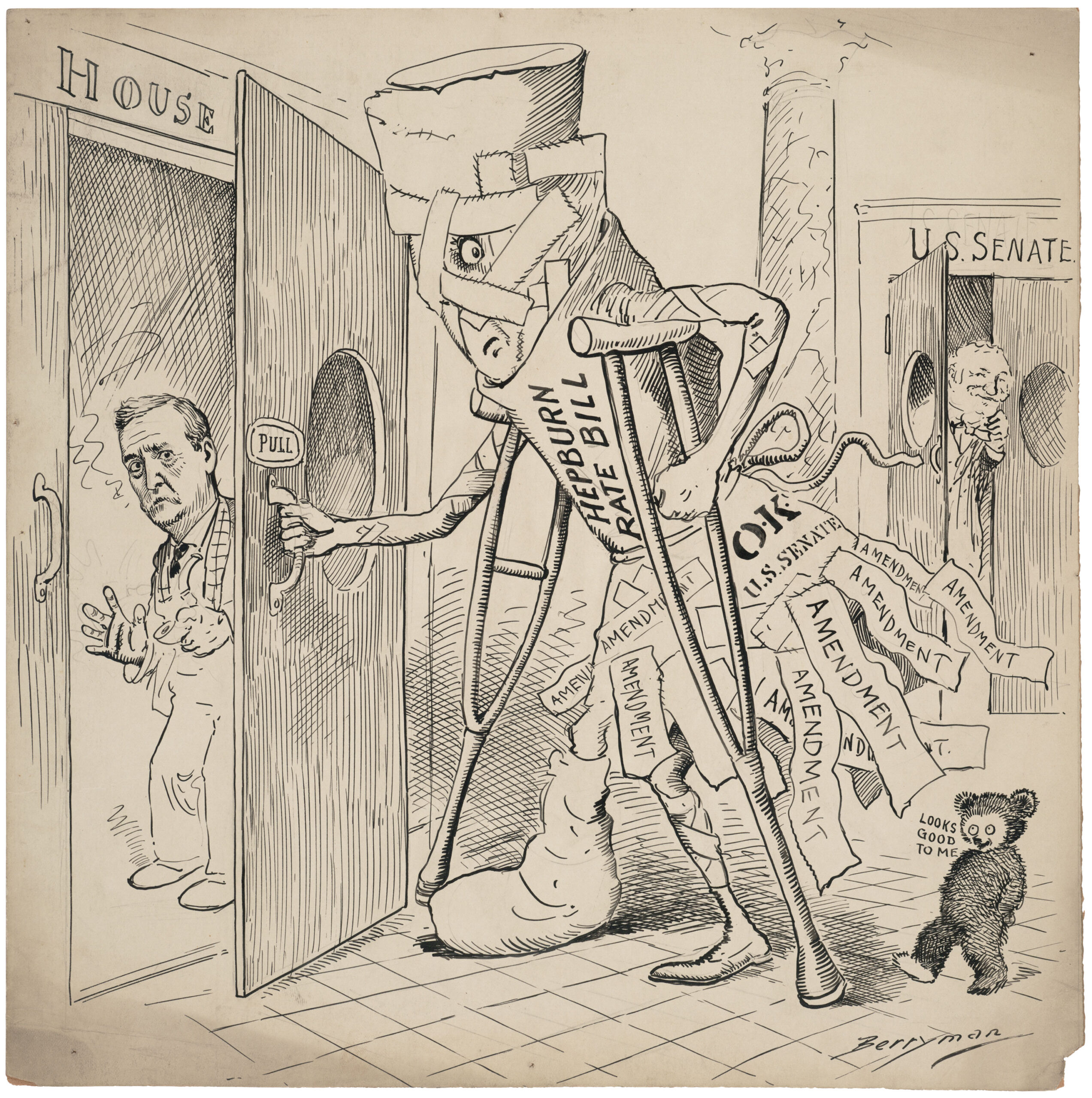
The measure is named for Representative William P. Hepburn of Iowa, who played a leading role in the House. The legislative debate also included Senate leaders with differing views on the commission’s authority and the courts’ role in reviewing its decisions. A bill supported by the president could still be substantially debated and amended as it moved from chamber to chamber. Contemporary political cartoonist Clifford K. Berryman drew the Hepburn Rate Bill burdened by amendments, a useful primary source for the atmosphere in which the legislation took shape.
After conference negotiations the act became law on June 29, 1906. The National Archives preserves both background on the legislation and Berryman’s cartoon, which appeared during the debate. The image is not a photograph of the president signing the law, and it is not neutral evidence that one side was right. It is a period cartoon reflecting contested congressional maneuvering. Used with the statute’s text, it helps readers understand the difference between the aims of reformers and the specific provisions Congress ultimately agreed to enact.
The power to prescribe maximum rates
The central change was authority for the ICC, after a complaint and investigation, to determine that an interstate carrier’s existing rate was unreasonable and prescribe a maximum rate that the carrier would thereafter be expected to observe. This strengthened the earlier system in which the commission could criticize or condemn a charge without an equally clear, effective tool for establishing the replacement figure. The ability to set a prospective ceiling made the ICC a more consequential regulator of railroad commerce.
However, the 1906 power had limits. The commission did not simply announce universal prices for every railroad service, nor did it acquire unlimited authority to stop every proposed rate change before it took effect. Under the 1906 scheme, relevant complaints and investigations followed established procedures, and carriers could challenge rulings. Later legislation further enlarged the ICC’s authority. Keeping those stages separate avoids attributing all subsequent rate-control powers to the Hepburn statute alone.
Which carriers and services came within federal oversight?
The act expanded the reach of the existing regulatory framework to additional transportation-related enterprises, including express companies, sleeping-car companies and certain oil pipelines. Its definitions also addressed railroad facilities and the services needed to move freight, such as terminals and associated handling functions. These changes mattered because transportation companies could arrange operations through subsidiaries, facilities or contracts that complicated narrow definitions of a ‘railroad.’ A law that only reached locomotives and track operators might miss important charges associated with moving goods.
Broadening coverage did not mean bringing every business in the economy under the ICC. The law related to interstate carriage and specified transportation services, while the states continued to have their own roles in intrastate matters. The precise words of the 1906 statute are important when evaluating a particular historical case. A pipeline carrying oil, for example, could raise regulatory questions different from those of a local urban trolley. The act sought a more coherent scope for interstate transportation regulation, but it was not a general consumer-protection law for all products.
Free passes, favoritism and accounting
Beyond the headline rate-setting power, the law addressed practices that could influence business and public officials. One prominent provision generally restricted free railroad passes for interstate travel, subject to detailed statutory exceptions. Such passes could be used to reward favored people, encourage influence or form part of the special treatment that reformers considered improper. The exceptions matter: railroad employees and certain other specified categories could still receive lawful free transportation, so an absolute claim that every free pass became illegal is inaccurate.
The statute also strengthened record-keeping and accounting requirements. Standardized information could help the ICC compare charges, investigate practices and understand the costs that carriers reported. Regulation depends not only on a power to announce decisions, but also on access to reliable evidence. Accounts of railroad reform that focus exclusively on a maximum-rate sentence miss the administrative tools that made oversight more practicable. At the same time, reporting rules did not eliminate disputes about what expenses were reasonable or how complex carrier operations should be measured.
The relationship to rebates and earlier antitrust measures
Railroad reform formed part of a broader federal response to concentrated economic power. The Elkins Act of 1903 strengthened the government’s ability to prosecute discriminatory railroad rebates, while the Hepburn Act revisited the ICC’s powers and related practices. These laws should be distinguished from the Sherman Antitrust Act, which addressed unlawful restraints and monopolization through a different legal framework. Antitrust enforcement and rate regulation could overlap in public debates but used different tools to address market conduct.
Roosevelt’s administration also pursued the Northern Securities case, challenging a large railroad holding-company combination. That litigation concerned corporate control and competition; the Hepburn Act concerned the legal authority to regulate carrier services and charges. Both illustrate the administration’s view that national markets could justify stronger federal oversight, but neither can substitute for the other in a historical explanation. They were complementary components of a wider, contested reform movement.
What the law changed—and did not change—for shippers
Shippers who believed they faced unreasonable charges gained a more meaningful regulatory route to challenge rates. A formal investigation could lead to an ICC order prescribing a maximum. Yet the remedy required evidence, administrative work and sometimes litigation, and not every complaint would end in the shipper’s favor. Railroads remained private businesses, continued to set many charges in the first instance and operated within a legal system allowing review of commission action. The actual experience of a customer therefore depended on the route, service, facts and procedural outcome.
Nor did the act guarantee uniformly low transportation costs. A maximum rate is a legal ceiling in a specified context, not a promise that every rate will become inexpensive. Carriers could face real expenses in maintaining track, equipment and labor, while customers could dispute whether charges reflected those expenses fairly. Historians assessing effects need to examine particular rulings and markets instead of assuming that rate authority instantly solved every grievance. The law strengthened tools, and their deployment was a continuing administrative story.
Later amendments and the long-term regulatory system
The Hepburn Act was a significant step rather than the end of railroad regulation. Congress returned to the subject in 1910 with the Mann–Elkins Act and other subsequent measures, revising the powers available to the ICC and the scope of oversight. Interstate transportation itself continued to evolve through automobiles, trucking, aviation and changing industrial organization. Later twentieth-century debates turned increasingly to when regulation should be loosened or replaced, and the ICC was eventually abolished in the 1990s with functions transferred or ended.
Looking back from those later changes, the particular achievement of 1906 is clearer. The act provided a more effective maximum-rate authority and broadened the range of regulated transportation services at a moment when railroads were central to U.S. commerce. It did not create a timeless, all-powerful commission. The Progressive Era legislative setting and the precise statutory limits help explain why later lawmakers still saw reasons to revise the system.
Why the Hepburn Act matters to the Progressive Era
The law is a useful case study in what federal economic reform meant in practice. It involved Congress identifying a problem of interstate trade, expanding an existing institution, defining jurisdiction, giving officials investigative and decision-making powers, and preserving avenues for legal dispute. That process is more concrete than broad descriptions of the Progressive Era as simply an age of reform. It shows how controversies over shipping costs, business favoritism and national authority translated into an enforceable statute.
The Hepburn Act also helps connect the ICC’s creation in 1887 to Roosevelt’s economic program and to later changes in federal administration. The key factual distinction remains simple: the 1887 law established the regulatory commission; the 1906 law materially strengthened what it could do. Reading both in sequence reveals how an American regulatory system developed through successive statutes and controversies rather than appearing fully formed in a single year.
Timeline
- 1887: Interstate Commerce Act creates ICC
- 1903: Elkins Act addresses railroad rebates
- Early 1906: Hepburn rate legislation proceeds through Congress
- May 1906: Berryman cartoon depicts amendment-heavy bill
- June 29, 1906: Hepburn Act becomes law
- 1910: Mann–Elkins Act further revises ICC powers
Frequently asked questions
What did the Hepburn Act of 1906 do?
It enlarged ICC authority to prescribe maximum railroad rates after investigations, expanded coverage of transportation services and restricted many free interstate passes.
When was the Hepburn Act signed?
President Theodore Roosevelt signed it on June 29, 1906.
Did the Hepburn Act create the ICC?
No. Congress established the Interstate Commerce Commission under the Interstate Commerce Act of 1887.
Who was Hepburn?
William P. Hepburn was a U.S. representative from Iowa associated with the House legislation.
Could the ICC stop any new rate increase before it took effect in 1906?
Not as a general unlimited authority. The 1906 scheme dealt with rates through complaints and investigation; further power developed under later legislation.
Did it cover oil pipelines?
Certain oil pipelines were brought within the enlarged statutory framework, alongside express and sleeping-car companies.
Were all free railway passes banned?
No. The statute prohibited many passes but expressly preserved specified exemptions, including various employee categories.
Sources and further reading
The original 1906 law and National Archives sources support the legal distinctions explained above.