Battle of Mobile Bay (1864): Farragut, Torpedoes and Fort Morgan
On August 5, 1864, Union Admiral David Glasgow Farragut led a fleet past Confederate defenses into Mobile Bay, Alabama. The Union ironclad USS Tecumseh sank a
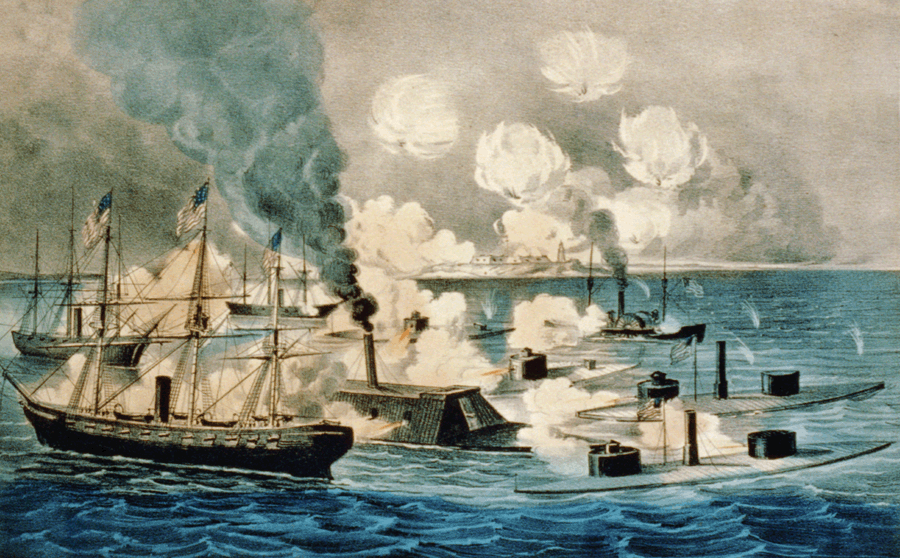
On August 5, 1864, Union Admiral David Glasgow Farragut led a fleet past Confederate defenses into Mobile Bay, Alabama. The Union ironclad USS Tecumseh sank after hitting a torpedo, but Farragut’s ships continued and defeated the Confederate ironclad CSS Tennessee. Fort Gaines and Fort Morgan surrendered later in August, closing the bay to Confederate blockade runners although the city of Mobile remained in Confederate hands until 1865.
This guide separates events, causes, battlefield decisions and long-term consequences using historical research.
On this page — 23 topics
What happened in the Battle of Mobile Bay?
The Battle of Mobile Bay was a major naval engagement fought on August 5, 1864, near the entrance to Mobile Bay in Alabama. Union Admiral David G. Farragut commanded a fleet that passed the guns of Confederate Fort Morgan and confronted Confederate warships inside the bay. The Union monitor Tecumseh sank, but the main fleet continued and compelled the ironclad CSS Tennessee to surrender. It was an important military and political victory for the United States because it restricted Confederate access to overseas trade. The harbor forts were captured in separate operations later that month.
Why was Mobile Bay important to the Confederacy?
By the summer of 1864 the federal naval blockade had severely restricted Confederate foreign trade. Mobile remained an important Gulf port connected to rail networks and inland resources, and blockade runners could still attempt to pass through its defended approaches. Ships imported military stores and other goods while exporting commodities useful for securing overseas credit. Capturing the bay would close a major route through which the Confederacy sustained its war effort. Naval control mattered even if Union soldiers did not immediately occupy the city, because shipping could no longer enter or leave under the former conditions.
Who was Admiral David Farragut?
David Glasgow Farragut was a senior United States naval commander whose experience extended back decades before the Civil War. In 1862 he had led Union operations that captured New Orleans, demonstrating the usefulness of aggressive naval movement past fixed Confederate batteries. At Mobile Bay he again accepted the dangers of entering a strongly defended harbor. Farragut’s role has often been reduced to a famous quotation about torpedoes, but the operation also required planning, coordination with the army, the use of ironclads and the maintenance of a fleet formation under heavy fire. His victory strengthened his naval reputation.
Who commanded the Confederate naval defense?
Confederate Admiral Franklin Buchanan directed a small defending naval force that included the ironclad ram CSS Tennessee and several supporting gunboats. The ironclad’s heavy armor and offensive weapons made it a serious threat to individual wooden Union vessels, but Buchanan faced an opposing fleet with far greater numbers and firepower. The Confederate strategy relied on the support of shore fortifications and underwater mines to make the channel dangerous. When Farragut’s ships pushed into the bay, Buchanan sought to challenge them directly. His force was eventually overwhelmed, and Buchanan was wounded during the battle.
What were Fort Morgan and Fort Gaines?
Fort Morgan stood on the eastern side of the main entrance to Mobile Bay, while Fort Gaines occupied Dauphin Island to the west. Their artillery covered important approaches used by ships entering the bay. Confederate defenders also relied on obstacles and a field of underwater mines that restricted the navigable channel. The Union fleet could not simply sail through an undefended opening. Its crews had to pass guns at relatively close range while maintaining a workable formation. The forts were part of an integrated harbor defense system, not the sole participants in a one-sided artillery duel.
How did Farragut organize his fleet?
Farragut arranged wooden warships in pairs so that a damaged vessel might be assisted or steered through the narrow passage by its partner. Four Union monitors, armored vessels with revolving turrets, accompanied the force to engage Confederate defenses. The fleet needed to keep moving despite heavy smoke, strong current and the danger of grounded or damaged ships. The paired arrangement showed how commanders adapted to the vulnerability of wooden ships operating under fortification fire. Success depended on sailors’ seamanship as well as guns; a blocked channel or collision could expose multiple ships to continued Confederate artillery.
What were Civil War torpedoes?
In 1864 the word “torpedo” usually described an underwater explosive device comparable to a modern naval mine, not the self-propelled weapon the term commonly suggests today. Confederate defenders placed such devices in Mobile Bay to restrict the entrance and force Union ships into predictable paths covered by artillery. Some mines failed to explode, but the threat was real. The sinking of the USS Tecumseh showed that an ironclad was not invulnerable beneath its armored hull. Understanding period terminology prevents confusion when reading naval reports or the famous phrase associated with Farragut’s decision to continue.
Why did the USS Tecumseh sink?
The Union monitor USS Tecumseh struck a Confederate underwater torpedo while moving toward the harbor entrance on August 5. The explosion caused the vessel to sink rapidly, killing many members of its crew. The sudden loss alarmed ships behind it and threatened to disrupt the fleet’s movement through the channel. The tragedy demonstrates how hidden underwater weapons could be more dangerous to heavily armored ships than some conventional gunfire. Although the incident is central to the battle, historians should not suggest the entire Union fleet was destroyed or that every mine in the channel functioned successfully.
Did Farragut really say ‘Damn the torpedoes’?
The familiar phrase is traditionally associated with Farragut’s determination to move the fleet forward after the Tecumseh sank. His exact words were recorded differently by witnesses and later writers, so popular versions should not be presented as a perfectly verified transcript. What is clear is that he ordered the advance to continue despite the danger of mines and shore fire. The decision helped prevent a long halt in a vulnerable channel. The legend captures the urgency of the moment, but the military outcome depended on many officers and crews carrying out the movement under difficult conditions.
How did the fleet pass Fort Morgan?
After the Tecumseh went down, Farragut’s ships continued through the entrance while firing at Confederate positions. Fort Morgan’s guns struck Union vessels, but the ships succeeded in moving beyond the most dangerous channel. Smoke, noise and battle damage complicated communication. Once inside, the fleet could maneuver against Confederate gunboats and the ironclad Tennessee. The passage was a significant success because fixed artillery alone had not kept the Union ships outside the bay. Still, Fort Morgan remained held by Confederate troops after the naval battle and would require a separate surrender following army and navy operations.
What was the CSS Tennessee?
The CSS Tennessee was a Confederate ironclad ram built to fight Union wooden and armored warships. It had a casemate protecting its guns and attempted to use both its artillery and hull to damage opponents. Admiral Buchanan took the vessel into combat against Farragut’s larger fleet after the Union ships passed the harbor entrance. The Tennessee proved difficult to destroy through ordinary gunfire, but Union ships repeatedly struck and attacked it, damaging steering and other equipment. Eventually the crew could no longer fight effectively. Its surrender became the decisive naval event that completed Farragut’s victory on August 5.
How did Union ships defeat the Tennessee?
Union monitors and wooden warships converged on the Confederate ironclad from several directions. They fired into vulnerable points and used the weight and speed of their own hulls to ram it. Repeated impacts damaged parts of the Tennessee, while close-range gunfire battered its armor and fighting capacity. With Buchanan injured and the ship unable to maneuver or fire effectively, Confederate officers surrendered. This action illustrates the limits of ironclad protection when a vessel faces numerous enemies and cannot control its movements. It was not a contest in which one miraculous Union shot sank the Confederate flagship.
Were there army operations at the same time?
Yes. The Mobile Bay campaign was a combined operation involving Union ground troops under Gordon Granger as well as Farragut’s naval force. Soldiers landed on Dauphin Island and prepared operations against Fort Gaines, restricting Confederate options and supporting the fleet. Capturing forts and controlling shore positions prevented the Confederacy from restoring access to the bay after the naval defeat. This cooperation mattered because warships could pass batteries without necessarily occupying them. Mobile Bay demonstrates the importance of coordinated army and navy efforts in the Union campaign to close Confederate ports.
When did Fort Gaines surrender?
Fort Gaines surrendered on August 8, 1864, after the Union fleet had gained control of the bay and federal land forces threatened the fort. The garrison faced an increasingly untenable position, cut off from effective support and confronted by ships that could operate within the harbor. Its surrender eliminated one of the fixed defenses guarding the entrance. The event occurred three days after the naval battle and should not be merged into August 5 in a simplified chronology. It made Union control over the western side of the bay entrance much more secure.
When did Fort Morgan surrender?
Fort Morgan continued to resist after Fort Gaines fell. Union soldiers and naval vessels established positions and subjected the fort to a siege and heavy bombardment. Its Confederate garrison surrendered on August 23, 1864. This completed the removal of the main defenses that had guarded the entrance to Mobile Bay. The separate surrender date is important: the naval victory made control possible, but occupying and disarming the defenses required additional operations. Once the fort fell, Confederate shipping through the bay was effectively shut down, severely limiting Mobile’s usefulness as an international trading port.
Did the Union capture the city of Mobile in August 1864?
No. The Union secured the bay and the major coastal forts, but the city of Mobile itself remained Confederate for several more months. Federal forces did not occupy the city until April 1865 during the final campaigns of the war. The distinction is often lost because the naval battle is described as the “capture of Mobile.” The strategic achievement in 1864 was to close the harbor to Confederate commerce. That was extremely valuable even without immediate control of every street, warehouse and railroad facility inside the city. A precise account separates maritime access from the later land campaign.
How many casualties were there?
National Park Service battle summaries estimate roughly 1,827 casualties associated with the Mobile Bay operations, though different references may include different time periods and actions. The sinking of the Tecumseh was particularly costly to its crew, while other vessels were damaged and sailors were killed or wounded in the fighting. Confederate losses included captured personnel from the defeated fleet and garrisons. Readers should not assume that the total represents men killed on August 5 alone. Naval warfare combines ship losses, casualties and prisoner counts differently from land battles, making careful definitions essential.
How did Mobile Bay affect the 1864 election?
The victory came during a politically difficult summer for Abraham Lincoln. Union armies were suffering heavy casualties in Virginia and fighting through Georgia, while many Americans doubted whether the war could be ended successfully. The success at Mobile Bay, followed by the capture of Atlanta in September, improved the sense that federal military operations were making progress. It would overstate the case to say Mobile Bay alone determined the election. Rather, it was one part of a series of victories that strengthened Lincoln’s standing against George B. McClellan in the presidential election of 1864.
What is the battle’s historical importance?
Mobile Bay illustrates the combined effects of a naval blockade, coastal fortifications, ironclad warfare, underwater mines and military leadership. Farragut’s fleet accepted extreme risks to close a strategically important harbor, and the subsequent surrender of the forts gave the Union lasting control of the entrance. The operation also demonstrates that a famous one-line quotation can conceal a complex victory achieved by many sailors and soldiers. Its importance lies in restricting Confederate trade and demonstrating that shore batteries could be overcome through coordinated movement, not in the instant capture of the city of Mobile.
Where can the campaign be studied today?
Fort Morgan and Fort Gaines remain key historical places for understanding the entrance to Mobile Bay. Their sites and museum exhibits explain coastal artillery and the naval operation, while the protected historic landscape helps visitors appreciate the channel’s narrow approaches. The National Park Service battle summary provides the outcome and broad chronology. Historical charts, period prints and vessel records help distinguish which actions took place on August 5 and which were part of later siege operations. Modern warship photographs are not substitutes for the 1864 harbor geography.
Timeline
| Date | Event |
|---|---|
| August 3–4 | Union landings and preparations at Dauphin Island. |
| August 5 | Farragut passes the harbor forts; Tecumseh sinks; CSS Tennessee surrenders. |
| August 8 | Fort Gaines surrenders. |
| August 23 | Fort Morgan surrenders, sealing Mobile Bay to blockade running. |
| April 1865 | Union troops occupy Mobile city. |