Death of Franklin D. Roosevelt (April 12, 1945): How Truman Became President
Death of Franklin D. Roosevelt (April 12, 1945): How Truman Became President
How Franklin Roosevelt died during his fourth term, why Harry Truman succeeded him and what changed in wartime leadership.
Quick answer
Franklin D. Roosevelt won the presidential election of 1944 while the United States remained engaged in World War II. His victory gave him an unprecedented fourth elected term. The war in Europe was approaching its end, but the Pacific conflict continued and major diplomatic decisions remained unresolved.
Key facts
On this page
Roosevelt’s fourth term
Franklin D. Roosevelt won the presidential election of 1944 while the United States remained engaged in World War II. His victory gave him an unprecedented fourth elected term. The war in Europe was approaching its end, but the Pacific conflict continued and major diplomatic decisions remained unresolved.
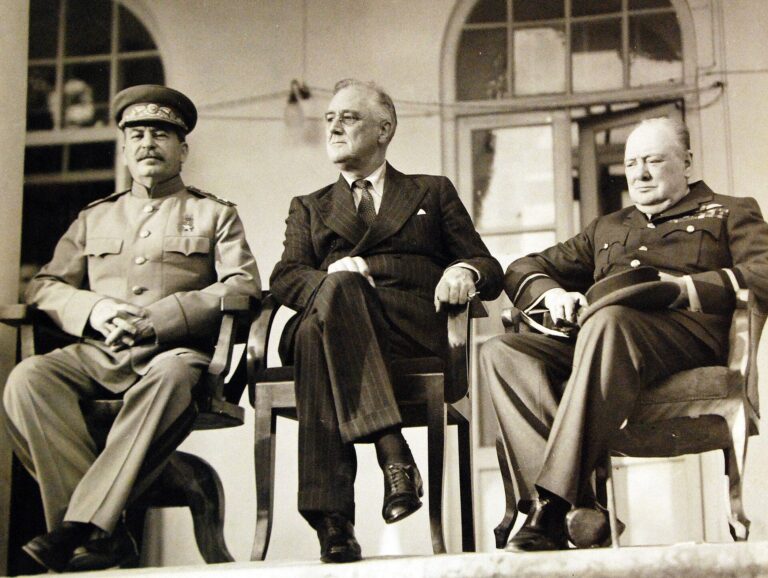
At the beginning of 1945 Roosevelt attended the Yalta Conference with Winston Churchill and Joseph Stalin. His health was poor, though the full extent was not widely understood by the public.
What happened at Warm Springs
On April 12, 1945, Roosevelt suffered a sudden cerebral hemorrhage while staying at Warm Springs, Georgia. He died that afternoon, less than three months after his fourth inauguration. His death shocked a country that had known him as president through the Great Depression and most of the Second World War.
The timing made the transition unusually consequential. The United States was nearing victory in Europe while still planning operations against Japan.
Truman takes the oath
Vice President Harry S. Truman became president under the constitutional rules of succession. He took the presidential oath on April 12 at the White House. Truman had served only a short time as vice president and had not been fully included in every sensitive wartime discussion.
The transfer of power was legally straightforward, but presidential responsibility changed hands in the midst of global war.
The decisions Truman inherited
Truman inherited the coordination of Allied operations, the emerging shape of the postwar settlement, relations with the Soviet Union and decisions connected with the secret atomic-bomb program. He also faced the immense task of turning wartime mobilization toward peacetime life.
It is misleading to imply that Truman immediately possessed complete knowledge of every project or diplomatic dispute. He had to learn quickly from senior advisers and military officials.
Legacy of a sudden transition
Roosevelt’s death marked the end of a presidency that had transformed federal government and American global engagement. Truman went on to preside over Germany’s surrender, the conclusion of war with Japan and the first major stages of the Cold War.
The episode shows why vice-presidential selection and clear succession procedures have practical historical importance, especially during emergencies.
Frequently asked questions
When did FDR die?
April 12, 1945.
What caused his death?
A cerebral hemorrhage.
Who became president after Roosevelt?
Vice President Harry S. Truman.
Sources and further reading
Further reading: Presidential Election of 1944 · Yalta Conference