Bataan Death March (1942): Surrender, Prisoners, Deaths and Aftermath
What followed the April 9, 1942 surrender of Bataan, why U.S. and Filipino prisoners endured a lethal forced march, and how the atrocities were investigated.
Quick answer
Following the surrender of U.S. and Filipino defenders on the Bataan Peninsula on April 9, 1942, Japanese forces forced tens of thousands of prisoners northward in the Philippines. Beginning around April 10, captives marched in intense heat with inadequate food, water and medical care, and many were beaten or killed. Survivors continued by rail and foot to camps including Camp O’Donnell, where more died from disease, starvation and poor conditions. Estimates of how many were marched and killed vary; historians describe thousands of deaths. The Bataan Death March was a war crime, not an ordinary movement of prisoners.
Key facts
On this page
- How Bataan became the center of the Philippine defense
- The April 9 surrender and command decisions
- The route northward from the peninsula
- Beatings, executions and denial of water
- Why Filipino prisoners’ experiences deserve attention
- Arrival at Camp O’Donnell and continuing deaths
- What the Japanese command knew and controlled
- The fall of Corregidor and the wider occupation
- Survivor testimony and the record of atrocities
- War-crimes investigations after Japan’s surrender
- Why the Bataan Death March remains important
- Timeline
- FAQs
- Sources
How Bataan became the center of the Philippine defense
Japan attacked U.S. and Philippine military positions in December 1941, shortly after the strike on Pearl Harbor across the international date line. American and Filipino forces resisted an invasion of Luzon but eventually withdrew to the Bataan Peninsula and fortified positions on Corregidor. Their commanders hoped a concentrated defense might delay Japanese conquest and keep the entrance to Manila Bay contested. Food, ammunition and medical resources were limited, however, and promised reinforcement could not arrive through Japanese-controlled seas.
The defenders suffered months of air attack, disease and malnutrition. Many troops had malaria or dysentery before the final Japanese offensive began, making their ability to march afterward especially weak. An account that treats the captives as healthy soldiers simply marching between normal camps misses the conditions under which they surrendered. The Pearl Harbor history helps explain the wider opening of the Pacific War, but the Bataan campaign followed its own desperate timetable.
The April 9 surrender and command decisions
Major General Edward P. King Jr., commanding forces on Bataan, surrendered on April 9, 1942, as further organized resistance became untenable. He acted to spare exhausted soldiers further destruction, though other American forces on Corregidor and in the Philippines had not yet all surrendered. Japanese officers then faced the challenge of controlling far more prisoners than they had anticipated, but inadequate planning does not excuse subsequent deliberate abuse.
Filipino and American personnel were disarmed and assembled at numerous locations. The number caught up in the forced movement is commonly estimated in the tens of thousands; official Air Force museum material gives a figure near 78,000, including approximately 66,000 Filipinos and 12,000 Americans. Other historical accounts use somewhat different figures because of uncertainty over who was present, who escaped, and which stages of confinement they count. The uncertainty should be made explicit rather than hidden behind a falsely exact total.
The route northward from the peninsula
Prisoners were marched from southern Bataan through settlements including Mariveles and along routes toward San Fernando. From there many were packed into railway cars, taken farther north and forced to march again toward Camp O’Donnell. Accounts vary in their description of the total distance because different groups began at different points and did not always follow exactly the same route. The experience combined extended walking, rail transport and additional confinement.
Soldiers who had already gone hungry for weeks faced tropical heat and a severe shortage of potable water. Some could barely walk. Crowded rail cars compounded suffering through heat and poor ventilation, while the final journey into prison camps exhausted survivors further. The word march therefore describes a series of movements under Japanese guard rather than one uninterrupted column completing an identical mileage. Survivor testimony and wartime investigation records remain essential for reconstructing what individuals endured.
Beatings, executions and denial of water
Guards struck prisoners who could not keep pace, and witnesses described killings of people who fell behind or attempted to obtain water. Some captives were deprived of medical attention for serious wounds or illness. These abuses were widespread enough to define the event in American and Filipino memory, although individual experiences differed by group, guard and route. The Japanese military’s treatment violated accepted protections for prisoners of war.
An explanation based solely on overcrowding and poor logistics is inadequate. Unexpected numbers and shortages aggravated conditions, but deliberate brutality caused many deaths and terrorized survivors. Historical reporting should distinguish the operational failures that left prisoners exposed from acts of violence committed by captors. It should also avoid presenting the entire Filipino population as passive: local residents sometimes tried to bring water or food to captives despite threats and restrictions.
Why Filipino prisoners’ experiences deserve attention
Filipino soldiers made up a large majority of the men who surrendered at Bataan. They had defended their own homeland in formations operating alongside American forces, and their experience during the march and subsequent incarceration was central to the catastrophe. American histories sometimes focus on the smaller number of U.S. captives because those accounts were recorded for American military audiences. A complete history must recognize the scale of Filipino suffering.
The Philippines was under U.S. sovereignty at the time, with the Commonwealth government in the transition toward planned independence. Filipino troops fought in the United States Armed Forces in the Far East while their families faced Japanese occupation. Deaths during the march and in camps had direct consequences for local communities. Filipino testimony, memorials and postwar compensation debates belong alongside the better-known American survivor narratives.
Arrival at Camp O’Donnell and continuing deaths
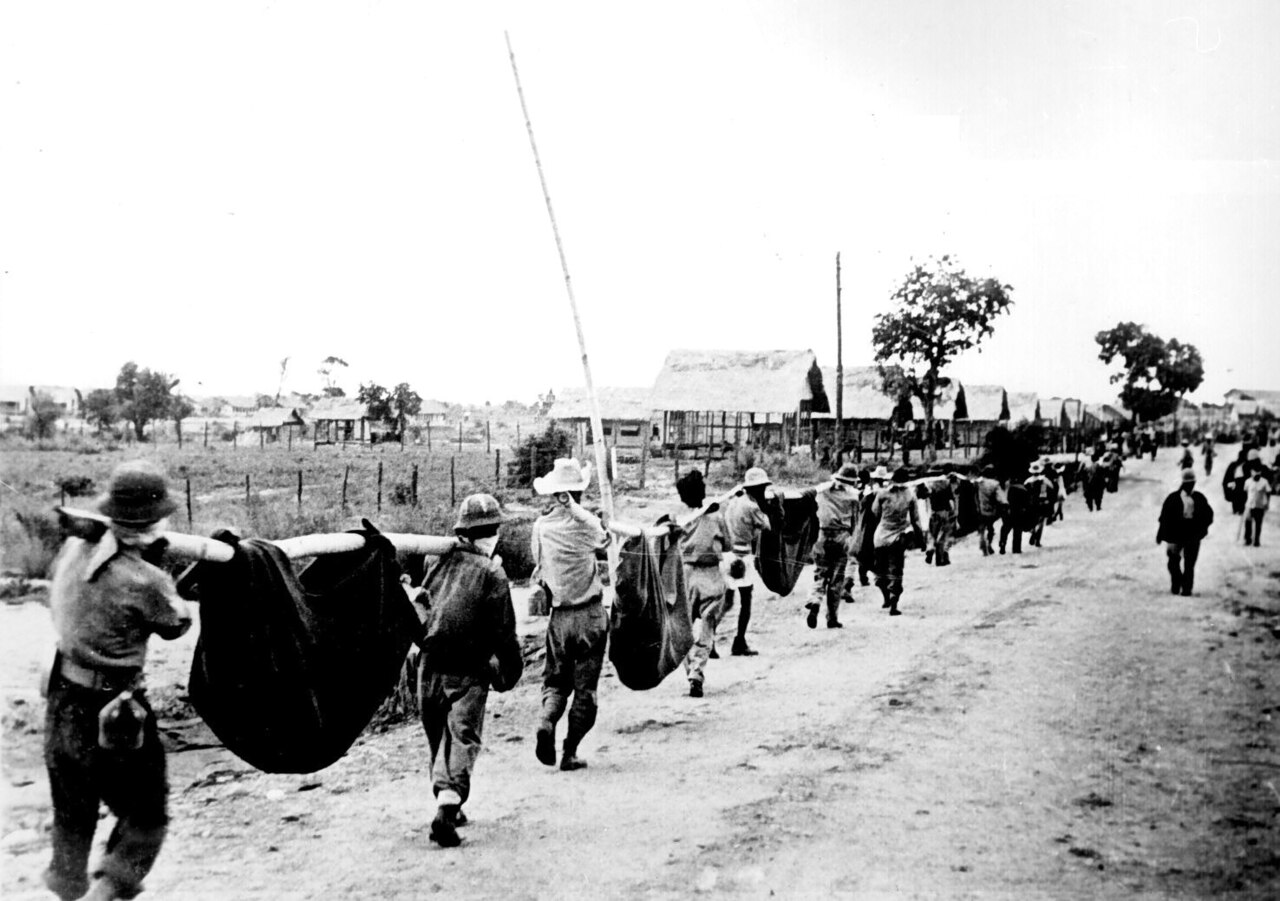
Camp O’Donnell, a former military installation in central Luzon, became a major prison camp after the march. Conditions there remained catastrophic. Inadequate sanitation, contaminated water, disease and malnutrition caused further deaths among prisoners who had already endured the journey. The featured photograph shows a burial detail at the camp in May 1942, after the forced march; its caption matters because the image is not a direct record of a roadside execution.
Different sources distinguish people who died on the route from those who died after arrival. Combining those categories without explanation can produce incompatible casualty totals. Some survivors remained at O’Donnell, while others were later moved to different camps or forced-labor sites. The march was an early stage of a much longer system of captivity, and the suffering did not end when prisoners reached the camp gates.
What the Japanese command knew and controlled
The movement of prisoners occurred within a chain of command responsible for their custody and welfare under the laws of war. The scale of the surrender placed pressure on Japanese arrangements, but the continued abuse and killing raised questions of individual and command responsibility. Postwar tribunals examined evidence about the treatment of captives and whether senior officers had failed to prevent or punish atrocities committed by troops under their authority.
Judging responsibility requires distinguishing orders directly proved by documents from failures of supervision and command. Not every Japanese soldier acted identically, and individual acts of assistance did occur, but the institution’s treatment of prisoners was indefensible. War-crimes investigations treated the atrocities as criminal conduct rather than an unavoidable consequence of military victory. The case became part of wider development in international military justice after 1945.
The fall of Corregidor and the wider occupation
U.S. and Filipino resistance in the Philippines continued after the surrender on Bataan. Corregidor, an island fortress near the entrance to Manila Bay, fell in May 1942 following further Japanese bombardment and assault. Its surrender meant more prisoners entered Japanese custody, while other Filipinos pursued resistance in guerrilla organizations. The separate dates matter: the Bataan Death March began before Corregidor fell.
Japanese occupation brought additional suffering for civilians and captured soldiers. Some prisoners were sent to labor camps elsewhere in the Japanese empire, including through transport voyages on crowded ships. The experience of captivity therefore extended beyond Camp O’Donnell and the Bataan Peninsula. A chronological account of the Pacific War must distinguish the April march, the May surrender, subsequent guerrilla resistance and eventual Allied reconquest rather than treating them as one event.
Survivor testimony and the record of atrocities
Survivors later described the heat, hunger, thirst, killings and breakdown of normal military order during the march. Oral histories and sworn statements provide details impossible to recover from operational reports alone. They also reveal differences in route and individual experience, explaining why historical estimates sometimes vary. Personal testimony should be read critically and respectfully, with attention to the circumstances in which witnesses recorded their accounts.
Military museums and archives preserve photographs, investigations, trial records and survivor interviews. Their evidence documents both direct abuse during the march and the subsequent camp conditions. The stark burial photograph selected here may distress readers, but it illustrates a documented consequence of captivity without substituting sensational reconstructions. Responsible historical publishing should prioritize accurate identification and dates over shocking imagery used without context.
War-crimes investigations after Japan’s surrender
After World War II, Allied authorities prosecuted Japanese commanders and personnel for offenses committed against prisoners and civilians. General Masaharu Homma, the Japanese commander responsible for the Philippines campaign, was tried by an American military commission and executed in 1946 after conviction. Historians have examined the trial’s procedures and the extent of command responsibility, but the underlying abuse of prisoners is well established.
Postwar legal proceedings did not uncover every individual death or produce a complete roster of all captives. They nevertheless created a documentary record of the crimes and contributed to public understanding of accountability for military command. Memorial institutions and veterans’ organizations continue to preserve survivors’ experiences. The history is not only about a famous military defeat but also about the obligations owed to prisoners once they have surrendered.
Why the Bataan Death March remains important
The forced march stands as one of the best-known atrocities against Allied prisoners in the Pacific theater. It exposed the vulnerability of sick and exhausted soldiers and the disastrous consequences when captors ignored the rules governing treatment after surrender. The event also illustrates the enormous sacrifices of Filipino forces, whose role was too often overshadowed in accounts centered exclusively on American troops.
The story connects battlefield defeat, forced movement, imprisonment and postwar justice. It must be told without inventing exact casualty figures where records remain uncertain or treating every death as occurring on the same road. The march’s enduring significance lies in its documented brutality, its place in Filipino and American memory, and the legal and moral importance of humane treatment of prisoners of war.
Timeline
- December 1941: Japan invades the Philippines
- January–April 1942: Defenders endure siege and shortages on Bataan
- April 9, 1942: Bataan forces surrender
- Around April 10: Forced prisoner movements begin
- April–May 1942: Captives marched, railed and held at Camp O’Donnell
- May 6, 1942: Corregidor surrenders
- 1945–1946: War-crimes investigations and trials
- Later decades: Memorials and survivor histories preserve the record
Frequently asked questions
When did the Bataan Death March begin?
Around April 10, 1942, after the April 9 surrender.
Who were the prisoners?
Mostly Filipino soldiers, alongside thousands of American military personnel.
How many prisoners were involved?
Estimates vary; the National Museum of the U.S. Air Force describes approximately 78,000 men.
How far did they travel?
Different groups traveled different routes, including a forced march, railway transport and further walking to camps.
How many died?
Thousands died, but estimates vary with the distinction between deaths on the march and in later camps.
What was Camp O’Donnell?
A former military installation converted into a prisoner camp where disease, starvation and unsanitary conditions killed many more.
Was it a war crime?
Yes. Deliberate abuse and killing of prisoners violated the laws of war.