Battle of Kennesaw Mountain (1864): Sherman, Johnston and the Failed Assault
On June 27, 1864, Union General William T. Sherman ordered frontal assaults against Confederate positions held by Joseph E. Johnston at Kennesaw Mountain near
On June 27, 1864, Union General William T. Sherman ordered frontal assaults against Confederate positions held by Joseph E. Johnston at Kennesaw Mountain near Marietta, Georgia. The attacks failed with heavy Union casualties. Despite that Confederate tactical victory, Sherman resumed maneuvering around Johnston’s flank, and the Union advance toward Atlanta continued.
This guide separates events, causes, battlefield decisions and long-term consequences using historical research.
On this page — 23 topics
When was the Battle of Kennesaw Mountain?
The Battle of Kennesaw Mountain was fought on June 27, 1864, during William T. Sherman’s Atlanta Campaign in northern Georgia. Union soldiers launched attacks against fortified Confederate positions commanded by Joseph E. Johnston near Marietta. The principal assaults failed to break the line, and the Confederates held their ground. However, the battle did not end the Atlanta Campaign. Sherman resumed movements around the Confederate flank, which eventually forced Johnston to retreat. Distinguishing the tactical result from the larger operational outcome is vital because the fight is sometimes described as an unqualified Confederate victory that stopped the Union advance indefinitely.
Why was Kennesaw Mountain important?
Kennesaw Mountain rises above the surrounding country near Marietta, giving observers commanding views of roads, valleys and the Western & Atlantic Railroad. That railroad connected Confederate positions with Atlanta and was an essential supply route for both armies when they controlled its different stretches. Johnston used the terrain to build a defensive line stretching across ridges, woods and lower ground. The mountain’s physical prominence can dominate historical photographs, but the battle involved a much wider defensive system. Much of the decisive infantry fighting occurred near Pigeon Hill and the Cheatham Hill sector rather than at the highest point alone.
How did the Atlanta Campaign reach Marietta?
Sherman advanced from Chattanooga into Georgia in the spring of 1864 with several Union armies. Johnston repeatedly withdrew from strong positions when threatened with being outflanked, preserving much of his force while yielding territory. Fighting developed around Resaca, New Hope Church, Dallas and other locations before the armies approached Marietta. The Union objective was to break Confederate military power and capture Atlanta, an important rail and industrial center. Johnston sought to defend routes and impose costs without risking a catastrophic open battle. The Kennesaw position offered a place to resist behind prepared fortifications while protecting communications toward Atlanta.
Who commanded the Union army?
William T. Sherman directed the Union Military Division of the Mississippi, with major field forces led by George H. Thomas, James B. McPherson and John M. Schofield. Their armies approached Confederate positions from different directions, coordinating movements along difficult roads and rail lines. Sherman’s usual preference was to maneuver around entrenched enemies rather than repeatedly attack them head-on. At Kennesaw he decided on a substantial frontal assault, partly believing Johnston’s defenses were stretched and vulnerable. The decision exposed the difficulty of choosing between a slow flanking approach and a potentially costly attempt to force an immediate breakthrough.
Who was Joseph E. Johnston?
Joseph E. Johnston commanded the Confederate Army of Tennessee after replacing Braxton Bragg following the 1863 battles around Chattanooga. He relied heavily on prepared positions and retreat when Union maneuver threatened his flanks. Supporters considered this a prudent way to preserve the army against superior forces; critics complained that he conceded too much territory without a major battle. Kennesaw Mountain showed that his troops could repel a powerful frontal assault when properly entrenched. Yet the result did not remove the strategic dilemma: Sherman could continue turning positions, and the Confederate army still had to defend the approaches to Atlanta.
What were the Confederate defenses like?
Confederate engineers and soldiers built trenches, artillery emplacements, rifle pits and log obstacles along the high ground and connecting ridges. The line made effective use of slopes and open approaches, forcing attacking infantry to cross exposed ground. Positions were designed so different sections could support each other with fire. The earthworks were not an improvised thin fence: they were a substantial defensive system improved while the armies maneuvered around Marietta. Modern park remains illustrate how effectively terrain and field fortifications protected Civil War defenders. Attacking them required precise coordination and sufficient fire support, both difficult in the wooded landscape.
What happened at Kolb’s Farm?
Before the main assault, Union forces fought Confederate troops near Kolb’s Farm on June 22, 1864. The Confederates attempted to strike Union movements in the vicinity but were repulsed. The engagement influenced Sherman’s understanding of Johnston’s line. He believed the Confederate defenses had become extended and that a direct attack at selected points might break them. The reasoning was not that Kolb’s Farm had decided the campaign; rather, it was one piece of battlefield evidence in a rapidly changing situation. The subsequent June 27 assault showed that apparent stretching of a defensive line did not necessarily make its strongest positions vulnerable.
Why did Sherman order a frontal attack?
Sherman hoped to break through Johnston’s line at selected points while making demonstrations elsewhere. He may also have wanted to discourage Confederate commanders from assuming that every Union movement would be an attempt to flank them. Persistent rain, poor roads and the logistical difficulties of moving around the position complicated alternatives. Nonetheless, the choice carried obvious dangers against entrenched soldiers on advantageous ground. The attack was a calculated gamble rather than an accidental encounter. Military historians debate whether its potential benefits justified the losses, especially because Sherman would soon succeed by reverting to maneuver instead of attacking the same positions again.
When did the June 27 attack begin?
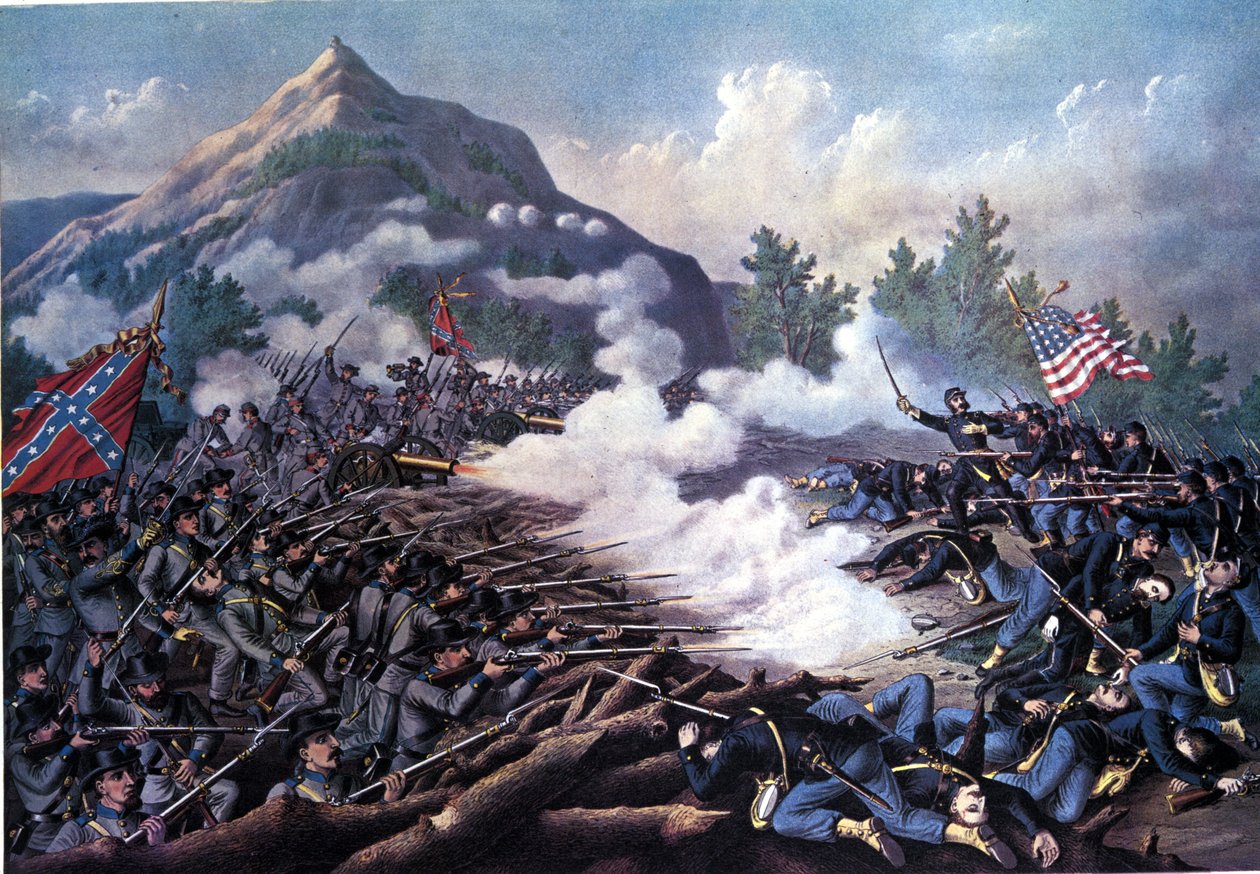
Federal artillery fired on Confederate positions before the Union infantry advanced during the morning of June 27. The attack involved separate sectors, including approaches around Pigeon Hill and the defensive line near Cheatham Hill. Troops had to move through woods, across broken ground and toward fortified slopes. Confederate defenders were prepared to fire from protected positions. Some Union units reached obstacles or portions of the earthworks, but the attack could not achieve a sustained breach. By late morning the main assault had failed. The timing shows that the fighting was concentrated rather than an uninterrupted full-day storming of the mountain’s summit.
What happened at Pigeon Hill?
Union formations including troops from McPherson’s Army of the Tennessee attacked the Confederate position near Pigeon Hill. The rocky ground, strong defenses and fire from the heights made progress difficult. Attackers became disrupted by terrain and resistance, and they could not carry the position. Pigeon Hill is a separate landmark within the broader Kennesaw battlefield and should not be confused with the high mountain summit or the Cheatham Hill sector. The action illustrates the limits of numerical strength when units must assault narrow, difficult approaches against a line that has had time to prepare and establish fields of fire.
What happened at Cheatham Hill?
The most famous fighting took place near a protruding Confederate position associated with Benjamin Cheatham’s division. Union soldiers attacked toward the works and suffered severe losses as Confederate troops fired from entrenched lines. Some attackers reached points close to the defenses, where fighting continued and wounded men lay between the lines. The area later became known as the Dead Angle. Its name reflects the concentration of casualties in a limited space and should not be mistaken for a formal period label for the entire battlefield. Preserved earthworks and memorials help visitors appreciate how short distances could become lethal under sustained musket fire.
What was the Dead Angle?
The Dead Angle was a particularly contested portion of the Confederate line at Cheatham Hill, where attackers tried to force their way through prepared earthworks. Some federal soldiers were pinned down so close to Confederate positions that withdrawal was dangerous. In the aftermath, efforts were made under temporary arrangements to recover or relieve wounded men. Descriptions of these encounters have become central to the battle’s memory. However, not every Union soldier fought at this single location, and the battle’s outcome resulted from fighting across multiple sectors. Site interpretation uses the surviving terrain to explain why this position became especially deadly.
How many casualties were there?
The National Park Service’s Kennesaw Mountain battle record estimates approximately 4,000 casualties, with about 3,000 Union and 1,000 Confederate casualties. Other historical works offer somewhat different totals depending on whether they include adjacent operations or use different returns. These are military casualties, not the number killed. Soldiers wounded, captured or missing must be distinguished from fatalities. The high cost relative to the limited ground gained reinforced the defensive advantages of entrenched positions. The figures also show why frontal attacks became controversial when maneuver remained an available alternative in the broader Atlanta Campaign.
Who won at Kennesaw Mountain?
The Confederate forces held their defenses and repelled the principal Union attacks on June 27, making the battle a Confederate tactical victory. Sherman did not seize the mountain by a direct assault and failed to break the line that morning. But the victory did not result in a Confederate counteroffensive that permanently halted the Union advance. The difference between tactical and strategic outcomes is important. Johnston’s army had successfully defended one position but remained vulnerable to movement around its flanks. Sherman eventually compelled another retreat without needing to repeat the same costly attack on the fortified slope.
How did Sherman resume advancing?
After the failed assault, Sherman returned to his preferred approach of maneuvering around Confederate positions, threatening the railroad and routes leading south. Johnston recognized that holding Kennesaw Mountain could become dangerous if Union troops reached his rear or cut essential supplies. The Confederates withdrew toward new positions closer to Atlanta. This movement preserved the army but surrendered the ground that had been defended successfully only days earlier. The sequence illustrates how an army can win an individual battle yet be forced to retreat for operational reasons. The outcome of June 27 cannot be understood independently of what happened in early July.
Did Kennesaw Mountain delay Atlanta’s capture?
The battle contributed to the grinding pace and human cost of Sherman’s advance, but it did not prevent the Union from reaching Atlanta. Confederate resistance and difficult terrain had slowed the campaign for weeks. After Johnston left the Kennesaw line, operations continued around the Chattahoochee River and the approaches to Atlanta. Johnston was later replaced by John Bell Hood, whose army fought several major battles in July. The eventual Union occupation of Atlanta in September depended on subsequent maneuvers and railroad operations, not on a reversal at Kennesaw. See the Atlanta Campaign guide for the sequence.
How was the battle affected by weather?
The Atlanta Campaign involved prolonged periods of rain that turned roads into mud and made it difficult to move wagons, artillery and large infantry formations. Weather contributed to the difficulty of conducting flanking operations and influenced commanders’ expectations about the pace of the campaign. By the time of Kennesaw, armies had experienced weeks of demanding movement, entrenchment and intermittent fighting. Poor visibility and heavily wooded ground added to the challenge of coordinating assaults. Weather did not cause Sherman’s failure by itself, but it was part of the operational environment in which he weighed a direct attack against another slow movement around Johnston’s line.
What did the battle mean for civilians?
Civilians in Cobb County faced armies occupying farms, cutting timber, moving livestock and damaging fields and buildings. Fighting created makeshift hospitals and burial sites, and residents struggled with displacement and insecurity. Confederate and Union commanders focused on the railroad and military terrain, but those features crossed ordinary communities. Enslaved people also confronted upheaval as Union forces advanced into Georgia, creating opportunities for escape and freedom while exposing families to danger. An accurate battlefield history should include these broader experiences rather than presenting Kennesaw as empty woods where only uniformed soldiers existed. The landscape’s preservation can help illuminate both military and civilian consequences.
What can visitors see at Kennesaw Mountain?
Kennesaw Mountain National Battlefield Park preserves the mountain, earthworks and important locations associated with the June 1864 battle. Trails lead to Pigeon Hill, Cheatham Hill and other positions, while historic markers and interpretive material clarify the sequence of attacks. The battlefield’s steep terrain helps explain why Confederate fire was effective and why Union movement was so difficult. Modern vegetation, roads and park facilities have changed the setting, so period maps remain valuable. The National Park Service park website is the best source for current visitor information and the site’s military history.
How does Kennesaw fit into Civil War strategy?
Kennesaw Mountain highlights the interaction between maneuver and fortification in the 1864 Atlanta Campaign. Sherman often gained ground by threatening the Confederate flank, while Johnston used prepared positions to avoid risky open-field battles. On June 27, Sherman attempted to break that pattern with a direct attack and was repulsed. The subsequent Confederate withdrawal showed that holding strong terrain was not the same as securing an entire region. The battle provides a useful comparison with the deadly frontal attacks at Cold Harbor in Virginia, where fortified defenders also inflicted severe losses on attacking Union infantry.
Timeline
| Date | Event |
|---|---|
| May–June 1864 | Sherman advances through northern Georgia during Atlanta Campaign. |
| June 19 | Johnston’s troops occupy the Kennesaw defense line. |
| June 22 | Fighting at Kolb’s Farm. |
| June 27 | Union attacks at Pigeon Hill and Cheatham Hill are repulsed. |
| Early July | Johnston withdraws as Sherman threatens flanks. |
| September 1864 | Union forces eventually occupy Atlanta. |