Battle of Cold Harbor (1864): Grant’s Assault, Casualties and Outcome
A failed assault on Confederate earthworks forced Grant to change his approach to Richmond.
The Battle of Cold Harbor was fought near Richmond, Virginia, from May 31 to June 12, 1864. On June 3, Union infantry under Grant and Meade attacked well-entrenched Confederate soldiers commanded by Robert E. Lee. The attack failed with severe Union losses. Grant subsequently moved toward the James River and Petersburg rather than continuing direct assaults on Richmond’s northeastern defenses.
Discover what happened, why it mattered, and how historians interpret the military decisions and the human cost.
On this page — 19 topics
What was the Battle of Cold Harbor?
Cold Harbor was a major engagement near Richmond during Grant’s 1864 Overland Campaign. It developed around a crossroads after weeks of fighting at the Wilderness, Spotsylvania and along the North Anna River. Confederate forces under Robert E. Lee built strong earthworks, while Union troops sought to push through toward the capital.
The best-known moment came on June 3, when a large Union assault was repulsed. Yet the overall battle lasted longer, and cavalry actions, infantry attacks, trench fighting and attempts to recover wounded men all formed part of the campaign. Short accounts can exaggerate the meaning of one hour by ignoring the wider sequence.
Where was Cold Harbor located?
The battlefield lay northeast of Richmond, Virginia, around a crossroads known as Old Cold Harbor. Roads connecting surrounding communities made it a valuable point for armies moving south. The name did not describe freezing weather; the fighting took place in late spring and early summer, often in difficult heat.
By controlling the crossroads and the approaches to it, the armies hoped to influence movement toward Richmond. The battlefield included open areas and woods, but the decisive defensive lines featured trenches and raised earthworks. Anyone studying a map should distinguish Old Cold Harbor from New Cold Harbor and look at the direction of Union advances.
Why was Grant still fighting near Richmond?
Grant’s previous engagements had failed to destroy Lee’s army, but the Union continued to press southward. With stronger resources and continuing military pressure in other theaters, Grant aimed to restrict Confederate choices and seize routes that could destabilize the defense of Richmond. He preferred a decisive opportunity but repeatedly met prepared troops.
After fighting at Totopotomoy Creek, federal cavalry and infantry advanced toward Cold Harbor. Grant hoped a coordinated assault could break a defensive line and open the way south. The plan was not irrational simply because it eventually failed, but the delay that allowed Confederate fortifications to strengthen severely reduced the attackers’ prospects.
Who fought at Cold Harbor?
Ulysses S. Grant directed the Union’s general strategy, George G. Meade commanded the Army of the Potomac, and commanders such as Winfield Scott Hancock, Horatio G. Wright and William F. Smith led important attacking formations. These were separate corps operating on an extended line rather than a single compact column.
Robert E. Lee commanded the Confederate Army of Northern Virginia. His subordinates occupied and improved field defenses at threatened points. Communications, coordination and the arrival of reinforcements determined where assaults were feasible. The battle shows the difference between a commanding general’s intention and what formations could actually accomplish on the ground.
What happened on May 31 and June 1?
Union cavalry under Philip Sheridan moved toward Cold Harbor and encountered Confederate cavalry supported by infantry. Control of the crossroads changed the way both commanders planned their next move. As more units arrived, the confrontation expanded beyond a cavalry skirmish into an engagement involving substantial numbers of infantry.
On June 1, parts of the Union line attacked with some limited gains, but neither side broke the opposing army. Confederate reinforcements strengthened the threatened positions, and commanders assessed where to make their next effort. Because these events preceded the disastrous June 3 assault, treating Cold Harbor as a one-day battle leaves out important decisions.
Why was the Union attack postponed?
Grant and Meade intended a coordinated attack, but movements, exhaustion and difficulties in assembling units prevented the planned assault from occurring on time. Some formations had marched long distances and were not ready to attack. A postponement allowed more troops to come into line but also gave Lee’s men additional time to dig.
This trade-off is central to the battle. Large armies could not be concentrated instantly, especially after weeks of nearly continuous fighting. Yet defenders behind growing earthworks became harder to dislodge with every passing hour. The final attack suffered from the cost of delay combined with uncertainties about the strength and shape of the Confederate line.
What happened in the June 3 assault?
Before dawn on June 3, tens of thousands of Union soldiers advanced against Confederate positions across a broad front. Many encountered intense rifle and artillery fire from prepared works. Some local attacks gained ground or momentarily threatened the line, but the general offensive did not achieve a breakthrough.
Troops were pinned down near their objectives and improvised shelter by scraping earth with tools and even personal equipment. Unit commanders had limited visibility and could not easily turn temporary advances into a coordinated success. The attempted offensive ended with heavy losses and a clear recognition that repeating the attack on the same terms would be disastrous.
Why were the Confederate defenses so strong?
Lee’s men used earthen parapets, logs and obstacles to protect infantry and artillery. They benefited from carefully chosen lines that covered open approaches and allowed defenders to fire from relative safety. An attacker crossing exposed ground had far less protection and could lose cohesion before reaching the works.
Defensive advantages were not unique to Cold Harbor, but they had become highly developed by this stage of the Overland Campaign. The troops had spent weeks learning to dig quickly and to position fieldworks where they supported one another. Strong defenses multiplied the effects of firepower, especially when a large attack was poorly synchronized.
How many Union soldiers died in minutes?
A popular claim states that several thousand Union soldiers died in only a few minutes. That formulation is misleading because commonly cited casualty figures describe killed, wounded, missing and captured rather than deaths alone, and the time window is often vague. There is no single universally agreed count of men killed during a precise short interval.
The National Park Service estimates roughly 12,000 Union casualties and nearly 4,000 Confederate casualties across the broader Totopotomoy and Cold Harbor operations. These are not June 3 death totals. Sources should specify both the dates and the category being counted. The failure was severe without relying on dramatic numerical shortcuts.
What happened to wounded soldiers between the lines?
Some Union wounded remained trapped in the exposed area between the armies, unable to move without being fired upon. Recovery efforts were delayed while commanders negotiated temporary arrangements. The danger from wounds, heat and lack of water grew with each passing day, adding suffering beyond the initial fighting.
The episode is one of Cold Harbor’s most troubling aspects and a reminder that battlefield losses extend beyond the moment of injury. Both military leaders faced practical and diplomatic obstacles to arranging care. Modern accounts should avoid assigning an exact universal fate to all casualties, because experiences varied by location and the ability of comrades to reach them.
What did Grant say about Cold Harbor afterward?
Grant later expressed regret about the last assault at Cold Harbor, a statement often cited in judgments of his generalship. That retrospective assessment matters, but it should be read alongside the decisions and information available in 1864. Commanders did not possess a complete aerial picture of enemy fortifications or a reliable way to predict all consequences.
His regret does not erase tactical mistakes; nor does it establish that every earlier maneuver of the campaign was futile. Historians debate the execution of the assault, the role of Meade and corps commanders, and whether alternatives were available. A balanced account assesses the operation rather than choosing between hero worship and caricature.
Did Cold Harbor end the Overland Campaign?
Cold Harbor was the final major battle usually included in the Overland Campaign. Grant did not break Lee’s line, but he also did not abandon the offensive. He shifted the army away from the position and prepared a large movement across the James River, aiming at Petersburg and its critical railroad connections.
The move marked a transition from the sequence of battles north and east of Richmond to prolonged pressure on a city whose transport network supplied the Confederate capital. Cold Harbor therefore influenced strategy even as a Union defeat. It helped convince Grant that a direct approach through Lee’s prepared positions was not the most promising way forward.
How did the battle affect civilians?
Families in the region had already experienced years of military activity, property damage and uncertainty. The 1864 operations brought more troop movements, requisitions and destruction of farms or woodlands. For people held in slavery, the approach of Union forces could create possibilities for escape, but leaving familiar places carried serious risks.
These experiences should be included alongside the armies’ tactical actions. Soldiers in trenches and civilians living nearby faced different dangers, while nurses and medical staff struggled to deal with wounded men. The human landscape makes clear why an apparently simple battle map covers a complicated and often traumatic social history.
Who won the Battle of Cold Harbor?
Lee’s army successfully defended its positions and inflicted severe losses on the attacking Union force. Cold Harbor is therefore commonly identified as a Confederate defensive victory. That conclusion refers to the battle, not the final result of the Civil War. The Confederate army remained under growing pressure despite stopping the assault.
Grant retained the initiative to shift operations southward. Within days his troops were moving across the James River toward Petersburg. Distinguishing a tactical defeat from a strategic decision to continue the campaign helps explain why Cold Harbor could be Lee’s last major field success without reversing the larger trajectory of the war.
How should Cold Harbor be studied today?
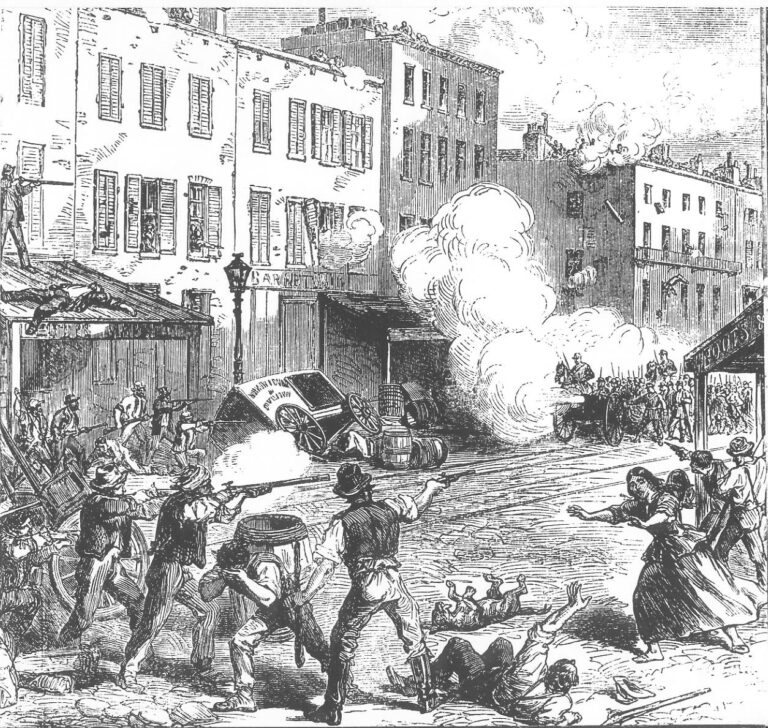
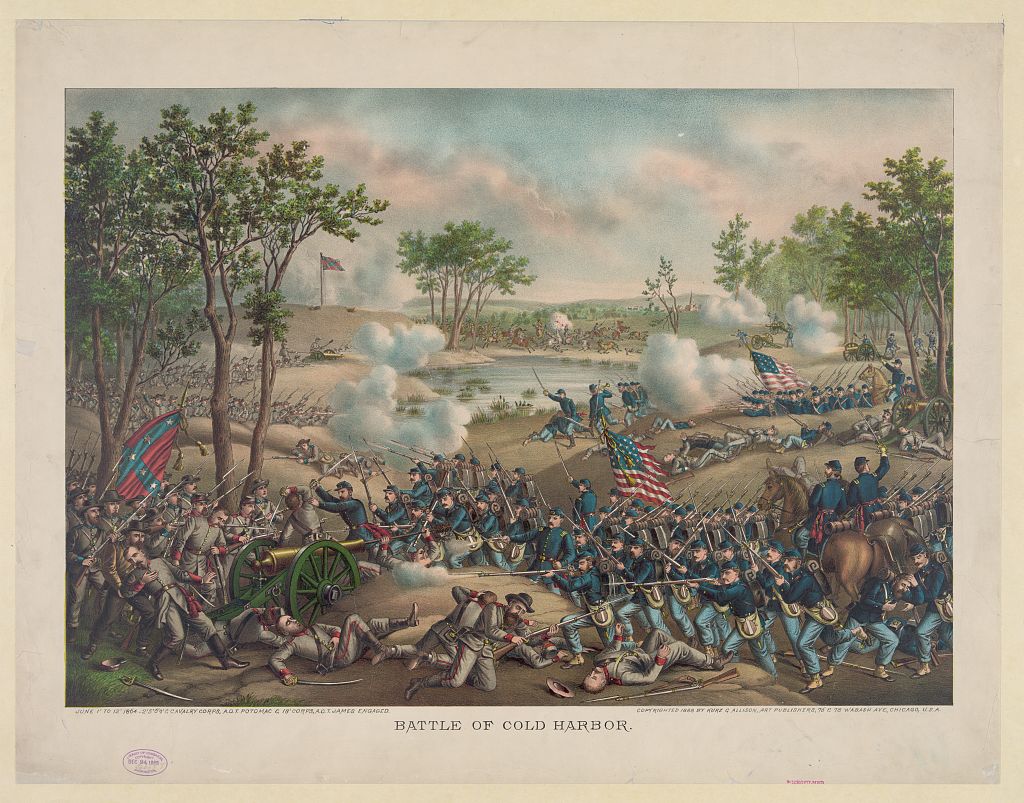
The National Park Service provides maps, battlefield interpretation and an account of the fighting from May 31 through June 12. Compare those materials with soldiers’ letters and contemporaneous sketches, while remembering that later commemorative art may dramatize specific moments. The image above is an 1888 interpretation, not a wartime photograph.
The central historical questions concern the risks of attacking entrenchments, the limits of command coordination, the treatment of casualties and the difference between immediate and longer-term outcomes. Studied this way, Cold Harbor becomes more than a frequently repeated statistic about how many men fell during one charge.
Battle of Cold Harbor 1864 timeline
The sequence below separates the main phases instead of treating several weeks or months of operations as a single battle.
| Date | Event |
|---|---|
| May 31 | Union cavalry fights for the Old Cold Harbor crossroads. |
| June 1 | Additional infantry attacks and reinforcements arrive. |
| June 2 | Both sides prepare; Union assault is delayed. |
| June 3, early morning | Major Union assault fails against Confederate earthworks. |
| June 4–7 | Entrenchments, skirmishing and delayed care for wounded. |
| June 12 | Union army starts withdrawing for movement toward the James. |
| Mid-June | Grant shifts operations toward Petersburg. |
Frequently asked questions
When was it fought? May 31–June 12, 1864.
Where was it? Near Richmond, Virginia.
Who commanded the armies? Grant, Meade, Lee.
Who won? Confederate defensive victory. See the analysis above for the difference between tactical and strategic outcomes.
What else should I read? Start with our Civil War timeline and causes and the related guides below.
Historical sources and further reading
Sources include federal battlefield scholarship, campaign research and archival visual material. Interpretations and numerical estimates have been distinguished from direct documentary evidence where necessary.