Battle of the Bulge (1944–1945): Ardennes Offensive, Bastogne and Allied Victory
How Germany launched the surprise Ardennes Offensive in December 1944, why Bastogne held out, and how Allied armies defeated the attack.
Quick answer
The Battle of the Bulge began on December 16, 1944, when Nazi Germany launched a surprise offensive through the Ardennes in Belgium and Luxembourg. German commanders hoped to split Allied armies, capture vital logistical targets and force the Western Allies to negotiate. The German breakthrough created a large bulge in the front line, while American forces resisted at places such as Bastogne. Improved weather allowed Allied air power to operate more effectively, and Allied counterattacks halted and reversed the advance. The campaign is commonly dated to January 25, 1945, though some accounts include related operations through the end of January.
Key facts
On this page
- Why Hitler attacked in the Ardennes
- German aims and the proposed route to Antwerp
- The surprise attack on December 16
- Why the battle became known as the Bulge
- The difficult fighting around St. Vith
- Bastogne and its importance as a road junction
- The ‘Nuts!’ reply to a surrender demand
- George Patton’s Third Army turns north
- Air power and the return of better weather
- The northern and southern Allied counterattacks
- Civilian suffering and German war crimes
- Casualties and why figures differ
- Why the German offensive ultimately failed
- How the battle is remembered
- Timeline
- FAQs
- Sources
Why Hitler attacked in the Ardennes
After the successful Allied landings in Normandy in June 1944, American, British and Canadian forces advanced across France and into the Low Countries. Germany had suffered severe defeats, and Allied leaders expected continuing pressure to push the war toward the German frontier. Yet supply problems, determined German resistance and stretched communications slowed the Allied advance. Adolf Hitler believed an ambitious counteroffensive might exploit this pause and reverse the situation on the Western Front.
The selected area was the Ardennes, a region of forests, hills and difficult roads in Belgium and Luxembourg. German troops had used routes through the wider region during earlier offensives, but American commanders still considered a major armored assault there unlikely in winter conditions. Hitler hoped to concentrate remaining armored strength for a surprise attack, seize important crossings and disrupt the alliance before its armies could coordinate a response.
German aims and the proposed route to Antwerp
The German high command planned to break through the American line and push toward the Meuse River, with Antwerp as an ambitious strategic objective. Capturing Antwerp or cutting access to it could threaten essential Allied supply routes. A successful thrust might separate British-led forces to the north from American armies to the south and potentially create political pressure for an unfavorable peace settlement.
Those goals were far more ambitious than the logistical position of Germany’s armies could comfortably support. Fuel supplies were scarce, tanks depended on roads vulnerable to congestion and the offensive required rapid progress before the Allies reacted. German commanders expressed doubts about the scale of Hitler’s objectives, but the operation went ahead. The gap between aspiration and available resources became a central weakness as the campaign unfolded.
The surprise attack on December 16
German artillery and infantry attacked along a broad sector early on December 16, 1944. Thick clouds and winter weather helped conceal movements and limited the immediate use of Allied aircraft. American units were caught in difficult circumstances, some with little experience or spread across defensive positions. The initial breakthroughs created confusion and forced commanders to reconsider whether this was a local assault or a major operation.
The German attack was not completely invisible beforehand. Allied intelligence had evidence of German movement, but commanders underestimated the scale and strategic ambition of the coming offensive. Weather, terrain and German secrecy contributed to the surprise. Historians distinguish between a total absence of warning and an inadequate interpretation of information. The speed of the early advance made the problem especially serious.
Why the battle became known as the Bulge
As German forces penetrated the American line, maps showed a protrusion or bulge extending westward into Allied-held territory. That visual shape gave the battle its familiar English name. The German designation for the offensive differed, and Allied military records also refer to the Ardennes-Alsace campaign. The shape changed repeatedly as different sectors resisted or collapsed and Allied counterattacks began.
The term does not describe one isolated engagement. Fighting occurred across numerous towns, forest roads, river valleys and defensive positions. Americans at the northern shoulder, central breakthrough and southern flank faced different immediate threats. A complete account must therefore include more than Bastogne or one dramatic armored clash, even though those episodes are central to popular memory.
The difficult fighting around St. Vith
The town of St. Vith and surrounding road network became an important objective because German armored formations needed usable routes to continue westward. American troops conducted delaying actions that interfered with German timetables and forced attackers to use limited alternative roads. The defense eventually withdrew under pressure, but the delay had strategic value in an operation that depended on speed.
Road congestion, weather and logistical confusion slowed both armies. German forces needed to seize junctions rapidly while American commanders moved reinforcements into the area. A delaying battle can matter even when its defenders ultimately leave a town, because the attacking force spends time and resources it cannot recover. The defense around St. Vith is an example of that principle.
Bastogne and its importance as a road junction
Bastogne, Belgium, occupied a network of roads essential to German movements across the region. American forces, including elements of the 101st Airborne Division and other units, held the area as German troops surrounded the town. The defenders faced shelling, shortages and winter conditions, while the Germans sought control of roads that could support their drive westward.
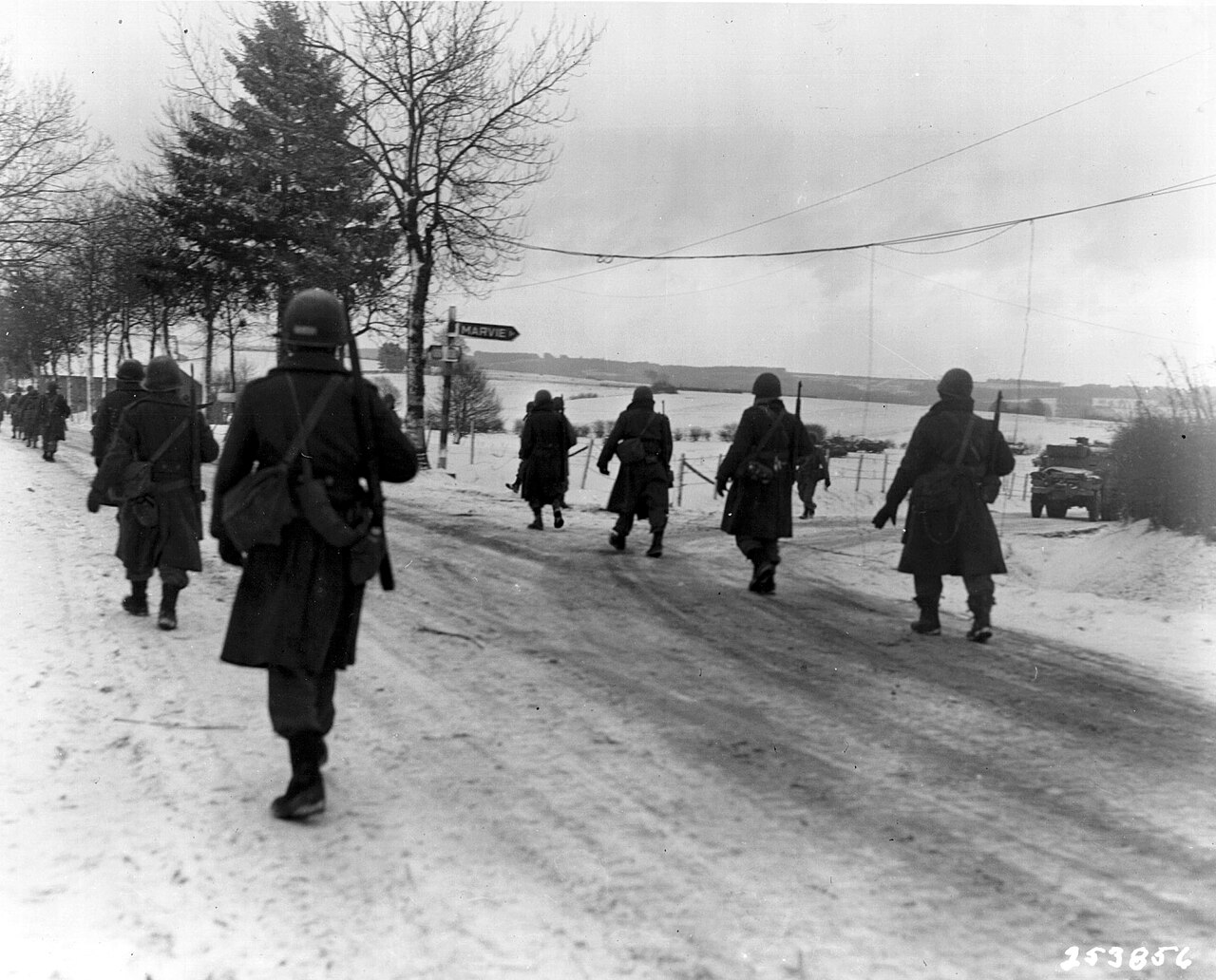
The featured archival photograph shows American 101st Airborne troops moving near Bastogne in the snow. It conveys the terrain and conditions rather than depicting every unit involved. The popular impression that the 101st alone fought the entire siege overlooks artillery, armored, medical and other formations that contributed to the defense. Their combined resistance helped obstruct German plans.
The ‘Nuts!’ reply to a surrender demand
On December 22 a German delegation delivered a demand that the American garrison surrender. Brigadier General Anthony McAuliffe, acting commander of the 101st Airborne Division, famously replied ‘Nuts!’ The terse response became a powerful symbol of determination among surrounded troops and later in American public memory.
Although memorable, the exchange should not overshadow the military factors that made the defense possible. Soldiers were protecting defensive positions, using limited ammunition, maintaining communications and receiving support under extraordinarily difficult circumstances. Morale was important, but successful resistance depended on organization and combat effort across multiple units. Historical storytelling is strongest when it places famous quotations inside the broader operational picture.
George Patton’s Third Army turns north
General George S. Patton’s Third Army shifted forces northward to counter the German offensive. Reorienting units during winter required moving soldiers, fuel and equipment along crowded roads while maintaining other responsibilities. The American command sought to attack the southern flank of the bulge and reach the defenders of Bastogne. These movements became an important part of the Allied operational response.
On December 26 elements of Patton’s forces broke through to Bastogne, opening a ground connection to the garrison. That did not mean every threat immediately disappeared or that fighting around the town ended the same day. German attacks and difficult operations continued. The relief demonstrated Allied ability to redirect forces and cooperate under pressure after the initial surprise.
Air power and the return of better weather
During the opening days, cloud cover and winter conditions restricted the Allies’ ability to use aircraft against German movements. When the weather improved, American and British air forces could attack transport routes, vehicles and concentrations of troops more effectively. Air operations also supported logistics and the defense of key positions, while Allied ground forces continued to fight across the region.
Air superiority did not single-handedly stop the offensive. German fuel shortages, resistant American units, Allied reinforcements and the limits of German operational planning were all important. The interaction of these factors explains why the offensive stalled. A balanced account avoids attributing an entire ground campaign either to one famous general or to a single period of clear skies.
The northern and southern Allied counterattacks
Once Allied commanders recognized the scale of the German attack, they coordinated counteroffensives from the north and south. Forces under British and American commands worked to contain the salient and then reduce it. German units that had advanced west were increasingly exposed to attacks on their flanks and supply routes. Holding captured territory became difficult as the original hope for a rapid breakthrough faded.
The campaign required careful coordination among commanders, and disagreements arose about priorities and the best use of reserves. Allied units advanced through snowy terrain against determined defensive positions. The operation developed from emergency containment into a sustained effort to restore the front. By late January the major German gains had been eliminated, though further fighting continued toward the German border.
Civilian suffering and German war crimes
The Ardennes Offensive affected civilians living in the combat area. Villages were damaged or destroyed, people fled bombardment and shortages made survival difficult. German troops and SS formations committed atrocities, including the murder of American prisoners of war near Malmedy. The killings became a notorious episode investigated after the conflict. Other violence against civilians occurred during the campaign.
These events should be addressed separately from ordinary battlefield casualties because prisoners and noncombatants were protected under the laws of war. The facts of individual incidents require careful documentary study, especially where later trials and contested evidence became part of their history. The U.S. Holocaust Memorial Museum and military archives offer resources for understanding the violence within the larger German offensive.
Casualties and why figures differ
The Battle of the Bulge was among the costliest campaigns fought by U.S. forces in Europe during World War II. Estimates of American casualties commonly approach 80,000 to 90,000 killed, wounded and missing, depending on the dates and categories counted. German casualty estimates also differ significantly, sometimes ranging from approximately 80,000 to 100,000 or more. These are not precise figures established through one universally accepted accounting method.
Casualty totals should never be used as if all represent deaths. Many include wounded and missing personnel, and some missing individuals later returned. The geographical and temporal boundaries of the campaign also affect which losses appear in the calculation. It is better to cite source-specific ranges and explain the differences than to claim a single unqualified number is exact.
Why the German offensive ultimately failed
German forces did not capture Antwerp or achieve the intended decisive split between Allied armies. The early surprise was offset by strong defensive stands, logistical limitations and coordinated reinforcement. Fuel shortages and the difficulty of moving armored vehicles through narrow winter roads restricted German mobility. Allied air operations and counterattacks increased the pressure as the weather improved.
The offensive exhausted valuable German formations and matériel at a point when the country was also under growing Soviet pressure in the east. Defeat in the Ardennes removed any realistic possibility that the Western Front would be fundamentally reversed. Yet victory did not end the war immediately. Allied armies still faced hard fighting before Nazi Germany surrendered in May 1945.
How the battle is remembered
The Battle of the Bulge remains associated with snowbound American troops, Bastogne, the leadership of Patton and Eisenhower, and an astonishing recovery from a major surprise. Those memories convey genuine aspects of the campaign but can obscure the contributions of less famous units and the cost to civilians. The battlefield stretched across a wide region, and soldiers experienced different conditions and threats.
Its strategic importance is best understood alongside the D-Day invasion and subsequent Allied advance through western Europe. The winter offensive was Germany’s attempt to regain the initiative, not an isolated last battle after everything had already been decided. The campaign’s failure helped clear the way for the final Allied invasion of Germany.
Timeline
- June 6, 1944: Allies land in Normandy
- December 16, 1944: German offensive begins
- December 19–23: Critical defensive fighting at St. Vith and Bastogne
- December 22: McAuliffe sends ‘Nuts!’ reply
- December 26: Patton’s forces reach Bastogne
- January 1945: Allied counterattacks reduce the bulge
- January 25, 1945: Campaign commonly considered concluded
- May 1945: Germany surrenders
Frequently asked questions
When did the Battle of the Bulge begin?
December 16, 1944.
When did it end?
The U.S. Army commonly dates the campaign through January 25, 1945.
Where was it fought?
Principally in the Ardennes region of Belgium and Luxembourg.
Why is it called the Bulge?
The German advance created a bulge in Allied front-line maps.
Why was Bastogne important?
It was a vital road junction needed for the German advance.
Who said ‘Nuts!’?
Brigadier General Anthony McAuliffe in response to a German surrender demand.
Did Patton’s army relieve Bastogne?
Elements of his Third Army opened a ground connection on December 26, 1944.
Who won?
The Western Allies defeated the German offensive.
Were the casualties all deaths?
No. Common casualty totals include killed, wounded and missing.