World War II Rationing in America (1942–1945): Sugar, Gasoline and OPA Books
How wartime shortages led to ration books, coupons and price ceilings, what Americans could buy, and why sugar rationing continued after 1945.
Quick answer
The Office of Price Administration (OPA) administered major U.S. civilian rationing and price-control programs during World War II. Sugar rationing began in May 1942, while gasoline restrictions started regionally in May and expanded nationwide in December. Families used ration books, coupons and point systems to obtain limited quantities of certain goods. The War Production Board helped direct materials to war industries but was not the same agency as the OPA. Many restrictions ended after the war; sugar rationing continued until 1947.
Key facts
On this page
- Why wartime shortages affected American households
- What was the Office of Price Administration?
- War Ration Book One and the coupon system
- Why sugar was rationed beginning in May 1942
- How gasoline rationing differed by region and date
- Tires, shoes, canned food and meat
- How local ration boards worked
- Price ceilings and inflation controls
- The black market and inequalities in practice
- Victory gardens and household adaptation
- When rationing ended after the fighting
- Why World War II rationing remains significant
- Timeline
- FAQs
- Sources
Why wartime shortages affected American households
When the United States entered World War II, factories, farms, railroads and shipping networks faced enormous demands from the armed forces and Allied governments. Metals, rubber, fuel and agricultural products were diverted to military use, while wartime employment increased household income. More people wanted to buy goods at the same time that fewer civilian products could be manufactured. Without controls, shortages might have encouraged panic buying and sharp price increases.
Rationing attempted to distribute limited supplies more evenly rather than allowing wealthier consumers to buy everything available. Officials also sought to reduce inflation, preserve scarce resources and prevent hoarding. The system had practical and political costs, requiring paperwork and restrictions on ordinary choices. The experience varied by household size, location and goods needed, so the home front cannot be described as an identical rationing burden for every American.
What was the Office of Price Administration?
The OPA developed from federal efforts to stabilize prices before full American entry into the war. The Emergency Price Control Act of January 1942 gave it a stronger statutory basis for imposing price ceilings and rent controls. Wartime agencies also delegated major rationing responsibilities to the OPA. Its employees and local boards oversaw price regulations, coupon distribution, appeals and compliance investigations across the country.
The War Production Board dealt primarily with industrial production priorities and allocation of materials, while the OPA addressed much of the civilian marketplace. These agencies cooperated, but their functions were not interchangeable. It would be inaccurate to say that every ration book was directly issued by the WPB or that the OPA itself built the aircraft and ships consuming scarce supplies.
War Ration Book One and the coupon system
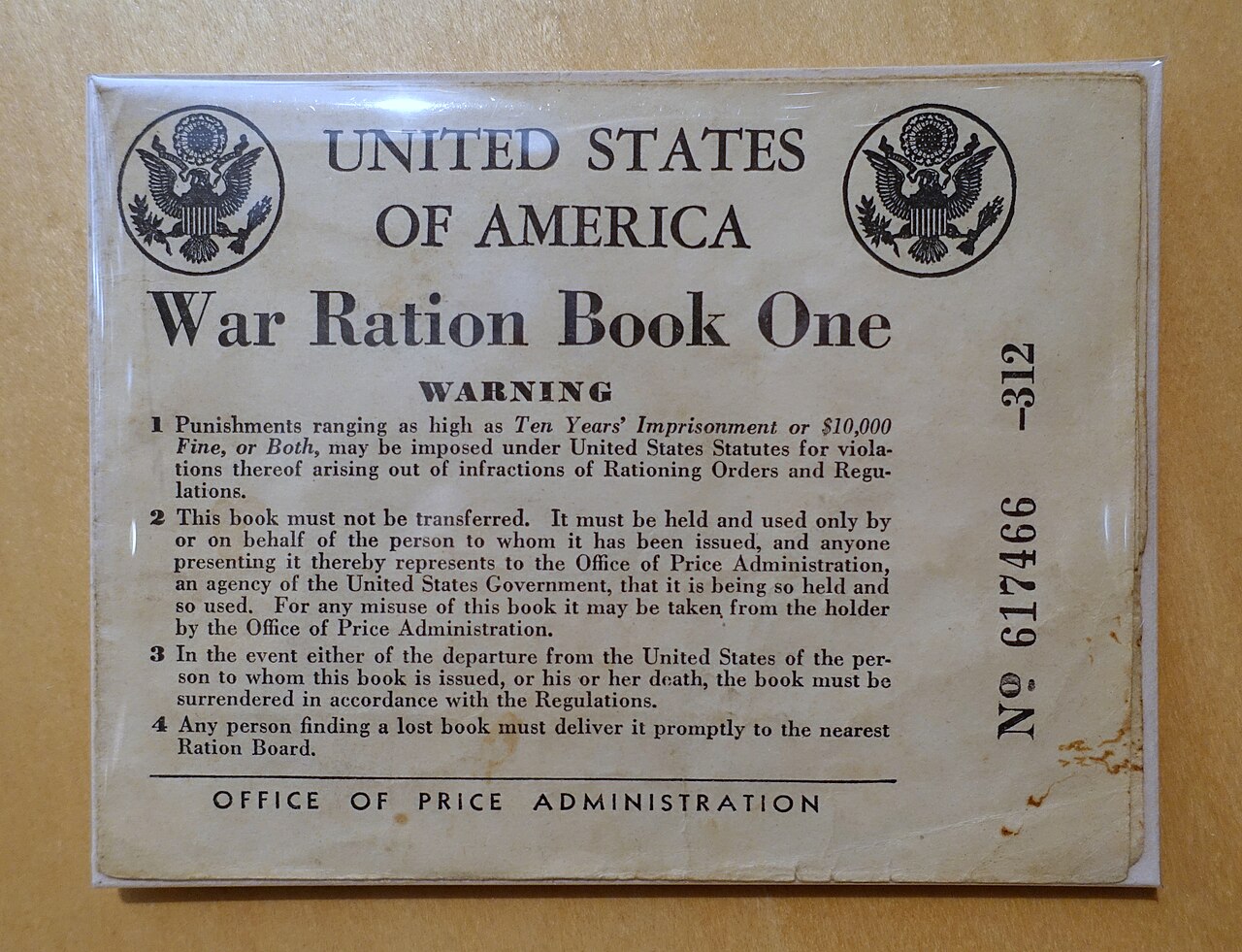
War Ration Book One became a symbol of civilian sacrifice in 1942. Households registered through local boards and received books containing numbered stamps. Merchants required the appropriate coupons as well as payment when consumers purchased rationed goods. The book did not function as free money: having enough ration points did not eliminate the need to pay the store’s price.
The featured photograph shows an original ration book exhibited at the Smithsonian. The artifact is historically connected to the program, while the museum photograph itself was taken decades later. Later ration books and coupon rules changed as different products came under control. Reading an original book is useful for understanding how many small purchases became part of a nationwide administrative system.
Why sugar was rationed beginning in May 1942
Sugar was the first major food widely rationed, beginning in May 1942. War disrupted imports and shipping, while sugar remained important for households, bakeries and food manufacturers. A rationing system limited the amount available to individuals and helped avoid a rush in which early shoppers could leave store shelves empty for others. Officials issued schedules indicating how many coupons could be used during particular periods.
Consumers adapted recipes, saved supplies and looked for substitutes, while food businesses faced separate allocation arrangements. The rules evolved with production and import conditions rather than remaining fixed through every year of the war. Sugar rationing ultimately continued until 1947, after most wartime restrictions had ended, demonstrating that shortages and supply disruptions did not disappear immediately when fighting stopped.
How gasoline rationing differed by region and date
Gasoline rationing first applied in parts of the eastern United States in May 1942, where transport disruptions and shortages were particularly serious. The policy later extended nationwide in December. Conservation also sought to reduce civilian automobile use and wear on tires, because Japanese expansion in Southeast Asia severely disrupted access to natural rubber. Thus gasoline restrictions did not always arise solely from an absolute shortage of fuel produced in the United States.
Windshield stickers and ration classifications shaped how much fuel motorists could obtain. Workers with essential travel needs might receive different allowances from those whose driving was mostly personal. The rules created appeals and disputes because commuting distances and access to public transport varied widely. An account stating gasoline was first rationed everywhere in May or that all motorists received identical amounts would miss the regional start and classification system.
Tires, shoes, canned food and meat
The rationing program reached many goods beyond sugar and gasoline. Tire purchases were restricted early, and new passenger automobiles became difficult to obtain because civilian manufacturing was sharply curtailed. Shoe rationing introduced limits in 1943, while point rationing covered categories such as processed foods, meats, fats and certain dairy products. Each system used rules appropriate to the availability and administrative complexity of its goods.
Point systems allowed some flexibility: consumers could choose among products in a group while remaining within the allotted points. Other systems required product-specific stamps or certificates based on need. The National Archives’ rationing handbook distinguishes uniform coupon, point, differential and certificate rationing. Treating every rationed item as if it used one identical coupon would therefore oversimplify how the home front actually functioned.
How local ration boards worked
Local boards were essential to administering the national policy. Volunteers and officials registered households, issued books, processed applications and helped people understand new rules. Merchants had to collect ration currency and comply with price ceilings, while inspectors investigated possible violations. Hospitals, restaurants and business users sometimes needed arrangements different from ordinary household allowances.
The system depended on a large amount of local labor and recordkeeping. Households might face confusion when stamps became valid or expired, particularly as rules changed. Officials attempted to explain policies through posters, radio announcements and printed instructions. The scale of administration shows why rationing was more than a patriotic slogan: it was an extensive practical system linking federal decisions to neighborhood stores and kitchen tables.
Price ceilings and inflation controls
Rationing limited how much of a scarce item could be purchased, while price ceilings limited how much sellers could legally charge. The two policies worked together because restricting quantities without limiting prices might still leave poor families unable to afford necessities. Officials sought to stabilize the cost of living as wartime wages and demand increased. Price controls extended beyond strictly rationed goods and could include rents in designated areas.
Enforcement was difficult and controversial. Sellers sometimes complained that allowed prices did not cover rising costs, while consumers worried about shortages and unfair access. Black markets emerged when goods were sold without required coupons or above legal prices. The OPA publicized enforcement efforts and relied on consumer cooperation, but the system was never perfectly uniform or free of evasion.
The black market and inequalities in practice
Shortages created incentives to trade privately, misuse coupons or sell goods at illegal prices. Some people could pay more than official limits or obtain extra supplies through personal networks. This undermined rationing’s stated goal of distributing essentials fairly. Authorities investigated violations, and wartime newspapers reported disputes involving gasoline, meat and other products.
Not everyone had equal access to stores, transportation or time needed to navigate the rules. Low-income families could possess coupons yet still lack money to buy the rationed goods, and rural households faced different travel problems from urban residents. Race and segregation could also shape access to commerce. An accurate history therefore compares the official system’s promise of equality with its imperfect operation in communities.
Victory gardens and household adaptation
Many families planted vegetables, repaired clothing and found ways to stretch scarce ingredients. Victory gardens were promoted as a way for civilians to contribute to food availability and morale, while waste collection and conservation campaigns encouraged saving materials needed for military production. Community organizations, schools and neighborhood groups helped spread practical advice.
Such activities were valuable to some households but were not possible on equal terms everywhere. Apartment residents might have limited land, and families working long hours could have little time to garden or preserve food. Wartime publicity often portrayed an idealized cheerful household, whereas contemporary diaries and interviews reveal frustration as well as pride. That contrast makes the home-front record richer than a collection of nostalgic posters.
When rationing ended after the fighting
Many rationing restrictions were lifted during 1945 as military demands declined, shipping changed and factories prepared to make civilian goods again. The process did not occur for every item on the same date. Some goods remained scarce while production and distribution returned toward peacetime arrangements. Sugar controls lasted until 1947, long after the war ended in Europe and the Pacific.
The end of rationing also did not guarantee immediate price stability. Policymakers debated whether to maintain ceilings to protect consumers or remove controls to encourage supply. The rapid transition to a consumer economy created new challenges. Understanding these changes shows that wartime institutions can outlive the emergency that created them, and dismantling them may be nearly as complicated as their introduction.
Why World War II rationing remains significant
American rationing linked the front lines to ordinary household decisions. The government attempted to balance civilian needs, military production, inflation and fair distribution through a national system that reached millions of consumers. It reshaped shopping, cooking, driving and recordkeeping, making shortages visible even to people who never traveled overseas.
The historical record also reveals limits to wartime solidarity. Black markets, unequal access and bureaucratic frustration existed beside genuine cooperation. Ration books, store notices and government reports provide evidence of both. Reading them alongside the War Production Board history clarifies how production decisions and civilian purchasing restrictions formed related but distinct parts of the U.S. home-front effort.
Timeline
- January 1942: Emergency Price Control Act gives OPA broader powers
- January 1942: Consumer rationing duties delegated to OPA
- May 1942: Sugar rationing and regional gasoline restrictions begin
- December 1942: Gasoline rationing becomes nationwide
- 1943: Meat, processed foods and shoes subject to broader systems
- 1945: Many wartime rationing restrictions end
- 1947: Sugar rationing ends
Frequently asked questions
What did OPA stand for?
Office of Price Administration.
When did sugar rationing begin?
May 1942.
When did gasoline rationing become nationwide?
December 1942, after regional controls began in May.
Were ration books free money?
No. Households still had to pay stores, as well as surrender required coupons or points.
Why were tires and gasoline restricted?
Rubber scarcity, transport needs and military priorities made reducing civilian driving important.
Was the OPA the same as the WPB?
No. They were separate agencies with related but different responsibilities.
When did rationing end?
Many restrictions ended in 1945, but sugar rationing continued to 1947.