War Production Board of 1942: How American Factories Mobilized for World War II
Why FDR established the War Production Board in January 1942 and how priorities for materials, factories and labor transformed the American home front.
Quick answer
President Franklin D. Roosevelt established the War Production Board (WPB) on January 16, 1942, through Executive Order 9024. Its chairman, Donald M. Nelson, coordinated priorities for America’s wartime industrial output, including the conversion of factories to military production and allocation of scarce materials. The board managed production priorities and conservation campaigns, while consumer price controls and rationing were largely administered by the separate Office of Price Administration. The WPB’s authority grew from urgent mobilization after Pearl Harbor and was wound down after the war.
Key facts
On this page
- Why America needed a wartime production authority
- Mobilization began before December 1941
- Executive Order 9024 on January 16, 1942
- Donald Nelson and the board’s leadership
- Factory conversion from civilian goods to military production
- Allocating steel, aluminum, copper and rubber
- The Controlled Materials Plan and evolving rules
- What the WPB did not do: ration books and prices
- Scrap drives and civilian conservation
- Workers, women and unequal opportunities
- Production achievements and military logistics
- Conflicts between the board and other agencies
- What happened after the war?
- Timeline
- FAQs
- Sources
Why America needed a wartime production authority
The United States entered World War II after Japan’s attack on Pearl Harbor in December 1941. American factories were already producing substantial quantities of military equipment for Britain and other Allied countries, but direct involvement in war created far greater demands for aircraft, ships, ammunition, tanks and communications systems. Civilian consumers still wanted automobiles, household appliances and other goods, and the available factories could not satisfy every competing need at once.
Raw materials were also finite. Steel, aluminum, copper, rubber and machine tools were essential to military projects, while shortages and transport constraints threatened production schedules. The government therefore needed a mechanism to decide which orders would take precedence and how industrial resources would be allocated. The War Production Board emerged as one part of the national machinery for turning economic capacity into military supplies.
Mobilization began before December 1941
American defense production did not begin from zero when the United States entered the war. Roosevelt had supported preparedness and military assistance throughout 1940 and 1941. Earlier organizations, including the National Defense Advisory Commission, the Office of Production Management and the Supply Priorities and Allocations Board, had responsibilities connected to production and procurement. The Lend-Lease Act of March 1941 had already increased the importance of supplying foreign governments.
Those predecessor organizations nevertheless faced coordination difficulties as military and civilian requirements expanded. Different agencies and armed services sought priority for their own programs, often competing for the same factories, workers and scarce inputs. After Pearl Harbor the pace of mobilization made fragmentation harder to accept. The WPB was meant to give greater central direction to industrial priorities, building on rather than replacing all previous efforts and organizations instantly.
Executive Order 9024 on January 16, 1942
Roosevelt established the War Production Board by Executive Order 9024, signed January 16, 1942. The National Archives confirms both the date and the new body’s place in the federal wartime administrative structure. The order charged the board with guiding and coordinating war procurement and production, including setting policies for the use of materials and productive capacity. It also superseded certain prior coordinating functions, with further administrative changes following later in January.
The legal instrument was an executive order rather than a congressional act bearing the name War Production Board Act. Congress still had a major role in appropriations, military procurement and legislation affecting the economy. The agency had to work with the armed services, the Office of Price Administration and other institutions rather than simply commanding every public body without limits. This distinction prevents the wartime government’s many separate functions from being credited to one office.
Donald Nelson and the board’s leadership
Donald M. Nelson, a former executive associated with Sears, Roebuck and earlier defense-supply work, became the WPB’s chairman. His experience in procurement and distribution made him a prominent figure in Roosevelt’s effort to organize production. The board included civilian and military interests, and the chairman faced constant pressure to reconcile conflicting needs among military services, industry, labor and other agencies.
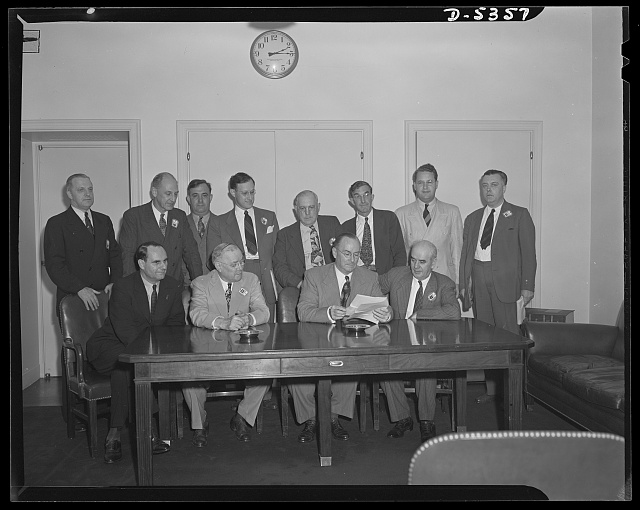
The featured photograph shows Nelson at a meeting with leaders from the American Federation of Labor, the Congress of Industrial Organizations and WPB officials. It illustrates a central challenge: production depended not only on a directive issued in Washington but on the cooperation of workers, employers and many institutions. The image is from wartime agency activity and does not purport to show the signing of Executive Order 9024.
Factory conversion from civilian goods to military production
Automobile manufacturers, metalworking firms and other industrial businesses shifted a large share of capacity from civilian products to military orders. Factories that had built passenger cars could produce aircraft parts, engines, trucks, armored vehicles or other equipment depending on facilities and contracts. The transition required new machine tools, training, production schedules and supply chains. It was not a process in which every automobile plant instantly began producing the same type of tank.
The WPB helped direct priorities and restrictions that encouraged or required some industries to stop or reduce civilian manufacturing. Passenger automobile production was sharply curtailed in 1942 so that facilities, materials and labor could support wartime needs. The transformation became a defining feature of the home front, but actual production involved private firms, military procurement agencies, workers and engineers as well as federal coordination.
Allocating steel, aluminum, copper and rubber
Materials allocation was central to the board’s role. A shipbuilder, aircraft manufacturer and civilian refrigerator company might all seek steel or copper, but wartime officials had to determine which orders were most important for national defense. Preference ratings and controlled-materials programs developed to direct available supplies to approved uses. The goal was to prevent lower-priority consumption from delaying essential weapons, aircraft and ship construction.
Scarcity was not the same for every material. Rubber became particularly important as Japanese military advances disrupted access to natural-rubber supplies in Southeast Asia. Aluminum was vital for aircraft, while steel and copper had many military and civilian uses. Policymakers used different restrictions and substitution efforts depending on the material. An accurate historical account does not describe one fixed rule that applied to all materials throughout the war.
The Controlled Materials Plan and evolving rules
During 1942 the government developed increasingly detailed systems for matching material supply to production requirements. The Controlled Materials Plan, implemented in 1943, allocated essential materials such as steel, copper and aluminum through a system connected to authorized production schedules. The plan sought to reduce bottlenecks caused by conflicting priorities and uncertainty about what manufacturers would receive.
The system was complex and changed during the war. Military requirements could shift after campaigns, shipping losses or the appearance of new technology. A factory needed more than metal: skilled workers, electricity, tools and transport could also become bottlenecks. Regulations therefore evolved through orders and administrative adjustments. Historians who study particular industries often consult WPB files to understand the specific restrictions that applied at a given moment.
What the WPB did not do: ration books and prices
The War Production Board influenced how many civilian goods could be made and how scarce materials were allocated, but it was not the sole agency controlling every part of the wartime economy. The Office of Price Administration administered major consumer price controls and rationing systems covering goods such as gasoline, sugar and tires. The OPA’s authority developed through separate executive arrangements and the Emergency Price Control Act of January 1942.
WPB directives helped determine that supplies were too scarce for ordinary consumer distribution, and some rationing authority was delegated to the OPA through interagency arrangements. But a household’s ration book and price ceilings were not administered solely by the WPB. This institutional distinction matters because many popular accounts treat ‘wartime rationing’ as one program run by a single agency. The National Archives preserves separate record groups for the WPB and OPA.
Scrap drives and civilian conservation
Federal and local campaigns encouraged households and businesses to conserve or collect materials that could support production. People saved or donated scrap metal, rubber and other useful items, and schools and communities organized collection efforts. Such activities became visible symbols of civilian participation in the war. The WPB and related agencies supported conservation campaigns as part of broader efforts to make scarce resources available.
The practical importance of particular drives differed by material and by the economic cost of processing collected scrap. Propaganda sometimes emphasized participation and morale as much as immediate quantities delivered to factories. It would be misleading to suggest that donating a saucepan directly produced a particular aircraft or that all collected material was equally useful. The campaigns are best understood within wartime industrial management and community mobilization.
Workers, women and unequal opportunities
Military contracts created tremendous demand for industrial workers, expanding opportunities for many women and bringing people into factories that had traditionally excluded them. Wartime publicity promoted women workers as essential to national defense. However, the opening of jobs did not end discrimination. Black workers, women and other groups faced barriers in hiring, promotion, wages and workplace conditions, even as war production depended on their labor.
The Fair Employment Practice Committee, established in 1941 through separate federal action, sought to address discrimination in defense industries. It was not an office created by the War Production Board in January 1942. Labor organizations also argued over wages, working conditions and worker participation. The Wagner Act of 1935 provides the earlier labor-relations framework, while wartime production introduced additional pressures and agreements.
Production achievements and military logistics
By the later war years American industry supplied enormous quantities of aircraft, ships, vehicles, ammunition and equipment to U.S. forces and Allies. The expansion relied on industrial infrastructure, private firms, government contracts and the labor of millions. The War Production Board helped coordinate priorities and resource allocation within that system, reducing some conflicts and addressing shortages as they developed.
Attributing every bomber, truck or ship directly to the WPB alone would ignore the work of military procurement agencies, transport authorities, factories and workers. Yet coordinated materials allocation made it easier to sustain production on a scale that the prewar market had not been designed to deliver. The government’s role went beyond purchasing goods: it reshaped what manufacturers could make and when they could obtain critical inputs.
Conflicts between the board and other agencies
The chairman and staff confronted overlapping military demands and disagreements over how much authority civilian coordinators should possess. The Army, Navy and other offices controlled different aspects of procurement, while industrial firms sought stable schedules and sufficient materials. Political leaders and military commanders sometimes disagreed about priorities. Nelson’s leadership was criticized at various points, and organizational changes affected the board’s influence.
Those disputes do not mean the WPB was powerless or that wartime production was an effortless success. Large-scale coordination is particularly difficult when circumstances change quickly and some information is unreliable. Agency records document detailed negotiations over orders, restrictions and exceptions. A realistic history describes administration as an ongoing process rather than an infallible central plan.
What happened after the war?
With the end of World War II in 1945, the need for emergency production controls declined. The government began removing restrictions and encouraging factories to return toward civilian production. The WPB’s major functions were wound down and transferred or superseded through reorganizations after the war. The shift was complicated because industries needed to change contracts, obtain materials and meet pent-up consumer demand.
The agency left extensive records held by the National Archives, useful for studying individual industries, products and decisions. Its legacy also influenced later thinking about emergency mobilization and coordination between public authorities and industry. That does not mean modern institutions automatically possess its wartime powers. The WPB was created for a particular global emergency, and its history illustrates both the possibilities and difficulties of redirecting an economy under wartime conditions.
Timeline
- 1940–1941: Defense-production coordinating agencies established
- December 7, 1941: Pearl Harbor attack
- January 16, 1942: Executive Order 9024 establishes WPB
- January 1942: Additional agency changes and allocation directives
- 1942: Civilian factory production sharply restricted in some sectors
- 1943: Controlled Materials Plan implemented
- 1944–1945: War production reaches enormous scale
- Late 1945: Emergency production functions wound down and reorganized
Frequently asked questions
When was the War Production Board founded?
January 16, 1942.
Which order created the WPB?
President Roosevelt’s Executive Order 9024.
Who was the first chairman?
Donald M. Nelson.
What did the WPB do?
It coordinated wartime production priorities, industrial conversion, allocation of scarce materials and related measures.
Did the WPB distribute gasoline ration books?
Major consumer rationing and price controls were administered by the separate Office of Price Administration, with interagency coordination.
Why did automakers stop making civilian cars?
War production priorities redirected factories, materials and labor toward military output.
Was the board a private company?
No. It was a wartime federal agency.
Did it continue unchanged after 1945?
No. Its emergency functions were wound down or reorganized as the United States returned to peacetime production.