Securities Exchange Act of 1934: How the SEC Was Created and Why It Matters
How the Securities Exchange Act created the SEC in June 1934 and introduced federal oversight of trading, exchanges, reporting and market fraud.
Quick answer
President Franklin D. Roosevelt signed the Securities Exchange Act of 1934 on June 6. It created the U.S. Securities and Exchange Commission (SEC), which began operating that July, and established federal regulation of major securities exchanges and trading markets. The law addressed fraudulent and manipulative trading, broker-dealer activity and corporate disclosures, while giving the Federal Reserve authority over certain credit used to buy securities. Joseph P. Kennedy was the SEC’s first chairman. It was separate from the Securities Act of 1933, which focused on new securities offerings.
Key facts
On this page
- Why federal oversight of Wall Street became a national issue
- The Pecora hearings and revelations about market practices
- The Securities Act of 1933 came first
- What Roosevelt signed on June 6, 1934
- How the Securities and Exchange Commission was established
- Why Joseph P. Kennedy became the first chairman
- Exchange registration and oversight of trading
- Fraud, manipulation and misleading information
- Corporate reporting and information for investors
- Margin credit, short-swing profits and insider issues
- How the SEC differed from federal banking agencies
- The Securities Exchange Act’s enduring historical role
- Timeline
- FAQs
- Sources
Why federal oversight of Wall Street became a national issue
The stock market boom of the late 1920s brought growing participation, extensive use of borrowed money and public excitement about rising share prices. When the market crashed in October 1929, investors lost large sums and confidence fell sharply. The crash was part of a much wider economic crisis, but it also prompted scrutiny of how exchanges, brokers, corporate insiders and promoters had conducted business. Critics argued that investors often lacked reliable information and that manipulative practices undermined confidence in markets.
Before the New Deal, exchanges largely regulated important aspects of their own operations, while states maintained securities laws with varying requirements. Federal law did not provide the modern coordinated system for supervising secondary securities markets. Lawmakers debated whether disclosure, rules on trading conduct and a national agency could improve market fairness without eliminating legitimate investment or capital raising. Their response developed through several statutes rather than one law imposed immediately after the crash.
The Pecora hearings and revelations about market practices
Beginning in 1932, the Senate Banking and Currency Committee investigated securities-market practices. Ferdinand Pecora became closely associated with the hearings, which examined the conduct of important bankers, brokers and financial institutions. Testimony and documents focused public attention on conflicts of interest, inadequate disclosure and strategies that could benefit insiders at the expense of less informed investors. The hearings acquired a reputation for exposing weaknesses in the pre-crash financial system.
Not every criticized practice caused the Depression, and the hearings did not amount to a court verdict against the entire banking industry. Their significance was that legislators could examine specific transactions and use the evidence to design rules. The Library of Congress identifies the inquiry as a major background to the Securities Exchange Act. Pecora later became one of the SEC’s original commissioners, linking the investigations directly to the institution created in 1934.
The Securities Act of 1933 came first
Congress passed the Securities Act of 1933 before creating the SEC. The earlier act focused principally on the offer and sale of securities to the public, emphasizing registration statements and disclosure of material information for covered offerings. Its objective was to help investors receive relevant facts before buying a newly offered security, while prohibiting misrepresentations and other fraudulent conduct. Initially, administration of the 1933 system involved a division within the Federal Trade Commission.
The 1934 statute addressed a different but related problem: securities could continue trading after an initial offering, and exchanges and brokers needed rules applicable to that ongoing activity. The distinction between primary offerings and secondary market trading is a basic feature of the regulatory framework. It would be inaccurate to claim the Securities Exchange Act of 1934 was the first ever federal requirement for new securities disclosures; much of that foundation had been laid the previous year.
What Roosevelt signed on June 6, 1934
Roosevelt signed the Securities Exchange Act on June 6, 1934. The legislation created a permanent federal administrative structure for supervising securities exchanges and related markets and prohibited categories of fraud and manipulation. The Library of Congress preserves a guide to the statute, while the SEC maintains versions of its foundational laws. The act was enacted as Public Law 73-291 and is codified, with later amendments, primarily in Title 15 of the United States Code.
One important difference between a statute and a regulatory rule is that Congress established authorities and prohibitions while the agency later issued detailed regulations and interpreted statutory duties. The 1934 text did not contain every reporting form or securities trading requirement used many decades afterward. Those developed through later rulemaking, court decisions and new acts. Historical descriptions should identify the law’s original framework without projecting all modern SEC procedures back to the day of signature.
How the Securities and Exchange Commission was established
The new law created the Securities and Exchange Commission as an independent federal regulator. The Commission was composed of five members, with limitations on how many could belong to the same political party, and was responsible for administering securities regulation within its jurisdiction. Its operational work began in July 1934. The agency did not start as a private stock exchange or a division of a bank; it was a public institution exercising statutory powers over regulated market participants.
Early tasks included organizing personnel, transferring responsibilities from the Federal Trade Commission, developing procedures and engaging with the securities industry. Establishing an agency takes more than printing a name in a statute. Officials had to decide which records to collect, how exchanges would register and what investigative resources were necessary. The creation of a specialist regulator reflected Congress’s belief that markets needed a continuing institution rather than occasional investigations after crises.
Why Joseph P. Kennedy became the first chairman
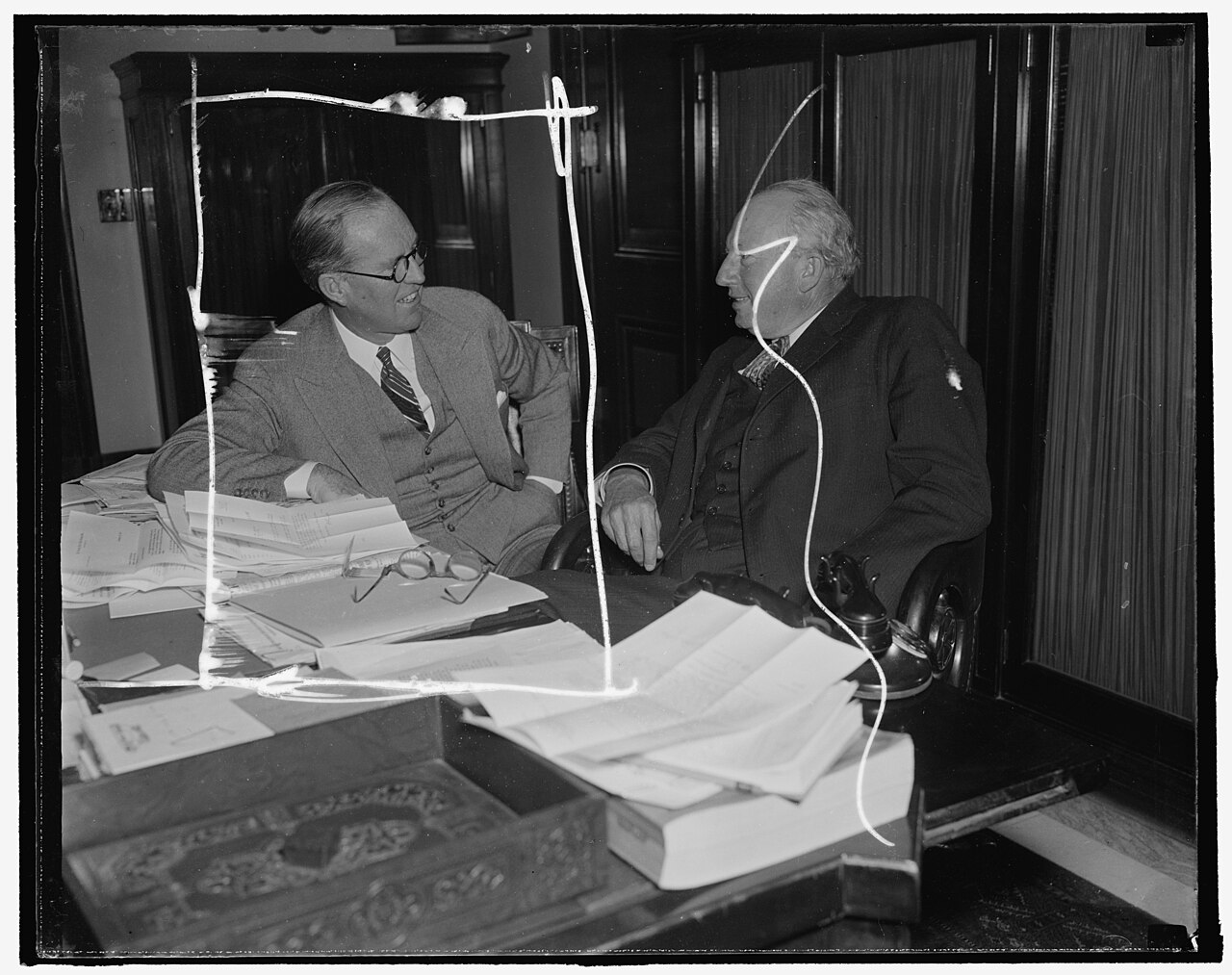
Joseph P. Kennedy, a businessman and investor, became the first chairman of the SEC in 1934. The appointment attracted attention because of his substantial experience in financial markets and his reputation as someone familiar with practices that reformers hoped to regulate. Supporters believed this background could help the Commission understand how trading actually worked, while critics questioned whether a person with Wall Street connections could be sufficiently independent.
The early Commission also included Ferdinand Pecora, James M. Landis, George C. Mathews and Robert E. Healy. Their backgrounds brought experience in law, markets and public investigations. The portrait accompanying this article depicts Kennedy as the agency’s first chairman; it is not a photograph of Roosevelt signing the statute. The leadership’s task was to turn broad legislation into an operating supervisory system and encourage confidence without promising that investors could never lose money.
Exchange registration and oversight of trading
The 1934 law established a system of federal registration for securities exchanges within its scope. Exchanges were required to meet applicable statutory and regulatory conditions, while the SEC obtained authority to supervise important trading practices. Exchange rules, disclosures and standards could be examined as part of federal oversight. The system developed over time, but the central principle was that trading venues affecting national commerce were no longer solely responsible for determining their own conduct.
The act also addressed broker-dealer practices and trading outside traditional exchanges. Over-the-counter markets posed different challenges from a central trading floor, and later regulation expanded the structure governing them. It is misleading to state that every security, exchange or transaction fell into identical requirements beginning in July 1934. Statutory definitions, exemptions and future amendments mattered. The lasting change was the creation of a federal supervisory authority able to respond to evolving market structures.
Fraud, manipulation and misleading information
Congress sought to prohibit practices that could distort securities prices or deceive investors. The act addressed manipulative transactions and fraudulent behavior and provided statutory authority for enforcement. Section 10(b) became particularly important as a foundation for later anti-fraud regulation, including SEC Rule 10b-5 adopted in 1942. That later rule should not be described as a regulation already fully written into the original June 1934 statute.
Federal securities regulation does not mean that every unsuccessful investment is fraud. Markets can fall because businesses perform poorly, interest rates change or economic conditions worsen. The law targets defined misconduct and requires compliance with particular disclosure or trading obligations; it does not guarantee a profit. This distinction was important in 1934 as it remains in understanding the historical purpose of investor-protection legislation.
Corporate reporting and information for investors
Publicly traded companies became subject to important federal reporting obligations under the 1934 framework. Registration and periodic disclosure requirements helped investors obtain financial and business information about companies whose securities traded in regulated markets. The SEC also developed rules concerning proxy solicitations and other communications to security holders. These systems expanded beyond the initial disclosures associated with offering shares to the public.
The development was gradual. The detailed form of annual reports, quarterly disclosures and electronic filing belongs to subsequent administrative history, not solely to the words passed by Congress in 1934. Nevertheless, the core change was profound: federal law created continuing requirements and an agency to supervise them. That offered investors a more systematic way to compare information about companies while placing new compliance obligations on issuers.
Margin credit, short-swing profits and insider issues
The legislation also addressed the use of credit to purchase securities and particular transactions by corporate insiders. Section 7 provided a framework for Federal Reserve regulation of credit associated with securities transactions. Section 16 established rules concerning certain officers, directors and major shareholders, including recovery of profits from specified short-swing transactions. These provisions reflected concern that excessive borrowing and insider advantages could distort markets.
Not every later insider-trading rule originated in exactly the same form in 1934. Courts and regulators developed complex interpretations over subsequent decades. The original statute created some important categories and enforcement tools, but present-day legal doctrine should not be treated as a verbatim record of the initial act. The distinction matters for history because it illustrates how a basic legal architecture can acquire additional details through litigation and administrative decisions.
How the SEC differed from federal banking agencies
The SEC supervised securities markets and specified securities activities, while other institutions handled distinct banking responsibilities. The Banking Act of 1933 had established deposit insurance and restricted certain bank-securities relationships. The Federal Reserve also held responsibilities affecting credit and the banking system. Congress did not create the SEC to replace the FDIC, insure stock-market losses or operate every exchange itself.
Those institutional distinctions show how the New Deal addressed different kinds of financial risk. Deposit insurance sought to protect qualifying bank deposits against failure, while securities disclosure and anti-fraud rules aimed to improve markets without guaranteeing investment returns. Emergency banking measures in March 1933 addressed an immediate panic. The 1934 SEC framework was a longer-term attempt to establish oversight over securities trading and corporate reporting.
The Securities Exchange Act’s enduring historical role
The 1934 act created an institution that became central to federal securities regulation. The SEC’s jurisdiction and tools changed substantially through later legislation, but the original framework established permanent oversight of major exchanges, brokers, reporting and fraud prevention. Its creation reflected political recognition that investor confidence depended partly on enforceable rules and reliable information, not merely private promises by market participants.
The law was one component of the broad reform response to the Great Depression. The 1929 crash and Depression explain the urgency, the 1933 disclosure statute laid earlier foundations, and the 1934 act established a regulatory agency for continuing market activity. An accurate history distinguishes those pieces rather than treating the SEC as either the cause of recovery or a guarantee that future crashes would become impossible.
Timeline
- October 1929: Stock market crash
- 1932–1934: Pecora investigation examines Wall Street practices
- May 1933: Securities Act of 1933 enacted
- June 6, 1934: Securities Exchange Act signed
- July 1934: SEC begins work under Joseph P. Kennedy
- 1942: SEC adopts Rule 10b-5
- Later decades: Disclosure and market oversight rules continue to evolve
Frequently asked questions
When was the Securities Exchange Act signed?
June 6, 1934, by President Franklin D. Roosevelt.
Did the act create the SEC?
Yes. The Securities and Exchange Commission began operating in July 1934.
Who was the first SEC chairman?
Joseph P. Kennedy, appointed in 1934.
What is the difference between the 1933 and 1934 securities acts?
The 1933 act chiefly addressed disclosures for securities offerings; the 1934 act established oversight of exchanges, ongoing trading and the SEC.
Did the SEC insure stock investments?
No. Securities regulation does not guarantee investment returns or insure stocks against market losses.
What were the Pecora hearings?
Senate inquiries into securities market practices from 1932 to 1934 that helped build support for reforms.
Was Rule 10b-5 enacted in 1934?
No. The 1934 statute provided authority, and the SEC adopted Rule 10b-5 in 1942.