Lincoln Memorial Dedication (1922): Design, Ceremony and Segregation
How the Lincoln Memorial was designed and dedicated—and why the segregated 1922 ceremony exposed contradictions in America’s memory of emancipation.
Quick answer
The Lincoln Memorial in Washington, D.C., was dedicated on May 30, 1922, with President Warren G. Harding, former president and Chief Justice William Howard Taft, and Tuskegee Institute president Robert Russa Moton participating. Architect Henry Bacon designed the temple-like building; sculptor Daniel Chester French created Lincoln’s seated statue. The ceremony took place before a largely segregated audience, revealing the distance between honoring Lincoln and protecting equal citizenship.
Key facts
On this page
- Why Americans planned a memorial to Lincoln
- From the McMillan Plan to the west end of the Mall
- Henry Bacon’s design and Greek temple architecture
- Daniel Chester French’s statue of Lincoln
- Inscriptions, murals and the memorial’s message
- Construction from 1914 to 1922
- What happened on May 30, 1922?
- Robert Russa Moton and the segregated audience
- Why a national monument can acquire new meanings
- The memorial as architecture and public space
- Why the 1922 dedication matters
- Timeline
- FAQs
- Sources
Why Americans planned a memorial to Lincoln
Abraham Lincoln’s death in April 1865 made the preservation of his memory a national concern. He was associated with the Civil War, the preservation of the Union and the emancipation of enslaved people. Yet the country disagreed over how to commemorate those achievements and which elements of the past should receive emphasis. A large federal memorial required authorization, money, a suitable location and an artistic design capable of satisfying political leaders over multiple administrations.
Lincoln was honored in statues and local monuments long before the Washington memorial was completed. The plan for a monumental structure on the National Mall developed through a lengthy political and architectural process rather than immediately after his assassination. The fact that the memorial opened nearly six decades after his death helps explain why later Americans could bring different interpretations of Lincoln to the dedication. The project became a national statement about memory as well as a work of architecture.
From the McMillan Plan to the west end of the Mall
In 1902 the Senate Park Commission, commonly associated with Senator James McMillan, proposed a broader redesign of Washington’s monumental core. Its plan favored a memorial at the western end of the Mall, on land near the Potomac River. The location would place Lincoln in a visual relationship with the Washington Monument and the Capitol. Not everyone agreed that a new monumental building belonged in that landscape, and alternatives were debated before a final site and design were approved.
The selected site created engineering and construction problems because of the land’s relationship to the river. It also gave the memorial a vast public setting where crowds could later assemble. That space mattered when the dedication took place in 1922 and, decades later, when major civil-rights demonstrations used the steps. The building’s later public role grew out of both its commemorative meaning and the physical characteristics of its position on the Mall.
Henry Bacon’s design and Greek temple architecture
Architect Henry Bacon designed the building in the form of a monumental Greek Doric temple. Its ring of exterior columns, stepped platform and restrained stone surfaces were intended to convey permanence and public dignity. The design evokes classical ideals that reformers and public architects commonly associated with democracy and civic virtue. The final structure also includes inscriptions naming states and a carefully arranged interior.
Classical imagery was a deliberate choice, not evidence that Lincoln himself had specified such a monument. Architecture can express an interpretation of historical character while remaining a product of the era that commissioned it. The National Park Service documents Bacon’s role and the competing design discussions. The memorial’s visual simplicity at a distance contrasts with the craftsmanship of its interior sculpture, inscriptions and murals, which together present a particular narrative about national unity.
Daniel Chester French’s statue of Lincoln
Inside the chamber sits the monumental marble image of Lincoln created by sculptor Daniel Chester French. The seated figure looks outward, hands resting on the chair, and gives visitors a personal subject within a large formal structure. The statue was carved in Georgia marble by the Piccirilli Brothers from French’s design. It is important to distinguish the artist who conceived the work from the craftsmen who executed the carving.
Visitors sometimes interpret differences in the hands, face or posture as secret symbols. Those stories are often repeated without reliable contemporary evidence. A stronger historical approach examines French’s artistic intentions where documentation exists and recognizes that viewers may interpret the image differently. The statue’s significance does not depend on speculative hidden codes. It lies in the memorial’s success in making an individual historical figure the focus of a national public space.
Inscriptions, murals and the memorial’s message
The interior includes Lincoln’s Gettysburg Address and Second Inaugural Address. The speeches connect the monument to the war, sacrifice, freedom and hopes for reconciliation. Jules Guerin painted the two large murals, which represent themes associated with Lincoln’s life and political legacy. These elements formed a coherent commemorative program rather than decoration added without historical purpose.
Preserving a speech in stone does not resolve disagreements over its meaning. The Gettysburg Address expressed a vision of a nation founded on equality while the country remained deeply divided over civil rights in the decades following the war. The memorial’s inscriptions encourage interpretation of Lincoln through his words, but the 1922 dedication shows that public commitment to those words could remain selective or contradictory.
Construction from 1914 to 1922
Work on the memorial began in 1914, following federal authorization and design selection. The U.S. Army Corps of Engineers helped oversee substantial aspects of the construction. The project required a stable foundation, large quantities of stone, specialized carving and coordination among engineers, architects and artists. Its completion therefore depended on a workforce and institutions beyond the handful of individuals most frequently named in public accounts.
The First World War occurred during the construction years and shaped the wider country in which the memorial was built. By the time the building approached completion, Americans had experienced war, an influenza pandemic and major political unrest. The long construction interval also meant that the people who dedicated the building belonged to a different administration and public moment from those who began the project. That transition forms part of the meaning of the 1922 ceremony.
What happened on May 30, 1922?
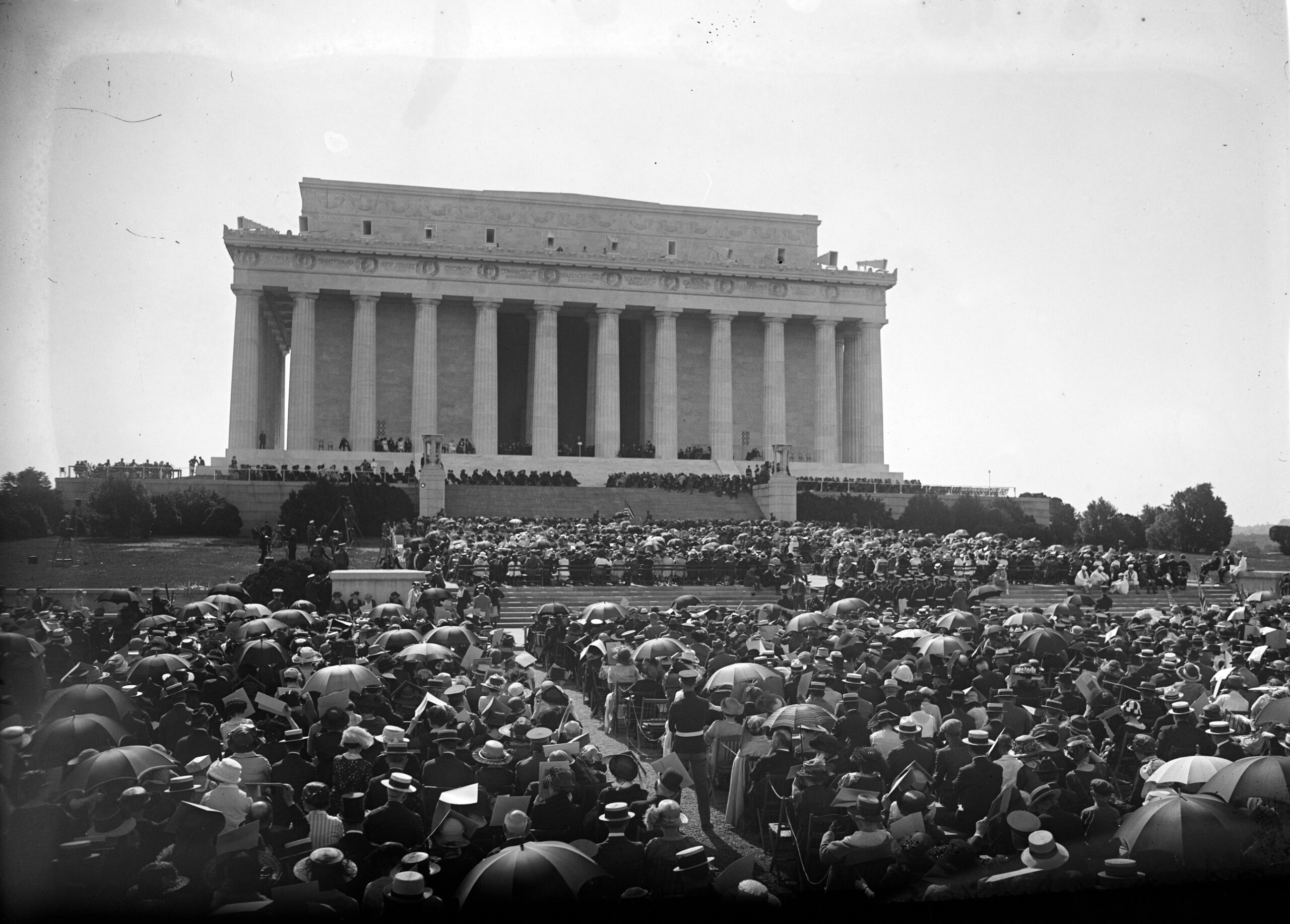
The Lincoln Memorial was officially dedicated on Memorial Day, May 30, 1922. President Warren G. Harding accepted the monument on behalf of the nation. William Howard Taft, then Chief Justice and a former president, participated as a leading figure in the memorial commission. Robert Russa Moton, president of the Tuskegee Institute, delivered an address. Robert Todd Lincoln, Abraham Lincoln’s only surviving son, was also present.
Tens of thousands attended, with the National Park Service citing an estimate around 75,000 in a detailed historical inventory. Historical photographs show a vast audience on the steps and surrounding grounds. The photograph used here records the dedication audience rather than a later tourist visit. A particularly important point is that the ceremony was about national memory and present-day citizenship at the same time, and those themes did not fit comfortably together.
Robert Russa Moton and the segregated audience
Robert Russa Moton addressed the dedication despite restrictions on what he was allowed to say and the segregation of much of the audience. The National Park Service and Smithsonian describe how the occasion both celebrated emancipation and exposed racial inequality. Black attendees were not treated as equal participants in the public ceremony, a striking contradiction at a monument honoring the president most associated with emancipation.
Moton’s presence should not be treated as proof that the ceremony was fully inclusive. His speech and the organization of the gathering reflected continuing disputes over civil rights. It is also inaccurate to claim the dedication was only about exclusion: organizers and participants genuinely sought to honor Lincoln. The historical significance lies in the tension between public ideals and the institutions that failed to realize them. The discrepancy made the site especially meaningful to later civil-rights advocates.
Why a national monument can acquire new meanings
Although the memorial was dedicated in 1922, its cultural significance did not stop with that ceremony. Visitors could interpret Lincoln’s legacy differently, and the location became associated with demands for justice and equal citizenship. In 1939 the singer Marian Anderson performed at the memorial after racial exclusion prevented her concert at Constitution Hall. The event placed the monument at the center of a national debate about discrimination in public life.
The 1963 March on Washington later brought an enormous civil-rights demonstration to the site. Martin Luther King Jr.’s speech there linked the unfinished promise of emancipation with the conditions facing Black Americans a century later. Such events did not erase the 1922 dedication or make the memorial mean only one thing. They illustrate how public spaces can become venues for new historical claims long after their builders have died.
The memorial as architecture and public space
The monumental setting combines a temple structure, interior sculpture, inscriptions and broad exterior steps. Those features shape the visitor’s approach, making the ascent to Lincoln’s image part of the experience. The design also creates large platforms for public gatherings and views across the Reflecting Pool toward the Washington Monument. These spatial choices helped the site function as both a commemorative destination and a civic meeting place.
Photographs from different periods reveal how the same building can frame different public experiences. The 1922 dedication recorded a segregated social order, the 1939 concert challenged racial exclusion, and the 1963 march made civil rights a central part of the monument’s modern meaning. Architectural history and political history therefore reinforce rather than replace one another. The building’s design made its later public role possible, while activists gave that setting additional significance.
Why the 1922 dedication matters
The opening of the Lincoln Memorial marked the completion of a major national building project and a carefully designed commemorative statement. It brought together Harding, Taft, Moton and members of the Lincoln family before a vast audience. But the ceremony’s segregation revealed that honoring emancipation did not necessarily mean enforcing equal participation. Both facts belong in the historical record.
The memorial is now among the most recognizable sites in Washington, but it should not be described as having always carried the same political message. Its story begins before the 1922 dedication and continues through many later gatherings. Reading the original event alongside Lincoln’s Gettysburg Address and the March on Washington helps explain how a monument can embody national aspirations while also exposing their unfinished realization.
Timeline
- 1865: Abraham Lincoln assassinated
- 1902: McMillan Plan proposes a memorial at the Mall’s west end
- 1914: Construction begins
- May 30, 1922: Memorial dedicated
- 1939: Marian Anderson performs at the memorial
- August 1963: March on Washington gathers at the site
Frequently asked questions
When was the Lincoln Memorial dedicated?
May 30, 1922, on Memorial Day.
Who designed the Lincoln Memorial?
Henry Bacon designed the building, Daniel Chester French designed the seated statue, and Jules Guerin painted the murals.
Which president dedicated it?
President Warren G. Harding accepted the memorial for the nation.
Who was Robert Russa Moton?
The Tuskegee Institute president who spoke at the 1922 dedication about racial equality.
Was the audience segregated?
Much of the dedication audience was segregated, despite the memorial’s association with emancipation.
When was construction begun?
Work began in 1914, with the dedication taking place in 1922.
What later events occurred there?
Marian Anderson’s 1939 concert and the 1963 March on Washington were major events at the memorial.