Teapot Dome Scandal: Oil Leases, Senate Investigation and Albert Fall
How secret federal oil leases, financial transfers to Albert Fall and persistent Senate investigators exposed a major Harding-era corruption scandal.
Quick answer
The Teapot Dome scandal arose from 1922 leases of federal naval petroleum reserves arranged under Interior Secretary Albert B. Fall during President Warren G. Harding’s administration. Teapot Dome in Wyoming was leased to Harry Sinclair’s company, while Edward Doheny’s interests obtained rights at Elk Hills in California. Senate inquiries starting in 1922 uncovered financial transfers to Fall. In 1929 he was convicted of accepting a bribe and later imprisoned; the Supreme Court also voided disputed leases.
Key facts
On this page
- What was the Teapot Dome scandal?
- Why the Navy maintained petroleum reserves
- Albert Fall and the transfer of administrative control
- The secret leases of 1922
- How the Senate opened its investigation
- Financial transfers to Fall
- The 1924 hearings and the public reaction
- The Supreme Court and the cancellation of leases
- Albert Fall’s 1929 bribery conviction
- Did President Harding personally take a bribe?
- Why the scandal matters to congressional oversight
- Timeline
- FAQs
- Sources
What was the Teapot Dome scandal?
Teapot Dome has become a shorthand for public corruption, but the scandal was not a single act of theft from a warehouse of oil. It involved decisions by federal officials to lease strategic petroleum reserves to private companies, followed by evidence that the official directing those decisions had received substantial private benefits from associated businessmen. The government owned the reserves, and the arrangements raised questions of competitive bidding, public interest and the independence of the cabinet member supervising them.
The chronology stretches over years. Secretive leasing decisions were made in 1922; senators demanded an explanation and opened an investigation; hearings in 1923 and 1924 exposed suspicious transfers; civil litigation and criminal prosecutions continued afterward. President Warren G. Harding died in 1923 before many revelations became public. Describing Teapot Dome solely as a crime ‘in 1929’ mistakes the year of a major conviction for the years in which the improper arrangements developed.
Why the Navy maintained petroleum reserves
By the early twentieth century naval vessels increasingly used petroleum, and military leaders worried about the availability of fuel during future emergencies. The federal government set aside petroleum reserves so that valuable deposits would not be exhausted through ordinary commercial production before the Navy might need them. A reserve was therefore a strategic asset and not simply another parcel being sold on a routine real-estate market.
Teapot Dome was in Wyoming; Elk Hills was in California. Both became involved in the affair, but the leases and private companies must be distinguished. Teapot Dome lent its memorable name to the whole scandal, while the California transactions were also crucial to demonstrating Fall’s connections with oil investors. Because the reserves were intended to serve a national purpose, how officials handled drilling rights mattered well beyond the immediate value of the oil.
Albert Fall and the transfer of administrative control
Albert Bacon Fall became secretary of the interior under Harding in 1921. Previously a U.S. senator, he had considerable familiarity with western land and mineral policy. He advocated transferring practical control of naval oil reserves from the Navy to his department. Administration officials argued that drilling and leasing might prevent losses from nearby commercial extraction and could provide benefits for naval fuel supply.
Such arguments did not by themselves establish corruption. A government may have policy reasons to lease a reserve, but the conditions of a lease and any private payments to decision-makers are separate matters. The controversy arose because significant rights were arranged without ordinary competition and because Fall’s personal finances changed in ways investigators could not easily explain. This distinction is important: evidence of conflict of interest and bribery, rather than a general disagreement about public versus private oil production, drove the scandal.
The secret leases of 1922
Fall approved arrangements involving Harry F. Sinclair’s Mammoth Oil Company at Teapot Dome and Edward L. Doheny’s Pan American interests at Elk Hills. The secrecy and absence of competitive bidding attracted concern from other oil companies, journalists and legislators. Supporters of the arrangement argued that private development might be justified by threats of drainage or the government’s need for additional facilities. Opponents wanted to know why favored companies had received valuable contracts through closed negotiations.
The record also contains different dates for preliminary decisions, formal agreements and public disclosure. For this reason the phrase ‘the leases were made in 1922’ is more reliable as a brief summary than assigning every aspect of the arrangement to one day. On April 18, 1922, Fall publicly acknowledged the Teapot Dome lease and another arrangement nearing completion, prompting more questions. An official explanation had become necessary, even though the most damaging financial evidence had not yet been revealed.
How the Senate opened its investigation
Wyoming Senator John Kendrick pressed for an inquiry after details of the leases emerged. The Senate’s Committee on Public Lands and Surveys pursued the transactions, seeking records and testimony. The congressional investigation was important because lawmakers could examine government conduct that had already received executive approval. Its function was not identical to a criminal trial; senators sought facts, testimony and documents that could lead to oversight or later action.
The committee’s investigation developed over time, and extensive hearings began in October 1923 under the leadership of Senator Thomas J. Walsh of Montana. Walsh’s persistence was central to the case. He followed financial records and contradictory accounts when some officials and witnesses attempted to portray transfers as ordinary private transactions. The Senate’s historical account emphasizes how the investigation demonstrated Congress’s capacity to scrutinize executive decisions, even amid resistance.
Financial transfers to Fall
The most damaging revelations involved payments and other financial benefits Fall received from oil executives. Edward Doheny had provided Fall with a $100,000 transfer described as a loan, while evidence also emerged concerning approximately $300,000 in cash and securities associated with Harry Sinclair. These figures should not be combined into one alleged single cash payment. They involved different people, transactions and legal proceedings.
Fall maintained that the arrangements could be explained innocently, but investigators questioned the timing and whether the transactions influenced his official decisions. The documented transfers changed the meaning of the leases in public debate. No longer was the issue only whether a particular petroleum policy was wise. The central question became whether a cabinet official had privately benefited while allocating government resources to selected businesses. The later prosecution of Fall showed the legal significance of that evidence.
The 1924 hearings and the public reaction
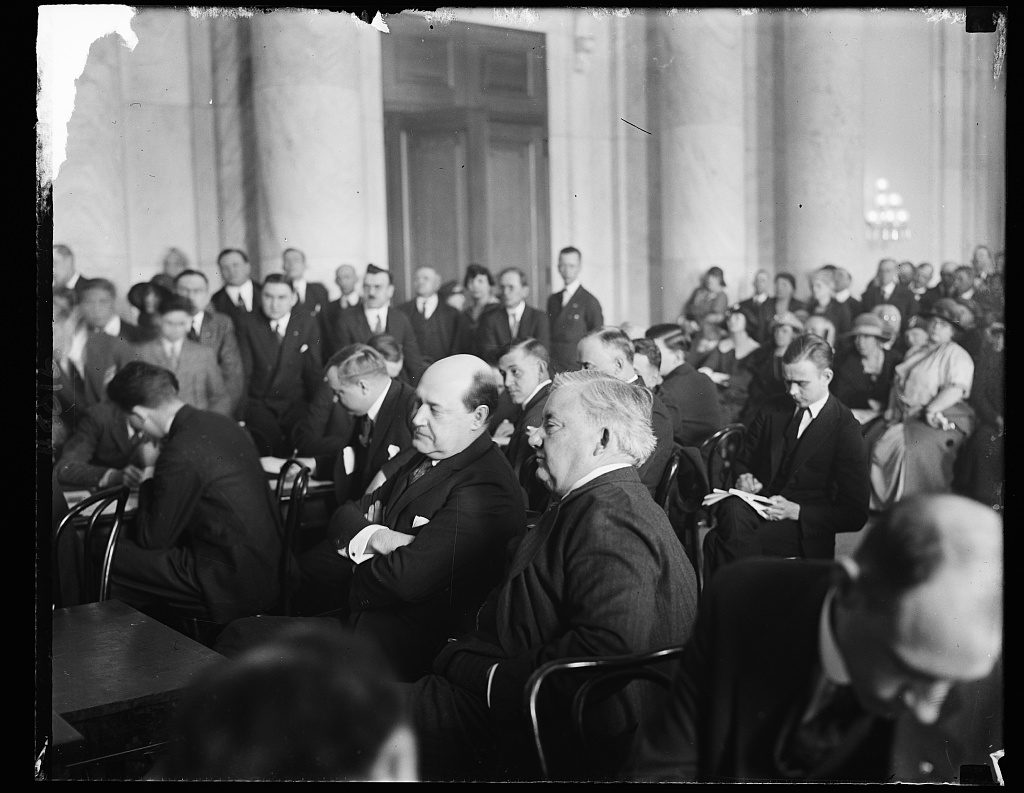
Teapot Dome became national news as Senate hearings exposed private financial dealings and offered the public a detailed view of executive decision-making. Photographs show oil executives and their lawyers attending hearings. The image accompanying this article features Sinclair and counsel Martin Littleton during 1924 proceedings; it is not a picture of Harding signing a lease or of a payment being exchanged. Such precise captions matter when historical photographs are used to illustrate disputed conduct.
Congressional hearings allowed voters to see that claims about the reserves were being tested against testimony and documentary evidence. The investigations unfolded after Harding’s death and continued into Coolidge’s presidency. Their duration is itself significant. The Senate did not obtain every answer at once, and the eventual consequences depended on cooperation among investigators, civil litigators, prosecutors and the courts. The story is therefore also an example of how oversight can require years of sustained work.
The Supreme Court and the cancellation of leases
The federal government sued to cancel the disputed leases, arguing that they had been obtained through corrupt arrangements. The Supreme Court ultimately upheld decisions voiding the leases, including cases involving Mammoth Oil and Pan American Petroleum. These civil judgments addressed the government’s entitlement to its reserves and the improper nature of the transactions. They were distinct from criminal judgments determining the personal guilt of individual defendants.
Restoring a reserve to public control does not automatically establish that every executive or contractor was convicted of a crime. A civil case and a criminal case ask different legal questions and may operate under different evidentiary standards. The Teapot Dome history is often simplified into ‘everyone was found guilty,’ but the outcomes varied. Differentiating those outcomes makes it easier to understand what the investigation proved and which legal tools were available to remedy public misconduct.
Albert Fall’s 1929 bribery conviction
Fall was convicted of accepting a bribe in October 1929. The bribery conviction concerned the transfer from Edward Doheny and ultimately led to Fall’s imprisonment. He became the first former U.S. cabinet member imprisoned for crimes committed while serving in office. The date is a crucial milestone, but the case reached judgment years after the original 1922 leases and the 1923–24 congressional hearings.
Other defendants faced different charges and outcomes. Sinclair served time for offenses including contempt of Congress and attempts to influence a jury, while he and Doheny were acquitted on certain criminal conspiracy charges. Doheny was also acquitted on a bribery-related charge. A historically careful account should not state that all the oil executives were convicted of the same bribery offense as Fall. Those distinctions illustrate the difference between political scandal, suspicious transactions and the precise elements that prosecutors could prove.
Did President Harding personally take a bribe?
The scandal became closely associated with Harding because the leases were made during his administration and by one of his cabinet members. But investigators did not establish that Harding personally received the payments at the center of Fall’s case. Conflating the administration’s responsibility with a proved private payment to the president would exceed the evidence. Harding’s political judgment in appointing and supervising officials can be debated without inventing a conviction or financial transaction involving him.
Harding died unexpectedly in August 1923. As a result, he did not face the public inquiry and later judicial outcomes in the way surviving officials and private executives did. The posthumous growth of the scandal damaged his historical reputation and fueled criticism of his administration. Our 1920 election history explains how Harding came to office, while Teapot Dome explains one major controversy that followed.
Why the scandal matters to congressional oversight
The Senate investigation demonstrated that Congress could uncover hidden executive transactions using subpoenas, witness testimony and documentary inquiry. The Teapot Dome litigation became associated with the development of congressional investigative powers and the limits of private claims over public records. These institutional consequences have value beyond the particular oil reserves because they concern how government investigates possible misconduct by its own officials.
Teapot Dome remains a strong case study in conflicts of interest. Oil development, by itself, was not the offense: the problem lay in secretive allocation of public assets and payments to the official controlling the decisions. The episode shows how public trust can be harmed when decision-makers have private financial relationships with beneficiaries of government contracts. It also shows why investigators must distinguish rumor from documents and why civil remedies and criminal accountability can follow different paths.
Timeline
- 1921: Fall becomes secretary of the interior
- 1922: Teapot Dome and Elk Hills lease arrangements
- 1922: Senate opens inquiry into reserve leasing
- October 1923: Major Senate hearings begin
- 1924: Financial transfers and witness testimony draw national attention
- 1927: Supreme Court rulings void key leases
- October 1929: Fall convicted of accepting a bribe
- 1931: Fall begins prison sentence
Frequently asked questions
What was Teapot Dome?
A scandal involving secret noncompetitive leases of federal naval petroleum reserves and financial transfers to Interior Secretary Albert Fall.
Where was Teapot Dome?
A federal petroleum reserve in Wyoming; related transactions involved the Elk Hills reserve in California.
Who was Albert B. Fall?
Harding’s interior secretary, convicted of bribery in 1929 and later imprisoned.
When did the scandal happen?
The leases were arranged in 1922; Senate hearings became major news in 1923–24, and litigation continued into the late 1920s.
Was Warren Harding convicted?
No. Harding died in 1923, and investigators did not prove he personally received Fall’s payments.
Were the oil leases voided?
Yes. The courts invalidated major disputed leases and restored control to the government.
Were all the oil executives convicted?
No. Outcomes differed among bribery, conspiracy, contempt and jury-related proceedings.