Palmer Raids (1919–1920): First Red Scare, Arrests and Deportations
Why federal agents arrested thousands of suspected radicals after World War I, how deportation proceedings worked and who challenged the raids.
Quick answer
The Palmer Raids were coordinated arrests and searches led by the U.S. Department of Justice under Attorney General A. Mitchell Palmer in November 1919 and January 1920. Officials targeted suspected anarchists and communists during the First Red Scare. Thousands were detained, many without adequate legal safeguards, and some noncitizens were deported. Department of Labor officials, lawyers and civil-liberties advocates challenged evidence and procedure, leading to many proposed deportations being canceled.
Key facts
On this page
- What were the Palmer Raids?
- The postwar First Red Scare
- The 1919 bombing campaign and Palmer’s home
- How the Justice Department built its intelligence operation
- The first coordinated raids in November 1919
- The deportation of Emma Goldman and Alexander Berkman
- The January 2, 1920 nationwide raids
- The legal problems: warrants, searches and detention
- The Department of Labor and Louis F. Post
- Why the American Civil Liberties Union formed in 1920
- Why the May Day alarm damaged Palmer’s credibility
- The lasting historical significance
- Timeline
- Frequently asked questions
- Sources
What were the Palmer Raids?
The Palmer Raids were a series of federal and local law-enforcement operations conducted against suspected political radicals in the aftermath of World War I. The principal waves occurred on November 7, 1919, and January 2, 1920. Officials searched meeting places, arrested people and sought to deport foreign-born residents alleged to be associated with radical organizations. Many of those arrested had not been convicted of violent crimes. The operations became a defining episode of the First Red Scare, a period of intense fear about anarchism, communism and revolutionary movements.
The raids were named for Attorney General A. Mitchell Palmer, who directed the Justice Department during the relevant period. But naming an operation for one official can obscure the many institutions and people involved: federal investigators, local police, immigration authorities, political groups and legal advocates. Understanding the episode requires distinguishing criminal investigation, suspicion of political ideas and the separate legal procedures used for deporting noncitizens. Those were not automatically interchangeable sources of authority.
The postwar First Red Scare
The Russian Revolution of 1917 and subsequent political turmoil overseas heightened fears among some U.S. officials and members of the public that revolutionary violence might spread to America. At home, wartime restrictions on dissent, strikes, labor disputes and inflammatory reporting contributed to an atmosphere of suspicion. Some Americans viewed socialist, anarchist and communist organizations as threats to political and economic order. Other people argued that government critics and immigrant communities were being unfairly branded as dangerous.
Political radicalism contained different movements with different aims and methods. Anarchists were not identical to communists, socialist political parties or unions. Moreover, membership in a group or advocacy of unpopular ideas did not establish that an individual had committed violence. The First Red Scare often blurred those distinctions. The Palmer Raids emerged from this political setting, in which allegations of foreign subversion could justify expansive investigations and demands for rapid action.
The 1919 bombing campaign and Palmer’s home
A series of attempted and actual bomb attacks in 1919 increased public anxiety. On June 2 an explosion damaged Palmer’s house in Washington, D.C., and killed the bomber. Other attacks were associated with a violent anarchist campaign. The FBI’s historical account places these events among the pressures influencing Palmer’s response. They provided a real public-safety concern, but officials then pursued sweeping operations against political organizations that included people for whom individual evidence of involvement in bombings was absent.
The distinction matters. A government can legitimately investigate acts of violence while still being responsible for respecting legal safeguards when arresting suspects. The attacks did not prove that every immigrant radical, union organizer or person attending a political meeting was a bomber. When historians evaluate the raids, they examine both the crimes that alarmed officials and the breadth of subsequent law-enforcement actions.
How the Justice Department built its intelligence operation
Palmer reorganized efforts to investigate radical movements, and a young Justice Department employee, J. Edgar Hoover, became a leading figure in the General Intelligence Division. Investigators assembled files on organizations and individuals and coordinated with field agents. The system linked surveillance, informants and records to a campaign aimed at alleged revolutionary activity. It existed before Hoover became the much better-known director of the FBI in later decades.
The intelligence work raised important questions about the difference between investigating crime and collecting political information. Police might seek to identify people involved in actual violent plots, but compiling lists of individuals because of ideology or association could sweep in many others. Later inquiries into the raids examined this problem. The historic record does not support treating all names gathered by investigators as proof of illegal conduct.
The first coordinated raids in November 1919
The first major wave took place on November 7, 1919, the anniversary of the Bolshevik seizure of power in Russia. Federal agents and local authorities targeted suspected members of radical organizations, especially groups linked by officials to anarchism and revolutionary activity. Arrests occurred in several cities, and investigators seized organizational records. Reports from the time are inconsistent about exact totals, but the operations brought hundreds of people into custody and set the stage for a much larger campaign.
Participants in targeted organizations had different levels of involvement and political beliefs. Some were active organizers, while others may have attended meetings or simply been present when a raid occurred. The raids therefore raised questions about individualized grounds for arrest. Historical accounts should not state that a person was guilty merely because officials placed them in a roundup. The legal status of detainees depended on evidence, citizenship, immigration rules and subsequent proceedings.
The deportation of Emma Goldman and Alexander Berkman
Among the prominent radicals deported during the period were Emma Goldman and Alexander Berkman, anarchist activists whose political views and prior prosecutions had made them well known. In December 1919 they and many others were sent from the United States aboard the transport ship Buford, sometimes called the ‘Soviet Ark’ by contemporaries. Approximately 249 people were deported on that voyage. This episode became a symbol of the government’s use of immigration powers against foreign-born political activists.
The Buford voyage should not be confused with the later mass arrests of January 2, 1920. It followed earlier proceedings and occurred before that second raid wave. Deportation was also different from a criminal sentence: officials relied on immigration-law grounds, though past convictions or alleged organizational membership could influence cases. The distinction helps explain why the Department of Labor played a decisive role in reviewing the legality of later deportation attempts.
The January 2, 1920 nationwide raids
The largest coordinated operation began on January 2, 1920, with arrests and searches across many cities. The Library of Congress’s historical guide cites thousands of arrests, and other sources give differing totals depending on whether they count initial detention, formal charges or later immigration cases. Rather than choose a single number as unquestionable, it is more accurate to say that thousands were swept into the operations, far more than could be shown individually to have committed violent offenses.
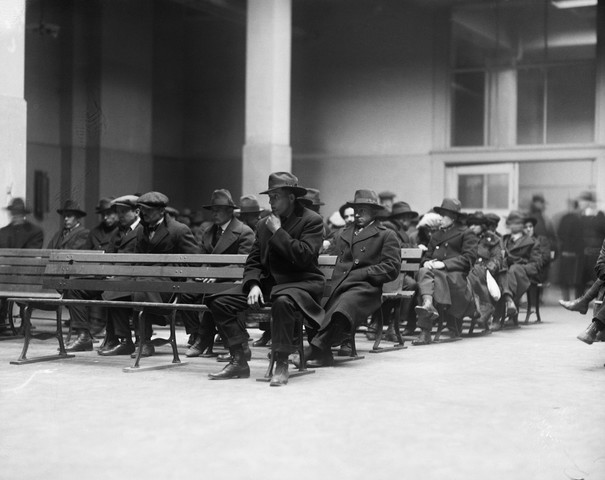
Local police and federal agents entered offices and meeting places associated with suspect organizations. Detainees could face crowded facilities, delays and inadequate access to counsel. The photograph accompanying this article records people taken to Ellis Island for immigration proceedings in January 1920. It documents a real detention setting but does not establish the legal outcome for every individual pictured. Some were eventually released, while others faced deportation.
The legal problems: warrants, searches and detention
One of the central controversies was whether officials had lawful grounds and properly issued warrants for searches and arrests. Civil-liberties critics documented cases of detention without adequate process, sweeping searches and coercive treatment. The ACLU’s historical account characterizes the raids as a major example of overreaching government action. Federal officials defended their work in the context of threats from political violence, but their broad approach drew criticism from lawyers, journalists and others concerned about constitutional protections.
Lawful investigation requires more than the identification of unpopular political beliefs. Arrest, detention and deportation operate under different legal rules and should rest on relevant facts and procedures. The Palmer Raids exposed how quickly those distinctions could collapse during a political emergency. It was possible for officials to identify real wrongdoing while simultaneously subjecting many uninvolved people to invasive enforcement. That tension lies at the heart of the raids’ historical significance.
The Department of Labor and Louis F. Post
Immigration authorities, which were then within the Department of Labor, had important responsibilities for deportation proceedings. Assistant Secretary Louis F. Post reviewed numerous cases and found substantial defects in the way evidence and arrests had been handled. He canceled many proposed deportations. Labor Department historical records show that these decisions produced conflict with Palmer and other officials who wanted deportations to proceed more readily.
Post’s intervention demonstrates that the federal government did not speak with one undivided voice. Different departments interpreted legal duties differently, and some officials resisted the Justice Department’s aggressive program. The review did not undo every harmful consequence of detention, nor did it mean that no deportations occurred. It did, however, sharply limit the results of the mass roundup and demonstrated that administrative scrutiny could check unlawful or inadequately supported actions.
Why the American Civil Liberties Union formed in 1920
The American Civil Liberties Union was established in January 1920, during the controversy surrounding wartime repression and the Palmer Raids. Its origins lay partly in earlier efforts to defend conscientious objectors and others prosecuted under wartime laws. Organizers including Roger Baldwin, Crystal Eastman and other civil-liberties advocates sought a continuing institution that could defend rights beyond the immediate circumstances of World War I. The organization was not created solely in reaction to one raid, but the crackdown was an urgent part of its environment.
The ACLU’s early activity included challenges to deportation practices, restrictions on political expression and labor organizing. The Espionage and Sedition Acts had already raised difficult First Amendment disputes. The Palmer Raids broadened the focus to searches, detention and immigration due process. Together these controversies helped shape the emerging field of organized civil-liberties advocacy.
Why the May Day alarm damaged Palmer’s credibility
In spring 1920 Palmer and others warned about a possible radical uprising associated with May Day. The anticipated nationwide revolutionary outbreak did not materialize on May 1. The unfulfilled prediction added to criticism of the government’s alarmist public claims. The earlier bomb attacks and some political violence were real, but broad forecasts of imminent organized revolution required evidence that officials could not adequately substantiate.
The failure of the predicted uprising weakened the political case for continued mass action, while scrutiny of deportation cases had already revealed practical and legal problems. Public opinion did not change uniformly or overnight, and anti-radical campaigns continued in different forms. Nevertheless, by 1920 the Palmer Raids were increasingly recognized as a warning about the consequences of using fear to justify sweeping law enforcement.
The lasting historical significance
The Palmer Raids show how a government confronting genuine security worries can expand enforcement far beyond individuals linked by evidence to criminal acts. They occurred within the First Red Scare, when ideology, immigrant status and labor activism were often treated as signs of dangerous disloyalty. Those suspicions had serious effects on people subjected to searches, detention, deportation proceedings and public stigma. The legal record and subsequent criticism reveal both the breadth of the operations and the weaknesses in many cases.
The story also illustrates limits on executive action. The Department of Labor reviewed cases, civil-liberties advocates investigated abuses, and the courts and Congress became settings for scrutiny. The raids stand alongside wartime speech prosecutions and restrictive immigration laws as a central episode in early twentieth-century debates over national security and rights. Their importance is not a claim that all radicals were innocent or all officials acted with the same motives; it is the documented need to distinguish legitimate investigation from punishment based on association and fear.
Timeline
- 1917: Russian Revolution heightens political alarm in U.S.
- June 2, 1919: Bombing damages Attorney General Palmer’s house
- November 7, 1919: First major coordinated raids
- December 1919: Buford deportation voyage
- January 2, 1920: Largest wave of raids
- January 1920: ACLU founded
- Spring 1920: Louis F. Post reviews and cancels deportation cases
- May 1, 1920: Predicted mass radical uprising does not occur
Frequently asked questions
When did the Palmer Raids occur?
The main coordinated waves were November 7, 1919, and January 2, 1920.
Who ordered the Palmer Raids?
Attorney General A. Mitchell Palmer directed the Justice Department’s anti-radical campaign.
Why were people arrested?
Officials targeted people suspected of anarchist or communist associations during the First Red Scare, often without adequate individualized evidence.
How many people were arrested?
Thousands were detained, particularly in January 1920. Exact totals vary among sources and counting methods.
Were everyone arrested deported?
No. Many deportation cases were canceled or detainees released after legal review.
Who was Louis F. Post?
An assistant secretary at the Department of Labor who reviewed proceedings and canceled many proposed deportations.
What was the Soviet Ark?
A nickname for the ship Buford, which carried around 249 deportees, including Emma Goldman and Alexander Berkman, in December 1919.
Sources and further reading
Archival research guides and institutional histories support the dates and legal distinctions outlined above.