Election of 1912: Wilson vs. Roosevelt, Taft and Debs — Results and Causes
How Wilson defeated a divided Republican field in one of the most unusual U.S. elections.
Woodrow Wilson won the U.S. presidential election of November 5, 1912, with 435 electoral votes and roughly 42% of the popular vote. Former president Theodore Roosevelt, running as a Progressive or Bull Moose candidate, finished second with 88 electoral votes; Republican president William Howard Taft received eight. Socialist Eugene V. Debs earned about six percent of the popular vote but no electoral votes. The contest revealed deep divisions over the direction of American reform.
Compare candidates, party platforms, popular votes, electoral results, and the long-term effects on Progressive reform.
On this page — 25 topics
Who won the presidential election of 1912?
Democratic candidate Woodrow Wilson won the presidential election held on November 5, 1912. He carried 435 of 531 electoral votes, defeating former president Theodore Roosevelt of the Progressive Party, incumbent Republican president William Howard Taft and Socialist candidate Eugene V. Debs. Wilson gained approximately 42 percent of the national popular vote, not an absolute majority, because the other three candidates attracted substantial support. Roosevelt finished second in both popular and electoral votes, an unusual achievement for a major third-party presidential campaign. The results reflected political division within the Republican Party and competing plans for reform. The election brought a Democrat into the White House after four consecutive Republican presidential victories.
What were the full Electoral College results?
The National Archives records 435 electoral votes for Wilson, 88 for Roosevelt and eight for Taft, with no electoral votes for Debs. A candidate needed 266 votes to win. The election involved 48 states, including newly admitted Arizona and New Mexico, and the nationwide Electoral College total was 531. The distribution of electoral votes gave Wilson an overwhelming majority despite his modest popular-vote plurality. California also had a split electoral outcome because voters selected individual electors rather than casting a perfectly uniform statewide ticket. Historical tables sometimes differ slightly in popular-vote figures, reflecting recounts and compilation methods, but the official electoral totals are clear and should not be replaced by estimates.
How many popular votes did each candidate receive?
The American Presidency Project’s election table reports approximately 6.29 million votes for Wilson, 4.12 million for Roosevelt, 3.49 million for Taft and 900,000 for Debs. Rounded percentages were about 41.8, 27.4, 23.2 and 6.0 respectively. Small differences among published totals result from how historians and election databases compile state returns. These percentages illustrate that Wilson won with a plurality rather than support from more than half of all voters. Votes in individual states determined the Electoral College result, so national totals alone cannot tell the entire story. The contrast between the large electoral margin and divided popular vote is one of the election’s most important features.
Who was Woodrow Wilson?
Woodrow Wilson was governor of New Jersey and the Democratic presidential nominee in 1912. Before entering elected politics he had been a scholar and president of Princeton University. His campaign offered a program called New Freedom, arguing that excessive concentration of corporate power threatened ordinary enterprise and that government should restore competitive conditions. Wilson’s record as president later included federal banking and antitrust reforms, but also racist segregation in parts of the federal workforce. His victory is therefore important for multiple reasons and should not be presented as an uncomplicated advance for all groups. The election result was shaped both by Democratic campaigning and by the unprecedented division among Republican and Progressive candidates.
Why did Theodore Roosevelt run again?
Roosevelt had served as president from 1901 to 1909 and supported Taft as his successor. Their relationship deteriorated over disputes involving conservation, tariff policy, progressive organization and the administration’s direction. By 1912 Roosevelt sought the Republican nomination, arguing that Taft had failed to carry forward important reforms. After Taft secured the party’s nomination, Roosevelt helped establish a separate Progressive Party campaign. His candidacy drew voters who supported stronger national regulation and a more active presidency. The split was not simply a dispute between two men with identical policies. Their supporters held different views about party loyalty, government reform and the proper balance between business, labor and executive power.
Why was the Progressive Party called the Bull Moose Party?
Roosevelt’s supporters became widely known as the Bull Moose Party after he adopted the image of a strong, vigorous bull moose to describe his fitness and determination during the 1912 campaign. The nickname captured the energetic style that distinguished the Progressive ticket from established party organizations. The party nominated Roosevelt for president and California governor Hiram Johnson for vice president. Its platform included proposals relating to social insurance, labor protections, political reform and women’s suffrage. The label did not indicate a different candidate from Roosevelt; Bull Moose and Progressive referred to the same 1912 national campaign. The party’s electoral success was considerable for a third-party organization but insufficient to win the presidency.
Who was William Howard Taft?
William Howard Taft was the incumbent Republican president, elected in 1908 after Roosevelt left the White House. He had experience in law, administration and overseas governance and pursued important antitrust litigation while president. Yet progressive Republicans criticized his conservation decisions and perceived closeness to more conservative party leaders. Taft believed his legal and administrative approach offered a more responsible direction than Roosevelt’s emphasis on presidential power. In 1912 he won the Republican nomination but faced a party deeply divided by Roosevelt’s challenge. His eventual electoral total of eight votes was exceptionally low for an incumbent major-party president, although he still received a substantial national popular vote.
What caused the Republican Party split?
Differences accumulated after 1909, including disputes over tariffs, environmental administration, regulatory approaches and party organization. Roosevelt and his allies believed Taft was abandoning reform, while Taft’s defenders viewed Roosevelt as undermining party procedures and seeking an excessive personal role. Several presidential primaries demonstrated support for Roosevelt, but the convention’s delegate process favored Taft in critical contests. The disagreement grew so intense that Roosevelt and supporters formed the Progressive ticket. Splitting the Republican electorate improved Wilson’s prospects in numerous states, though the exact result of a hypothetical united party cannot be known. The outcome depended on actual statewide voting patterns, not a simple arithmetic sum of Roosevelt’s and Taft’s national totals.
What happened at the Republican convention?
The Republican National Convention met in Chicago in June 1912 amid disputes over delegate credentials and the method used to choose the presidential nominee. Taft supporters maintained enough organizational control to secure his renomination. Roosevelt’s followers accused party managers of unfair treatment and rejected the convention’s result. The episode demonstrated tensions between direct primaries and traditional convention procedures, an issue that influenced later party reform. Roosevelt did not simply lose a nationwide popular referendum and then change party affiliation; nominations were determined through complicated state and national processes. The subsequent Progressive convention offered an alternative campaign organization that sought to challenge the established Republican leadership.
What was Roosevelt’s New Nationalism?
Roosevelt’s New Nationalism emphasized a stronger federal role in managing large corporate enterprises and providing protections for workers and consumers. He argued that the national government should have sufficient authority to oversee concentrated economic power and promote the common good. Supporters advocated measures involving social justice, workplace conditions and political reform. The program developed from ideas associated with his earlier Square Deal but was articulated more extensively during the years after he left the White House. It was not the same as Wilson’s New Freedom, although the two campaigns overlapped in their criticism of abuses. The distinction helps explain why the 1912 election featured competing versions of progressivism rather than a simple choice between reform and no reform.
What was Wilson’s New Freedom?
Wilson’s New Freedom emphasized restoring opportunity for individuals and smaller enterprises through changes to tariffs, banking and antitrust policy. The campaign criticized concentrated economic power and suggested that competition could be strengthened by preventing unfair restraints. Roosevelt, by comparison, was more willing to accept the permanence of large enterprises if federal authorities regulated them actively. The distinction was not absolute, and Wilson’s later administration adopted regulatory tools that went beyond simple restoration of competition. The 1912 rhetoric nevertheless reveals a real disagreement about how government should respond to industrial concentration. Both candidates claimed reform credentials and challenged the idea that established economic arrangements should remain completely beyond public oversight.
Who was Eugene V. Debs?
Eugene Victor Debs was the Socialist Party’s presidential candidate. He had become prominent as an organizer of railway workers and leader in the Pullman Strike of 1894, then developed a national career advocating social ownership and stronger protection for workers. In 1912 Debs received approximately six percent of the popular vote, one of the Socialist Party’s most notable presidential results, but he won no electoral votes. His participation reminds readers that the election involved more than a three-way contest. Some Americans viewed the programs of Roosevelt and Wilson as insufficient because they sought changes within capitalism rather than a fundamental transformation of ownership and labor relations.
What was the Progressive Party platform?
The Progressive Party’s 1912 platform called for a wide range of political and social reforms, including women’s suffrage, stronger public oversight of industry, better labor standards and mechanisms for democratic participation. Proposals also addressed social insurance and the influence of corporate money in politics. Not every measure became law, and supporters differed about how far national intervention should go. The platform was historically important because it demonstrated a significant national audience for reform beyond the existing Republican organization. However, the party also reflected racial exclusions and compromises of the era, and its leaders did not guarantee equal civil rights to every group. Its achievements and limitations should be considered together.
Did women’s suffrage influence the campaign?
Women’s voting rights had become a major issue by 1912, although the Nineteenth Amendment was still eight years from ratification. The Progressive Party endorsed nationwide women’s suffrage, and women activists worked within and alongside different political organizations. Some states already allowed women to vote in presidential elections, which made their support electorally significant in those jurisdictions. Yet many women could not vote, and suffrage organizations differed over tactics and party allegiance. The Nineteenth Amendment history explains the long path to national constitutional protection. The campaign contributed to growing public debate but did not itself enfranchise all American women.
Why did Roosevelt suffer a shooting during the campaign?
On October 14, 1912, Roosevelt was shot in Milwaukee by John Schrank while campaigning for president. The bullet was slowed by objects he carried, including a folded speech and eyeglasses case, and Roosevelt survived. He gave a speech after being injured before receiving medical treatment. The incident became one of the campaign’s most widely reported episodes, reinforcing his public reputation for physical toughness. It happened weeks before the November election and was unrelated to the assassination of President McKinley in 1901. The attack did not remove Roosevelt from the race, but it disrupted his campaigning and added an extraordinary moment to an already unusual political contest.
How did the Electoral College produce Wilson’s victory?
Most states allocated electoral votes through a winner-take-all approach, so a candidate receiving more votes than rivals in a state could gain all its electors even without majority support there. Because Roosevelt and Taft divided many voters who might otherwise have supported a Republican ticket, Wilson won numerous states with pluralities. The result was 435 electoral votes for Wilson against 88 for Roosevelt and eight for Taft. Nationally, Wilson secured roughly forty-two percent of the vote, illustrating how a fragmented field can generate an overwhelming electoral majority. California’s split elector outcome is an important qualification to the general winner-take-all pattern. Understanding state returns is essential before making confident claims about what would have happened without the split.
Was 1912 Roosevelt’s strongest third-party election?
Roosevelt’s 88 electoral votes and more than one quarter of the popular vote made the Progressive campaign an exceptional performance for a presidential candidate outside the two established major parties. The former president’s personal reputation and network of reform-minded supporters helped him attract voters in many states. Yet a strong national showing did not translate into enough state victories to win the Electoral College. The campaign also demonstrates that third-party movements can influence the agenda even without taking the presidency. Its proposals shaped public debates about labor, regulation and democratic reform, while many participants later moved back into the Republican Party or joined other organizations.
Did Wilson’s victory mean most Americans supported his program?
No simple conclusion follows from the national percentages. Wilson won a plurality, not a majority, while Roosevelt, Taft, Debs and smaller candidates attracted many millions of votes for different reasons. Some citizens supported Wilson’s New Freedom, others wanted to defeat the incumbent party, and still others responded to local political loyalties. The election reflected a fragmented political landscape rather than unanimous acceptance of one reform platform. After taking office Wilson had to negotiate legislation with Congress and respond to changing events. His administration’s actions should not be treated as the inevitable fulfillment of all voters’ wishes, particularly when many groups lacked equal access to elections.
What happened to the Republican Party afterward?
The split exposed disagreements about the direction of American conservatism and progressivism. Roosevelt’s Progressive organization achieved significant votes in 1912 but did not permanently replace the Republicans as a major national party. Some politicians and voters returned to Republican ranks in later elections, while others carried reform commitments elsewhere. Taft did not hold the presidency after March 1913, though he later became chief justice of the United States in 1921. The contest reshaped party relationships and influenced the development of primaries, convention politics and progressive legislation. Its significance extends beyond the personal rivalry because it demonstrated the importance of organizational structures for translating popular support into an electoral victory.
How did the election influence later Progressive reforms?
Wilson’s administration enacted important legislation concerning federal banking, tariffs and antitrust policy, including creation of the Federal Reserve System in 1913 and the Federal Trade Commission in 1914. These achievements were shaped by Congress, social movements and existing policy debates, not the election alone. Some reforms drew on proposals that had been discussed by Roosevelt and other candidates. Wilson’s presidency also contained policies that harmed racial equality and marginalized African Americans in federal administration. A complete assessment should not equate Progressive Era reform with universal progress for every community. The 1912 election provides a key window into why different political coalitions sought government intervention while disagreeing over its purpose and beneficiaries.
Why does the election remain important?
The election of 1912 combined a sitting president, a former president, a Democratic reform governor and a prominent socialist in one highly competitive national campaign. It exposed a serious split in the Republican coalition and demonstrated the attraction of different plans for responding to industrial capitalism. Wilson’s decisive electoral victory despite a popular-vote plurality is a major lesson in the Electoral College’s operation. The result also highlighted debates about women’s suffrage, labor rights, executive power and corporate regulation that continued beyond the campaign. Studying the election through official returns, contemporary speeches and party platforms produces a more accurate account than assuming Roosevelt and Taft were interchangeable or that Wilson gained the support of most voters.
Where can the official election results be checked?
The National Archives 1912 Electoral College record reports the presidential electoral totals and provides documents concerning the vote count. The Library of Congress election guide identifies candidates, campaigns and primary sources. The American Presidency Project provides detailed popular-vote figures, including the Socialist Party result. Published counts may differ slightly for some states, so researchers should specify which source they follow when quoting exact national votes. The essential facts are that Wilson won 435 electoral votes, Roosevelt received 88, Taft eight and Debs none, with Wilson winning about forty-two percent of the popular vote.
1912 presidential election results
| Candidate | Party | Popular vote (approx.) | Electoral |
|---|---|---|---|
| Woodrow Wilson | Democratic | 41.8% | 435 |
| Theodore Roosevelt | Progressive | 27.4% | 88 |
| William H. Taft | Republican | 23.2% | 8 |
| Eugene V. Debs | Socialist | 6.0% | 0 |
The percentages are rounded; other minor candidates received remaining votes. Source: American Presidency Project and National Archives.
Election of 1912 timeline
| Date | Event |
|---|---|
| 1909–1911 | Relations between Roosevelt and Taft deteriorate. |
| Early 1912 | Roosevelt challenges Taft for Republican nomination. |
| June 1912 | Republican convention nominates Taft. |
| August 1912 | Progressive Party nominates Roosevelt and Hiram Johnson. |
| October 14 | Roosevelt wounded in Milwaukee shooting. |
| October 30 | Taft’s vice president James S. Sherman dies. |
| November 5 | Wilson wins general election. |
| February 1913 | Electoral votes counted: Wilson 435, Roosevelt 88, Taft eight. |
| March 4, 1913 | Wilson takes office as president. |
Historical sources
- National Archives — 1912 Electoral College Results
- National Archives — 1912 Election Electoral Tally
- Library of Congress — Presidential Election 1912 Guide
- American Presidency Project — 1912 Election Statistics
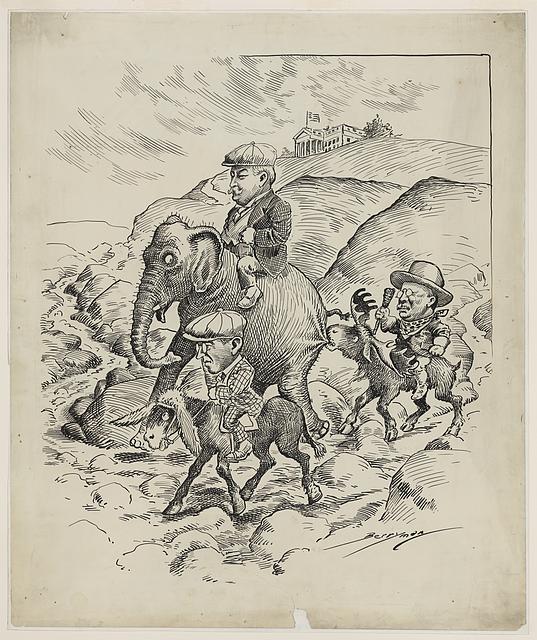
- Library of Congress — Roosevelt 1912 Political Cartoon
- Theodore Roosevelt Center — New Nationalism
- Miller Center — Election of 1912