Northern Securities Case (1904): Roosevelt’s Railroad Trust-Busting Victory
How a railroad holding company became Roosevelt’s most famous early antitrust case.
On March 14, 1904, the U.S. Supreme Court upheld a federal antitrust challenge to the Northern Securities Company, a holding company combining control of major competing northwestern railroads. The case was initiated during Theodore Roosevelt’s presidency under the Sherman Antitrust Act and became a landmark in the federal government’s efforts to limit unlawful corporate combinations.
The people, competing railroads, federal lawsuit and precise meaning of the 1904 judgment.
On this page — 23 topics
What was Northern Securities Company?
Northern Securities Company was a railroad holding company organized in 1901 to bring major competing railway interests under shared control. Its principal target was ownership of stock in the Northern Pacific and Great Northern railways, important carriers across the northern United States. By holding shares in both competitors, investors could coordinate activities or reduce rivalry without necessarily merging every rail line into a single corporation. The arrangement attracted immediate political attention because transport charges influenced farmers, merchants and communities across state lines. The federal government eventually argued that the holding company’s control restrained interstate commerce in violation of the Sherman Antitrust Act. The case became a defining moment in Progressive Era economic regulation.
Why were Northern Pacific and Great Northern important?
The Northern Pacific and Great Northern operated major routes between the Midwest and Pacific Northwest, carrying grain, timber, passengers and other products. Their networks made access to northern markets and ports possible for communities that depended on rail transport. Competition between carriers could influence rates and service, although construction costs and complex ownership relationships shaped that rivalry. Combining their shares created the possibility that decisions important to customers would be coordinated through common management. The railroads were not simply small local businesses; they were part of a national industrial network with substantial capital requirements. This geography explains why a stock-holding arrangement in one corporation could raise federal questions about commerce among many states.
Who was J. P. Morgan?
John Pierpont Morgan was a prominent financier whose banking interests played a major role in railroad reorganization and consolidation. He supported arrangements intended to stabilize carriers and reduce destructive competition in a highly capital-intensive industry. Morgan and his associates helped organize Northern Securities as an instrument of common ownership. Critics feared that such concentration would weaken competitive pressure and increase the influence of a small group of wealthy investors. Morgan did not personally operate every train or set every tariff, but financial control could shape corporate policy. The dispute made him an important figure in public debates about whether large investment combinations served economic efficiency or harmed the public interest.
Who was James J. Hill?
James J. Hill was a leading railroad builder and executive associated with the Great Northern Railway and the expansion of rail service across the northern plains and Pacific Northwest. He regarded coordinated planning and investment as central to efficient operations. His interests overlapped with Morgan’s, particularly in their efforts to control rail networks serving similar regions. Hill and other financiers saw consolidation as a way to manage costs and financial instability. Opponents argued that the same arrangement could suppress competition between companies that previously had incentives to win business independently. A careful history distinguishes Hill’s role in developing rail infrastructure from the legal question of how shares in competing lines were held.
What role did Edward H. Harriman play?
Edward H. Harriman was another influential railroad financier whose interests included the Union Pacific Railway. In 1901 a struggle over control of Northern Pacific shares exposed intense competition among major investment groups. The contest became associated with turmoil in the stock market as investors attempted to secure voting control. Northern Securities emerged in the aftermath of these conflicts as a way of organizing common railroad ownership. Harriman’s position and later disputes with Morgan and Hill contributed to the complicated corporate history. It would be misleading to portray the case as an argument between one railroad owner and President Roosevelt alone. Several financiers, boards and companies were involved, and their interests did not remain identical.
Why was a holding company controversial?
A holding company may own shares of other companies rather than directly operating trains, factories or shops. Such a structure can simplify investment and coordination, but it can also reduce independent decision-making when one parent controls firms that would otherwise compete. Northern Securities held significant interests in important railways serving overlapping areas. Federal prosecutors argued that the arrangement was a means of restraining trade among states. Supporters said investment and consolidation were lawful methods of financing better railway service. The legal issue did not concern whether buying any single share was illegal; it concerned whether the particular combination’s structure and effect violated the law regulating interstate commerce.
What was the Sherman Antitrust Act?
The Sherman Antitrust Act, enacted in 1890, prohibits specified agreements restraining interstate or foreign trade and unlawful monopolization. In its early years enforcement was limited by resources and narrow judicial interpretations. Roosevelt’s Justice Department used the act to challenge Northern Securities, showing that federal officials might pursue powerful railroad financiers rather than rely entirely on market forces or state regulators. The 1904 ruling strengthened the practical importance of the statute. The case did not rewrite the act or create all modern antitrust doctrine. It applied broad language already enacted by Congress to a particular arrangement of corporate stock ownership and railroad competition.
Why did Roosevelt pursue the case?
Roosevelt argued that powerful corporations should obey federal laws and remain answerable to public authorities when their conduct harmed competition. He did not advocate abolishing every large enterprise, but he wanted to demonstrate that economic influence did not place owners beyond legal review. Northern Securities offered a prominent case involving railroads that affected national commerce. His administration chose litigation rather than attempting to seize the trains or personally dissolve corporations by executive order. The decision also aligned with the developing Square Deal principle of a stronger public-interest role for government. Roosevelt’s political leadership mattered, but courts and prosecutors had to establish the legal grounds for intervention.
Who was Attorney General Philander C. Knox?
Philander C. Knox served as attorney general under McKinley and Roosevelt and supervised federal legal action against Northern Securities. The Justice Department prepared a suit arguing that control of formerly competing railways had been consolidated in violation of the Sherman Act. Knox’s work illustrates that trust-busting was not a matter of presidential speeches alone; lawyers assembled evidence and developed arguments for a federal court. The case eventually reached the Supreme Court through ordinary appellate processes. The administration’s willingness to pursue the suit against well-connected financiers made it politically prominent, but the outcome depended on legal interpretation and judicial decisions that the executive branch could not dictate.
When did the federal lawsuit begin?
The Roosevelt administration brought its federal antitrust action against Northern Securities in 1902. Earlier political disputes and related litigation had already raised questions about the merger and railroad ownership. The suit sought relief against a holding structure established the year before. Proceedings continued through lower courts and reached the Supreme Court, which decided the matter in March 1904. It is therefore inaccurate to date the formation, lawsuit and final judgment all to 1904. Distinguishing 1901, 1902 and 1904 helps explain the sequence from corporate organization through federal challenge to judicial resolution. Investors and newspapers followed the case closely because its implications might extend to other industrial combinations.
What happened in the lower federal court?
A federal circuit court ruled against the Northern Securities arrangement before the case reached the Supreme Court. The lower court considered whether the combination of stock interests permitted the principal railroads to restrain competition in interstate transportation. The company appealed, maintaining that its corporate ownership was lawful under existing legal principles and state company law. The dispute became a test of whether federal commerce and antitrust powers could reach a holding company that claimed to be merely an owner of shares. The lower court’s reasoning was important, but the case’s national precedent depended on the subsequent Supreme Court judgment. A chronology should not present the 1904 ruling as the first legal decision ever issued about the arrangement.
When did the Supreme Court decide the case?
The Supreme Court decided Northern Securities Co. v. United States on March 14, 1904. The published decision appears at 193 U.S. 197, making its text accessible through official federal reports and legal archives. The Court upheld relief against the combination under the Sherman Act. The justices did not agree on every legal theory or on the scope of government authority, and the decision included important separate opinions. Its significance lay in supporting federal action against a very powerful holding-company structure involving competing interstate carriers. The decision is best described precisely rather than summarized as an unlimited declaration that all railroad mergers or all large corporations were unlawful.
Was the decision unanimous?
No. The Supreme Court was divided, and individual justices offered differing arguments about the relation between corporate stock ownership, state law and the federal commerce power. Those disagreements matter because the boundary of lawful cooperation among companies was still being worked out. A general statement that the Court ordered relief is correct; a claim that every justice accepted Roosevelt’s interpretation would not be. Some opinions emphasized the practical effect of combining competitors, while dissenters raised concerns about the reach of federal power over corporate property. Reading the published judgment reveals legal questions that a short political slogan such as trust-busting cannot convey. Its narrow procedural context should not be confused with a complete modern competition code.
What happened to the company afterward?
The ruling required unwinding the unlawful combination, and the Northern Securities holding arrangement was dissolved or reorganized as the relevant stock interests were redistributed. The physical railway networks did not vanish, nor did all rail operations stop at once. The government sought to change control relationships rather than destroy tracks and locomotives. Investors pursued further arrangements and legal arguments about how to distribute shares. The financial effects were complicated because ownership rights could be reshaped without eliminating the underlying business value. The outcome demonstrated a significant federal capacity to challenge concentrated ownership, even though it did not permanently remove wealthy financiers from the railroad industry.
Did passengers and farmers immediately benefit?
The judgment addressed the legal structure of competition, but it did not establish that every freight rate fell or all shippers gained better service immediately. Railway prices depended on distance, traffic levels, equipment, investment and regulatory rules as well as ownership. The Interstate Commerce Act and later Hepburn Act approached some of these problems through direct carrier regulation. Northern Securities instead challenged a company combining competitors. The difference matters when measuring historical impact. The case had powerful symbolic and legal consequences, yet detailed claims about lower prices or local economic gains require separate evidence about actual transportation conditions after the decision.
Was Northern Securities the first antitrust case?
No. The Sherman Act had been used in federal legal proceedings before Roosevelt entered office, and courts had already issued decisions interpreting it. Northern Securities became famous partly because it challenged such an influential railroad holding company and demonstrated a more assertive federal approach. It represented a notable victory for Roosevelt rather than the first time any American official tried to enforce national competition rules. The preceding history includes cases involving manufacturing, labor boycotts and restraints among businesses. Recognizing that broader context prevents Roosevelt’s reputation from overshadowing the statute’s creation in 1890 and the work of officials, lawyers and litigants under earlier administrations.
How did newspapers portray Roosevelt’s trust-busting?
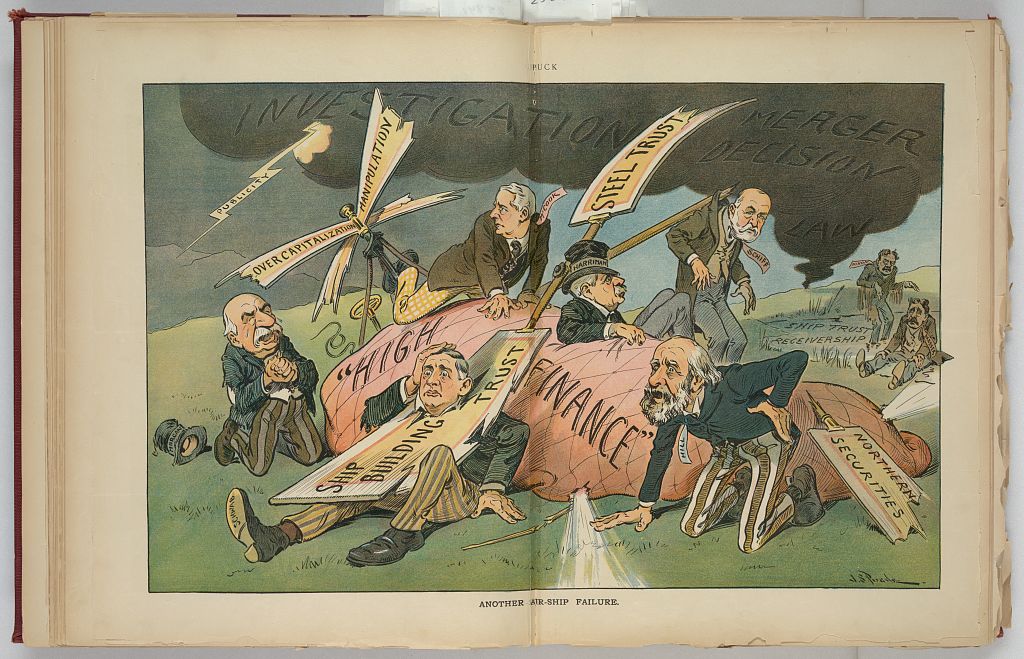
Newspapers and magazines used animal imagery, cartoons and dramatic headlines to frame Roosevelt’s conflict with large financiers. Some depicted the president as a bold defender of ordinary people, while others warned that aggressive regulation threatened investment and stability. The Puck cartoon accompanying this article portrays a metaphorical crash of speculative high finance and includes Northern Securities among its labels. It is a period interpretation, not a photograph of any courtroom or a literal account of how the company fell. Political cartoons are useful primary sources for public opinion, but historians must compare them with the Court’s opinion and the correspondence of businessmen and officials to establish events accurately.
How did the case shape the Square Deal?
Northern Securities became a prominent example of the control of corporations, one element later summarized among Roosevelt’s three Cs. The victory made antitrust enforcement more visible to voters and encouraged expectations that government could contest large business combinations. Other parts of the administration’s domestic agenda dealt with labor mediation, consumer products and conservation. The case did not produce an automatic break-up of every trust or a federal commitment to prohibit all mergers. It strengthened the credibility of selective prosecution and offered legal arguments for later litigation. Roosevelt’s approach combined acceptance of large-scale industrial organization with a willingness to intervene where he believed law and public welfare required it.
What did the decision mean for later antitrust law?
The case formed part of a developing body of Supreme Court decisions interpreting the Sherman Act. Later cases involving Standard Oil and American Tobacco in 1911 addressed additional questions about monopoly power, competitive behavior and remedies. Congress then enacted the Clayton Antitrust Act and Federal Trade Commission Act in 1914. These developments show that the 1904 ruling was a stage in legal evolution, not the final settlement of every question about market concentration. Modern law uses tests and institutions developed over many decades. Northern Securities is remembered because the federal government won a consequential case against a structure built by some of the nation’s wealthiest financiers.
Where can the decision be read?
The Supreme Court’s opinion in Northern Securities Co. v. United States, 193 U.S. 197, is preserved in the official United States Reports. The Library of Congress holds documents from Roosevelt’s papers dealing with the lawsuit and later reactions. The Theodore Roosevelt Center and historical collections provide useful context about the financiers and the administration’s public arguments. Comparing the judgment with those materials helps distinguish the legal holding from the political mythology of trust-busting. The essential dates are the company’s formation in 1901, federal action in 1902 and Supreme Court judgment on March 14, 1904.
Northern Securities timeline
| Date | Event |
|---|---|
| 1901 | Northern Securities holding company organized after struggle for rail control. |
| 1902 | Justice Department challenges combination under Sherman Act. |
| 1903 | Lower federal court rules against the arrangement. |
| March 14, 1904 | Supreme Court upholds federal relief. |
| 1904 onward | Holding company’s stock arrangement unwound. |
| 1911 | Later Standard Oil and tobacco cases extend antitrust history. |
| 1914 | Clayton and Federal Trade Commission Acts supplement Sherman framework. |
Historical sources
- Supreme Court — Northern Securities 193 U.S. 197
- Cornell Law School — Full Opinion
- Library of Congress — Roosevelt Timeline, 1900–1905
- Library of Congress — Roosevelt Legal Correspondence March 1902
- Library of Congress — Northern Securities Documents 1904
- Library of Congress — Puck Cartoon Another Air-Ship Failure