William McKinley Assassination (1901): Shooting, Death and Roosevelt’s Succession
What happened in Buffalo in September 1901 and why Roosevelt became president.
President William McKinley was shot by Leon Czolgosz on September 6, 1901, while greeting visitors at the Pan-American Exposition in Buffalo, New York. He died from complications of his wounds on September 14. Vice President Theodore Roosevelt then took the presidential oath in Buffalo, beginning an administration associated with Progressive Era reform.
A source-based account of the shooting, medical response, succession and lasting influence on presidential protection.
On this page — 22 topics
When was William McKinley assassinated?
President William McKinley was shot on September 6, 1901, during a public reception at the Temple of Music in Buffalo, New York. The attack did not cause immediate death. McKinley survived for eight days before dying on September 14, after infection and other complications developed. Newspapers reported frequent changes in his condition, and his apparent early improvement contributed to national hope that he would recover. These two dates matter: September 6 marks the shooting, while September 14 marks the death and presidential succession. McKinley was the third American president to be assassinated, after Abraham Lincoln and James Garfield, although the circumstances of each crime were different.
What was the Pan-American Exposition?
The Pan-American Exposition was a major 1901 world’s fair in Buffalo intended to display industrial technology, electrical illumination and cooperation among nations of the Western Hemisphere. Its grand buildings, exhibitions and public gatherings attracted visitors from far beyond New York. McKinley attended to make a presidential speech and meet members of the public. The fair’s Temple of Music hosted the reception at which he was attacked. The public setting demonstrates the era’s expectations of relatively close contact between national leaders and citizens. The fair also reflected American commercial ambition after the Spanish–American War, which had expanded U.S. involvement in the Caribbean and Pacific.
Who was President William McKinley?
McKinley was the twenty-fifth president of the United States, elected in 1896 and reelected in 1900. He had served in the Civil War and in Congress before becoming governor of Ohio. His administration supported a protective tariff, monetary policy associated with gold and an expanded American role abroad. The victories of 1898 and the acquisition of the Philippines formed a prominent part of his presidency. His political record should not be reduced to his final days, but the assassination abruptly changed the national leadership at a moment of significant debate about corporations, empire and reform. His death brought Theodore Roosevelt, elected vice president in 1900, into the presidency.
Why was McKinley visiting Buffalo?
McKinley visited Buffalo to participate in the Pan-American Exposition and address its international audience. His September 5 speech emphasized commerce and greater cooperation among countries in the Americas, including a view of reciprocity in trade. A reception was arranged for the following afternoon so visitors could greet the president. Large public lines and the ceremonial atmosphere made it difficult to supervise every person approaching him. McKinley had already attended official events and toured portions of the fair before the attack. It is inaccurate to imply he was shot while delivering his speech: the shooting occurred the next day in a receiving line at the Temple of Music.
Who was Leon Czolgosz?
Leon Czolgosz was the man who shot McKinley. He was an American-born factory worker who had become attracted to anarchist ideas and expressed hostility toward political authority. His ideological sympathies influenced how authorities and newspapers interpreted the killing, but investigators did not establish that a large anarchist organization ordered or planned the attack. Czolgosz acted at the reception with a concealed handgun and was restrained immediately afterward. He later received a rapid criminal trial and was executed by the state of New York. Describing him as an anarchist does not make other anarchists responsible for the crime, and historians distinguish personal motive from proven conspiracy.
How did the shooter conceal his weapon?
Czolgosz approached the president with his handgun concealed in a handkerchief or cloth wrapped around his right hand, according to contemporary accounts. He used the ordinary motion of greeting the president to get close enough to fire. Two shots were discharged, causing injuries that were not immediately judged certain to be fatal. People nearby responded quickly, and Czolgosz was seized before he could escape. The episode exposed weaknesses in event security and the difficulty of inspecting every person in a public receiving line. Accounts of individual gestures and words vary, so vivid dialogue from later retellings should be treated cautiously unless grounded in reliable testimony.
Where was the Temple of Music?
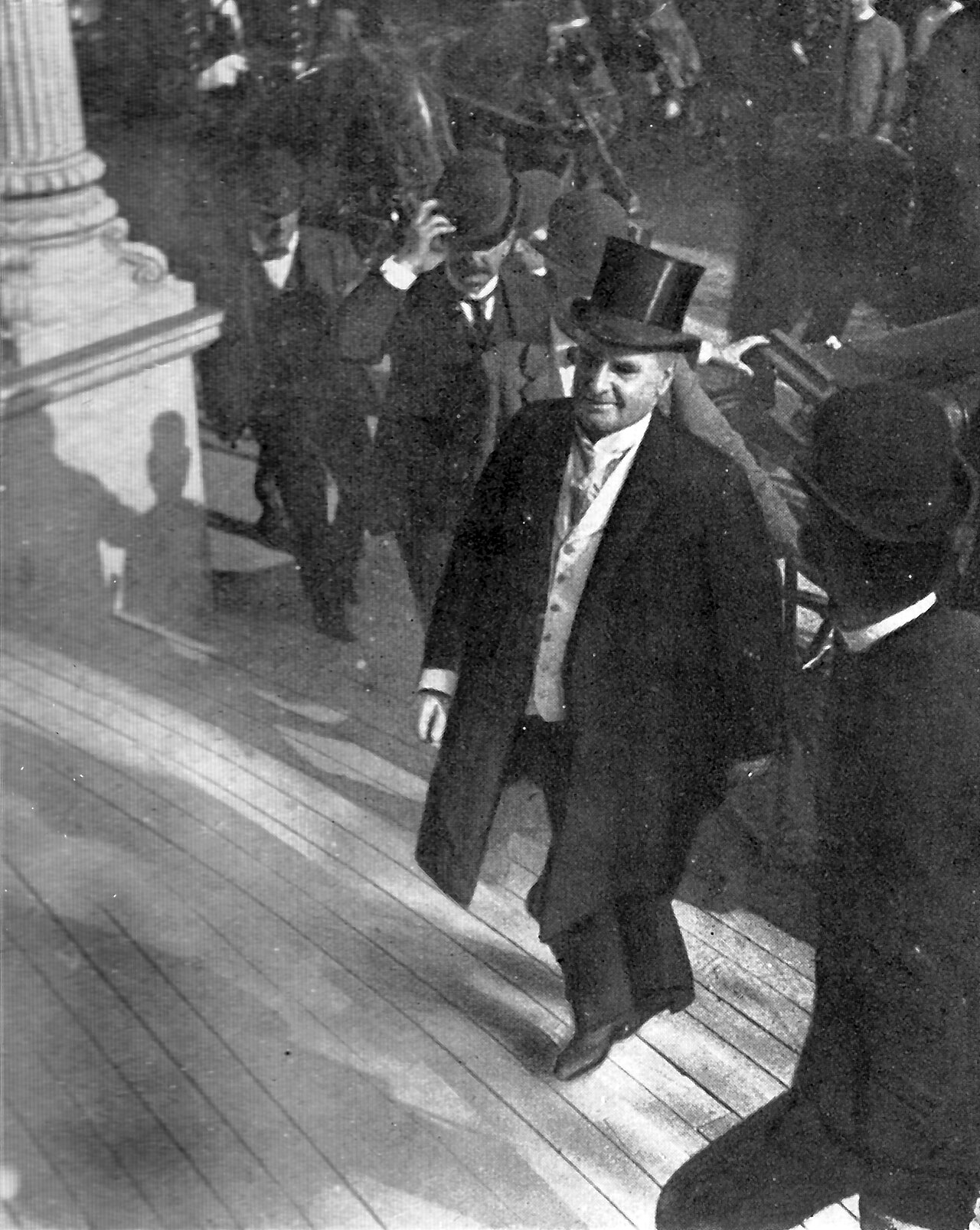
The Temple of Music stood within the exposition grounds in Buffalo. It was a large, elaborately decorated exhibition building rather than a theater in another city or a government office. The September 6 reception assembled people in a crowded hall where the president greeted visitors. The fair buildings were temporary, and the original Temple of Music did not survive as a modern public attraction. Historical plans, postcards and period photographs help locate the site and show its architecture. The image accompanying this article was taken shortly before the shooting and is not a photograph of the actual moment the gun was fired.
What happened immediately after the shooting?
McKinley was taken for emergency medical treatment, and surgeons operated to address his wounds. Hospital resources at the fair were not equivalent to a modern trauma center, despite the exposition’s celebration of advanced technology. Physicians initially believed that the president had a reasonable chance of survival and released hopeful bulletins. Czolgosz was arrested, and news of the shooting spread across the country by telegraph and newspaper. Crowds gathered for updates, while the vice president and other officials followed the situation closely. Subsequent deterioration showed that initial optimism was premature. The treatment is best understood through contemporary medical limitations rather than claims that one simple device certainly would have saved him.
Why did the president die eight days later?
Infection and tissue damage developed after the shooting, and McKinley’s condition deteriorated despite surgery and supportive care. Accounts often describe gangrene associated with the abdominal injury and its complications. Antibiotics, modern imaging and intensive-care techniques were not available in 1901. Historians have debated whether medical decisions worsened the outcome, but retrospective certainty about one cause or an alternative treatment is unwarranted. McKinley died early on September 14 at the home of John G. Milburn in Buffalo. The National Park Service records his death at about 2:15 a.m. The interval between shooting and death became a period of national anxiety and frequent news bulletins.
Where did McKinley die?
After initial treatment, McKinley was cared for at the Buffalo home of businessman John G. Milburn, president of the exposition. His wife, Ida McKinley, was also in the city. The president’s final hours unfolded away from the crowded fair buildings, in a private residence made into an improvised center of national attention. This location is sometimes confused with the Temple of Music, where the shooting occurred. A complete chronology distinguishes the site of the crime, places of treatment and the home where death occurred. McKinley’s passing in Buffalo made it necessary for the vice president to return to the city quickly and assume the presidency.
Where was Theodore Roosevelt when he heard?
Vice President Theodore Roosevelt had visited Buffalo after the shooting and then resumed travel when reports suggested that McKinley was recovering. He was in the Adirondack region when word arrived that the president’s condition had become critical. Roosevelt traveled urgently back to Buffalo and learned that McKinley had died. His journey became part of the public memory of a sudden transfer of power, but the presidency did not remain vacant until he physically arrived. Under the constitutional succession system, the vice president became president on McKinley’s death. The oath was then administered publicly to formalize the transition and demonstrate continuity of government.
Where did Roosevelt take the presidential oath?
Roosevelt took the oath on September 14, 1901, in the library of Ansley Wilcox’s house in Buffalo. Federal judge John R. Hazel administered the oath. The building is preserved as the Theodore Roosevelt Inaugural National Historic Site, interpreted by the National Park Service. The ceremony was smaller and more subdued than a scheduled inauguration following an election. Roosevelt was forty-two years old and remains the youngest person ever to become U.S. president. The occasion marked the beginning of his administration, which subsequently emphasized corporate regulation, conservation and a wider public role for the presidency. The succession was constitutional, not the result of a new election in September 1901.
What happened to Czolgosz?
Czolgosz was arrested after the attack, tried for murder and convicted in a rapid New York state proceeding. He did not present a developed defense centered on a verifiable conspiracy. He was executed in the electric chair at Auburn Prison on October 29, 1901. Contemporary authorities and press used the crime to investigate and stigmatize anarchist activists, leading to wider arguments about political violence and immigration. Czolgosz was American-born, so describing the assassin as an immigrant who arrived to kill the president would be historically false. The speed of the prosecution reflected national outrage and also raises questions about legal procedures during periods of intense public emotion.
Did the assassination change presidential protection?
The attack strengthened demands for more continuous presidential security. The U.S. Secret Service had previously guarded leaders on some occasions but did not yet operate under the permanent presidential-protection structure familiar today. After 1901 its agents undertook full-time protection of the president, and Congress later supplied explicit funding and authority for such work. The transformation was gradual rather than a complete security system instituted on September 7. The incident showed the vulnerability of open public events and the pressure to balance presidential accessibility with safety. Modern presidential protection grew from several incidents and changes in law, including lessons drawn from this third presidential assassination.
Was the crime part of a wider anarchist conspiracy?
Czolgosz had been influenced by anarchist ideas, and officials investigated potential connections. However, a confirmed organized conspiracy directing the shooting was not established. Public reaction sometimes blamed people solely because they attended radical meetings, published unpopular ideas or belonged to immigrant communities. The Haymarket Affair of 1886 illustrates an earlier episode in which fears about anarchism shaped legal and political responses. The cases were different and should not be merged into one narrative. Responsible historical interpretation distinguishes the assassin’s personal responsibility from claims about collective guilt. The authorities’ fear also contributed to later debates over political expression and the treatment of radical organizations.
How did the death affect American politics?
McKinley’s death elevated Roosevelt, whose priorities and public style differed from his predecessor’s in important respects. Roosevelt became closely associated with the Progressive Era and the Square Deal, including efforts to oversee corporate power, mediate major labor disputes and preserve natural resources. The Anthracite Coal Strike of 1902 soon tested his approach to industrial conflict. The assassination did not automatically enact any reforms; Roosevelt and Congress acted within changing political coalitions and court decisions over several years. The succession nevertheless altered the leadership of the Republican Party and created a more visible presidency that appealed directly to national public opinion.
What happened at McKinley’s funeral?
McKinley’s death prompted public mourning in Buffalo, Washington and his home state of Ohio. Ceremonies and processions drew crowds, and his remains were ultimately laid to rest in Canton. Newspapers printed tributes, photographs and descriptions of the transfer of his body. The scale of the mourning reflected the importance of presidential symbolism and the suddenness of the death. At the same time, different Americans held differing opinions of his administration, particularly on overseas expansion. Historical descriptions of funeral observances are valuable evidence of public commemoration, but they do not prove that every citizen shared the same political views or felt the same emotions about the president’s record.
How is the assassination commemorated?
Theodore Roosevelt Inaugural National Historic Site in Buffalo preserves the place where Roosevelt took the oath of office after McKinley’s death. The National Park Service interprets the transition and the city in which it occurred. Other memorials and historical collections document the Pan-American Exposition, the lost Temple of Music and the president’s funeral. The Library of Congress newspaper guide provides a chronological route into original reporting. Visitors should avoid treating reconstructed or later exhibits as photographs of the moment of the attack. Sources distinguish McKinley’s actual final public appearance from dramatic engravings created afterward.
What sources provide the most reliable chronology?
The National Park Service’s Roosevelt Inaugural Site documents September 14 and the oath, while the Library of Congress records the September 6 shooting and the eight-day interval before death. The National Archives’ presidential assassination studies explain security policy and the evidence regarding the killer’s motives. Newspaper archives capture how Americans learned about a crisis before modern broadcast media. Comparing these materials prevents common errors such as dating the shooting to September 14, claiming the fair photograph records the moment of violence or suggesting Roosevelt was elected in 1901. The historical importance lies in the events themselves and the constitutional continuity of the presidency.
McKinley assassination timeline
| Date | Event |
|---|---|
| September 5, 1901 | McKinley speaks at Pan-American Exposition. |
| September 6 | Leon Czolgosz shoots McKinley at Temple of Music. |
| September 6–13 | Doctors treat president; public receives medical bulletins. |
| September 14 | McKinley dies; Roosevelt takes oath in Ansley Wilcox home. |
| September 1901 | Nation mourns and holds funeral ceremonies. |
| October 29 | Czolgosz executed at Auburn Prison. |
| 1902 onward | Secret Service presidential protection becomes more continuous. |